Productized CLI agents need runtime profiles, not demos
With 90% of engineering leaders reporting gains, the CLI agent must evolve beyond simple demos to survive enterprise adoption. A productized CLI is not merely a demo wrapped as an npm package; it is a rigorous runtime discipline that projects capabilities into a configurable, extensible, and inspectable entry point. As code churn rates jumped from 3.3% in 2021 to nearly 7.1% by 2025, the shift toward agentic workflows demands architecture that handles boilerplate autonomously while engineers focus on system design.
A working prototype is not a shippable product. DEV Community analysis reveals that while a demo only needs to execute a single loop, a production-ready system must resolve invisible friction points like active profiles, file edit permissions, and provider switching without human intervention. The market's rapid move from code completion to supervised autonomy means your tool must answer complex questions about project instructions and extension trust before a single token is generated.
The dividing line is runtime identity. A Profile resolves which policy, tools, context sources, and provider a session may use before a single token is generated, which keeps company and personal workflows separated across project contexts. Extension trust policies then decide which installed plugin may actually execute, transforming a fragile script into a reliable platform capable of handling the 19.3% productivity surge seen in modern engineering teams.
The Role of Runtime Identity in Productized CLI Agents
Profile as Governable Runtime Intent in Productized CLI
A productized CLI resolves runtime identity through a Profile rather than executing a direct model.call. This governable runtime intent binds policy, tool bundles, context sources, provider preferences, and output contracts into a single atomic unit. Demo scripts often accumulate fragile flags like --dangerously-auto-approve, yet a Profile enforces consistent behavior across diverse project environments. It is explicitly not a theme skin, nor is it merely a default model name or a collection of glued prompts. The architectural shift separates the agent core from the user interface using a typed JSON-RPC protocol. This design enables multiple frontends, such as IDEs or web consoles, to share the same agent logic without duplication.
Operationalizing Profiles: Chat, Code, and Review Use Cases
A Profile collapses scattered flags into a single runtime identity that enforces strict permission boundaries. The chat profile permits read-only Q&A, blocking all file edits and command execution to prevent accidental drift. The code profile enables read/write workspace access but mandates human confirmation for high-risk operations. This separation addresses the reality that blind code reviews prefer specific agent outputs 67% of the time, suggesting distinct modes improve code quality. Operators gain governance without sacrificing the speed of terminal-native runtimes now standard across substantial AI labs. The review profile restricts agents to reading diffs and files, prohibiting writes entirely while outputting findings first. This constraint mirrors efficient patterns where typed wrapper scripts achieve costs as low as $0.101 per task by avoiding unnecessary tool overhead. Enforcing these boundaries requires the CLI to resolve identity before invoking any model, adding latency to the initial handshake. Teams deploying this architecture must balance the security of locked-down profiles against the friction of frequent permission prompts. Without explicit profiles, a single misconfigured flag can expose a production workspace to unrestricted modification.
Demo CLI Flag Accumulation vs Productized Profile Systems
A demo CLI degrades by accumulating flags like --model and --mcp-config over nine days, creating unmanageable startup complexity. Scattered configuration via these flags and environment variables leads to inconsistent behavior, whereas a productized profile system engineers runtime boundaries effectively. The goal is to replace fragile command lines with a governable runtime identity that resolves policy before execution. MCP tool schema overhead can consume up to 72% of the context window, a penalty avoided by CLI-based approaches using existing command structures. Between February 2025 and early 2026, every substantial AI lab shipped a terminal-native agent runtime, yet many ignore the cost of unstructured flag accumulation. The limitation of flag accumulation is that it forces operators to track provider names and rule locations manually. A profile system collapses this complexity into a single atomic unit, ensuring that file edits and command risks remain bounded. Without this structure, the same command yields different results across projects, breaking trust in the automation layer. Operators should adopt a profile system to prevent configuration drift and maintain auditability. AI Agents News recommends moving beyond direct model.call patterns to achieve this stability.
Inside the Unified Tool Pipeline and Provider Resolver
Provider Resolution selects a backend by matching ProviderCapability tags like streaming and large-context rather than hardcoded vendor names. This mechanism prevents provider details from leaking into the user experience when internal semantics must align with task requirements. Operators avoid brittle startup flags by defining required capabilities such as tool-intent or structured-output in the profile definition.
The resolver evaluates available backends against these constraints to instantiate the correct runtime identity. Market data shows distinct specialization across tools: Claude Code serves as the consensus default for serious multi-file reasoning work. In contrast, Codex CLI remains preferred for sandboxed execution safety within the OpenAI stack.
| Capability | Standard Flag | Resolver Token |
|---|---|---|
| Streaming Output | --stream |
streaming |
| Tool Execution | --tools |
tool-intent |
| Context Window | --ctx |
large-context |
A critical limitation exists because providers cannot own session state or decide loop continuation independently. The system must enforce these boundaries externally since the backend only returns model events. Relying on provider-native features for governance creates fragility when switching vendors during an outage. Teams gain durability by decoupling task requirements from specific vendor implementations.
Merging Configuration Layers with Provenance Tracking
Six distinct configuration layers merge using provenance metadata to prevent provider leakage during resolution. The system stacks built-in defaults, user preferences, project policies, session flags, command-line overrides, and environment injections into a single ConfigValue object containing value, source, path, and reason fields. This structure answers exactly where a setting originated and why it applies.
- The resolver ingests all six layers simultaneously.
- Merge rules arbitrate conflicts rather than accepting last-writer-wins logic.
- Project constraints cannot override user-mandated read-only modes.
- Output includes the specific file path justifying every active setting.
| Layer Type | Override Scope | Mutability |
|---|---|---|
| Built-in | None | Immutable |
| User | Global | Editable |
| Project | Repository | Locked |
| Session | Temporary | Volatile |
| CLI Flag | Immediate | Explicit |
| Environment | Host | Injected |
Operators fixing inconsistent CLI behavior across projects rely on this audit trail to trace unexpected tool permissions. Without provenance, debugging why a specific model was selected becomes guesswork. The architecture ensures provider semantics like tool-intent or structured-output remain internal, shielding users from raw SDK errors or differing tool names.
Market flexibility demands such strict separation. OpenCode supports local setups and 75+ models, requiring clear boundaries between provider capabilities and user intent. Similarly, the rapid adoption of managers like CC Switch highlights the industry need for unified patching across seven distinct tools. The limitation is computational overhead; tracking four metadata fields per value increases memory usage compared to simple string maps. Yet, this cost is necessary to maintain a governable runtime identity where no provider detail leaks into the user experience.
Preventing Context Saturation and Prompt Injection in Project Instructions
Dumping full repository rules into system prompts triggers context saturation when MCP schema overhead consumes excessive token capacity. Treating project instructions as distinct context sources with attributes like trust and appliesTo mitigates injection risks by isolating untrusted input from the core directive. The mechanism separates static policy from flexible session state, preventing malicious overrides. However, progressive disclosure increases architectural complexity by requiring a runtime filter to evaluate relevance before injection. Network operators must implement strict boundaries where project-specific rules cannot elevate permissions set in the user layer.
| Risk Factor | Consequence | Mitigation Strategy |
|---|---|---|
| Schema Bloat | Session failure due to token window limits | Progressive disclosure of rules |
| Prompt Injection | Unauthorized command execution | Attribute-based filtering |
| Context Loss | Model ignores critical constraints | Compaction systems |
Refactoring tasks can rapidly saturate a 200,000-token window without active compaction systems. The limitation is that aggressive filtering may omit edge-case constraints needed for complex fixes. This forces a trade-off between context completeness and operational stability. Operators should prioritize context compaction to maintain session viability during long-running automation loops. AI Agents News recommends validating provider resolution logic to ensure fallback models respect these truncated context contracts without failing.
Measurable Reliability Gains from Extension Trust Policies
Extension Lifecycle States and Visibility Rules
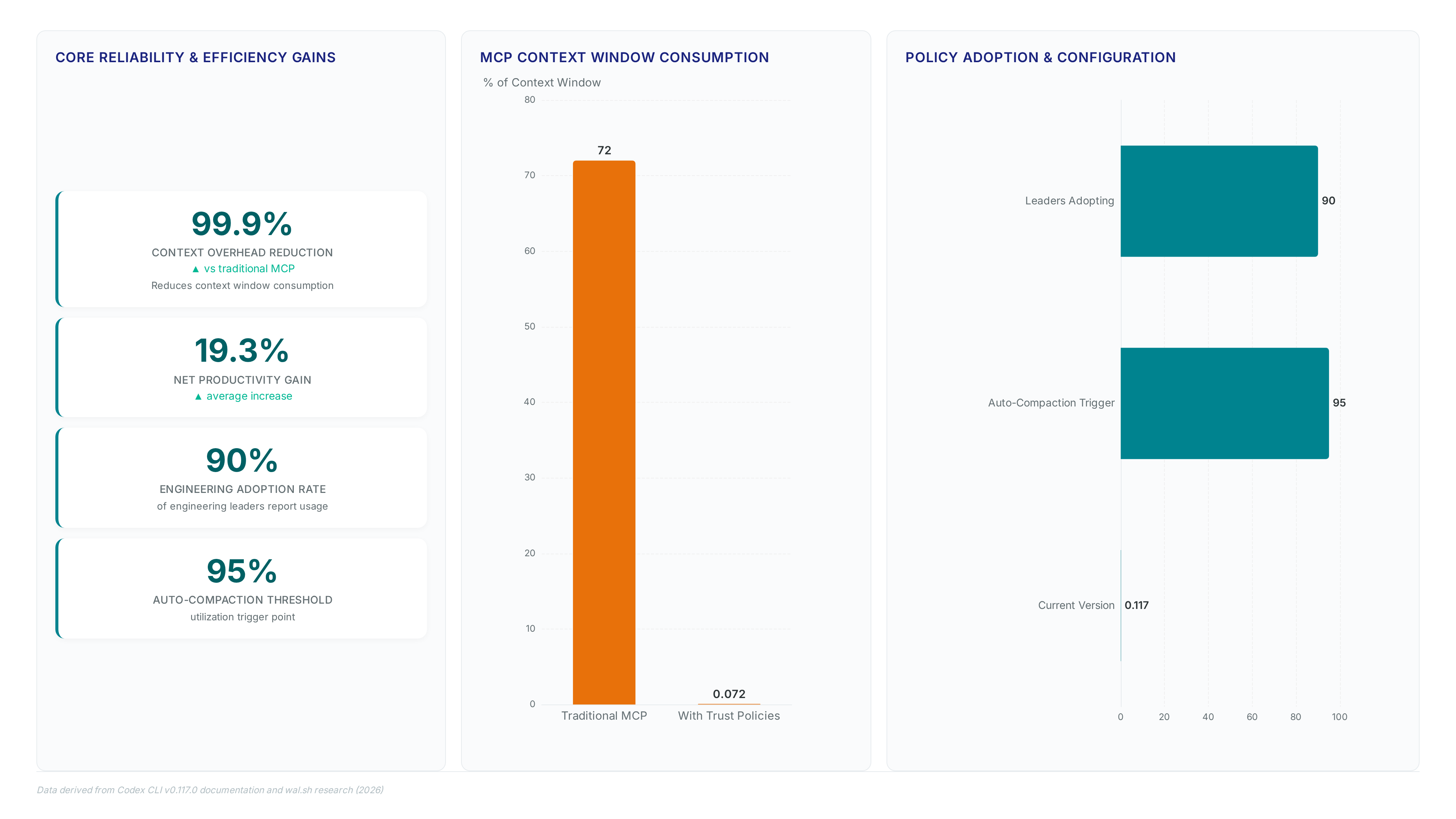
Codex CLI v0.117.0 enforces a strict nine-state progression where installed extensions remain inert until explicitly enabled by policy. This granular control separates discovery from execution, ensuring that merely possessing a plugin does not grant it runtime privileges. The Plugin Host validates manifests against the Capability Catalog, yet visibility remains distinct from executable permission. Operators observe that an enabled tool often fails to appear in the active session if the Discovery Policy filters it based on profile constraints. This separation prevents accidental capability exposure during profile switches. Governance frameworks now treat these state transitions as hard boundaries rather than soft suggestions.
The doctor --profile code command outputs a stable JSON schema across seven layers to prevent runtime drift in automated hosts. This structure is necessary because the command line has re-emerged as the center of gravity for AI-assisted coding, demanding predictable preflight validation over interactive guessing. The mechanism iterates through Config, Profile, Provider, Extensions, Capabilities, Context, and Output states, flagging mismatches between declared intent and actual permissions.
Operators require this granularity because modern agents prioritize sandboxed execution to mitigate risks when shell access is granted. A typical diagnostic report separates discovery from action, adhering to the principle that visible tools are not necessarily executable.
AI Agents News recommends embedding this diagnostic step before any agent loop initiates to guarantee consistent behavior. The resulting JSON payload provides the governable runtime identity required for enterprise adoption. Without such explicit boundary enforcement, CLI agents remain fragile demos rather than production assets.
Migrating to a Multi-Provider Profile System
Setting Layer Precedence Before You Migrate
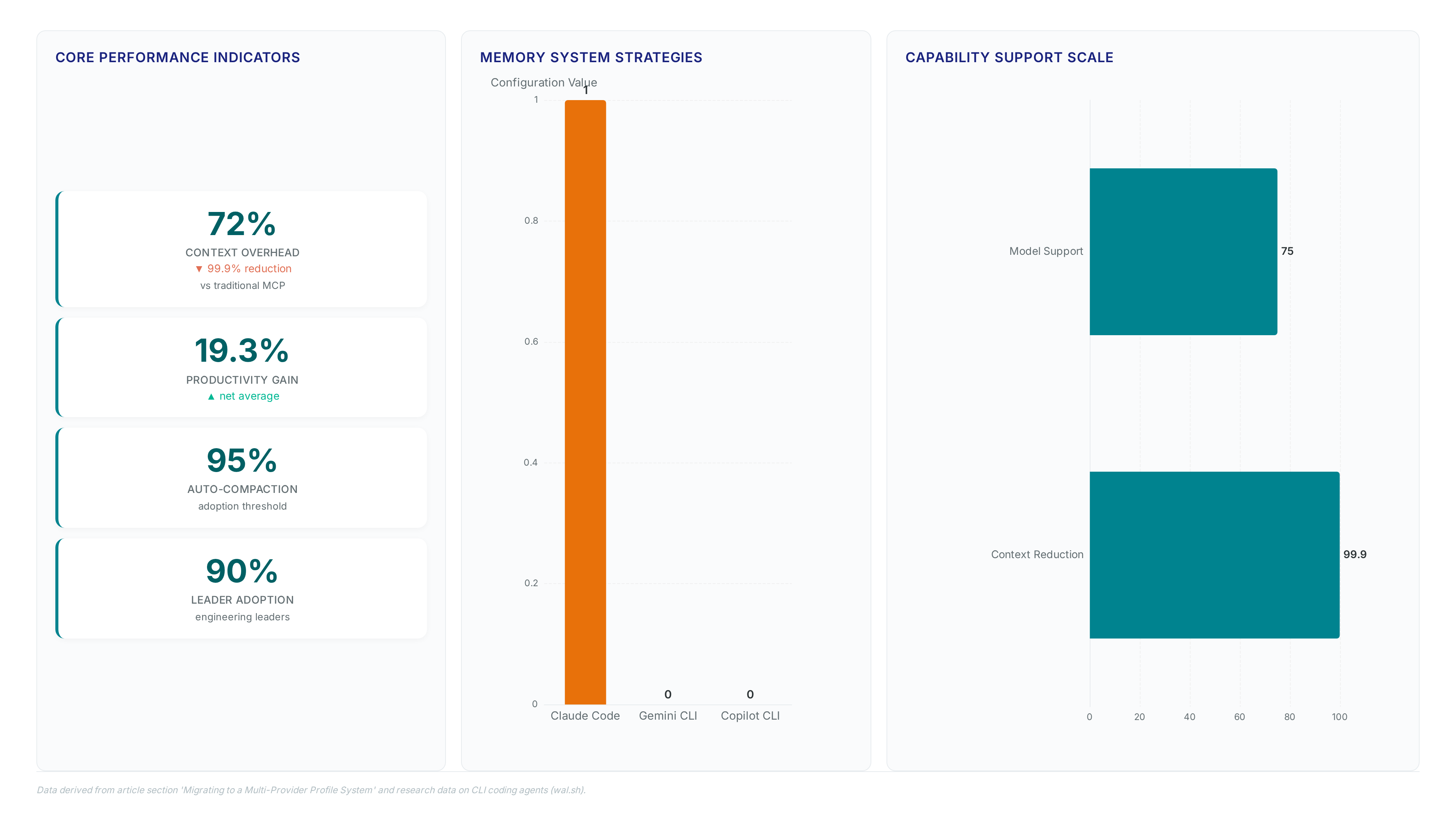
Migration starts by writing precedence down, not by rewriting call sites. The six layers arbitrate conflicts explicitly instead of accepting last-writer logic: a read-only mode set in the user layer survives a project override, and a session flag stays temporary by construction. Tracking value origin requires embedding provenance metadata within every resolved setting, so each active value still names its source, path, and reason when an operator asks why it applies.
Implementing Provider Resolver Logic for Fallback Strategies
Resolver logic selects the primary endpoint by matching required ProviderCapability flags like streaming or tool-intent against available registries rather than hardcoded names. Operators observing market trends note that tools like OpenCode support over 75 models, yet raw flexibility increases the risk of schema mismatch during emergency failover. The limitation is that capability matching adds latency to the initial handshake, potentially delaying the first token in time-sensitive CI pipelines. Networks relying on strict SLAs must weigh this resolution delay against the stability gained from automated provider switching.
- Define a capability matrix mapping each profile to mandatory features like structured-output or large-context window support.
- Configure priority chains where the session layer overrides the project layer only for non-safety-critical parameters.
- Implement a unified event contract that normalizes diverse provider errors into a single parseable format for the agent runtime.
- Validate that fallback providers maintain identical tool-intent signatures to prevent runtime execution failures.
Direct provider calls often bypass safety guards, whereas a resolver enforces the EU AI Act compliance requirements scheduled for August 2026 by logging every switch event. Teams should adopt the governance frameworks suggested by AI Agents News to manage these complex resolution trees effectively.
Runtime Validation Checklist Using the Doctor Command
Execute doctor --profile code to inspect seven runtime layers before the agent loop initializes.
- Verify installed extensions possess explicit trust declarations in the manifest.
- Confirm enabled capabilities appear within the active Discovery Policy.
- Ensure visible tools map to executable paths in the Tool Runtime.
- Detect permission conflicts between the active profile and loaded plugins.
- Validate MCP schema paths do not saturate the context window.
- Assert output contracts match the consuming host requirements.
- Check credential presence across all six configuration layers.
The mechanism returns a structured JSON blob rather than human-readable logs, enabling direct consumption by CI pipelines. This approach minimizes token waste compared to verbose MCP schema negotiations that often consume significant context overhead. Operators using sandboxed execution benefit from early detection of unsafe tool intents before they reach the runtime. However, strict validation increases startup latency, creating tension between security posture and time-to-first-token in urgent debugging scenarios. Static checks also age badly when team extensions change frequently, since they cannot predict a provider shifting behavior between releases. Organizations adopting this rigorous preflight stance align with emerging compliance frameworks discussed by AI Agents News. The cost of skipping validation is unpredictable agent behavior across diverse project environments.
About
Marcus Chen serves as Lead Agent Engineer at AI Agents News, where he daily evaluates the orchestration mechanics of frameworks like CrewAI, AutoGen, and LangGraph. His direct experience shipping production multi-agent systems provides the technical foundation necessary to dissect the complex transition from CLI demos to productized agents. Unlike superficial overviews, Chen's analysis stems from wrestling with the very configuration layers, provider switching, and runtime checks detailed in this article. At AI Agents News, his role involves rigorously testing how coding agents handle capability discovery and stable output protocols under real-world constraints. This hands-on engagement with the agent environment allows him to authoritatively argue that a true product entry point must be configurable, extensible, and inspectable. By connecting daily framework benchmarking to architectural discipline, Chen offers builders a factual roadmap for evolving CLI tools beyond simple npm wrappers into reliable, enterprise-ready solutions.
Conclusion
Scaling a CLI agent exposes the same breaking point every time: the tool has no runtime identity. Flags pile up, project rules leak into the system prompt, and the same command produces different results in two repositories, so nobody can say which policy was in force when an agent edited a file. A Profile closes that gap by binding policy, tool bundles, context sources, provider preferences, and output contracts into one resolvable unit, and provenance metadata forces every active setting to name where it came from.
The order of work is narrow. Define the chat, code, and review profiles first, so read-only work cannot touch the workspace. Move provider choice behind capability matching next, so an outage swaps a backend instead of breaking a contract. Then run doctor --profile code before the agent loop starts and treat a failed layer as a stop rather than a warning.
That is the whole distance between a demo and a product. A demo executes one loop, while a productized CLI can state, before the first token, what it is allowed to do and where that permission came from.
Frequently Asked Questions
It binds policy, tool bundles, context sources, provider preferences, and output contracts into a single runtime identity. The resolution happens before the model call, so the same command behaves identically across projects instead of depending on scattered flags and environment variables.
Typed wrapper scripts achieve costs as low as $0.101 per task by avoiding unnecessary tool overhead. This efficiency comes from enforcing strict permission boundaries and preventing agents from executing redundant operations during runtime.
Blind code reviews prefer specific agent outputs 67% of the time, suggesting distinct modes improve quality. Separating profiles ensures read-only safety for chats while allowing necessary edits only within governed code contexts.
Code churn rates jumped from 3.3% in 2021 to nearly 7.1% by 2025, demanding better agentic workflows. This surge requires architecture that handles boilerplate autonomously so engineers focus on system design.
Extension trust policies transform fragile scripts into robust platforms, enabling a 19.3% productivity surge in modern engineering teams. These policies ensure reliable capability handling before any token generation occurs during agent execution.