Local runtimes for engineers: Zero-cost inference
Running advanced AI models locally no longer requires dedicated GPU hardware thanks to lightweight runtimes. Ollama serves as the runtime, the Smolagents library keeps abstraction minimal for transparency, and type-safe crews then run on personal infrastructure.
Engineers are increasingly rejecting the "rented intelligence" of cloud APIs, where every decision incurs a bill and exposes data to external networks. Instead, the focus has shifted to orchestration layers that communicate directly with models on local hardware. Ollama leads this transition as a lightweight runtime for open-source LLMs. While it lacks the raw throughput for massive concurrency, its zero-cost structure makes it the default choice for developer laptops and privacy-focused deployments.
The system extends beyond simple serving to sophisticated coordination frameworks like Smolagents from Hugging Face. With roughly 1,000 lines of code, this tool avoids heavy abstraction, allowing developers to inspect agent logic directly while supporting CodeAgent workflows that execute actions in sandboxed Docker environments. By mastering these local runtimes and Python frameworks, teams can build reliable multi-agent systems that operate entirely within their own network boundaries, free from external API keys or usage limits.
What a Local Runtime Actually Replaces
Ollama as Docker for Language Models on Local Hardware
Bypassing external API dependencies secures data privacy and kills per-token billing in one move. Ollama acts as the core runtime layer here, serving open-weight models through an OpenAI-compatible interface. It skips the usual pain of manual CUDA driver installation or complex Python environment configuration. Engineers can pull and serve models via a single command, slashing setup time for a functional local AI environment to approximately five minutes. The runtime operates efficiently on consumer-grade hardware without expensive GPU upgrades, enabling developers to deploy capable local models.
Eliminating Vendor Lock-In with Zero-Cost Inference Runtimes
Shifting AI economics moves spending from recurring operational expenditure to upfront capital investment in hardware. Engineers remove per-token fees and data egress costs entirely by enabling local execution. This approach caps the marginal cost of inference at zero after the initial model download, effectively eliminating vendor lock-in penalties. The cost model relies solely on hardware acquisition rather than subscription tiers. Agent orchestration logic decouples from cloud provider billing cycles and rate limits as a result. Managed services increase monthly invoices linearly when scaling occurs, yet local runtimes allow throughput to scale with available compute without additional licensing fees. This financial structure supports private AI agents that process sensitive data within the network perimeter, avoiding third-party data sharing risks. Engineers must manage hardware capacity planning and GPU availability internally under this model. Teams gain full control over pricing and data sovereignty but assume responsibility for infrastructure maintenance and uptime. Organizations adopting this stack must evaluate their tolerance for self-managed operations against the long-term savings of zero-cost inference.
Throughput Limitations of Single-Node Ollama Deployments
Developer accessibility takes priority over raw throughput in Ollama, creating bottlenecks in high-concurrency production environments. The runtime excels at serving single-user workflows on local hardware yet lacks the kernel-level optimizations required for parallel request handling beyond a single developer's laptop. Queueing delays appear as concurrent sessions exceed the host's sequential processing capacity when teams attempt to scale multi-agent systems. Agent orchestration layers managing complex, multi-file workflows may experience latency spikes when relying solely on default local serving due to this architectural constraint. Engineers frequently pair the simplicity of local development with vLLM's PagedAttention-based serving for production workloads requiring higher performance to address this issue. This hybrid approach retains the privacy benefits of local execution while offloading heavy inference to a more strong engine. The system is moving towards these multi-provider architectures where Ollama serves as a neutral, local execution layer agnostic to the specific agent framework. Local runtimes eliminate token costs while introducing compute-bound constraints that demand careful capacity planning.
Inside the Python Framework System for Agent Coordination
Type-Safe Agent Outputs and Code Execution in PydanticAI and Smolagents
PydanticAI enforces strict schema validation to guarantee structured outputs, while Smolagents prioritizes direct code generation for action execution. The former uses Python type hints to automatically self-correct malformed JSON, ensuring data integrity for compliance-sensitive workflows without manual parsing logic. In contrast, Smolagents deploys CodeAgent instances that write and execute Python code directly, often within sandboxed environments like Docker or Modal to isolate runtime risks.
| Feature | PydanticAI | Smolagents |
|---|---|---|
| Primary Mechanism | Type-hint validation | Code writing |
| Output Format | Structured JSON | Executable Python |
| Safety Model | Schema correction | Sandboxed execution |
| Best Fit | Data pipelines | Task automation |
This architectural divergence creates a specific operational tension: PydanticAI prevents format errors but cannot validate the logical correctness of the generated content, whereas Smolagents enables complex reasoning through code but risks runtime failures if the model lacks sufficient capability. Developers combining these approaches with local runtimes via Ollama must recognize that type safety does not equate to semantic truth. While PydanticAI ensures the output matches the expected structure, it cannot prevent an agent from confidently returning valid but factually incorrect data types. Builders requiring high assurance should layer external verification steps after schema validation, rather than relying solely on the framework's structural guarantees.
Deploying CrewAI and AgentScope for Local-First Multi-Agent Coordination
CrewAI organizes agents into role-based crews, whereas AgentScope routes interactions through a centralized message hub. Builders select CrewAI when the priority is defining clear agent personas and goals for collaborative task completion without complex state management overhead. This framework operates as a self-contained unit, avoiding heavy external dependencies while supporting local runtimes via Ollama. Conversely, AgentScope becomes the preferred choice for production environments requiring strict privacy guarantees and auditable interaction logs. The framework ensures data sovereignty by running agents entirely on user infrastructure, meaning no telemetry leaves the local network boundaries.
| Feature | CrewAI | AgentScope |
|---|---|---|
| Coordination Model | Role-based crews | Message hub |
| Privacy Architecture | Local-compatible | Strictly local-only |
| Primary Use Case | Collaborative workflows | Auditable production |
The technical distinction lies in message passing: AgentScope uses structured hubs to enforce transparent communication flows between agents. This architecture prevents the unstructured chatter often observed in peer-to-peer agent loops. However, this rigidity introduces latency compared to CrewAI's more flexible, goal-oriented negotiation style. Teams must weigh the need for strict audit trails against the desire for rapid, ad-hoc collaboration. Selecting the wrong coordination primitive can bottleneck system throughput as multi-step workflows spread. Neither framework replaces the need for a strong local inference engine, but both provide distinct mechanical advantages for specific orchestration topologies.
Performance Degradation Risks in Smolagents and Microsoft Adapter Limitations
Smolagents exhibits sharp performance degradation on models below the 7B parameter range, creating reliability gaps for compact local deployments. While the framework excels with capable CodeAgent logic, smaller transformers often fail to generate valid execution paths without extensive prompting tuning. This constraint forces engineers to balance memory footprint against functional stability when selecting Ollama hosted models for resource-constrained edges. Conversely, the Microsoft Agent Framework presents integration friction outside proprietary clouds. Community reports indicate that provider adapters for non-Azure endpoints frequently misinterpret tool definitions, causing silent failures in heterogeneous stacks. Teams relying on open ecosystems must validate these connectors rigorously before production rollout. The risk profile differs significantly between the two: Smolagents fails visibly through code errors, whereas adapter issues often manifest as unresponsive agents.
| Failure Mode | Smolagents | Microsoft Agent Framework |
|---|---|---|
| Primary Trigger | Model size < 7B parameters | Non-Azure provider usage |
| Symptom | Invalid code generation | Silent tool definition loss |
| Mitigation | Upgrade local model size | Custom adapter validation |
Builders prioritizing model-agnostic design should note that minimal abstraction does not guarantee universal compatibility. The architectural trade-off involves accepting higher hardware requirements to avoid the instability seen in smaller parameter counts. For enterprises operating mixed-cloud environments, relying on native adapters without verification introduces unnecessary operational fragility.
Deploying Type-Safe Multi-Agent Crews on Local Infrastructure
Building Type-Safe Multi-Agent Crews with CrewAI and PydanticAI
CrewAI defines collaborative agent roles while PydanticAI enforces strict schema validation on every output token. Engineers apply Ollama as the local inference engine for these complex systems, enabling production-grade teams to run entirely on-premise without data exfiltration risks. The CrewAI framework allows developers to group agents with specific goals into a single crew, avoiding heavy dependencies on external orchestration layers like LangChain. This modular approach supports the Model Context Protocol across multiple transports, maintaining a local-first architecture while connecting to standardized tool servers.
The pairing works because PydanticAI accepts any OpenAI-compatible endpoint, so pointing a crew at a local Ollama instance is a configuration change rather than a refactor. In compliance-heavy sectors like finance that is what lets data integrity rules hold on premise: no unverified payload reaches the database, and nothing leaves the network to get checked.
| Feature | CrewAI Focus | PydanticAI Focus |
|---|---|---|
| Primary Goal | Role-based collaboration | Type safety & validation |
| Mechanism | Agent crews & goals | Python type hints |
| Local Support | Native Ollama integration | Compatible via API swap |
The operational tension lies between rapid prototyping and strict validation; CrewAI accelerates role definition, but without PydanticAI, the system accepts any string the model generates. Relying solely on role prompts for formatting often fails under load or with smaller local models. Adding a validation layer introduces latency but prevents downstream pipeline corruption. Builders must decide if their use case tolerates occasional parsing errors or demands the guarantees of a typed interface.
Validating Local-First Connectivity via Model Context Protocol and HTTP Transports
Verification begins by confirming the CrewAI runtime successfully initiates Model Context Protocol connections over stdio, SSE, and streamable HTTP transports. This configuration enables agents to reach standardized tool servers while retaining a strictly local-first data posture. Engineers must validate that the orchestration layer treats the local Ollama instance as the primary inference engine rather than a fallback option. While frameworks like LangChain focus on tool augmentation, Ollama provides the necessary local execution layer required for private deployments.
| Transport Mode | Validation Target | Local Integrity |
|---|---|---|
| Stdio | Process I/O streams | High |
| SSE | Event stream latency | Medium |
| Streamable HTTP | Request continuity | High |
A critical limitation emerges when network policies block persistent connections, forcing a revert to polling mechanisms that increase latency. Relying on local HTTP transports introduces a single point of failure if the host machine loses power. Builders should prioritize stdio connections for maximum reliability in air-gapped environments.
Resolving Common Failures in Distributed Agent Systems
AgentScope Message Hub Architecture for Coordination
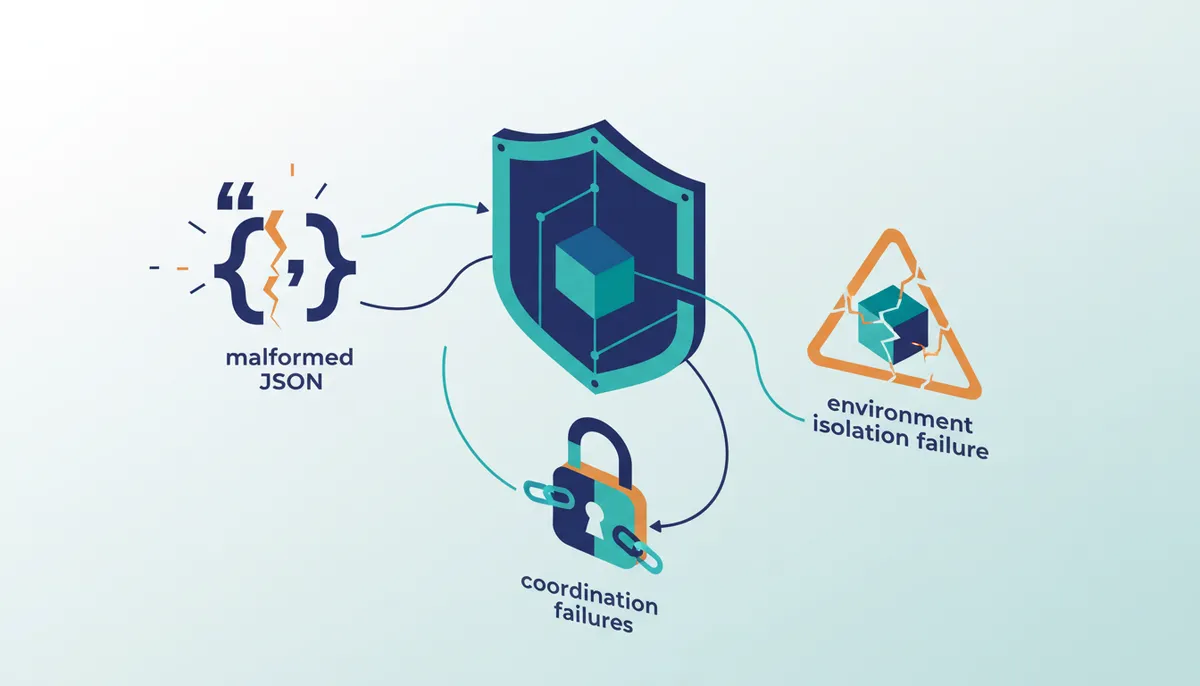
Routing every inter-agent signal through a centralized message hub stops coordination breakdowns before they spread. This design forces structured passing, removing the foggy ambiguity found in unstructured peer-to-peer chatter typical of distributed setups. Decoupling message transport from agent logic creates a deterministic record of each state transition, a requirement for debugging complex multi-agent flows. Proprietary ecosystems often lock data to specific cloud providers, yet this local-first method keeps information inside the network perimeter while supporting isolated backends like Docker. Auditability takes precedence over raw throughput here, a necessary constraint for production environments where traceability matters more than marginal latency gains. Over 27,300 GitHub stars and backing from two peer-reviewed papers prove the community values this academic rigor. Simplicity here has a shape: one serialization point, which is also the place where massive-scale concurrent operations queue behind each other. Plan for that ceiling before the swarm grows into it.
Isolating Agent Tools with Docker and E2B Sandboxes
Executing tools inside isolated Docker containers or remote E2B sandboxes stops environment leakage in AgentScope 2.0. Local agents cannot accidentally modify host system files or expose sensitive network credentials during tool use under this configuration. Separating the execution layer from orchestration logic eliminates a primary vector for coordination failures where one agent's state corrupts another. Operational overhead increases with this isolation, a factor teams frequently underestimate during initial deployment. Managing container runtimes adds complexity to the local development workflow. Vendor trust is unnecessary compared to cloud-only solutions because code never leaves user infrastructure without explicit permission. Treating local runtimes as the standard for confidential code generation workflows drives this industry shift. Shared processes stay convenient right up to the first case of environment poisoning, which is exactly what the container overhead buys off.
Schema Validation Catches Format Errors, Not Coordination Failures
Schema validation and coordination failure sit on different axes. A payload can satisfy every type hint and still come from an agent that misread its handoff, and the structural check passes it through untouched. Format guarantees are cheap and local; agreement between agents is neither, and no amount of validation upstream substitutes for a record of what was actually exchanged.
About
Priya Nair, AI Industry Editor at AI Agents News, brings rigorous market analysis to the evaluation of local AI agent frameworks. Her daily work tracking product launches and platform shifts for companies developing autonomous systems provides a unique vantage point on why engineers are increasingly prioritizing local orchestration. By monitoring the trajectory of coding agents and multi-agent platforms, Nair identifies the critical need for infrastructure that reduces reliance on external APIs while maintaining reliable coordination capabilities. This article's focus on Python tools for local execution directly reflects the strategic pivot she observes among technical founders seeking cost-effective, data-sovereign solutions. At AI Agents News, our mission is to provide the neutral, technical clarity builders need to navigate these evolving architectural choices without vendor bias. We do not endorse specific third-party runtimes but rather analyze their functional merits to help engineers make informed decisions about their local deployment strategies.
Conclusion
Scaling local AI agents reveals that zero marginal inference cost often masks rising operational debt in container management. While consumer-grade hardware with sufficient RAM enables deployment, the complexity of multi-file edits demands rigorous isolation to prevent environment poisoning. Teams frequently underestimate the overhead of managing Docker runtimes locally, leading to coordination failures when concurrent operations bottleneck at the message hub. The shift toward local execution in 2026 is not merely about privacy but about establishing a sustainable boundary between orchestration logic and tool execution.
So the ledger balances differently than the pitch suggests. Per-token billing goes to zero and comes back as container lifecycles, capacity planning, and serialized message logs somebody has to read. Local runtimes are the right default for confidential work and for a laptop; they are the wrong default for a team with nobody to keep the sandboxes and the hub honest.
Frequently Asked Questions
You need only consumer hardware to start, with no dedicated GPU required. This low barrier allows developers to deploy advanced models on standard laptops without expensive GPU upgrades or cloud subscriptions.
The marginal cost of inference becomes negligible after the initial model download. This eliminates per-token billing entirely, allowing teams to scale usage without increasing operational expenditure on API fees.
The limit is throughput and validation rather than the editor. Single-node Ollama processes requests sequentially, so several agents editing at once queue behind each other, and format complexity grows with every file in the handoff. Schema validation catches malformed output; it does not catch an agent that edited the wrong file.
Smolagents degrades sharply below the 7B parameter range: the model stops producing valid execution paths, so the failure shows up as a code error rather than silently. The fix is a larger local model, which raises the memory footprint the local deployment was chosen to keep small.
About five minutes, because Ollama pulls and serves a model in a single command and skips manual CUDA driver installation. That figure covers the runtime only; the layer above it, crews and transports and sandboxes, is where the remaining setup time actually goes.
References