Desktop coding agents handle parallel work better
Intent by Augment Code required the least manual reconciliation during parallel work on shared contracts in early 2026 testing. The central thesis is that effective AI coding agents now demand dedicated desktop orchestration rather than simple IDE extensions to manage complex, multi-step workflows. As noted by Molisha Shah, these systems function by planning tasks, executing code, and observing results without constant human intervention What Is an AI Coding Agent? How They Work.
Living specs serve as continuously updated plans to keep multiple agents aligned across large codebases. In practice, parallel execution architectures like Intent outperformed Codex Desktop App and Claude Code by reducing friction at cross-service boundaries. We compare top desktop AI agents against CLI and cloud alternatives to determine which form factors best support long-horizon engineering tasks.
These observations stem from running tools on private production repositories between February and March 2026. Vendor claims vary, but the shift toward terminal-first or desktop-first mission control surfaces highlights a move from single-window assistance to full autonomous development platforms. This evolution addresses the specific limitations of editor-bound interactions when scaling agent teams.
The Role of Living Specs and Context Engines in Modern AI Development
Defining Living Specs and the Context Engine Formula
Static prompts die the moment code changes. A living spec replaces them with a flexible, shared document that auto-updates as parallel agents finish tasks, acting as a canonical source of truth. This architectural shift alters the functional coding agent equation to the sum of the underlying Model plus specific Context/Orchestration. Performance evaluation now spans four primary categories: agentic coding performance, workflow depth, code quality, and real-world adoption rates.
The Context Engine serves as the infrastructure layer, where capacity becomes a primary competitive advantage over raw model intelligence alone. Specialized engines process notably larger codebases than standard models allow, enabling enterprise-grade context awareness. Selecting an agent requires analyzing orchestration logic and context retention mechanics rather than just base model benchmark scores. As the industry trends toward model agnosticism, the specific large language model matters less than the agent's ability to manage complex workflows and maintain state. Developers must prioritize systems exposing these orchestration layers for debugging.
Applying Context Engines to Multi-Agent Orchestration
Context engines act as shared memory pools, enabling parallel agents to coordinate without prompt drift.
Desktop environments apply a Context Engine to maintain awareness across entire repositories, unlike IDE sidebars constrained to single-file views. Augment Code implements a proprietary 200,000-token Context Engine, allowing specialist agents to access full codebase semantics rather than fragmented snippets, and reports a self-verified accuracy rate of 70.6% on the SWE-bench Verified benchmark. This architecture supports the Model Context Protocol (MCP), standardizing how different tools share state across CLI and GUI interfaces. By decoupling orchestration from the editor, these systems assign distinct roles, coordinator, coder, verifier, to separate processes running in isolated sandboxes.
The market distinguishes between "local IDE-attached" agents and "cloud-hosted" agents, creating a bifurcation in deployment models where local agents may shift costs to compute infrastructure while cloud agents bundle these into service fees. Engineers weigh coordination benefits against the total cost of ownership, which now includes the "deploy layer." For teams managing coupled microservices, tools using living specs required less manual reconciliation when parallel work touched shared contracts than tools without such coordination mechanisms. Future agent performance depends less on raw model intelligence and more on how effectively the orchestration layer manages token budgets and role separation. Builders should prioritize tools that expose these orchestration concepts explicitly, ensuring that context sharing remains deterministic even as task horizons expand.
IDE Extensions vs Desktop Agents: Task Horizon Limits
IDE extensions often function as "editor assistants" focused on inline function generation, whereas desktop and CLI-native agents are categorized as "repository-level" tools capable of handling broader context and multi-file operations. Architectural differences mean sidebar plugins typically offer narrower IDE support compared to agents extending MCP support across CLI, VS Code, and JetBrains plugins. True agentic capabilities now demand dedicated infrastructure to handle background verification without binding the local editor session. This shift enables autonomy levels that distinguish inline suggestions from agents executing entire tasks, with task horizons expanding from minutes to hours and longer.
| Feature | IDE Extension | Desktop Agent |
|---|---|---|
| Execution Scope | Synchronous, editor-bound | Asynchronous, isolated VMs |
| Coordination | Single context window | Shared living spec |
| Resource Load | Local CPU/GPU intensive | Offloaded to cloud sandbox |
| Workflow Type | Single-file completion | Multi-file orchestration |
The terminal-first approach further supports this by favoring CLI-native agents for heavy inference tasks. Desktop architectures allow background agents to test changes and record logs independently, while IDE plugins struggle with cross-service dependencies. A key limitation remains the complexity of managing these distributed states; operators must reconcile agent outputs manually if the orchestration layer lacks a unified context engine. Consequently, the form factor matters notably when adding parallel agents or longer task horizons, as desktop apps and CLI tools make it easier to run parallel work and monitor long-running jobs compared to synchronous, editor-bound interactions. The cost of this capability is increased infrastructure overhead, yet it remains necessary for scaling beyond simple completions.
Inside Multi-Agent Orchestration and Parallel Execution Architectures
Coordinator-Specialist-Verifier Patterns in Desktop Agents
Intent functions as a dedicated workspace where multiple AI coding agents share one living spec. A Coordinator agent breaks tasks into that spec before delegating work to parallel Specialist agents, so planning, execution, and validation stay aligned to one evolving plan rather than fragmented prompts. Tools operating on partial context lack this synchronization, yet this system uses a shared document as a canonical source of truth to reduce prompt drift. The Verifier role validates outputs against original requirements before the spec updates to reflect what was actually built.
Sculptor serves as containerized infrastructure for running and coordinating these AI coding agents by providing isolated environments necessary for parallel execution. Background agents run in their own isolated VMs, test their own changes, and record work via video and logs. This separation allows developers to define autonomous task execution where agents modify stack files and create directories without manual intervention. The cost is that maintaining semantic consistency across services requires strong context handling, as parallel agents risk generating conflicting code despite having isolated execution spaces. Builders must decide between raw parallel speed and the coordination overhead required for complex, multi-service codebases.
Executing Parallel Tasks in Cloud Sandboxes and Docker Containers
Parallel execution in cloud sandboxes enables long-horizon tasks to proceed without being tied to a developer's local uptime. Cloud tasks get their own isolated sandbox, and tasks can run for more than 24 hours uninterrupted, even when your laptop is offline. This architecture isolates heavy compute from the local machine, enabling cloud-hosted agents to handle extended engineering sequences without resource contention. Teams can delegate multi-step refactoring jobs that persist through network fluctuations or system reboots by decoupling execution time from local availability.
Local stability relies on running each agent within an isolated Docker container, preventing interference between parallel processes or the host environment. This sandboxed execution model ensures that unstable code generated during early planning phases cannot corrupt the developer's local toolchain or dependencies. IDE extensions constrained by synchronous editor interactions cannot match this approach, which supports true asynchronous workflow management.
| Feature | Cloud Sandbox Execution | Local Docker Isolation |
|---|---|---|
| Primary Goal | Long-horizon continuity | Local environment safety |
| Constraint | Requires network connectivity | Limited by host CPU/RAM |
| Failure Mode | Remote session timeout | Container crash (contained) |
Latency versus duration creates operational tension; cloud sandboxes offer extended runtime while local containers provide quicker feedback loops for immediate verification. Developers must balance these modes based on task horizon rather than defaulting to a single deployment pattern. Strategic workflows often involve initial scaffolding occurring locally, then offloading extended validation to remote sandboxes. This strategy optimizes both cost and developer velocity without sacrificing system integrity.
Preventing Prompt Drift Across Parallel Agents
Uncoordinated agents operating with partial context frequently generate conflicting outputs that require manual reconciliation. In multi-agent tasks run in Claude Code or Codex, each agent typically operated with its own prompt, creating divergence without a central authority. This fragmentation forces developers to act as manual glue, merging incompatible code changes and resolving stale assumptions after the fact. The solution requires shifting from isolated prompts to a shared living spec that acts as a canonical source of truth for all participants.
Strict isolation carries its own cost: agents needing local GUI tools or proprietary network resources not mapped to the sandbox wait at that boundary. Effective architectures enforce explicit coordination contracts to eliminate the overhead of post-hoc conflict resolution.
Comparing Top Desktop AI Agents Against CLI and Cloud Alternatives
Desktop Native vs cloud-native Execution Models
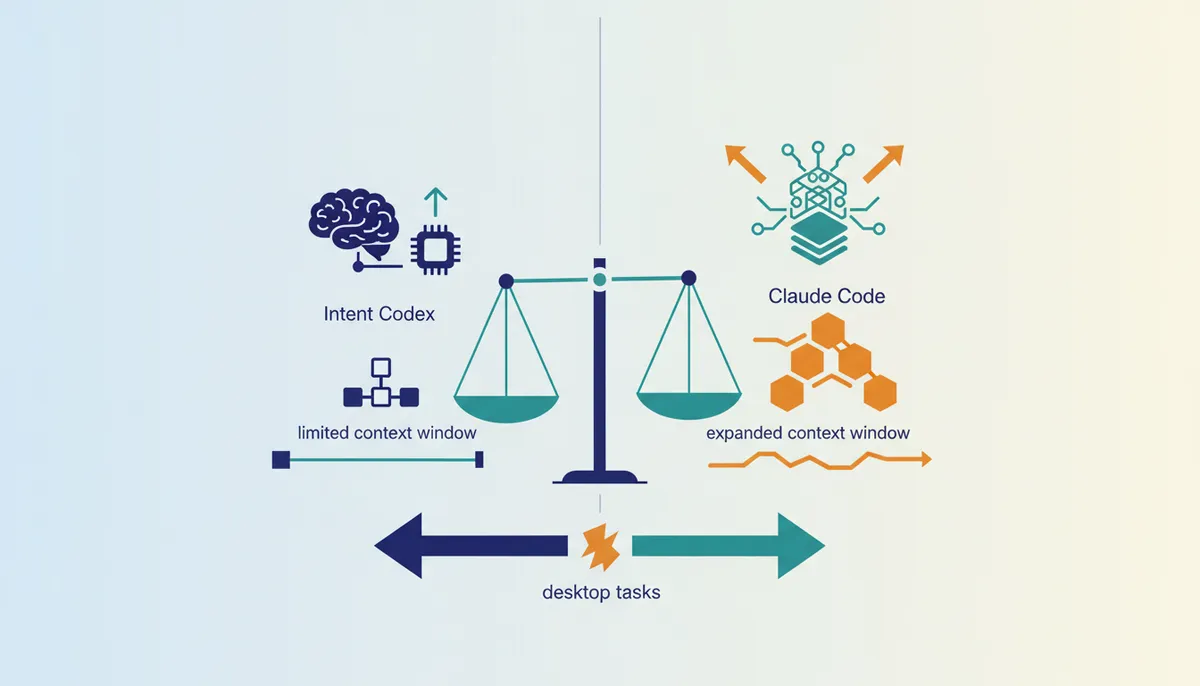
Intent runs as a macOS desktop app executing multi-agent workflows directly on the local workstation, whereas Devin executes tasks entirely within Cognition's remote cloud infrastructure following a structured plan, code, test, debug, and submit loop. This architectural divergence defines where code actually compiles and how isolation boundaries are enforced. Local execution models use the developer's existing hardware resources and OS-level sandboxing, offering an alternative to cloud-only solutions for teams prioritizing data residency. Conversely, cloud-native forms offload compute intensity to managed sandboxes, isolating runaway processes from the host machine.
Builders must weigh the latency benefits of local execution against the scalability of remote containers.
| Dimension | Desktop Native (e.g. Intent) | cloud-native (e.g. Devin) |
|---|---|---|
| Execution Location | Local OS process | Remote managed sandbox |
| Isolation Method | OS permissions, local sandboxes | Network-segregated containers |
| Resource Dependency | Host CPU/RAM limits | Provider compute allocation |
A critical tension exists between the immediate responsiveness of local agents and the environment consistency provided by remote execution. While local tools reduce context-switching friction, they inherit the instability of the host development machine. Cloud models guarantee a clean slate for every task but introduce network latency and potential data egress concerns. The choice ultimately depends on whether the primary constraint is compute capacity or context fidelity. Evaluating execution location depends on whether your workflow demands strict environmental reproducibility or low-latency iterative feedback.
Choosing Between CLI-First Claude Code and GUI Agents
Developers should select Claude Code when terminal-native orchestration and direct shell access are primary requirements for agent interaction. This CLI-first approach suits engineers who prefer configuring specialized subagents through command-line flags rather than managing graphical dashboards. In contrast, Intent serves teams needing a living spec to coordinate parallel work across shared contracts without manual reconciliation.
Top contenders rank highly on workflow depth rather than raw completion scores alone. Consequently, the choice depends on whether the engineering task requires the persistent context of a desktop workspace or the ephemeral nature of a command session. Evaluating the specific need for parallel execution versus linear task completion helps determine the appropriate form factor.
Intent vs Codex vs Claude Code: Orchestration Architectures
Intent implements a Coordinator + Specialists + Verifier pattern anchored by a living spec to prevent prompt drift across parallel tasks. Codex Desktop App isolates parallel agents within separate sandboxes, trading shared context for strict failure containment per execution unit. Claude Code relies on subagent delegation, where the primary process spawns specialized workers for discrete functions like file search or testing. This architectural split dictates whether coordination overhead resides in the orchestration layer or the execution environment.
| Feature | Intent | Codex Desktop App | Claude Code |
|---|---|---|---|
| Orchestration Model | Spec-driven coordination | Parallel isolation | Subagent delegation |
| Context Scope | Shared living spec | Per-sandbox window | Per-session window |
| Primary Constraint | Spec maintenance overhead | Sandbox initialization latency | Subagent communication cost |
| Best Fit | Complex multi-service updates | High-volume independent tasks | Terminal-native workflows |
Repository-level agents like Intent manage broader context windows than standard editor assistants, enabling multi-file operations without constant re-prompting. However, maintaining a synchronized living spec introduces latency that parallel sandboxes avoid by design. Developers prioritizing terminal-first interaction often prefer the explicit subagent control Claude Code offers over graphical coordination dashboards. Builders must choose between the safety of shared state or the speed of disjointed execution based on their repository coupling.
Deploying Spec-Driven Workflows for Production Codebases
Intent's macOS Workspace and BYOA Configuration
Intent functions as a dedicated macOS desktop application built for spec-driven development with multi-agent orchestration. This design separates agent execution from the IDE, so the plan that coordinates the agents outlives any editor session and avoids the context drift of prompt-based workflows where sessions lose track of previous steps.
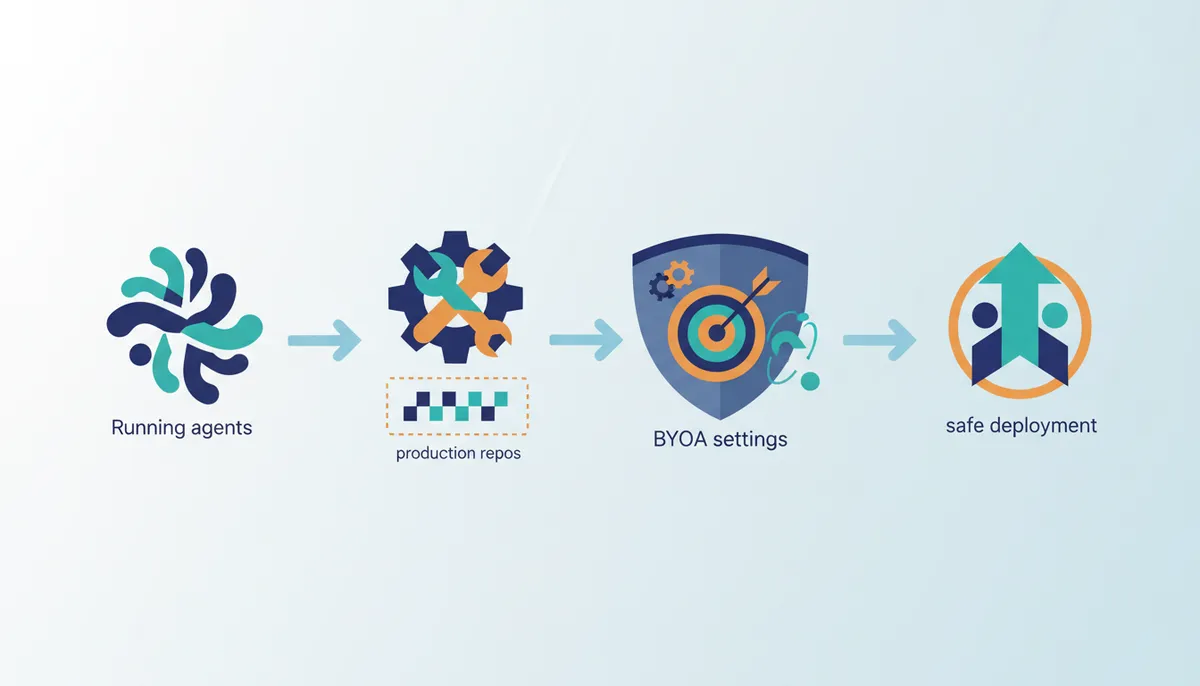
Bring-Your-Own-Agent (BYOA) configuration lets engineers plug external models into the Intent workspace. Users keep their current model subscriptions, yet accessing the proprietary 200,000-token Context Engine demands an Augment subscription. This engine delivers the semantic grasp of service boundaries and API contracts needed to coordinate work across complex, multi-service codebases.
| Feature | Standard BYOA | Augment-Enabled |
|---|---|---|
| Context Scope | Session-limited | Full codebase awareness |
| Orchestration | Manual prompt management | Living spec coordination |
| Dependency Graph | None | Semantic cross-service mapping |
Orchestration value stems from the shared context layer rather than underlying model weights. External agents lacking the Context Engine operate with isolated visibility, forcing developers to manually reconcile conflicting changes across service boundaries. Teams managing coupled repositories benefit from this desktop-first approach because prompt drift currently triggers integration failures.
Running Agents on Production Repos with Isolated Sandboxes
Market offerings split between "local IDE-attached" agents and "cloud-hosted" agents running in isolated sandboxes, presenting distinct trade-offs in speed and security. Heavy execution shifts to cloud-hosted agents that handle compute-intensive operations while local interfaces manage immediate interaction, optimizing security and cost through hybrid deployment models. Engineers working against production repositories often separate the execution plane from the development environment to avoid dependency conflicts and accidental data exposure.
- Define the living spec as the canonical source of truth for agent behavior and scope.
- Route all file system modifications and terminal commands through the remote sandbox boundary.
- Monitor long-horizon orchestration logs independently from the local IDE session state.
A hybrid approach reduces these risks by keeping the command interface local while enforcing a strict container boundary for all code generation and tool use. Strong network connectivity remains necessary for the duration of the task since this model prevents local environmental pollution. Selecting an orchestration platform becomes vital for tasks exceeding standard request timeouts given this connectivity constraint.
Validating Multi-Agent Coordination via Living Specs
Validation shifts the engineer's focus from managing individual threads to checking the consistency of the central plan, because agents in tools lacking shared state build on stale assumptions about API contracts.
| Validation Check | Purpose | Failure Mode |
|---|---|---|
| Spec Recency | Ensures all agents read latest constraints | Agents build against deprecated interfaces |
| Dependency Mapping | Verifies cross-service awareness | Silent breaks in upstream consumers |
| Role Isolation | Confirms specialist separation | Redundant or conflicting code generation |
Bring-your-own-agent (BYOA) setups allow teams to use external models within the orchestration layer, though full semantic understanding requires the Context Engine. Tension exists between model flexibility and context fidelity; maintaining coherent logic across heterogeneous models introduces complexity even though a functional coding agent is set as the sum of the underlying Model plus the specific orchestration or context provided. Systems risk losing coordinated multi-agent workflow advantages observed on large, coupled codebases without strict adherence to the shared document.
About
Marcus Chen is the Lead Agent Engineer at AI Agents News, where he specializes in evaluating multi-agent orchestration and tool-use mechanics for production environments. His daily work involves stress-testing agent frameworks like CrewAI, AutoGen, and LangGraph against complex, real-world codebases to distinguish genuine capability from marketing hype. This hands-on experience directly informs his analysis of emerging AI coding agent desktop applications, as he routinely assesses how different systems handle parallel task execution and context management. At AI Agents News, an independent hub dedicated to autonomous systems, Marcus focuses on how architectural shifts, such as moving agents from IDE sidebars to dedicated desktop environments, impact developer workflows and system reliability. His evaluation of recent tools stems from rigorous testing of long-horizon tasks, ensuring that recommendations are grounded in technical merit rather than vendor narratives. By connecting theoretical framework knowledge with practical implementation challenges, Marcus provides engineers with the factual clarity needed to navigate the rapidly evolving environment of autonomous coding solutions.
Conclusion
Parallel tasks fracture when they exceed standard timeout windows or when heterogeneous models drift from the central plan. The operational cost is not merely failed builds, but the silent accumulation of semantic debt where agents operate on stale API contracts. While self-verification metrics offer confidence in isolated tasks, true reliability at scale demands a shift from passive monitoring to active spec enforcement. Teams must prioritize architectures that enforce strict role isolation and flexible dependency mapping over raw model flexibility.
Adopt a hybrid execution model immediately, keeping command interfaces local while enforcing rigid container boundaries for all code generation. This approach mitigates environmental pollution while preserving the connectivity required for long-horizon tasks. Do not attempt complex multi-agent coordination without first establishing a mechanism to validate spec recency across all active threads.
Start this week by decoupling your orchestration logs from your local IDE state to independently verify that your agents are reading the latest constraints before they execute. This single step prevents the cascade of errors caused by prompt drift and ensures your workflow remains grounded in current reality rather than outdated assumptions.
Frequently Asked Questions
Desktop agents manage parallel workflows better than single-window IDE extensions. This architecture reduces manual reconciliation when multiple agents touch shared contracts, a critical advantage for complex team codebases.
A living spec acts as a continuously updated plan to keep agents aligned. In testing, this approach required significantly less manual intervention when parallel work involved shared contracts across services.
Leading agents like Intent report a self-verified accuracy rate of 70.6% on the SWE-bench Verified benchmark. This metric indicates strong performance on autonomous software engineering tasks within real-world contexts.
Choose desktop agents when a task needs local orchestration, direct access to the host repository, and low-latency feedback. Cloud sandboxes remain the better fit when a job must run for more than 24 hours without your laptop staying online.
Standard models often lack the capacity for full codebase semantics required by enterprise projects. Specialized engines process notably larger contexts, enabling agents to access entire repository structures effectively.
References