Code intent beats search volume for AI agents
The "Build AI agent with Python" keyword converts at 12% because it targets immediate code execution rather than broad theory. Traditional volume metrics fail developer audiences who demand code intent over generic information. Implementation tutorials and framework comparisons dominate the search environment, which renders standard volume data misleading. The "Awesome AI Agents for 2026" repository catalogs over 300 distinct tools, proving the system has outgrown legacy classification methods. Content from 2025 is already obsolete, so high-value terms have to be found inside rapid obsolescence curves.
Three distinct intent layers drive this niche, and conceptual explanations now represent a minority of high-value traffic. By prioritizing agent frameworks that determine orchestration capabilities, publishers can align with the specific vocabulary found in repository README files and issue discussions. This approach ensures content meets the rigorous standards of developers seeking working examples instead of theoretical overviews.
Code Intent Changes Developer Search Metrics
Code Intent Layers Replace Search Volume Metrics
Stop chasing raw traffic numbers. Code intent sorts developer queries by how ready the user is to implement, ignoring the noise of generic popularity scores. Old metrics collapse distinct technical needs into one misleading figure, but AI agent search behavior actually splits into three specific strata. Framework comparisons help teams evaluate architectures before picking a toolchain. Implementation tutorials offer step-by-step guides packed with code examples. Conceptual explanations provide core understanding of how agent technology works. These layers demand different content structures unlike general consumer searches.
| Intent Layer | Primary Goal |
|---|---|
| Framework Comparisons | Evaluate toolchains |
| Implementation Tutorials | Execute code steps |
| Conceptual Explanations | Understand mechanics |
Conversion efficiency drives the real value here. Broad tutorial terms pull in volume, yet code-specific queries convert at a notably higher rate than informational topics. Implementation-focused searchers arrive ready to write code, which collapses the decision funnel. Optimizing for volume captures passive readers while optimizing for intent captures builders. Prioritizing code intent demands rigorous technical accuracy that conceptual content avoids. Publishers sacrifice broad reach to gain high-fidelity engagement.
Distinguishing AI Agent Tutorial from CrewAI Tutorial Intent
Broad conceptual queries and framework-specific implementation demands live in different worlds. "AI agent tutorial" commands high volume with informational intent targeting the broadest audience seeking conceptual understanding. "CrewAI tutorial" holds substantial volume with implementation-intent targeting developers committed to a specific framework. Implementation queries signal readiness to write code rather than consume theory. Developers searching for specific frameworks like CrewAI bypass initial evaluation phases entirely. Narrow framework terms reduce total addressable traffic while increasing conversion probability. Builders optimizing for AI Overviews must recognize that structured content with working examples triggers citations more effectively than abstract explanations.
Rapid Obsolescence Curve Makes 2025 Content Irrelevant by 2027
By 2027, content published in 2025 often fails to address current agent autonomy requirements. Traditional SEO methods applied to AI agent topics produce misleading results because the developer searcher profile differs fundamentally from consumer audiences. Developers seek immediate implementation details rather than theoretical overviews, rendering generic high-volume keywords ineffective for capturing technical intent. System velocity exacerbates this decay: in a market this fragmented the vocabulary shifts monthly and the archive does not follow. Articles focusing on broad "AI agent" concepts miss the specific, framework-bound queries driving adoption today.
| Content Age | Relevance | Primary Deficit |
|---|---|---|
| 2025 Archives | Low | Lacks 2026 protocol standards |
| 2026 Guides | High | Matches current toolchains |
Relying on outdated metrics ignores how quickly research agents gain new capabilities. Static content cannot reflect these jumps. Builders should focus on code-intent keywords tied to specific, active repositories rather than abstract concepts.
GitHub Mining Drives Framework-Specific Entity Clusters
Defining Framework-Specific Entity Clusters via GitHub Vocabulary
A framework-specific entity cluster groups exact developer vocabulary found in repository READMEs rather than generic search terms. Traditional keyword tools miss this nuance because GitHub serves as a primary discovery source for AI agent queries. Repository README files, issue discussions, and trending repositories reveal the specific syntax engineers use when implementing solutions. For instance, analyzing the July 2026 trending page exposes how projects like "hallmark" generate clusters around Claude Code design patterns instead of broad "AI writing" topics. This approach captures the code intent driving 35% of implementation tutorials that volume-based metrics overlook.
A cluster anchored in LangGraph or CrewAI creates an entity gravity well that generic SEO cannot replicate. Builders must map problem keywords, implementation keywords, and system keywords to cover the full adoption lifecycle. Content aligns with how developers actually search for agent toolkits and unified API abstractions.
Mining GitHub Trending Repos for Anti-Slop and MCP Keywords
Examine the July 2026 GitHub trending page to see the current keyword system in action. The "hallmark" repository generates specific clusters around anti-AI-slop content filtering, Claude Code design patterns, and measurable agent output quality. Simultaneously, "code-review-graph" surfaces keyword opportunities in MCP-powered code intelligence, AI-assisted code review workflows, and persistent codebase mapping techniques. These repositories function as primary discovery sources because they expose the exact vocabulary developers use during implementation.
| Repository Focus | Primary Keyword Cluster | Technical Mechanism |
|---|---|---|
| hallmark | Anti-AI-slop filtering | Content quality thresholds |
| code-review-graph | MCP code intelligence | Persistent base mapping |
| skills | Agent directories | Reusable skill patterns |
The proliferation of specialized agents is evident across coding and research categories. Data indicates a shift toward hyper-specialization rather than generalist models. Relying solely on repository names misses the nuance found in issue discussions and README files, where configuration patterns and cross-framework MCP interoperability problems surface. You must balance broad framework terms with the granular, implementation-specific syntax found in these trending projects. Content strategies must prioritize extracting these precise technical terms from source repositories. Generic terminology often fails to capture the intent of engineers building production systems.
Generic Terms vs Framework-Anchored Clusters Like CrewAI and LangGraph
Generic search terms compete directly with academic papers and Wikipedia entries, whereas focused clusters around specific frameworks reach developers committed to that toolchain. This divergence occurs because broad queries attract theoretical overviews, while framework-anchored searches signal immediate implementation intent. Developers rarely search for abstract "agent orchestration" once they have selected a library; instead, they query specific patterns like CrewAI multi-agent setups or LangGraph supervisor configurations.
The distinction matters for capture rates in AI-generated responses. Generic content often serves the 25% of users seeking conceptual explanations, missing the majority who require executable code. Entity clusters function as cross-linked knowledge networks where a page detailing MCP server setup gains relevance for Model Context Protocol tools and standardized agent protocols.
| Search Target | Competition Source | Developer Intent |
|---|---|---|
| Generic Agent Terms | Academic Papers, Wikipedia | Conceptual Understanding |
| Framework Clusters | Documentation, GitHub Issues | Implementation & Code |
Generic terms offer broader reach and dilute the authority signals AI engines weigh for code intent. Developers search inside the tool they already picked, not across abstract concepts, which is what makes that reach worth so little here.
Assistants Cite Different Sources for the Same Framework
Where Claude Code and ChatGPT Look, and What They Miss
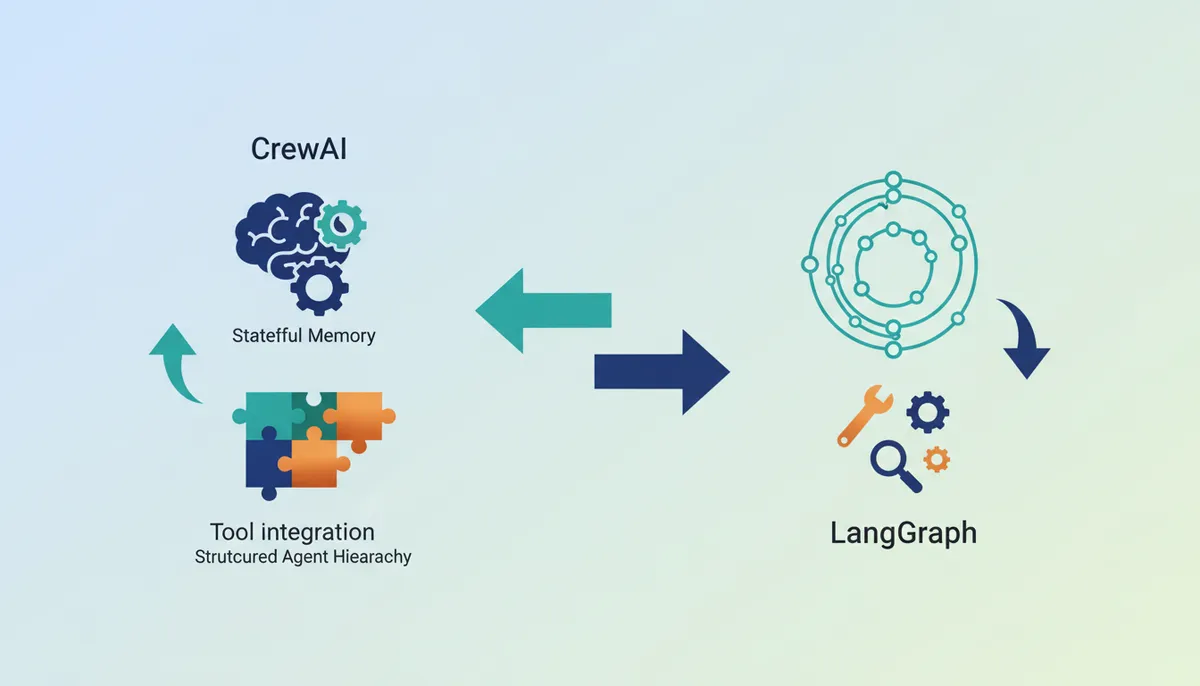
ChatGPT pulls CrewAI documentation and blog posts, favoring narrative explanations of agent architecture while skipping raw code blocks. Claude Code grabs GitHub READMEs and Stack Overflow threads, ignoring theory to focus strictly on tool integration patterns. These behaviors create isolated citation universes where no single guide bridges understanding to deployment across both tools. Models weigh narrative context against implementation density differently, causing each assistant to miss the specific vocabulary required by the other. Cross-tool visibility is therefore necessary for adoption. Current retrieval mechanisms silo knowledge based on the querying assistant rather than the developer's actual workflow stage. A builder using CrewAI might never see the strong stateful memory patterns documented in LangGraph repositories, and vice versa. The gap is measurable rather than theoretical: CrewAI tutorial queries surface documentation in Codex and ChatGPT but return no results in Claude Code, while LangGraph supervisor agent queries heavily favor repository READMEs over blog posts. Reconstructing a full picture therefore means querying more than one assistant, which is the only reason cross-referencing earns its cost.
Checking which is which is a scripting job. Operators construct a Python script to submit keywords to Claude Code API, OpenAI Codex, and ChatGPT, analyzing which documentation surfaces in responses. This automation replaces manual checking, allowing teams to track citation universes across multiple models simultaneously. Running a daily batch against 15 target keywords produces an actionable report on framework visibility. The script specifically checks for terms including crewai, langchain, langgraph, autogen, smolagents, and mcp.
Optimizing Content for AI Overview Citations and Multi-Turn Chains
Code Block Placement Rules for AI Overview Extraction
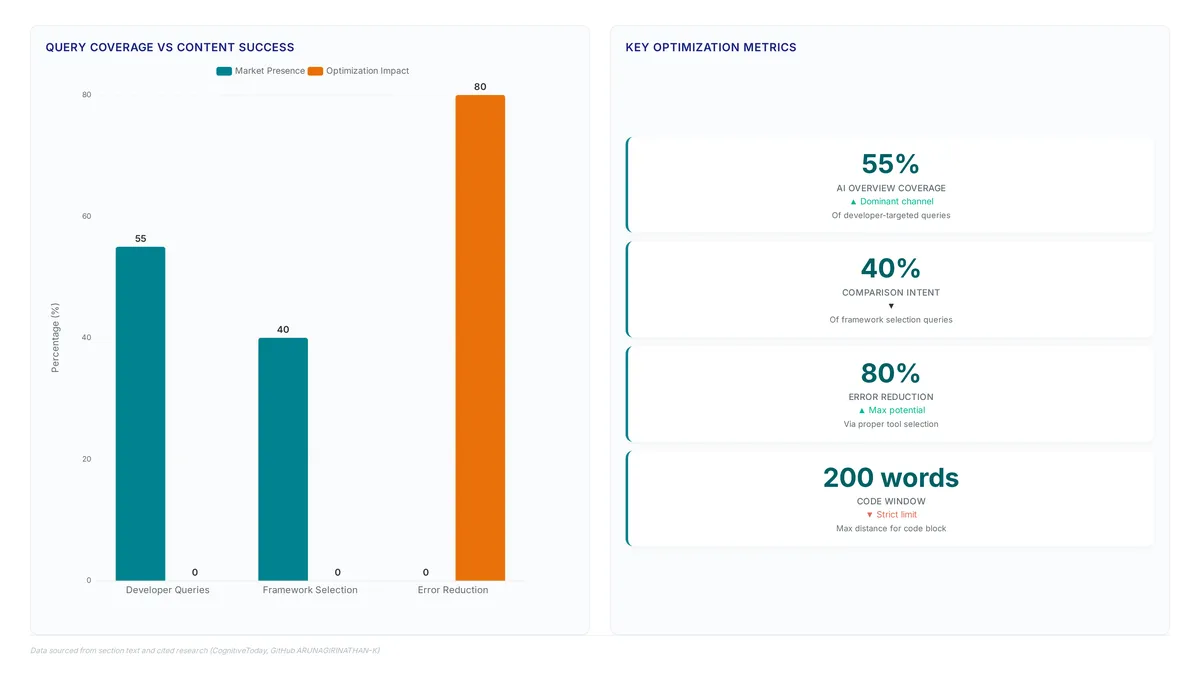
Google AI Overviews now appear for over 55% of developer-targeted queries, yet plain paragraphs without code rarely make it into the summary. To trigger extraction, content must include a code block within the first 200 words. This structural requirement forces a shift from narrative explanation to immediate technical utility. The mechanism relies on parsers identifying executable patterns early in the document stream. Evidence indicates that starting each section with a bold definition or command further signals relevance to extraction algorithms. However, rigid adherence to word counts can fragment logical flow if the introductory context is insufficient. The cost is a potential loss of nuance for complex architectural concepts that require preamble. For builders, this means restructuring tutorials to prioritize the troubleshooting note and implementation snippet before theoretical background.
| Requirement | Function | Impact |
|---|---|---|
| Code Block | Triggers extraction logic | Enables summary inclusion |
| 200 Word Limit | Defines proximity threshold | Filters late-stage examples |
| Bold Headers | Marks command intent | Improves parsing accuracy |
Standard AI chatbots answer questions based strictly on internal training data, whereas research agents actively gather information from external sources. Consequently, content lacking immediate code fails the intent filter for these autonomous systems. The implication for engineering teams is clear: documentation must be engineered as data, not prose. A guide missing the initial code window effectively becomes invisible to the primary discovery channel. Treating the first paragraph as a strict interface contract rather than an introduction ensures alignment with these extraction behaviors.
Mapping Five-Turn Developer Query Chains to Content Formats
AI agent queries unfold across five distinct turns, requiring content structures that evolve from high-level comparison to granular error resolution. Framework selection queries, representing 40% of intent, demand comparison tables that clearly distinguish orchestration capabilities and memory architectures.
| Query Stage | Required Format | Technical Anchor |
|---|---|---|
| Framework Selection | Comparison Table | Orchestration model |
| Installation | Terminal Commands | Dependency tree |
| Implementation | Annotated Code | Function signatures |
| Debugging | Error Glossary | Stack trace patterns |
| Optimization | Configuration Reference | Latency thresholds |
Debugging queries necessitate error message glossaries mapping specific stack traces to fix patterns, a format standard chatbots often miss when relying on static training data. Failure to provide this layered depth means missing the subsequent turns where developers seek reusable agent skills or MCP server configurations.
You cannot balance broad framework agnosticism with the deep specificity required for later turns; generic guides fail to capture the implementation-heavy traffic. Developers moving from "guide to setting up mcp server" to "steps for creating reusable agent skills" expect a continuous logical thread, not isolated articles. Content must anticipate the full chain, offering configuration references and security checklists before the user explicitly asks.
Converting Blog Guides to GitHub Repos for Claude Code Citations
Converting a guide into a GitHub repository with a structured README aligns content with the primary discovery source for AI agent queries. Claude Code and similar agents prioritize repository documentation over narrative text because trending repositories reveal the exact vocabulary developers use. Builders must migrate tutorial content to capture these high-value citations effectively.
- Initialize a public repository containing the full guide text within a
README.mdfile. - Place executable code blocks early in the document to satisfy parser requirements for immediate technical utility.
- Structure directories to mirror logical implementation steps rather than chronological posting dates.
- Organize content around the problem, implementation, and system keywords exposed by trending repositories.
The Awesome AI Agents for 2026 repository demonstrates how structured lists dominate agent discovery. However, migrating content removes the ability to monetize traffic through traditional display advertising models found on blog platforms. The limitation is a direct trade-off between immediate ad revenue and long-term agent visibility. Adopting this structural shift aligns technical writing with how modern coding assistants retrieve information. Developers ignoring this format risk exclusion from the primary discovery channel used by autonomous systems.
About
Diego Alvarez serves as Developer Advocate at AI Agents News, where his daily work involves building and benchmarking autonomous systems using frameworks like CrewAI, AutoGen, and LangGraph. This hands-on experience makes him uniquely qualified to analyze AI agent keyword research, as he constantly navigates the gap between theoretical SEO metrics and the practical needs of developers. Unlike traditional consumer searches, Diego's routine requires finding specific implementation code, evaluating GitHub activity, and tracking rapid framework updates, factors that render standard volume-based keyword tools ineffective for this audience. His role at AI Agents News, a hub dedicated to technical founders and engineering leaders, ensures this analysis prioritizes actionable technical depth over generic traffic stats. By focusing on the specific vocabulary and code-first expectations of the AI agent community, Diego grounds search strategy in real-world development challenges.
Conclusion
Scaling technical content for AI agents reveals a critical breaking point: narrative depth often sacrifices the structured precision required for machine parsing. As agents increasingly dominate discovery, the operational cost of maintaining traditional blog formats becomes the inability to be cited at all. Generic guides fail because they prioritize human reading flow over the rigid hierarchy agents require to extract code blocks and configuration data. The shift demands that writers treat documentation as a database entry first and an article second, accepting that this structural rigor may reduce immediate ad impressions while securing long-term relevance in automated workflows.
The rule that follows is narrow: if a guide contains executable steps, it belongs in a structured README before it appears as a blog post. That is the keyword judgment made one level up, at the format instead of the vocabulary. Volume counts how many people typed a phrase; the intent layer says which of them will run the code, and only the second number survives a market whose tool list turns over faster than the archive does.
Frequently Asked Questions
Broad terms attract passive readers instead of ready builders. Code-intent keywords convert at 12% because searchers arrive prepared to execute immediate code rather than consume theoretical overviews.
Publishers must prioritize implementation readiness over raw traffic numbers. Framework comparison queries represent 40% of intent and demand specific data tables that generic high-volume articles completely fail to provide.
A 2025 archive carries a specific deficit: it misses the protocol standards the toolchain settled on afterwards. With over 300 distinct tools in circulation the vocabulary turns over monthly, so repository mining beats reprinting a static guide.
Narrow framework terms reduce total addressable traffic and raise conversion probability, because a developer who names CrewAI has already finished evaluating. The catch is that the assistant decides which sources they see, so the same query returns different documentation in Codex and in Claude Code.
Conceptual content serves only 25% of users seeking fundamental understanding. The majority of high-value traffic now demands working code examples and structured data that AI Overviews prefer for citations.
References