AI coding agent vs simple autocomplete tools
GitHub Copilot serves 15 million developers, yet true AI coding agents now plan multi-step tasks without hand-holding.
The modern AI coding agent is defined by its ability to execute code, observe results, and decide the next action autonomously. You will learn how these systems differ from standard chatbots, examine the operational mechanics of top performers like Claude Code and Cursor, and discover practical strategies for integrating autonomous workflows into your daily routine.
We move beyond hype to evaluate tools based on their capacity to handle messy refactors and open pull requests independently. The analysis covers specific architectural differences between IDE-native solutions and standalone terminal agents. By understanding these distinctions, developers can avoid tools that merely simulate intelligence and adopt systems that genuinely reduce cognitive load during production deployments.
Defining the Modern AI Coding Agent and Agentic Capabilities
Defining AI Coding Agents Beyond Legacy Autocomplete
An AI coding agent executes multi-file refactors and terminal commands autonomously, surpassing the single-line suggestions of legacy autocomplete tools. The environment of AI coding tools has changed dramatically since early 2025, evolving from autocomplete to agents that can read entire codebases, plan multi-file operations, and open pull requests without constant human intervention. This evolution addresses the limitation of context-restricted completions that often fail to grasp architectural dependencies across a repository.
Claude Code leads hard multi-file reasoning tasks by executing an Explore, Plan, Code, Commit loop across entire repositories. Unlike single-file autocomplete, an AI coding agent ingests full codebase context to plan complex refactors spanning multiple services. This architectural awareness allows the system to modify directory structures and update imports simultaneously, preventing the broken dependencies common in piecemeal updates. While general tools offer broad utility, the ranking methodology prioritizes how well the agent handles complex, multi-file tasks. For enterprise teams requiring deep context awareness without truncation, solutions using large context engines provide necessary scale for messy codebases. This segmentation allows teams to align tool selection with specific workflow needs, whether that be local IDE integration or terminal-based autonomy.
Terminal-Bench 2.1 Scores Versus Real-World Usability
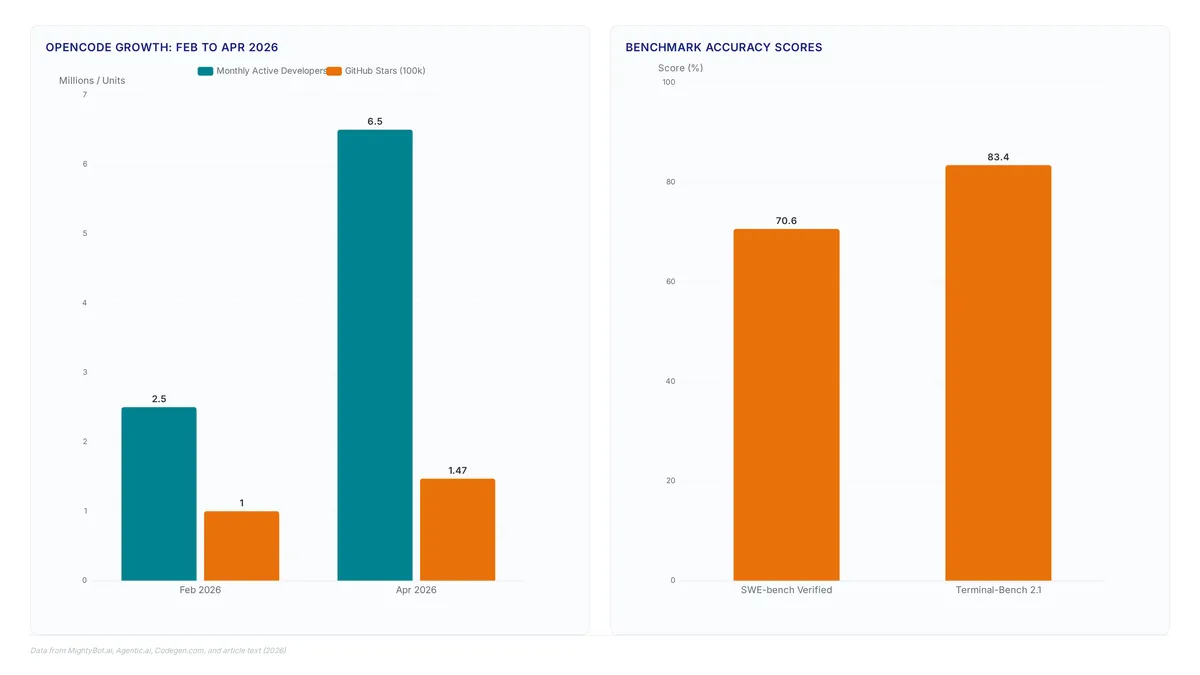
Terminal-Bench 2.1 quantifies command-line proficiency, yet high scores do not guarantee production reliability for daily engineering tasks. Codex running GPT-5.5 leads this metric at 83.4%, closely followed by Claude Code on Fable 5 at 83.1%. These figures measure isolated task completion rather than sustained workflow integration or agentic code review quality across complex repositories. Benchmark scores matter, but only as a starting point; real-world usability is what separates a good demo from a good tool. A critical tension exists between benchmark optimization and practical utility; an agent might solve a contained terminal challenge perfectly but fail to navigate the detailed dependency graph of a legacy enterprise codebase. Consequently, developers prioritizing raw benchmark numbers may overlook tools better suited for iterative, multi-file reasoning required in actual shipping cycles.
Real-world usability depends on how an agent handles context switching and error recovery, not initial task accuracy. OpenCode reached 147,000 GitHub stars by April 2026, a significant increase from 100,000 stars recorded in February 2026. Builders must evaluate whether their primary need is rapid command execution or deep structural understanding before committing to a specific stack. Industry analysis recommends selecting agents based on verified multi-file performance rather than single-metric dominance.
Architecture and Operational Mechanics of Leading AI Agents
Terminal-First Loops Versus IDE-Native Integration
Terminal-native agents execute a discrete Explore, Plan, Code, Commit loop that isolates execution context from the editor UI. This architectural choice defines the agent autonomy boundary for complex refactoring tasks. Claude Code exemplifies this CLI-native approach, running as a standalone process that reads the entire codebase before proposing changes. In contrast, IDE-native integration embeds the agent directly into the interface, treating the editor as the primary control plane. Cursor operates as a full IDE fork where the Composer engine proposes multi-file edits in a single pass within the UI thread.
The divergence creates a tangible cost between isolation and latency. Terminal agents run as standalone processes, allowing the terminal loop to handle complex reasoning steps.
| Feature | Terminal-Native | IDE-Native |
|---|---|---|
| Execution Context | Isolated CLI process | Embedded UI thread |
| Primary Loop | Explore, Plan, Code, Commit | Real-time suggestion |
| Best Fit | Multi-file reasoning | Daily interactive coding |
| Example | Claude Code | Cursor |
This structural difference dictates workflow suitability rather than raw model capability. Teams requiring deep multi-file refactors often apply the explicit control of terminal loops, while those focused on rapid iteration benefit from the smooth context of IDE integration. The market segmentation reflects these distinct operational modes, with developers choosing based on whether task complexity demands isolated reasoning or integrated speed. Builders should select the architecture that matches their primary engineering constraint: isolation for safety or integration for velocity.
Delegation Models for Autonomous PR Creation
Devin executes a delegation model where the agent spins up an isolated cloud environment to write and test code before returning a completed pull request. This architecture contrasts sharply with GitHub Copilot, which operates within the developer's local branch to research repositories, create plans, and open pull requests directly from the IDE. The distinction defines the boundary between local pairing and remote autonomy. Devin's approach requires no local dependency installation, as the agent provisions its own runtime to validate changes against the full repository context. Conversely, Copilot's branch-based workflow keeps execution proximate to the user, using existing local configurations while managing credits for agentic features. Notably, Devin Local replaced the original Cascade agent as the default on-machine agent to better support direct terminal control.
| Feature | Devin Delegation | Copilot Branch Workflow |
|---|---|---|
| Execution Context | Isolated Cloud Environment | Local Branch / IDE |
| Dependency Mgmt | Agent-provisioned | User-managed |
| Primary Use Case | Fully delegated tasks | Pair programming & review |
| Pricing Entry | $20/mo + $2.25 per compute unit | Free to $10/month |
Builders must choose based on task isolation requirements rather than mere convenience. However, cloud delegation becomes necessary when tasks require an isolated runtime that provisions its own dependencies distinct from the host machine. The limitation of local execution includes maintaining environment parity, whereas delegated models offload this overhead to the agent's runtime. For teams prioritizing strict separation between development workstations and production-like test environments, the delegated model offers a safer default. Evaluating the delegation pattern is necessary for any workflow requiring consistent, reproducible environments that diverge from local developer setups.
Cloud-First Scheduling Versus Local Agent Execution
OpenAI Codex operates as a cloud-first experience capable of scheduling future work and waking up automatically to resume tasks across days. This architecture contrasts with local execution models, which provide default on-machine execution for immediate, local resource utilization. The operational divergence creates a distinct choice between persistent cloud sandboxes and ephemeral local processes. Similarly, Google Jules clones repositories into a secure Google Cloud VM to ensure isolated execution.
| Feature | Cloud-First Scheduling | Local Agent Execution |
|---|---|---|
| Persistence | High (Scheduled/Wake-up) | Low (Session-based) |
| Resource Load | Remote (vendor infrastructure) | Local (CPU/RAM consumption) |
| Primary Use | Long-horizon async tasks | Interactive refactoring |
Developers choosing between Claude Code and OpenAI Codex must weigh task duration against latency requirements. The market bifurcation between local IDE-attached and CLI-native agents suggests environment preference drives adoption more than raw model capability. Selecting the deployment model that aligns with your team's specific security posture and latency tolerance remains the primary decision factor.
Practical Implementation Strategies for Enterprise and Individual Workflows
Configuring Cursor Agent Mode and Parallel Execution Limits
Configuring Agent mode in Cursor requires understanding the concurrency ceiling for parallel task execution and the batch-processing logic of the Composer engine. The environment supports running multiple parallel agents simultaneously, using automatic solution judging to evaluate outputs. This architecture allows the IDE to distribute discrete sub-tasks across multiple worker threads, significantly reducing latency for repository-wide refactors compared to single-threaded execution.
| Configuration Parameter | Function | Operational Constraint |
|---|---|---|
| Parallel Agent Count | Sets maximum concurrent workers | Capped by system limits |
| Composer Engine | Executes multi-file edits | Single-pass proposal only |
| Solution Judging | Auto-validates agent output | Integrated into agent mode |
The Composer engine functions as a coordinated orchestrator, proposing edits across multiple files in a single pass rather than iterating file-by-file. This approach minimizes context-switching overhead but introduces a dependency on the initial prompt's clarity; ambiguous instructions can cause the entire batch to fail validation. While high concurrency accelerates throughput, it proportionally increases token consumption, potentially exhausting lower-tier credit pools quicker than anticipated. Engineering teams should restrict parallel limits during initial trials to monitor burn rates before scaling to maximum capacity. Builders must balance speed against cost, as the efficiency gains of parallelism diminish if the solution judging loop rejects a high percentage of generated code.
Deploying GitHub Copilot for Autonomous Pull Request Workflows
GitHub Copilot coding agent mode became generally available on VS Code and JetBrains as of March 2026, enabling direct repository research and branch creation. Once the agent completes its task, it autonomously opens a pull request with a generated summary, effectively removing the manual steps of context switching and commit message drafting. This integration transforms the IDE environment from a passive editor into an active orchestration layer for routine maintenance tasks.
| Workflow Step | Manual Process | Agentic Process |
|---|---|---|
| Context Gathering | Developer reads files | Agent scans repo |
| Change Execution | Hand-coded edits | Multi-file patch |
| Submission | Git commit + push | Auto PR creation |
The cost structure for this capability relies on GitHub AI Credits, where one credit is pegged at $0.01, separating standard completions from expensive agentic actions. Teams must monitor credit consumption during the initial rollout, as complex planning loops can deplete balances quicker than linear coding tasks. While the free tier offers an accessible entry point, enterprise deployments often require the $39/month plan to manage team-wide usage policies effectively. A critical operational tension exists between autonomy and oversight; fully autonomous PR creation demands strong CI guards to prevent low-quality code from entering the review queue. Organizations should implement strict branch protection rules to maintain codebase integrity while using these automated workflows.
Mitigating Credit Exhaustion and Initialization Latency in Production
Operational stability for autonomous coding loops depends on curbing initialization delays and enforcing strict usage caps to prevent budget overruns.
Financial exposure scales rapidly when parallel agents operate without concurrency limits or cost-per-task visibility. Engineers must monitor the cost efficiency per task as a primary metric, since high-volume autonomous loops can exhaust monthly allocations during complex refactoring sessions. For platforms charging based on active work units, unmonitored background processes represent a significant fiscal risk.
| Risk Factor | Operational Impact | Mitigation Strategy |
|---|---|---|
| Initialization Latency | Wasted credits during idle loops | Monitor startup performance |
| Parallel Execution | Exponential credit burn rate | Cap concurrent agent count |
| Unit Pricing | Unpredictable monthly costs | Track $/task metrics strictly |
The tension between speed and cost dictates that quicker initialization does not guarantee cheaper runs if the agent enters inefficient reasoning loops. Builders should prioritize tools that expose unit pricing transparency over those offering only flat monthly fees. Configuring hard limits on active sessions helps align agent compute consumption with allocated budgets.
Economic Implications and Strategic Pricing Models for AI Development
Defining AI Agent Pricing Tiers and Credit Mechanics
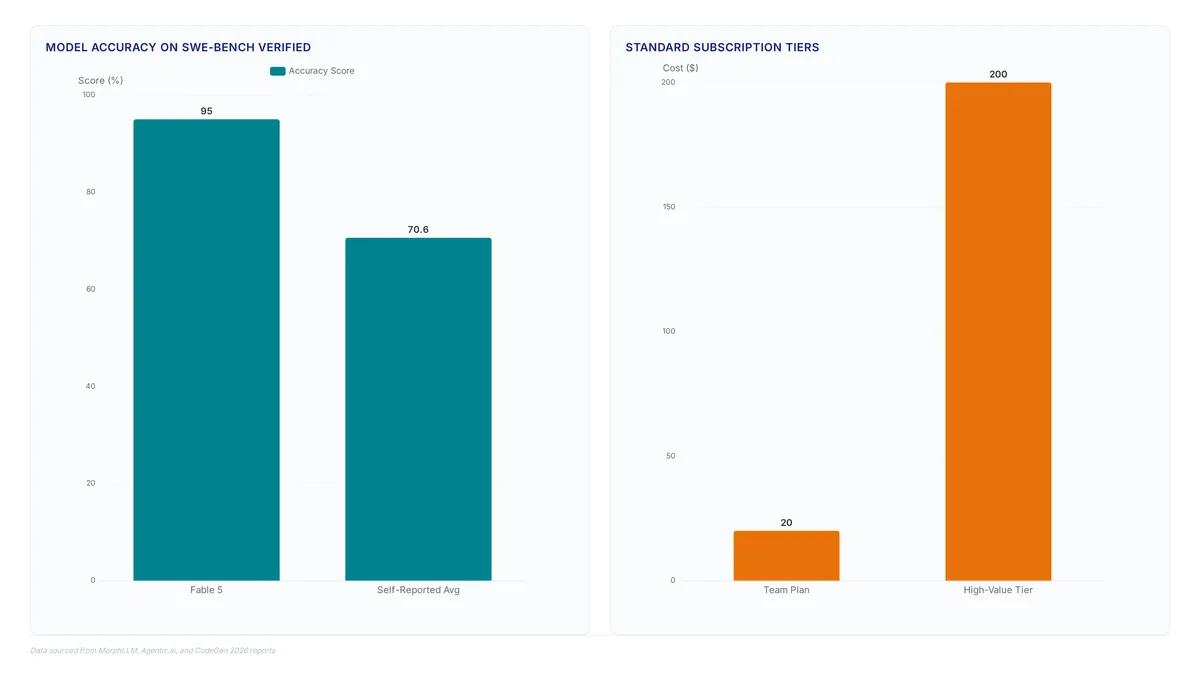
Market structures split in 2026 between local IDE attachments and cloud-hosted solutions, forcing distinct budgeting strategies. Base fees often cover the interface while heavy agentic workflows consume additional units. Standalone platforms charge alongside monthly subscriptions, creating variable cost structures that differ sharply from fixed IDE plugins. Predictable budgeting clashes with the flexibility autonomous terminal tasks require. Fixed tiers suit consistent daily coding, yet bursty multi-file refactoring depletes credits rapidly on variable models. Teams must audit task complexity because benchmark data now includes "$/task" metrics in scoring leaderboards. Devin Desktop serves as a cost-effective budget IDE with enterprise admin controls for routine edits, capping monthly overhead at lower price points. Complex architectural refactors often apply the reasoning depth found in models like Opus, justifying the premium tier cost based on performance needs.
Developers must evaluate hidden costs that accumulate outside the base subscription:
- Variable compute units for autonomous loops.
- Context window overages during large repository scans.
- Latency penalties when queuing requests on shared infrastructure.
Balancing immediate cash flow against long-term velocity defines the strategy; under-provisioning causes agent hesitation while over-provisioning wastes capital on unused capacity. OpenCode grows its community presence quicker than established competitors, pressuring vendors to justify high-tier pricing with tangible throughput gains rather than just model access. Builders should treat the $200/month tier as a resource for specific, high-complexity sprints rather than a permanent fixture. This approach aligns expenditure with actual value delivery, scaling the pricing plan with task difficulty rather than calendar time.
Contract Shapes That Contain Runaway Loops
A stuck retry cycle is a billing event before it is an engineering one: on platforms charging per action, a single looping process can exhaust a monthly budget in hours, which flat-rate subscriptions cannot do. Some enterprise solutions like Augment Code operate on fixed contracts to mitigate this volatility, yet most consumer tools retain usage-based exposure. Without native circuit breakers, engineers must manually monitor logs to prevent fiscal damage, so external budget alerts are worth implementing rather than relying solely on provider safeguards.
About
Diego Alvarez serves as Developer Advocate at AI Agents News, where he specializes in hands-on build guides and rigorous framework comparisons. His daily work involves constructing autonomous agents with tools like CrewAI, AutoGen, and LangGraph, alongside benchmarking coding agents against real-world production scenarios. This direct, practical experience makes him uniquely qualified to evaluate the current environment of AI coding agents. Unlike theoretical overviews, Diego's analysis stems from running these agents on actual codebases, testing their ability to handle complex, multi-file tasks and integrate smoothly into developer workflows. At AI Agents News, an independent hub dedicated to covering autonomous systems and agentic frameworks, Diego focuses on delivering factual, engineering-first insights. His assessments prioritize concrete capabilities, reliability, and cost-effectiveness over marketing hype. By grounding his rankings in empirical testing rather than vendor claims, he provides software engineers and technical leaders with the unbiased data needed to make informed decisions about adopting AI coding solutions.
Conclusion
Scaling autonomous coding from isolated tasks to entire workflows fundamentally shifts the operational bottleneck from code generation speed to financial governance. When agents plan and execute multi-step logic without hand-holding, the cost of a single retry loop can eclipse the value of the output. Teams relying on variable credit models face immediate risk if they treat these tools as always-on background services rather than targeted accelerators. The economic viability of high-autonomy systems depends entirely on capping exposure before deployment begins.
The line between autocomplete and an agent is not suggestion quality but scope of action: one proposes a completion, the other reads the codebase, plans the multi-file change, and opens the pull request. That is also where the bill comes from. Treat the agent tier as a targeted accelerator for the multi-file work completions cannot touch, cap it before deployment, and leave everything else to the cheaper surface.
Frequently Asked Questions
Entry tiers run from free to $10/month for Copilot and $20/mo plus $2.25 per compute unit for Devin. Users needing advanced reasoning models like Opus must upgrade to the $200 tier for complex tasks.
Codex leads terminal benchmarks with an 83.4% success rate on isolated tasks. Claude Code follows closely at 83.1%, though scores do not guarantee full workflow reliability.
Enterprise deployments often require the $39/month plan to manage teamwide usage policies effectively. This tier provides necessary controls that free or builder tiers lack for organizations.
Some platforms charge $2.25 per additional compute unit beyond the base subscription allowance. This variable cost structure means heavy autonomous usage can significantly increase monthly expenses.
The highest consumer tier costs $200 per month to access maximum reasoning capabilities. This investment targets professionals solving complex, multi-file architectural problems daily.
References