Text-to-SQL Roles: Why 3 to 7 Agents Beat One
A single agent fails by the third retry when context bloats with self-corrections. The math is unforgiving: multi-agent systems with specialized roles outperform monolithic models by isolating complex cognitive tasks like intent decomposition and schema mapping.
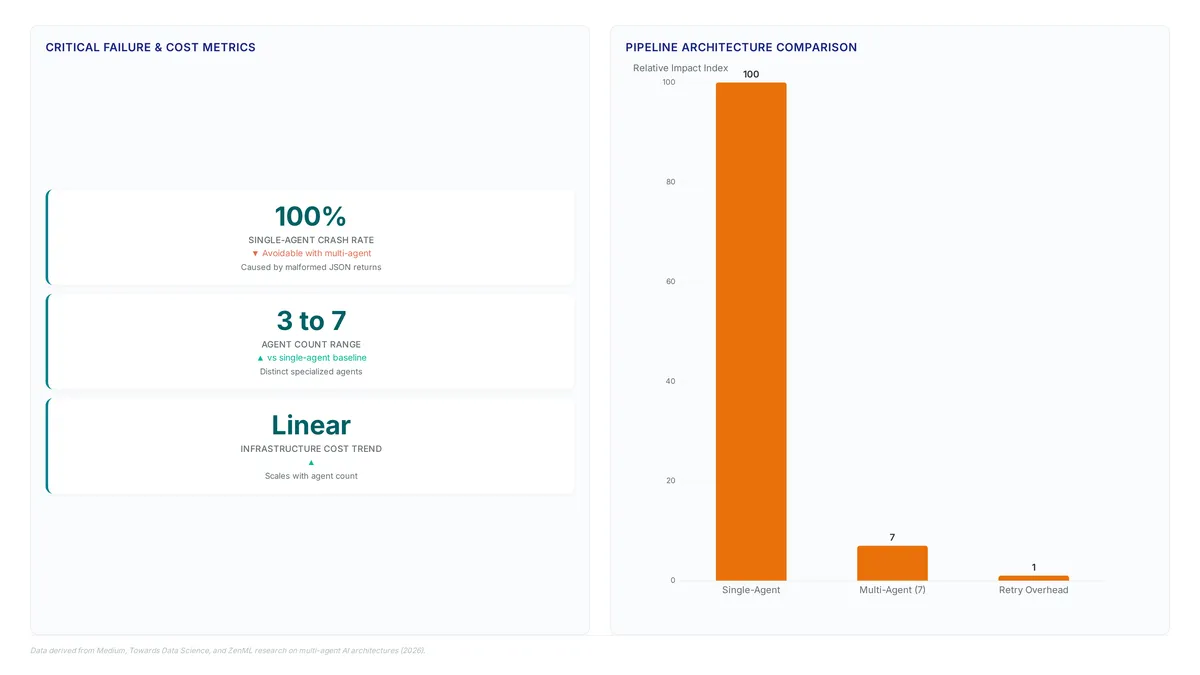
Research indicates that effective text-to-SQL frameworks deploy between 3 to 7 distinct agent roles, such as decomposers and executors, to handle query complexity effectively. One-agent architectures suffice for simple operations, yet they contradict themselves when forced to parse intent, map schemas, and validate syntax simultaneously. This fragmentation prevents the context window from becoming a graveyard of failed attempts.
We need to dissect the mechanics of building these resilient pipelines. LangGraph handles state management and orchestration to keep agent nodes synchronized, but only if you respect its rigid state definitions. We will examine the specific retry logic required to maintain pipeline stability when individual agents falter. Agent specialization is no longer optional for enterprise-grade database interactions; it is a survival mechanism.
The Role of Agent Specialization in Modern Text-to-SQL Systems
Defining Multi-Agent Systems: Orchestrators and Specialized Roles
Think of a multi-agent system as a coordinated collection of specialized entities where an orchestrator manages traffic flow, not a magic wand that fixes bad prompting. This design rejects the fragile hope that one prompt can simultaneously decompose intent, map schemas, generate queries, and validate results without error. Single agents frequently stumble on complex tasks because every failed attempt remains in memory, forcing the model to make tiny, incremental tweaks rather than stepping back to rethink the problem entirely. Specialized roles isolate these cognitive loads so schema mapping occurs only after intent parsing finishes. Multi-agent text-to-SQL frameworks typically apply between 3 and 7 distinct roles to maintain this necessary separation.
Sequential vs Parallel Execution in Text-to-SQL Pipelines
Strict dependency ordering defines sequential execution, meaning schema mapping cannot happen before intent parsing completes. This architectural constraint prevents logical errors by ensuring the system understands user goals before attempting database alignment. Validation logically cannot occur in text-to-SQL pipelines before query generation, making a purely parallel approach impossible for the core workflow. Production systems like SQL Bot implement a verification loop that executes an EXPLAIN statement to detect syntax errors before full execution, feeding detected errors back into a self-correction agent. Each stage operates on verified inputs rather than speculative outputs because of this sequential dependency.
Single-Agent Failure Modes: Malformed JSON and Pipeline Crashes
Single-agent text-to-SQL architectures frequently collapse because the model must simultaneously parse intent, map schemas, generate SQL, and validate output without structural separation. This convergence of distinct cognitive tasks forces the agent to operate with mediocrity across all four requirements rather than excellence in any. When a unified model attempts these competing mental models, it often returns malformed JSON, triggering a complete pipeline crash at the parsing step if not explicitly wrapped in error handling. The failure mode is systemic. Every failed attempt stays in memory, causing the context window to bloat with self-corrections that lead to increasingly small adjustments rather than fresh reasoning. After three retries, the output is merely a revision of a bad first draft, compounding the initial error. Unlike multi-agent pipelines that isolate parsing failures to specific nodes, a single-agent crash halts the entire workflow. Developers must wrap every json.loads call with safe fallbacks to prevent total system unavailability. The architectural cost of avoiding specialized agents is a brittle system where a single formatting error destroys the user session. Implementing explicit state management helps separate these concerns rather than relying on prompt engineering to overcome fundamental context limits.
Inside LangGraph State Management and Orchestration Mechanics
PipelineState Structure and Field Definitions in LangGraph
The PipelineState object acts as the immutable ledger for data flow, carrying eight specific fields between nodes. This shared memory structure contains user_query, intents, schema_mapping, generated_query, critique, final_response, retry_count, and failure_source. Each node functions as a discrete unit that reads from and writes to this central state, preventing the context bloat common in single-agent loops. By isolating schema mapping from query generation, the system ensures that factual grounding remains distinct from syntactic construction.
| Field | Type | Purpose |
|---|---|---|
intents |
Optional | Decomposed user goals |
schema_mapping |
Optional[dict] | Verified table/column links |
failure_source |
Optional[str] | Tracks agent causing error |
retry_count |
int | Prevents infinite loops |
Conditional edges inspect the critique field to route execution; if validation fails and retry_count is below the threshold, the graph loops to the build_query node. This explicit state management allows the Critic Agent to inject specific error messages into the prompt for the next attempt, rather than relying on the model to recall previous failures from an expanding token history. However, this rigidity introduces orchestration complexity, as developers must maintain strict schema definitions for every state transition. The failure_source field is particularly critical for debugging, as it identifies whether the Intent Parser or Query Builder caused the breakdown. Without this granular tracking, diagnosing why a specific SQL generation failed becomes a heuristic guess rather than a deterministic lookup. Builders must define these fields precisely, as missing keys will cause the graph execution to halt immediately.
Conditional Edge Routing Based on Critique and Retry Logic
Meanwhile, conditional edges in LangGraph route execution back to build_query when critique fails and retry_count stays below three. This mechanism prevents infinite loops by enforcing a strict ceiling on regeneration attempts. The orchestrator evaluates the global state to determine the next node, ensuring that a failed validation triggers a targeted retry rather than a full pipeline restart. Unlike sequential flows that proceed linearly, this architecture supports cyclic control where the failure_source field explicitly tracks which agent caused the deviation. The implementation relies on deterministic predicates attached to graph edges. When the Critic Agent returns a passed status of false, the system increments the retry counter. If the count remains under the limit, the flow loops; otherwise, it terminates or escalates. This approach contrasts with parallel execution models where independent agents process subtasks simultaneously without waiting for validation feedback.
| Feature | Sequential Execution | Conditional Cyclic Flow |
|---|---|---|
| Flow Control | Linear progression | Branches based on state |
| Error Handling | Terminal failure | Automated retry loop |
| State Usage | Input/Output only | Predicate evaluation |
Self-correction loops can effectively double or triple the token cost for failed queries, making the initial accuracy of the generator a critical cost factor. The trade-off is that while retry logic improves final output quality, it introduces latency variability that service level agreements must accommodate. Operators should note that three retries result in four total attempts, a threshold described as non-negotiable for stability.
Validating Intent Parser and Critic Agent Output Formats
Strict JSON schemas prevent pipeline crashes when LLMs return malformed syntax during intent decomposition.
Developers should implement deterministic routing for flow control while reserving LLMs for bounded judgment tasks. The Intent Parser node functions as a specialist, returning a JSON list containing description, metric, filters, and time_range. Simultaneously, the Critic Agent evaluates the output, returning a dictionary with passed, issues, and severity. Failure to enforce these exact keys causes json.loads exceptions that halt execution entirely.
| Agent Role | Required Keys | Data Type |
|---|---|---|
| Intent Parser | description, metric, filters, time_range |
List[dict] |
| Critic Agent | passed, issues, severity |
dict |
High-stakes applications increasingly incorporate human validation steps to verify safety before query execution. The trade-off for this rigid structure is increased implementation complexity compared to free-form text responses. Builders must treat tool outputs as contracts rather than conveniences to maintain system stability. Without these guards, context bloat accumulates rapidly as agents attempt to self-correct syntax errors instead of solving the user query. Specialization beats prompt bloat every time when managing production state.
Building a Resilient Multi-Agent Pipeline with Retry Logic
The Five-Agent Decomposition Chain for Text-to-SQL
Breaking raw questions into discrete intents stops the context bloat that breaks single agents. The Intent Parser Agent takes natural language and outputs structured objectives like ranking customers or computing trends without generating SQL. This separation stops the model from mapping schemas before it understands the core request. Implementation demands strict boundaries for each specialized node in the pipeline:
- The Schema Agent receives parsed intents and maps them to exact table names and column definitions, preventing the invention of plausible but non-existent fields.
- The Query Builder Agent constructs syntactically correct statements using only the grounded schema provided by the previous step.
- The Critic Agent evaluates the output against original intents to detect missing time windows or semantic errors before execution.
- The Response Agent formats the final result, adding plain-language explanations and surfacing any assumptions made during generation.
This sequential flow tackles the specialization versus generalization tension found in monolithic models. Isolating responsibilities stops the hallucination risks where a single model mixes validation with generation. Latency overhead appears as data passes through multiple network calls between agents. Builders must weigh the reliability gain against increased execution time for simple queries.
Wiring Conditional Edges for Critique-Driven Retry Loops
The conditional edge routes the pipeline based on the critic's return value to enforce strict validation gates. This mechanism stops the system from accepting malformed SQL by branching execution flow immediately upon detecting syntax errors or semantic mismatches. Implementing this logic requires defining predicates on the global state that trigger specific downstream nodes rather than proceeding linearly. When a retry occurs, the state carries the critique forward so the builder knows exactly why it is rebuilding the query. Without attaching this specific feedback, the system would simply regenerate identical errors, creating an infinite loop of failure.
- Define a conditional edge function that inspects the
critiquefield within the shared state object. - Route to the Response Agent only if the validation status equals "pass"; otherwise, route back to the Query Builder Agent with error context.
- Ensure the state object appends the specific error message to the conversation history to inform the next-generation attempt.
The trade-off is increased latency per request due to the additional validation hop, which operators must balance against reliability needs. Proper error handling mechanisms add computational overhead but prevent total pipeline collapse during complex schema scans.
Preventing Infinite Regeneration Cycles in Agent Workflows
Infinite regeneration cycles occur when the Critic Agent feedback fails to attach to the shared state, forcing the Query Builder Agent to repeat identical syntactic errors. The system lacks the signal required to break the loop without explicit error context propagation. It runs the same generation logic repeatedly until token limits are exhausted. This failure mode transforms a correctable syntax error into a permanent pipeline stall. Self-correction loops that re-generate queries after an EXPLAIN statement fails can effectively double or triple token costs for failed queries.
Engineers must implement a state-aware retry mechanism to prevent this:
- Capture the specific validation error from the database or syntax checker.
- Append this error message to the PipelineState object before re-invoking the builder.
- Ensure the Query Builder Agent receives the critique as a primary input constraint.
Operational risk lies in assuming the model remembers its own failure. The Intent Parser Agent and downstream nodes operate on stale assumptions without explicit state injection. AI Agents News recommends treating error messages as first-class data objects rather than transient logs. Omitting this propagation creates a system that confidently executes invalid SQL indefinitely.
Mitigating Context Bloat and Production Failure Risks
Context Bleed and Schema Hallucination in LangGraph

LangGraph passes full state between nodes, a design choice that allows early intent decomposition errors to propagate silently because the critic evaluates the query against the flawed intents rather than the original question. The system validates a wrong interpretation instead of the user's actual request, locking the pipeline into an unrecoverable logic path. Schema hallucination arises in databases with 200 tables where injecting the entire schema is impractical, requiring retrieved embeddings of the top 15 to 20 most relevant tables via vector search. Attempting to force full schema injection into a single context window exceeds practical limits for most production environments, leading to invented column names that appear plausible but do not exist.
Retry Loop Limitations and Token Cost Explosion
Retry loops fail catastrophically when the root cause is bad intent parsing, forcing repeated rejections until the ceiling is hit. If the initial decomposition misidentifies the user goal, the builder agent cannot generate a valid query regardless of iteration count. This behavior creates a hard dependency on upstream accuracy rather than iterative refinement. Token expenditure escalates rapidly in these failure scenarios. A sequential pipeline using five agents with a single retry loop incurs a minimum of six LLM calls per request. When self-correction triggers after an EXPLAIN statement fails, the system effectively doubles or triples the token cost for that specific transaction.
Debugging complexity compounds when state propagation masks the original intent error behind layers of retry noise. Retry logic treats symptoms, not causes, a reality network operators and builders must accept. Additional calls waste resources rather than resolve the query if the intent parser fails. Builders must implement strict validation gates before the retry loop engages. The system pays a premium for guaranteed failure without isolating intent errors early. Prioritizing deterministic routing for intent decomposition over probabilistic retry strategies helps mitigate these fixed costs.
When Single-Agent Pipelines Outperform Multi-Agent Architectures
Simple schemas and straightforward queries favor a consolidated single-agent design over distributed orchestration layers. Complex pipelines introduce significant overhead, additional failure points, and difficult debugging scenarios that outweigh benefits for basic tasks. A well-prompted agent with a basic retry loop consistently outperforms fragmented systems on latency and cost metrics when database complexity remains low. The hidden costs of unnecessary specialization include:
- Increased token costs from redundant context transmission across multiple nodes.
- Complex state management requirements that complicate error tracing.
- Higher likelihood of total pipeline crashes due to malformed JSON returns.
Single-agent failures often stem from unhandled parsing errors causing immediate crashes, yet these are solvable with standard error wrapping rather than architectural fragmentation. Multi-agent architectures introduce quantifiable overheads including increased token consumption, higher latency due to sequential handoffs, and expanded state management requirements compared to single-prompt solutions. Builders should prioritize implementing a strong single-agent system first, only introducing specialization when facing hard compliance boundaries or genuinely parallelizable workloads. This approach minimizes initial complexity while maintaining a clear upgrade path for future scaling needs.
About
Diego Alvarez serves as Developer Advocate at AI Agents News, where he specializes in constructing and benchmarking autonomous systems. His daily work involves rigorously testing frameworks like CrewAI, AutoGen, and LangGraph to identify exactly where single-agent architectures fail under complex loads. This hands-on experience directly informs the article's analysis of multi-agent pipelines, as Diego routinely encounters the same intent-parsing bottlenecks and schema-mapping errors described in the text. At AI Agents News, the team focuses on deconstructing these failure modes to help engineers build more reliable orchestration layers. By translating practical build challenges into clear technical guidance, Diego connects real-world development hurdles with the strategic shift toward specialized, multi-agent coordination. His expertise ensures that the discussion moves beyond theoretical benefits to address concrete reliability and evaluation metrics necessary for production-grade systems.
Conclusion
Scaling multi-agent systems reveals a harsh reality: architectural complexity often masquerades as capability while silently inflating operational fragility. When a single malformed JSON return triggers a complete pipeline crash, the distributed design becomes a liability rather than an asset. The ongoing cost here is not merely compute spend but the compounding engineering hours spent tracing state errors across fragmented nodes. Builders must recognize that deterministic routing for intent decomposition frequently outperforms probabilistic retry strategies when the underlying schema remains simple.
Match the architecture to the schema: keep a single-agent design as the baseline for simple queries, and split into the 3 to 7 specialized roles once intent parsing, schema mapping, and validation start colliding inside one context window. That threshold, not preference, is what justifies the orchestration overhead. This strategy preserves debugging clarity and prevents the premature optimization that leads to systemic instability. Start this week by auditing your current agent handoffs to identify any sequential dependencies that a single, well-structured prompt could resolve immediately. Eliminate redundant context transmission before adding more nodes to your graph.
Frequently Asked Questions
Single agents fail by the third retry due to context bloat from self-corrections. This forces the model to make small tweaks rather than rethinking the problem entirely, causing it to contradict itself when handling multiple operations.
Effective frameworks typically deploy between 3 to 7 distinct agent roles to manage complexity. This separation ensures tasks like intent parsing and schema mapping occur independently, preventing the context window from becoming a graveyard of failed attempts.
Malformed JSON returns trigger a total pipeline crash at the parsing step if unhandled. This failure mode occurs because single agents attempting all tasks simultaneously often generate invalid syntax while trying to validate their own output.
A sequential pipeline using five agents with a single retry loop incurs a minimum of six LLM calls per request. When self-correction triggers after an EXPLAIN statement fails, the token cost for that transaction effectively doubles or triples.
Sequential execution enforces strict ordering so schema mapping cannot happen before intent parsing completes. This architectural constraint prevents logical errors by ensuring the system fully understands user goals before attempting any database alignment or query generation.
References