Multiagent systems: Vertex AI for enterprise scale
Multi-agent systems at enterprise scale already handle datasets exceeding 20,000 documents in pharma, banking, and legal sectors. Splitting responsibilities across specialized roles like Planner, Retriever, and Executor agents creates superior fault isolation compared to traditional single-model architectures. Vertex AI services enable task parallelism and flexible delegation for customer support automation and code generation pipelines. More critically, specific agent orchestration mechanics prevent entire workflows from collapsing when individual components encounter errors.
Forcing one model to manage planning, retrieval, and tool execution simultaneously is inefficient. Modular agent collaboration solves this. By using Vertex AI for infrastructure consistency, organizations deploy agentic AI patterns that scale reliably. As workflows grow in complexity, the underlying system maintains stability through dedicated validation and context gathering layers rather than relying on a monolithic, overloaded processor.
The Role of Specialized Agent Architectures in Enterprise AI
Multi-Agent System Architecture vs Single-Agent Models
A multi-agent AI system spreads specialized roles across independent executors to handle complex workflows that overwhelm single-model setups. Traditional single-agent designs force one model to manage planning, retrieval, tool execution, and response generation, creating a bottleneck as tasks grow harder. This centralized approach demands excessive context maintenance, often causing reasoning errors or timeouts in long sequences. Multi-agent systems fix this by giving distinct functions to specific agents, like a Planner Agent for breaking down tasks and an Executor Agent for interacting with tools. Such separation enables fault isolation, so a failure in one module does not crash the whole workflow. Coding sessions have shifted from brief interactions to complex operations involving multi-file edits that single agents struggle to manage.
| Feature | Single-Agent Model | Multi-Agent System |
|---|---|---|
| Responsibility | Centralized logic | Distributed roles |
| Scalability | Limited by context window | Horizontal via parallelism |
| Failure Mode | Total workflow stop | Isolated task retry |
| Tool Use | Generic, unoptimized | Specialized per agent |
Successful enterprise implementations moved from single-agent models with limited scope to orchestrating teams of specialized agents for complex workflows. This architecture adds latency overhead from inter-agent communication that designers must optimize. Single agents suit simple queries, but task parallelism boosts efficiency for large-scale document processing or code generation pipelines.
Enterprise Deployment of Specialized Agent Roles
Deployments in pharma and banking widen that split: the Retriever Agent gathers context, preventing the contamination common in single-model approaches, and a Validator Agent checks output before delivery, which closes the loop. Specialization introduces network latency between handoffs that single-model systems avoid. The constraint is increased infrastructure complexity requiring strong communication protocols. A significant portion of production multi-agent deployments use this managed orchestration pattern to resolve customer tickets and automate supply chains. Without coordination, agents duplicate effort and lose state during handoffs. Builders should adopt this model when workflow complexity requires dividing responsibilities so higher levels focus on coordination while lower levels focus on execution.
Manager-Worker Orchestration Patterns in Vertex AI
The supervisor-based agent architecture defines a control plane where a central manager dynamically delegates subtasks to specialized worker nodes. This pattern differs from static sequential chains by enabling runtime task assignment based on current system state and agent availability. Production-ready implementations frequently adopt this Manager-Worker dynamic to maintain strict hierarchy while allowing flexible execution paths for complex enterprise workflows. Developers building these systems apply frameworks supporting at least 4 core orchestration patterns as of 2026, yet the supervisor model remains distinct for its adaptive routing capabilities. Unlike parallel fan-out strategies broadcasting identical queries, the manager agent evaluates context before invoking specific tools or downstream agents. This tension between runtime flexibility and structural fragility dictates deployment suitability for mission-critical applications.
Inside Vertex AI Agent Engine Orchestration and Tool Logic
Vertex AI Agent Engine Execution Lifecycle and Tool Orchestration
An input trigger starts the chain. The sequence follows a strict path: Input, Agent Trigger, Tool Call, Response Processing, and Output. This linear progression ensures that the Vertex AI Agent Engine maintains strict dependency chains between tasks so downstream agents receive validated context. Production systems often coordinate such actions through patterns like planner-executor loops to manage complex reasoning steps. The engine separates tool logic from agent decision-making to prevent duplicate integrations across specialized roles. By isolating these layers, a search agent and a deployment agent can share the same API connector without redundant engineering, and a broken integration is fixed by updating the agent that owns it instead of redeploying the entire fleet.
Implementing Parallel Agent Execution and Flexible Routing Patterns
Latency drops when multiple agents execute independently at the same time. Parallel routing suits non-dependent subtasks like simultaneous data retrieval. This approach contrasts with sequential chains where output from one node becomes the strict input for the next. In complex decompositions, a central orchestrator breaks requests into subtasks routed to specialized workers such as researchers or coders who process in parallel. The supervisor layer then manages flexible routing by deciding task flow based on live context and current workload conditions rather than static paths.
Implementation requires distinct configuration for execution modes to handle dependency graphs correctly:
| Execution Mode | Dependency Model | Best Use Case |
|---|---|---|
| Sequential | Strict linear order | Step-by-step validation pipelines |
| Parallel Fan-out | Independent branches | Broad context gathering |
| Flexible Supervisor | Context-aware branching | Variable complexity tickets |
State synchronization fails during parallel bursts. Race conditions emerge where agents overwrite shared memory contexts. Parallelism improves throughput. The flexible routing logic introduces overhead that can negate speed gains if the supervisor decision latency exceeds worker execution time. Builders must tune the granularity of subtasks; splitting work too finely increases coordination costs disproportionately. For structured hierarchies, the Manager-Worker pattern enforces consistency but requires careful tuning to prevent the central coordinator from becoming a bottleneck. Effective orchestration balances these modes by isolating state per worker while maintaining a global view for the supervisor.
State Handling Risks: Stale Data, Duplicate Execution, and Race Conditions
Multiple specialized agents attempt simultaneous updates to a shared memory layer without atomic locking mechanisms. Race conditions arise in distributed intelligence models under these circumstances. In architectures where workers function as stateless entities, the central orchestrator bears the full burden of maintaining transaction context, creating a single point of failure for state consistency. When an agent retrieves data that another process modifies milliseconds later, the system processes stale state, leading to logic errors that standard retry policies cannot resolve. This fragmentation often causes duplicate execution where independent agents perform identical tool calls because neither sees the other's pending operation in the global view.
| Failure Mode | Root Cause | Operational Impact |
|---|---|---|
| Stale State | Lagged synchronization | Incorrect decision paths |
| Duplicate Execution | Missing locks | Wasted compute credits |
| Race Condition | Concurrent writes | Data corruption |
Google Cloud addresses these risks in its Gemini Enterprise Agent Platform, which enforces security and long-running state management across the distributed fleet production-ready AI agents. Relying on a centralized state store introduces latency that can degrade real-time responsiveness for time-sensitive enterprise workflows. Builders must implement versioned state objects or optimistic concurrency controls to mitigate data loss during high-contention periods, and the safest split keeps tool agents stateless while memory retrieval stays centralized. The modularity gained from distributed intelligence collapses under the weight of inconsistent operational data without these safeguards.
Building Scalable Multi-Agent Workflows on Vertex AI
Implementing Horizontal Scaling with Load Balancers and Agent Pools
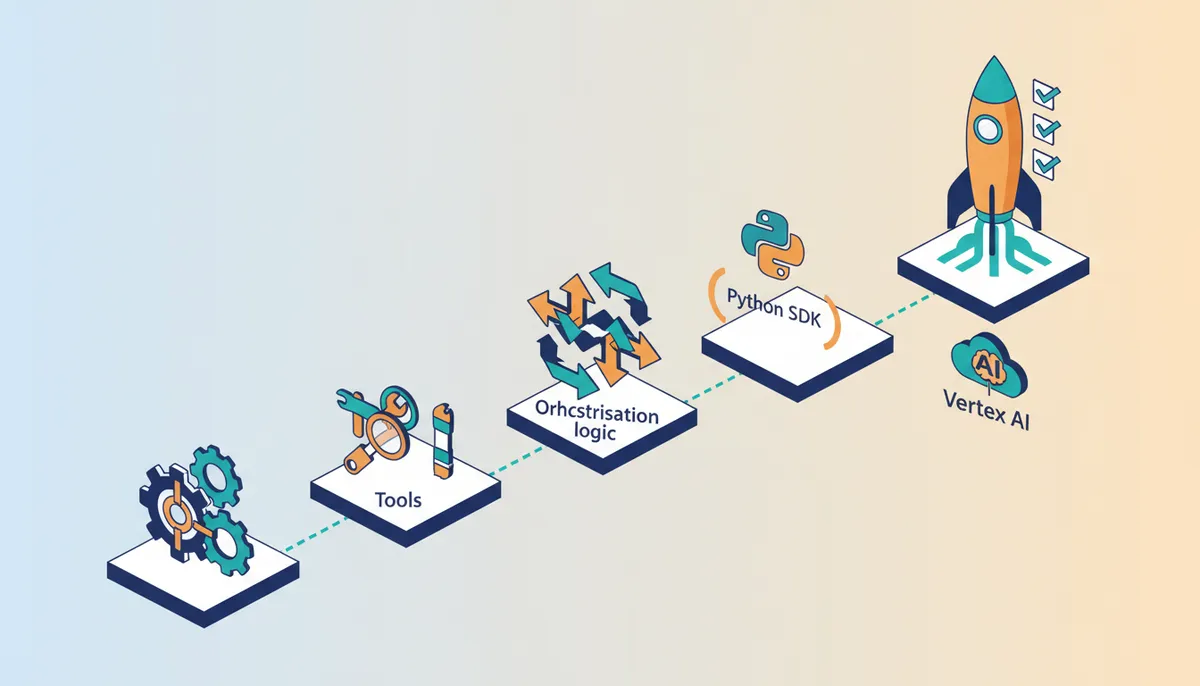
Deploying systems on Cloud Run or GKE distributes incoming requests across multiple compute instances to prevent bottlenecks. Traffic flows from the entry point through flexible execution environments, into the agent pool, and finally to the tool layer for execution. Variable workloads are absorbed by the platform rather than by manual intervention.
- Define the agent pool size based on the specific complexity of tasks and the "Manager-Worker" dynamic required.
- Configure the execution environment to route requests using patterns such as sequential, parallel, or supervisor-based architectures.
- Implement retry logic within the tool layer to manage transient failures, as the engine supports restarting only failed tasks.
- Monitor Vertex AI Agent Engine metrics to adjust scaling thresholds automatically as demand fluctuates.
Failure isolation becomes a primary benefit of this distributed approach. A crash in one Executor Agent does not halt the entire workflow. Dividing responsibilities introduces coordination overhead as the supervisor-based coordinator manages state across nodes, and tracking distributed traces gets harder than in a single-instance deployment. Teams must balance the need for specialized agent roles against the operational cost of maintaining distinct execution environments.
Strategic Advantages and Operational Risks of Vertex AI Agents
Vertex AI as a Single Deployment Environment
Google Vertex AI merges model access, infrastructure, and orchestration into one deployment environment. This unified approach pairs Gemini Models for native multimodal reasoning with BigQuery Integration to grant direct enterprise data access. Developers deploy distributed agents using Cloud Run / GKE, handling flexible execution needs without separate infrastructure layers. The Vertex AI Agent Engine simplifies operations by managing agent lifecycles and tool coordination internally.
| Feature | Vertex AI Approach | Operational Impact |
|---|---|---|
| Data Access | Native BigQuery connectors | Eliminates ETL latency for retriever agents |
| Compute | Cloud Run / GKE backend | Supports parallel tool execution patterns |
| Orchestration | Managed Agent Engine | Reduces custom state management code |
Adopting this architecture eliminates the fragmentation plaguing single-model approaches where context switching degrades performance. Reliance on a single vendor system introduces constraints around portability and exit strategy. Open-source frameworks like LangGraph offer different trade-offs; the managed service sacrifices lower-level control for operational consistency. The structural change improves fault isolation yet demands rigorous monitoring of token consumption and concurrency limits to prevent cost overruns. Builders must weigh managed orchestration convenience against the need for granular control over agent communication patterns.
Token Consumption and API Quota Risks in Distributed Workflows
Simultaneous execution across independent workflows drives compute usage and tool invocations, creating immediate exposure to API quota exhaustion. When a central orchestrator decomposes requests for specialized workers, the system incurs routing overhead that multiplies token consumption beyond single-model baselines. This pattern accounts for approximately 70% of production multi-agent deployments, based on public case studies from companies running agent-based customer support, document processing, and operational automation. Without strict concurrency limits, retry volumes from transient tool failures can trigger cascading cost overruns before operators detect the anomaly.
| Dimension | Single-Agent Workflow | Distributed Multi-Agent Workflow |
|---|---|---|
| Failure Domain | Localized to one process | Propagates across worker pool |
| Retry Behavior | Linear backoff | Exponential burst risk |
Developers building enterprise document processing systems note that orchestrating teams of specialized agents requires careful governance to avoid exponential cost growth as workflows expand. Builders should prioritize cost governance mechanisms within the Agent Development Kit to maintain fiscal control while scaling.
About
Marcus Chen is the Lead Agent Engineer at AI Agents News, where he specializes in dissecting production-grade multi-agent architectures. His daily work involves rigorously testing orchestration patterns across frameworks like LangGraph and AutoGen, making him uniquely qualified to analyze Google Vertex AI Agent Engine. Unlike theoretical overviews, this article stems from Chen's hands-on experience deploying scalable agent swarms that require precise tool use and context sharing. He evaluates how Vertex AI's managed infrastructure addresses real-world friction points in multi-agent coordination, such as state management and latency. As AI Agents News covers the shifting environment of autonomous systems, Chen connects Google's cloud-native capabilities to the practical needs of engineers building complex workflows. His analysis focuses on concrete architectural implications rather than marketing hype, helping technical leaders decide if Vertex AI fits their specific scaling requirements for enterprise AI workloads.
Conclusion
Scaling multi-agent systems reveals that modularity often masks exponential operational debt. While separating concerns allows independent updates, the resulting network overhead and state synchronization challenges create a fragile equilibrium where latency spikes and context drift become inevitable without strict governance. The 70% prevalence of this orchestration pattern in production means most teams are currently underestimating the compounding cost of inter-agent round trips and retry storms. You must treat token consumption not as a variable expense but as a hard architectural constraint that dictates agent granularity.
That constraint has a shape. Distributed workers sharing session state need centralized memory retrieval and hard concurrency limits, because a retry burst that propagates across the worker pool costs more than the monolith it replaced and stops the workflow anyway. Fault isolation that ends at the orchestrator is not fault isolation: it is the same single point of failure with more round trips in front of it.
Frequently Asked Questions
Deployments in pharma, banking, and legal run past 20,000 documents. The volume is not the hard part: one model holding planning, retrieval, and execution exhausts its context first, which is why the Retriever is split off to gather context without contaminating it.
Frameworks support at least 4 core orchestration patterns as of 2026. Three of them set the execution mode: sequential for step-by-step validation, parallel fan-out for broad context gathering, and a flexible supervisor that branches on live context instead of a fixed path.
Implementations often use a Manager-Worker dynamic with one central orchestrator. This hierarchy ensures strict task assignment based on system state, preventing duplicate efforts during runtime execution.
A failure stays inside the agent role that owns it, and the engine restarts only the failed task rather than the whole workflow. The isolation stops at the orchestrator, which still carries transaction context and remains a single point of failure for state consistency.
Single agents struggle with complex operations like multi-file edits due to context limits. Distributing roles across independent executors boosts task parallelism and maintains stability during long sequences.
References