Multiagent orchestration: why 70% use a central hub
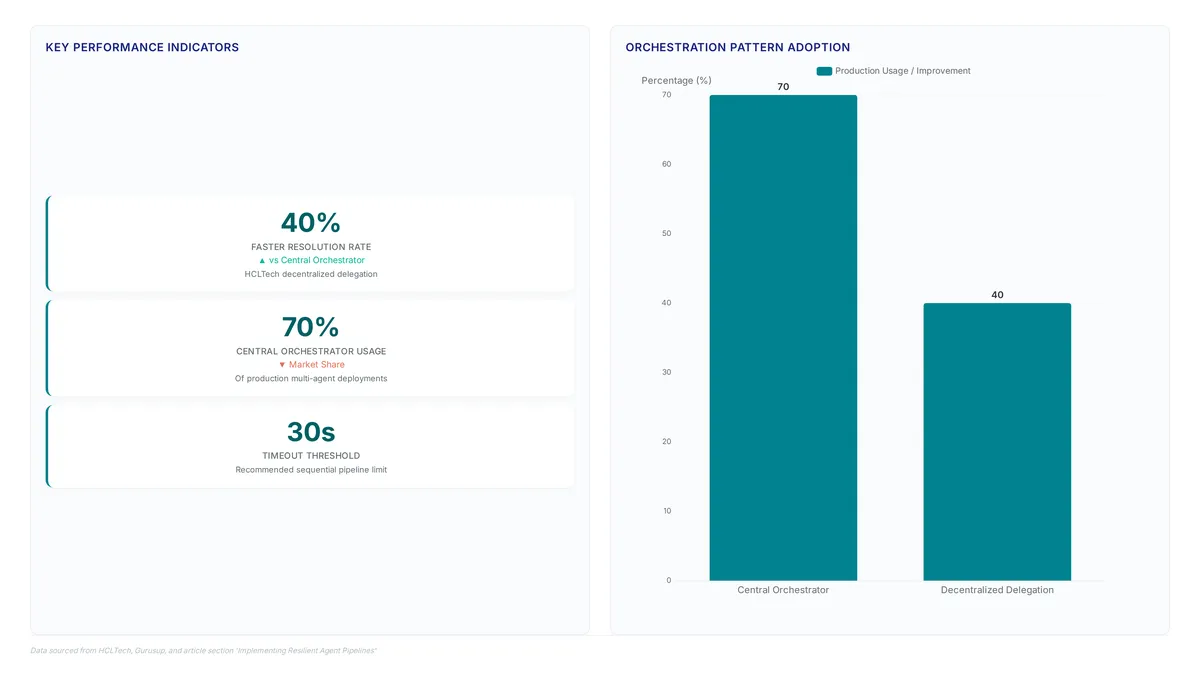
Roughly 70% of production multi-agent deployments lean on a central orchestrator to manage complex workflows. This isn't an accident; it's a signal. Multiagent orchestration has moved past the experimental phase. It is now the baseline for tasks that break single-agent models. As systems outgrow simple prompt engineering, the coordination overhead becomes the price of admission for reliability and security across distinct domains.
The reason is unglamorous: specialized agents pay off only once one component classifies intent and routes the work, and that hub is what keeps state, audit trails, and security boundaries tractable. Flexible delegation buys speed and hands back loops that never terminate unless you set iteration limits. Data from Gurusup confirms that successful implementations rely on an orchestrator to classify intent and route requests efficiently. By mastering these orchestration patterns, developers can sidestep unnecessary complexity while using frameworks like LangGraph for controllable agent construction. The goal is blunt: use the lowest level of complexity that reliably meets your requirements.
The Role of Specialized Agents in Modern AI Architecture
Defining Multiagent Orchestration and Agent Specialization
Multiagent orchestration fractures heavy workloads into narrow tasks handled by independent software units. Instead of forcing one model to know everything, systems break complex problems into specialized units of work, drastically reducing prompt complexity. Individual agents focus on specific capabilities, mirroring human teamwork to boost reliability. This Specialization means code complexity drops because each agent handles a tight scope.
Sequential chains, concurrent execution, and hierarchical delegation manage these interactions. A central orchestrator often classifies intent and routes subtasks to specialized workers, a topology dominating production deployments. This structure supports Scalability; you can add or modify agents without redesigning the whole system. Microsoft's Agent Framework 1.0 stabilizes these patterns for Python and .NET, signaling mature tooling for multi-agent orchestration.
Architectural overhead introduces latency and coordination costs. You cannot ignore them. Managing state across handoffs requires rigorous context sharing protocols to prevent data loss. Single agents suffice for linear tasks, but cross-domain problems demand distributed coordination. Maintainability improves because debugging isolates faults to specific agents rather than hunting through monolithic logic. Adopt this pattern only when prompt engineering or single-agent tool use fails to meet reliability thresholds. Each unit can also apply distinct models and compute resources for its specific outcome, an optimization a single prompt cannot reach once its context window fills with diverse tool definitions. The resulting systems handle complex workflows like insurance claims or supply chain management with minimal intervention.
Operational Patterns: Central Orchestrators vs Decentralized Delegation
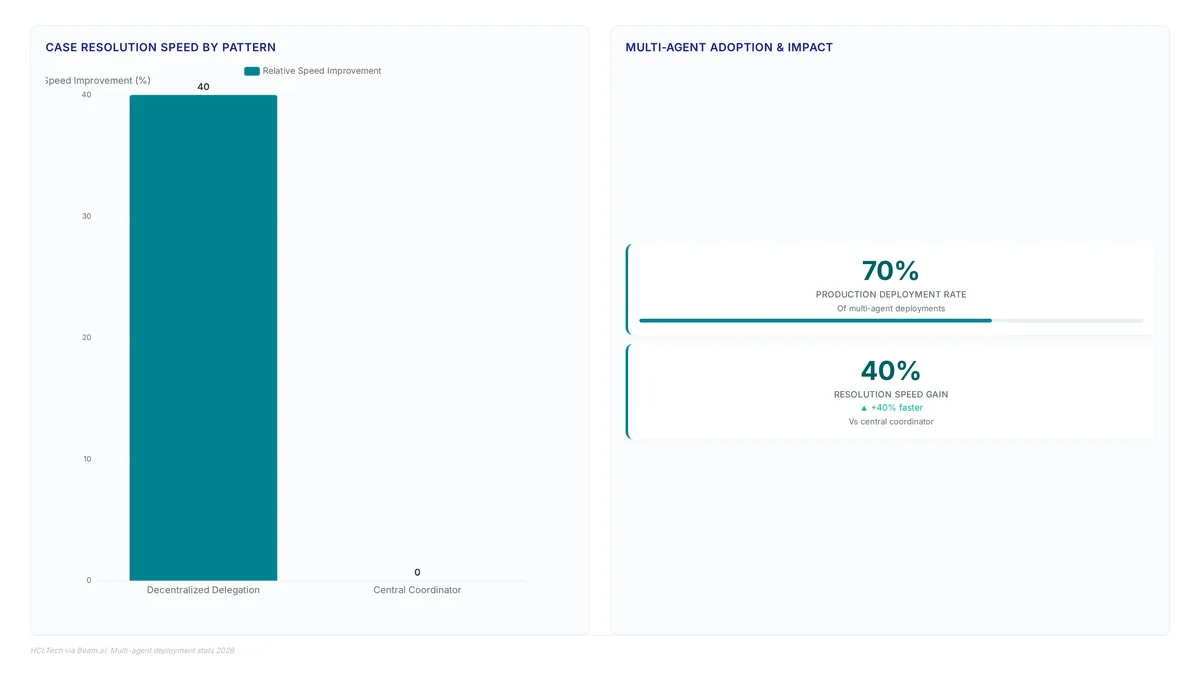
Production data shows central orchestrators manage a massive chunk of current multi-agent deployments by classifying intent and routing subtasks. This hub-and-spoke topology simplifies state management but creates a single point of latency for every inter-agent message. Conversely, decentralized delegation lets agents negotiate handoffs based on runtime context, removing the central bottleneck. HCLTech observed a 40% faster case resolution rate when shifting from rigid routing to this fluid peer-to-peer model. Remove the central coordinator, however, and you risk circular logic loops if termination conditions aren't strict in every agent.
| Feature | Central Orchestrator | Decentralized Delegation |
|---|---|---|
| Control Flow | Deterministic, top-down | Flexible, peer-to-peer |
| Latency Profile | High (serialization required) | Low (parallel execution) |
| Failure Mode | Single point of failure | Emergent loops |
| Best Fit | Structured workflows | Ambiguous queries |
The choice here is between maintainability and optimization. Centralized systems offer clear audit trails for debugging. Decentralized networks optimize for speed in ambiguous scenarios. Weigh the cost of coordination overhead against the need for rapid, context-aware resolution. Without strict governance, decentralized agents duplicate efforts or enter infinite negotiation cycles. Orchestrating via code rather than via LLM makes tasks more deterministic and predictable specifically in terms of speed, cost, and performance.
Inside the Mechanics of Sequential and Concurrent Workflows
Deterministic Prompt Chaining in Sequential Orchestration
Sequential orchestration locks AI agents into a fixed linear order where workflow logic strictly dictates the next executor. Often called prompt chaining, this pattern guarantees that output from one stage becomes the input for the next to ensure progressive refinement. Unlike flexible delegation models where agents select peers at runtime, the choice of agent remains deterministically predefined. The architecture mirrors the Pipes and Filters cloud design pattern but substitutes custom code with autonomous language model instances.
- A Template selection agent receives raw specifications to identify the correct base document structure.
- The output passes to a Clause customization agent that modifies terms based on negotiated business constraints.
- A Regulatory compliance agent validates the modified text against statutory requirements.
- Finally, a Risk assessment agent calculates exposure before finalizing the contract.
This predefined structure creates a pipeline of specialized transformations. Each agent processes the output from the previous agent, meaning the system lacks backtracking capabilities inherent in conversational or hierarchical models. Supervisor/worker patterns allow for flexible re-routing upon failure, yet sequential chains proceed linearly without automatic correction of upstream errors. Weigh the benefit of predictable latency against the risk of propagating errors through the entire pipeline. Reliability of the final output relies heavily on the precision of each transformation step. A single weak link compromises the whole sequence. Document processing pipelines earn this rigidity when regulatory adherence demands verifiable, step-by-step execution.
Reducing Runtime via Concurrent Fan-out/Fan-in Execution
Parallel agent execution compresses total latency by eliminating serial dependencies. This concurrent orchestration pattern mirrors the Fan-out/Fan-in cloud design, where an orchestrator dispatches identical or distinct subtasks to multiple workers simultaneously. Instead of waiting for Agent A to finish before starting Agent B, the system invokes all specialized agents against the shared context at once. This approach works best when workflow stages lack strict linear dependencies or when diverse insights are required to solve a single complex query. Total processing time approximates the duration of the slowest individual agent rather than the sum of all agents. Architectural analysis of multi-agent orchestration patterns confirms that concurrent execution fundamentally alters reliability profiles by isolating failure domains. If one parallel branch fails, the aggregator can still proceed with partial results or trigger a retry without stalling the entire pipeline. Token consumption and compute costs increase proportionally to the number of parallel threads. Weigh the cost of redundant context transmission against the value of reduced time-to-result. Parallelization provides thorough coverage for scenarios requiring diverse expertise, such as simultaneous legal, financial, and technical review of a document. Sequential handoffs cannot match this breadth without significant time penalties.
| Feature | Sequential Chaining | Concurrent Fan-out |
|---|---|---|
| Latency | Sum of all stages | Max of single stage |
| Context Load | Incremental accumulation | Full context per agent |
| Failure Mode | Pipeline stall | Partial result aggregation |
| Best Use | Dependent transformations | Independent analysis |
Validating Interaction Modes in Group Chat Orchestration
The chat manager enforces flow control by selecting active participants and switching between free-form brainstorming and rigid approval gates. This central coordinator prevents infinite loops by terminating conversations when output quality plateaus or token budgets exhaust. Configure explicit iteration limits within the agent definitions to halt recursive reasoning before compute costs escalate unchecked. Without these hard stops, agents may re-process identical context indefinitely, creating costly feedback loops that stall production workflows. The system supports various interaction modes, ranging from free-flowing brainstorming to the review workflows using fixed roles and approval gates.
| Mode | Coordinator Role | Termination Trigger |
|---|---|---|
| Brainstorming | Encourages divergence | Token limit reached |
| Quality Gate | Enforces schema | Approval granted |
| Debug Loop | Isolates error | Max iterations hit |
Flexible switching of interaction modes allows a single group chat instance to handle both creative exploration and final validation without rebuilding the topology. In frameworks like AG2 (formerly AutoGen), this coordination relies on a selector that determines the next speaker within a shared conversation. Flexibility outweighs raw throughput in this architectural trade-off, making the pattern suitable for complex tasks where distinct security boundaries or parallel specialization are required. Reserve this architecture for scenarios requiring iterative refinement rather than linear processing. Simple classification tasks do not need such overhead.
Measurable ROI from Flexible Delegation and Handoff Strategies
Handoff and Hierarchical Orchestration Mechanics
Handoff orchestration shifts full execution control between specialized agents based on immediate runtime context. An initial agent assesses task requirements then passes work to a peer better suited for the specific domain. Task routing engines interpret intent dynamically to select the optimal worker instead of following static rules. This flexibility carries a coordination tax. Excessive bouncing between agents creates infinite loops if capability limits remain undefined. Setting iteration limits prevents scenarios where no single agent resolves the query.
Hierarchical orchestration operates differently by building a task ledger that develops an approach plan with goals and subgoals which is eventually finalized and tracked. A central orchestrator or peer-based protocol manages work distribution, context sharing, and result aggregation. This structure differs from the linear handoff model where the path emerges during processing. Handoffs excel at triage while hierarchical systems provide structured oversight for complex, multi-step workflows requiring distinct security boundaries for each agent. Selection depends on whether the solution path requires iterative refinement and global tracking. The choice fundamentally alters how the system manages failure recovery and context preservation across long-running tasks.
Applying Complexity Levels to Agent Architecture
Select the Direct model call pattern when single-pass classification or translation suffices without tool access. This baseline approach eliminates coordination overhead entirely, serving as the most efficient entry point for simple queries. Moving up the spectrum, a Single agent with tools handles varied domain requests by looping through multiple model calls to refine results dynamically. Agent architectures exist on a spectrum of complexity where each level introduces coordination overhead, latency, and cost.
Implementing workflows that require distinct security boundaries or cross-functional problem solving often demands Multiagent orchestration. However, this added complexity introduces latency and new failure modes that simple pipelines avoid.
| Pattern | Best Use Case | Coordination Cost |
|---|---|---|
| Direct model call | Single-step translation | None |
| Single agent with tools | Flexible database lookup | Low |
| Multiagent orchestration | Cross-domain compliance | High |
Default to the lowest complexity level that reliably meets requirements before scaling out. Decentralized delegation patterns where agents delegate to each other based on runtime context have demonstrated quicker case resolution rates in specific enterprise scenarios. The cost of over-engineering is measurable in increased token consumption and debug difficulty. Verify that problem complexity exceeds the capacity of a single agent due to prompt complexity, tool overload, or security requirements before committing to a distributed architecture.
Checklist for Validating Flexible Delegation ROI
Select flexible delegation only when runtime context prevents pre-determining the optimal agent sequence. Static workflows suffice when routing logic relies on fixed rules rather than emergent task requirements. Verify that problem complexity exceeds the capacity of a single agent with tools before introducing coordination overhead.
| Criterion | Static Workflow | Flexible Delegation |
|---|---|---|
| Routing Logic | Deterministic, rule-based | Emergent, context-aware |
| Agent Knowledge | Global or partitioned upfront | Localized, discovered during execution |
| Control Flow | Central orchestrator dictates path | Agents transfer full control peer-to-peer |
| Best Fit | Known sequences | Unpredictable domain shifts |
Suboptimal routing decisions risk degrading user experience through latency or infinite handoff loops. The architectural cost includes added failure modes where agents might bounce tasks indefinitely without clear termination signals. Decentralized patterns have reported quicker case resolution rates in specific support scenarios, yet this gain vanishes if the initial triage lacks precision. Implement strict iteration limits to halt recursive reasoning before compute budgets exhaust. If a direct model call or deterministic dispatcher can resolve the intent, multiagent complexity offers no return. Validate that distinct protection boundaries or specialized tool sets necessitate separate agents rather than a monolithic prompt. Deploy this architecture only when domain expertise requirements surface dynamically during processing.
Implementing Resilient Agent Pipelines with Error Handling
Applying Progressive Refinement to Agent Workflows
Sequential pipelines address agent pipeline failures by enforcing linear dependencies where each stage refines the prior output. This structure prevents low-quality agent output from propagating unchecked, as later stages validate earlier transformations before proceeding. The mechanism relies on state persistence across steps, allowing earlier outputs to feed later decisions without requiring the user to re-supply context, though this introduces the risk of state corruption if intermediate data becomes malformed. Long, structured workflows for content production are cited as ideal use cases for the supervisor/worker pattern, where a research agent, drafting agent, and validation agent operate in a linear sequence with clear handoffs. This approach fails when early stages produce catastrophic errors that subsequent agents cannot correct, necessitating explicit quality gates between steps.
Define strict input schemas for each specialized agent to reject malformed upstream data immediately.
Reduced flexibility is the cost; you cannot backtrack or skip stages once execution begins. AI agent orchestration has matured past theory, distinguishing current capabilities from previous years where demos were largely single-agent loops. Reserve this pattern for tasks with verified linear dependencies rather than forcing complex reasoning into rigid chains. Extensive testing of failure modes is recommended before production deployment.
About
Marcus Chen, Lead Agent Engineer at AI Agents News, brings direct engineering rigor to the complex topic of AI agent orchestration. Having shipped production multi-agent systems, Chen understands that moving beyond single-agent prototypes requires mastering specific coordination patterns to manage tool use and memory effectively. His daily work involves evaluating frameworks like CrewAI, AutoGen, and LangGraph, giving him practical insight into the trade-offs between different architectural approaches. At AI Agents News, an independent hub for technical builders, Chen applies this hands-on experience to dissect orchestration mechanics without vendor hype. He connects theoretical patterns to real-world implementation challenges, helping engineers decide when multi-agent coordination is necessary versus when it introduces unnecessary overhead. This article reflects his commitment to grounding architectural decisions in concrete capabilities rather than marketing claims, ensuring readers can build reliable, scalable agent systems.
Conclusion
That 70% is the whole argument in one number: a central orchestrator that classifies intent and routes subtasks is what keeps multiagent orchestration auditable, and its serialization latency is what you pay for that. Decentralized delegation buys the 40% faster case resolution HCLTech observed and hands back emergent loops that only strict termination conditions contain. Treat coordination overhead as a tangible tax on system reliability rather than an abstract architectural choice. Adopt sequential orchestration only when task dependencies are strictly verified and linear; for any scenario requiring flexible reasoning or backtracking, this pattern introduces unnecessary fragility. Implement strict input schemas as mandatory quality gates immediately to reject invalid data before it triggers downstream failures.
Audit your current agent workflows against the provided complexity checklist this week. Specifically, downgrade any multiagent setup that does not demonstrably exceed the capabilities of a single agent with tools. This prevents compounding failure modes while preserving system observability. Anchor your architecture to the lowest viable complexity level so added coordination layers solve actual problems rather than creating new bottlenecks. Focus your engineering effort on validating these architectural boundaries before deploying additional agents into production environments.
Frequently Asked Questions
Avoid this complexity if prompt engineering or a single agent with tools solves your problem. Adding coordination overhead is unnecessary when Direct model call suffices for simple tasks.
Decentralized delegation yields a 40% faster case resolution rate by removing central bottlenecks. However, you must define strict termination conditions to prevent agents from entering infinite negotiation cycles.
Approximately 70% of production deployments use a central orchestrator to classify intent and route subtasks. This pattern simplifies state management but introduces a single point of latency for every message.
The main risk involves emergent loops where agents duplicate efforts or negotiate endlessly without a coordinator. You must implement rigorous governance to stop these circular logic loops from consuming resources.
Specialization allows individual agents to focus on narrow scopes, which significantly reduces prompt and code complexity. This approach improves maintainability by isolating faults to specific agents rather than monolithic logic.
References