Local coding agents: Build free private stacks
Running a local coding agent stack costs practically nothing beyond hardware, a stark contrast to the $7.60 per task charged by Fable 5 or the $200 monthly fee on premium proprietary plans. By shifting computation to your own machine, developers regain full control over their reasoning engines while eliminating recurring API expenses.
Open-weight models now serve as the core logic for private code generation, bypassing the privacy risks that plague 44% of organizations according to recent industry surveys. This guide dissects local inference engines, detailing how architectures like Qwen deploy via Ollama to read files, execute commands, and verify changes without leaking data to third parties.
We will assemble a production-ready local coding harness that remains free apart from electricity costs. While hybrid routing may become the default for large enterprises by late 2026, this approach offers an immediate, sovereign solution for individuals and teams tired of throttled performance and unpredictable pricing from substantial vendors.
The Role of Open-Weight Models in Private Code Generation
Defining the Local Coding Agent Harness Architecture
A local coding agent fuses a locally served LLM reasoning engine with a harness that reads files, runs commands, and verifies changes. This architecture swaps opaque cloud dependencies for an inspectable stack where the operator controls both model weights and the execution environment. Open-weight models driving these engines now deliver frontier-level performance. Options like Qwen score 73.7 on the Aider benchmark while running on consumer hardware. Such viability was absent just a year ago, forcing teams to re-evaluate default cloud reliance for sensitive tasks. Benchmark scores alone rarely predict success though.
Deploying Qwen3.6 with the Qwen-Coder Client
Qwen3.6 deployment requires the Qwen-Coder client to enable side-by-side operation with Codex on a single host. This configuration handles the local execution layer efficiently while cloud agents manage broader orchestration. Operators should switch from proprietary APIs to open-weight models when data privacy mandates that code never leaves the local network boundary. The Qwen3.6 35B-A3B variant uses DeepSeek Sparse Attention to notably reduce long-context compute overhead during complex file analysis.
Hardware constraints dictate model selection. The Qwen3-Coder-Next model fits within 32GB Mac memory or a single RTX 4090 GPU. Larger parameter counts necessitate multi-GPU setups that increase power draw and thermal management complexity in colocation racks. Running both Codex and local Qwen models simultaneously allows engineers to validate outputs against proprietary baselines without manual context switching. Initial configuration time exceeds simple API key insertion but yields long-term insulation from vendor price changes. Network teams gain full auditability of the inference engine, a capability absent in black-box cloud services. This setup ensures reproducibility across CI/CD pipelines by freezing the model version rather than relying on shifting cloud endpoints. Adoption depends on balancing the upfront integration effort against the strategic need for sovereign code generation capabilities.
Open-weight Qwen-Code offers transparent, purpose-built generation unlike the closed Claude Code system. Proprietary systems hide their training data and update cycles, while open models allow full inspection of weights and logic and free developers from vendor lock-in. Qwen models perform best when paired with their specific coding client, and cloud services like Codex require continuous connectivity where local stacks function entirely offline once deployed. Operators must weigh the convenience of managed services against the control offered by self-hosted inference engines.
| Feature | Qwen-Code (Open) | Claude Code (Proprietary) |
|---|---|---|
| Model Access | Full weights available | API access only |
| Optimization | Harness-specific tuning | Black-box updates |
| Cost Structure | Hardware + Electricity | Subscription + Token fees |
| Data Privacy | Local retention guaranteed | Dependent on vendor policy |
Cloud implementations often log inputs for safety filtering, creating potential exposure for sensitive intellectual property. Local deployments eliminate this risk by keeping all processing within the user's physical security perimeter. This approach supports data privacy mandates that forbid sending code to external servers. The open-weight ecosystem now rivals closed models in coding benchmarks. Adopting local agents requires managing hardware resources. Organizations avoiding API price volatility find predictable costs appealing compared to fluctuating token markets. The shift toward local execution represents a strategic move to secure the software supply chain against external disruption.
Inside Local Inference Engines and Model Architectures
Hybrid Attention and DeepSeek Sparse Attention Mechanics
Hybrid attention merges dense local processing with sparse global indexing to optimize token throughput for large contexts. Newer releases apply DeepSeek Sparse Attention (DSA) to reduce long-context compute costs by skipping redundant key-value pair calculations. This mechanism allows the Qwen3.6 35B-A3B variant to maintain high accuracy while consuming significantly less memory during file analysis. Operators observe that standard dense attention scales quadratically, whereas DSA maintains near-linear scaling past the 30 GB RAM threshold.
- The model identifies the code blocks using a coarse-grained sparse map.
- Dense computation focuses exclusively on these selected regions and the immediate query.
Quantifying tokens per second requires running the ollama_speed_memory_bench.py script against 50k word prompts to expose hardware bottlenecks. Generation speed reaches approximately 40 tok/sec on a recent Mac Mini but drops to 30 tok/sec on a DGX system. These throughput figures determine whether a local agent feels responsive or sluggish during iterative coding sessions. However, the Qwen 32B Instruct model shows that raw speed does not always correlate with solution quality. Operators must balance inference velocity against the reasoning depth required for complex refactoring tasks.
| Metric | Mac Mini (MLX) | DGX System |
|---|---|---|
| Throughput | ~40 tok/sec | ~30 tok/sec |
| Optimization | Metal Shaders | CUDA Cores |
| Thermal Profile | High Fan Noise | Stable |
| Best Use Case | Interactive Coding | Batch Processing |
RAM consumption fluctuates significantly during these tests, often consuming the majority of available system memory on consumer devices. Deployments using Ollama allow for running models with full data privacy, yet the memory footprint remains a hard constraint. The limitation is that smaller models like Gemma use far less memory but lack the contextual understanding of larger variants. Consequently, network engineers should prioritize machines with unified memory architectures if running 35B parameter models locally. AI Agents News recommends validating stability over extended durations rather than relying on short burst benchmarks.
MLX Optimization on Mac Versus DGX Spark Performance
The Qwen3.6 35B-A3B model executes quicker on Mac hardware than on the DGX Spark because the optimized MLX version uses Apple Silicon efficiently. Conversely, the Gemma 4 E2B architecture favors the raw compute throughput found in DGX systems, reversing the performance hierarchy observed with Qwen. This divergence forces operators to select inference engines based on specific model families rather than assuming a single host dominates all workloads. However, the open-weight system in 2026 provides genuine choices that did not exist a year prior, mitigating total lock-in to one hardware vendor. Production teams must therefore maintain heterogeneous test beds to validate speed claims before committing to large-scale deployments.
| Model Variant | Preferred Hardware | Primary Engine |
|---|---|---|
| Qwen 35B-A3B | Mac (Apple Silicon) | MLX |
| Gemma 4 E2B | DGX System | Standard CUDA |
Selection logic depends heavily on whether the workflow prioritizes the reasoning depth of larger parameters or the latency of smaller, specialized variants. A critical tension exists between the convenience of unified hardware and the reality that model-specific optimizations often dictate superior performance on disparate architectures. Operators ignoring this mismatch risk deploying slower agents that fail to meet interactive coding thresholds despite possessing powerful general-purpose GPUs. The cost of misalignment is measurable in developer wait times, which directly impacts the viability of local agents as daily drivers compared to cloud alternatives. Strategic deployment requires matching the inference engine to the model's native strengths rather than forcing a one-size-fits-all infrastructure policy.
Deploying a Local Coding Agent Stack with Ollama and Qwen
Ollama as the Local Inference Engine for Qwen3.6
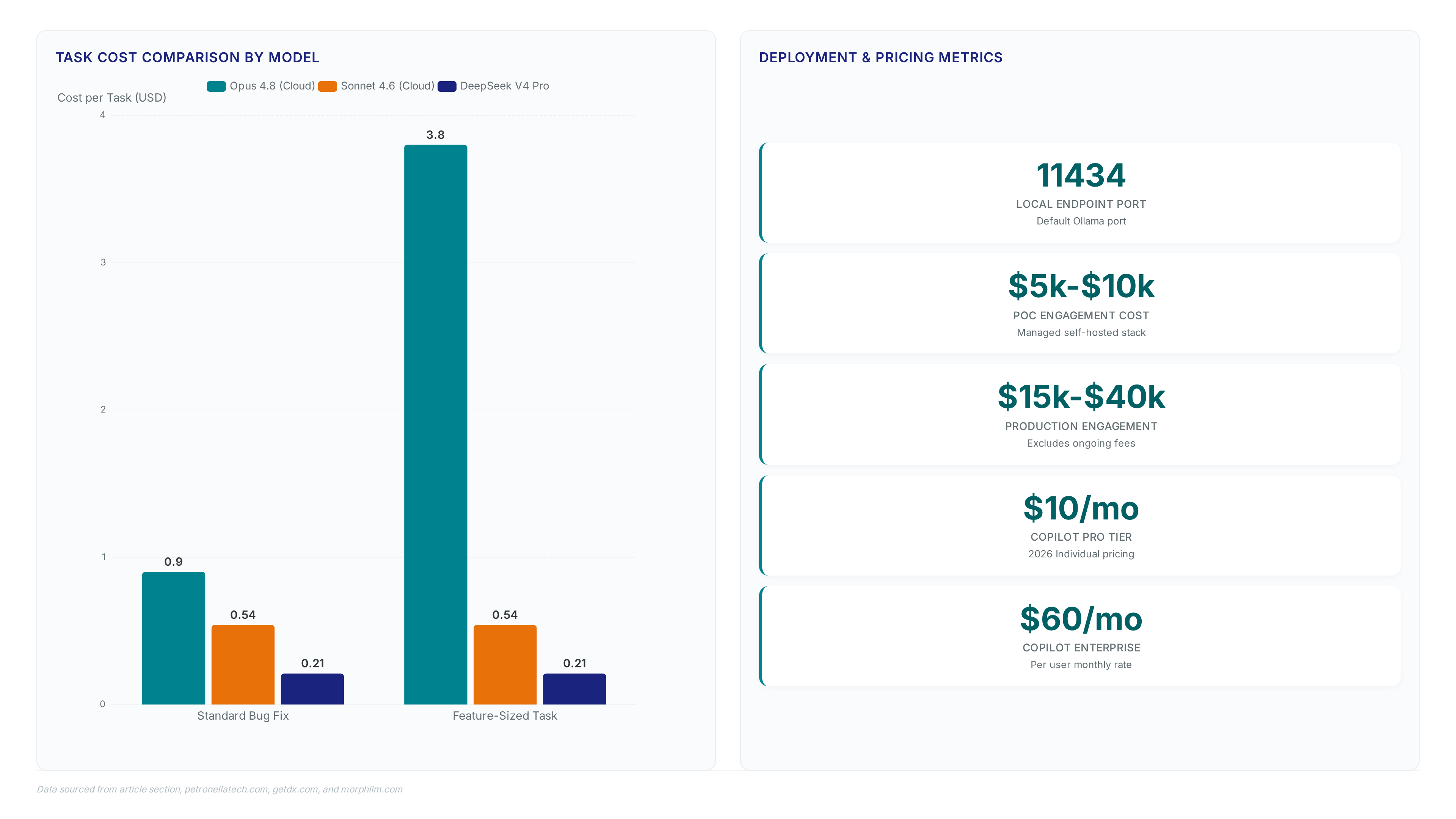
Ollama serves as the selected inference engine because its cross-platform installer simplifies deployment across macOS, Linux, and Windows environments. This framework manages open-weight models locally, offering a distinct advantage over complex alternatives like vLLM or SGLang for individual developers. Operators prefer this tool for automation workflows due to its straightforward CLI integration and minimal configuration overhead. The architecture separates the Qwen-Code client logic from the heavy lifting of model inference handled by the backend server. Users initiate the stack by pulling the specific model variant optimized for their hardware architecture: the pull command downloads the Qwen3.6 35B-A3B weights.
Connecting the Qwen-Code client to a local Ollama instance requires specifying the 127.0.0.1:11434/v1 endpoint within the custom provider settings.
- Launch the client and select "Custom Provider" from the list.
- Choose the "OpenAI-compatible" option to enable standard API handshake protocols.
- Enter
ollamaas the API key to satisfy local authentication checks. - Select the active model from the downloaded list to begin generation tasks.
This configuration transforms the theoretical stack into a functional environment where data privacy remains absolute because traffic never leaves the local host. The deployment flexibility ensures that proprietary codebases avoid external logging practices inherent in cloud alternatives.
Isolating the Qwen3.6 35B-A3B runtime on separate hardware like DGX Spark prevents unintended host system access during agent execution. Operators must verify four specific conditions before enabling the Qwen-Code client to ensure a secure local deployment.
- Confirm the inference engine serves the model within an isolated user account or virtual machine boundary.
- Validate that the deployment flexibility of the stack keeps all data traffic confined to the local host interface.
- Test the OpenAI-compatible endpoint at
127.0.0.1:11434/v1using theollamaAPI key. - Ensure the
ollama launchcommand initializes the local stack components without external network dependencies.
Skipping hardware isolation exposes the host filesystem to potential agent errors or hallucinated command executions. This checklist acts as the final gate before trusting the agent with production repository modifications. AI Agents News recommends this strict separation to maintain the integrity of the underlying operating system.
Optimizing Performance and Auditing Security in Local Agents
Defining Real-Task Evaluation Versus Standardized Benchmarks
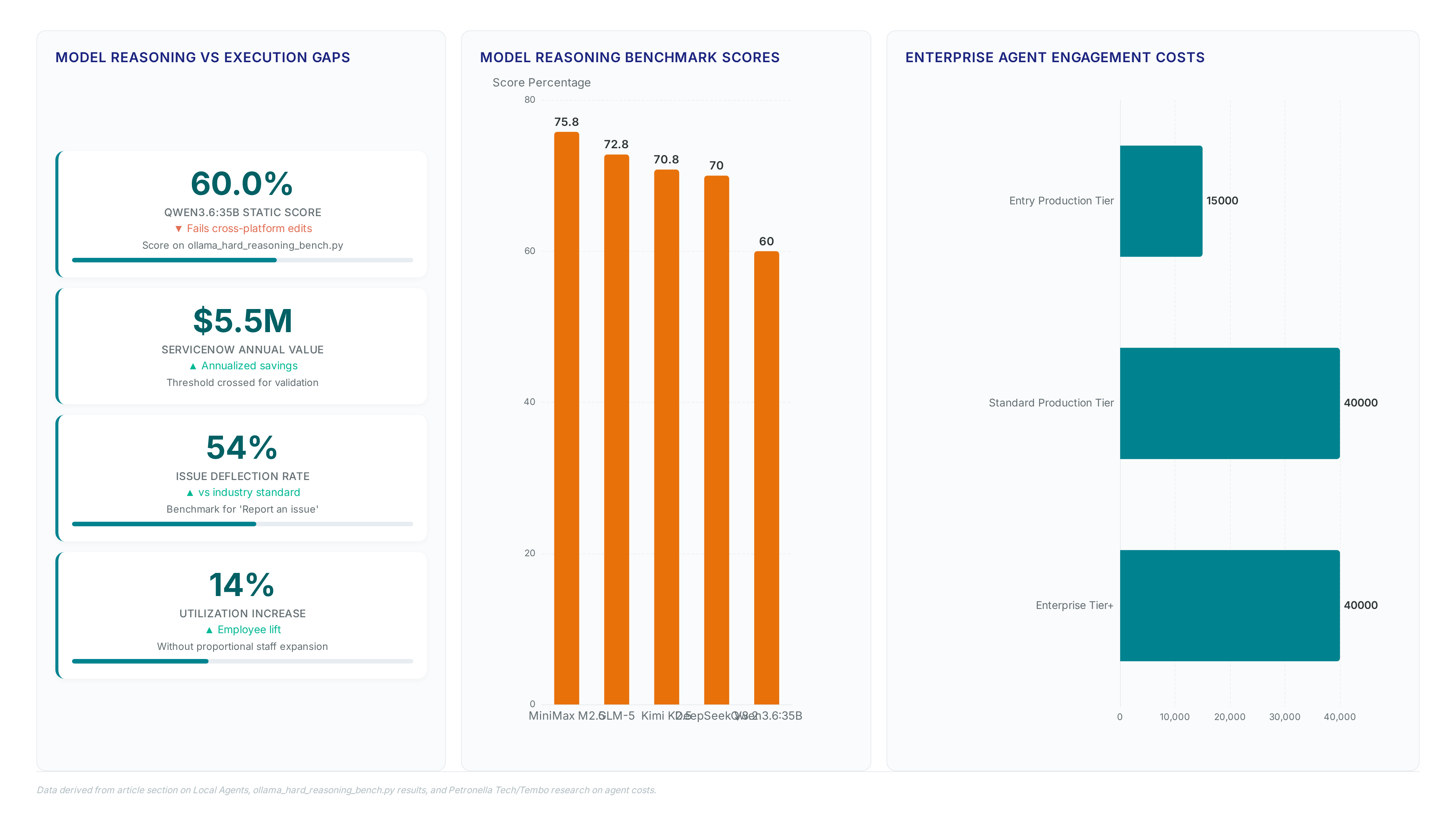
Static test suites miss critical agentic judgment gaps where qwen3.6:35b scores 60.0% on ollama_hard_reasoning_bench.py yet fails cross-platform path edits. Passing a standardized benchmark does not guarantee success in production loops where context windows shift and tool selection matters more than raw completion accuracy. The Evaluation Shift toward real-task validation reveals that models scoring high on static datasets often collapse when forced to navigate ambiguous file systems. Operators distinguish between reasoning capability and execution reliability before committing infrastructure resources. While qwen3.6:35b passes debugging reviews, it struggles with minimal edit choices required for complex refactoring tasks. Relying solely on published scores ignores the latency penalties incurred during failed tool calls. The cost of a false positive in an autonomous loop is a broken build, not an incorrect answer. Teams prioritize real-task evaluation on their own codebases over generic leaderboards. Only direct observation of agent behavior under load validates the suitability of a local LLM stack.
Auditing Agent Codebases for Data Egress and Prompt Injection
Auditing Qwen Code requires inspecting install scripts and shell command execution before enabling local agents to run commands with strict approval controls. The checklist verifies file read/write boundaries, secret handling, and network calls to prevent unauthorized data egress to external telemetry endpoints. Findings indicate that permissive modes like --yolo allow unrestricted shell access, whereas default configurations limit writes but still permit metadata transmission to Alibaba services unless explicitly disabled. Operators treat untrusted repositories as hostile inputs because repo instructions and tool outputs directly influence agent behavior through prompt injection vectors.
| Audit Category | Risk Vector | Mitigation Strategy |
|---|---|---|
| Install Scripts | Lifecycle hooks executing binaries | Manual review before installation |
| Network Calls | Telemetry leaking session IDs | Disable via usageStatisticsEnabled |
| File Boundaries | Unauthorized workspace reads | Enforce sandbox mode |
| Prompt Injection | Hostile repo instructions | Isolate execution environment |
Configuring ~/.qwen/settings.json to disable telemetry and auto-updates reduces the attack surface by preventing unexpected code downloads or data transmission. The transparency of local stacks allows engineers to inspect every layer of the agent harness for hidden data logging practices. Ignoring these checks leaves production environments exposed to subtle data leaks where session metadata escapes the local boundary unnoticed. AI Agents News recommends isolating agent execution within virtual machines to contain potential breaches from compromised modeling components.
Where a Local Stack Wins and Where It Does Not
The limitation of local agents lies in their inability to match the agentic judgment of proprietary clouds without extensive fine-tuning on domain-specific data. Operators should verify that a local switch does not simply shift workload to human reviewers who must correct agent errors post-generation, because that cost stays invisible in the hardware budget and real in developer hours. This tension defines the decision: prioritize local stacks where privacy mandates outweigh the latency of manual verification loops.
About
Diego Alvarez, Developer Advocate at AI Agents News, brings hands-on expertise to the complex environment of local coding agents. His daily work involves rigorously benchmarking autonomous frameworks like CrewAI and LangGraph, giving him unique insight into the trade-offs between proprietary APIs and fully local stacks. Unlike cloud-dependent solutions, local agents offer transparency and control, themes Diego explores regularly when evaluating tool use and function calling for engineering teams. At AI Agents News, an independent hub for technical founders and ML engineers, Diego focuses on practical build guides that highlight cost, reliability, and failure modes. This specific article reflects his commitment to providing runnable, example-driven content that empowers developers to deploy open-weight LLMs without vendor lock-in. By connecting his experience testing multi-agent systems with the tangible benefits of local execution, Diego delivers a factual roadmap for engineers seeking inspectable, production-ready coding autonomy.
Conclusion
Scaling local coding agents beyond pilot programs reveals a critical fracture point: operational friction increases non-linearly as judgment gaps widen. While hardware constraints have eased with models fitting on consumer GPUs, the real cost shifts to maintaining contextual accuracy without proprietary cloud intelligence. Benchmarks do not settle the question either: qwen3.6:35b passes debugging reviews yet still fails cross-platform path edits, so suitability is decided on your own repository rather than on a leaderboard. For most enterprises, a hybrid approach where sensitive data stays local while complex reasoning offloads to secure clouds offers a more sustainable path than rigid isolation.
Start by running the stack against your own codebase this week: pull the model variant your hardware can hold, point the client at 127.0.0.1:11434/v1, and audit the install scripts and telemetry settings before the agent touches a production repository. That single pass tells you whether local hardware solves your privacy problem or whether the gap you actually face is agentic judgment, which no amount of local memory will close.
Frequently Asked Questions
You need a Mac with 32GB memory or a single RTX 4090 GPU. The model fits within these specific hardware constraints while enabling full local code generation capabilities for developers.
Data privacy concerns drive 44% of organizations toward these self-hosted solutions. Keeping code generation within the local network boundary prevents data exfiltration risks inherent in proprietary black-box cloud services.
Running a local coding agent stack costs practically nothing beyond initial hardware investments. This contrasts sharply with the $7.60 per task charge often levied by proprietary cloud-based coding services.
Models like qwen3.6:35b score 60.0% on reasoning benchmarks yet still fail specific judgment tasks. Real-task evaluation on your own codebase remains the only reliable validation method before deployment.
Local setups eliminate recurring API expenses entirely while providing transparent, inspectable alternatives. Users avoid the $200 monthly subscription fees associated with premium proprietary plans while maintaining full control.