Cognitive ontology beats flat vector storage
With 17,889 GitHub stars, Cognee proves that 2026's agent bottleneck is no longer model intelligence but persistent memory architecture. While 79% of enterprises have deployed AI agents, most remain stranded in stateless loops because they rely on flat vector retrieval instead of cognitive ontology. Session isolation paired with automatic graph synchronization allows agents to retain critical data like "Q3 sales targets" across weeks without manual orchestration. The ECL pipeline (Extract, Cognify, Load) transforms raw logs into typed relationships, enabling agents to track complex entities like contract expiration dates with precision vector search cannot match.
The same graph gives cross-agent knowledge sharing: a research agent writes a financing event into the shared memory layer, and a sales agent reads it without new prompt engineering. Ontology-based reasoning also bounds what an answer may assert, because a contract renewal the graph does not hold is a claim the system cannot make.
The Role of Cognitive Ontology in Persistent AI Memory
Cognitive Ontology vs Vector Database Storage
Flat vectors lose context. A cognitive ontology structures data as connected entities, enabling reasoning over relationships rather than simple similarity matching. Traditional vector databases store unstructured embeddings that degrade during retrieval. Cognee employs an ECL pipeline to convert raw inputs into a structured knowledge graph. This architecture separates Session Memory for immediate context from Permanent Memory for historical traces, using Redis for low-latency caching before persisting enriched data to FalkorDB or LanceDB.
| Feature | Vector Database | Cognitive Ontology |
|---|---|---|
| Data Structure | Flat embeddings | Connected graph nodes |
| Retrieval Logic | Semantic similarity | Relationship traversal |
| Context Loss | High in long tails | Minimal via grounding |
| Hallucination Rate | Elevated | Reduced by grounding |
ArXiv paper 2505.24478 details how ontology grounding directly addresses LLM hallucination in long-tail knowledge retrieval by enforcing structural constraints on generated answers. Systems achieving 92% accuracy through brute-force indexing prioritize statistical probability. This approach prioritizes logical consistency. Maintaining a dual-layer system introduces operational complexity; operators must manage synchronization between fast caches and deep graph storage to prevent data divergence.
Agents shift from stateless query responders to persistent entities capable of cross-session continuity. Without this ontological backbone, multi-agent collaboration degrades into conflicting state assertions.
Cross-Session Persistence with Session ID Isolation
Session ID isolation separates transient dialogue from durable graph storage using unique identifiers. Cognee implements a dual-layer architecture where session_id parameters isolate short-term working context while automatically persisting critical facts like "Q3 sales targets" into long-term nodes. An agent can answer "What were our goals last quarter?" accurately weeks after the initial conversation, achieving true cross-session continuity. Developer demonstrations indicate that introducing this self-improving memory architecture increased Agent recall accuracy from 60% to 93%. The compute cost for the demonstrated accuracy improvement was only $2.
| Memory Layer | Function | Storage Backend |
|---|---|---|
| Session Memory | Fast, temporary context | Redis Cache |
| Permanent Memory | Historical graph data | FalkorDB / LanceDB |
Deploy ontology-based memory over standard vector search when query patterns require structured relationship tracing. Unlike flat embeddings, the graph structure preserves entity connections across time boundaries. This approach demands strict schema adherence during the cognify phase to prevent relationship drift. Ingestion latency increases compared to raw vector indexing. Enterprise adoption is accelerating in knowledge-intensive and regulated industries, with companies like Bayer using these technologies for scientific research workflows. Validate isolation boundaries before scaling to multi-tenant deployments.
Cognee Graph Retrieval vs LangChain Orchestration
Cognee distinguishes itself as a graph-native retrieval engine founded in 2023, prioritizing entity relationship tracking over the simple text splitting found in vector stores. LlamaIndex targets high retrieval precision. Cognee improves answer faithfulness by mapping documents into a connected network of ideas rather than isolated chunks. This structural approach contrasts sharply with LangChain, which functions primarily as an orchestration sandbox for chaining tools without inherent deep memory.
| Feature | Cognee | LangChain | LlamaIndex |
|---|---|---|---|
| Primary Focus | Graph Relationships | Orchestration | Vector Retrieval |
| Speed Index | Slow | Fastest (baseline) | Fast |
| Pricing Model | Token/Credit | Subscription + usage fees | Credit-based |
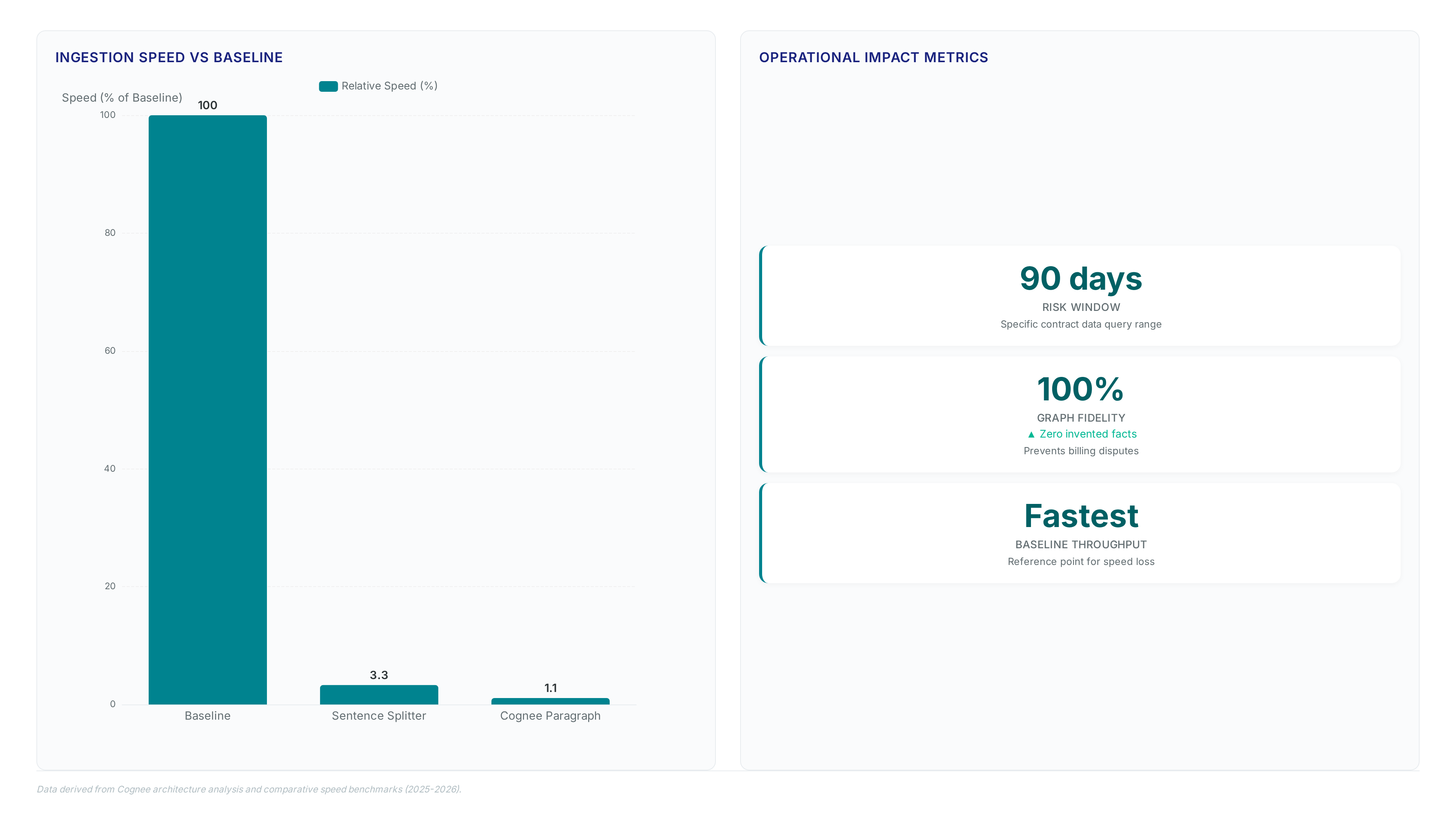
LangChain offers a modest monthly fee entry point but lacks native graph persistence, forcing operators to build custom connectors for state. In text splitting benchmarks, LangChain's RecursiveCharacterTextSplitter runs approximately 30x faster than LlamaIndex, yet raw speed sacrifices the semantic depth required for complex reasoning tasks. Cognee's chunking method is the slowest of the three because it prioritizes structural understanding over throughput; the section below puts a figure on that gap.
Operators choosing pure orchestration or simple vector indexing lose the ability to trace logical dependencies across long timelines. Deep reasoning scenarios demand the cognitive ontology that only graph relationships provide, making simple speed metrics misleading for production agents. This trade-off defines enterprise adoption in 2026.
Inside Cognee: Architecture for Cross-Agent Knowledge Sharing
Unified Ingestion of PDF, Audio, and Code via remember API
Disparate file types change into structured graph nodes through the remember API. Cognee processes Markdown, CSV, and transcription text uniformly, storing them via a single interface rather than separate silos. This approach targets structured knowledge extraction from diverse sources like Slack threads and documents to build queryable graphs. The system relies on LanceDB for persistent storage, FalkorDB for graph indexing, and Redis for high-speed caching.
| Data Type | Processing Method | Storage Target |
|---|---|---|
| PDF/Text | Semantic Chunking | FalkorDB Graph |
| Audio | Transcription Text | LanceDB Vector |
| Code | Syntax Parsing | Redis Cache |
Operators gain cross-agent knowledge sharing immediately, allowing a sales agent to query insights extracted from a research agent's uploaded reports. The architecture distinguishes itself with a graph-native retrieval engine that maps documents into a connected network of ideas. This structure supports complex boolean queries across modalities that pure vector indices miss. Default chunk_by_paragraph methods sacrifice throughput for semantic fidelity. Measurable latency occurs during initial bulk uploads compared to recursive splitters. Network teams must balance ingestion speed against the depth of contextual understanding required for downstream reasoning tasks. Test multi-modal pipelines with representative enterprise volumes before production deployment.
A research agent automatically captures a new financing event and updates the shared graph with a completion date of 2026-06-10. Sales and support agents immediately read these dynamics via API to quote accurate data during client interactions. Knowledge graphs replace isolated vector stores with a connected fabric where entity relationships enable cross-agent reasoning. Unlike flat embeddings, the graph structure allows a sales agent to traverse from a company node to its latest financing event without complex prompt engineering.
Implementation relies on a shared memory layer that reduces single-agent costs by 55% compared to pure platform solutions. Adoption is accelerating in regulated sectors, with enterprises like Bayer using these systems for complex scientific workflows. Forecasts suggest 40% enterprise integration by 2027 as organizations recognize the value of persistent state. Initial setup time for this shared architecture can increase by a factor of 2.3. Cost is high if ontology alignment fails; if the research agent tags data differently than the sales agent expects, retrieval fails despite the shared infrastructure. Cross-agent knowledge sharing demands upfront schema agreement rather than emerging organically from raw data ingestion.
Semantic Depth Trade-off: chunk_by_paragraph vs RecursiveCharacterTextSplitter
Cognee's default chunk_by_paragraph method runs roughly 90 times slower than LangChain's RecursiveCharacterTextSplitter, creating an immediate latency penalty for ingestion pipelines. This speed sacrifice enables deeper understanding of semantic context, making it particularly suitable for processing complex enterprise documents where boundary precision matters more than throughput. The mechanism prioritizes structural integrity over raw velocity, ensuring that graph nodes align with logical thought units rather than arbitrary character counts.
| Metric | Cognee chunk_by_paragraph |
LangChain RecursiveCharacterTextSplitter |
|---|---|---|
| Relative Speed | ~1.1% of the LangChain splitter | 100% (baseline) |
| Primary Goal | Semantic Context | Raw Throughput |
| Best Fit | Complex Reasoning | High-Volume Streaming |
| Overhead | High | Minimal |
Operators integrating multi-modal data face a distinct choice between rapid indexing and accurate relationship mapping. The slower chunking strategy improves answer faithfulness but demands higher compute resources during the initial load phase. Real-time applications requiring sub-second ingestion will stall without parallel processing adjustments. Static knowledge bases benefit from the resulting ontology grounding, which reduces hallucination rates in long-tail queries. This constraint defines the deployment architecture for systems needing cross-agent knowledge sharing versus those prioritizing immediate responsiveness.
Building Domain-Specific Reasoning with Ontology Grounding
Cognitive-Science-Grounded Ontology Generation Mechanics
Raw inputs change into structured graphs when the cognify process identifies relationships like (Acme Corp) ownership of (Contract A) with an expiry of 2026-09-15. This mechanism replaces simple vector similarity with cognitive-science-grounded ontology generation. An ECL pipeline extracts typed nodes from unstructured text, loading them into a persistent graph that supports flexible status tracking. Latency increases during ingestion compared to flat file parsing. Structural integrity is the cost; operators gain temporal reasoning capabilities but lose real-time throughput during the initial graph build phase.
| Capability | Vector Store | Cognee Ontology |
|---|---|---|
| Relationship Type | Semantic Similarity | Typed Graph Edges |
| Reasoning Scope | Single Query | Cross-Session |
| Hallucination Rate | High in Long-Tail | Suppressed via Grounding |
Invented facts about contract renewals or personnel hierarchies cannot exist within this architecture. Production networks require this fidelity because incorrect expiry dates trigger costly billing disputes or compliance failures. The resulting graph enables queries about future risks that flat embeddings cannot resolve without explicit prompt engineering.
Flexible Risk Forecasting via Entity State Tracking
Precise risk queries emerge from tracking active subscriptions and expiration dates, answering questions generic vector search cannot address. The system combines timelines and entity relations to respond to questions like "What risks does Acme Corp face in the next 90 days?" with specific contract data rather than vague summaries. Focus shifts from simple retrieval to structured reasoning about entity states and time-bound constraints. Ontology grounding allows the system to monitor multiple active subscriptions for a single client and trigger alerts when specific contracts approach expiry. Explicit links between companies, contracts, and dates remain maintained by the graph structure, unlike flat embeddings. This capability addresses the persistent memory problem where isolated agents lose critical context without a shared substrate.
| Capability | Vector Search | Ontology Grounding |
|---|---|---|
| Expiry Alerting | Manual scanning | Automated trigger |
| Relation Logic | Implicit | Explicit graph edges |
| Cross-Session | Lost | Persistent |
Defining domain schemas demands an upfront investment that may slow initial deployment compared to raw text ingestion. Measurable fidelity is the return; systems gain the ability to execute complex joins across time and entities that unstructured models miss entirely. This depth supports the industry shift toward multi-agent systems where shared, accurate state is mandatory for coordination. Deploy ontology-based memory when business logic depends on strict adherence to contractual dates and ownership chains; skip it when queries only need semantic similarity and never traverse entity relationships.
Integrating Cognee with Claude Code and Lifecycle Hooks
Defining Cognee's Five Lifecycle Hooks for Claude Code
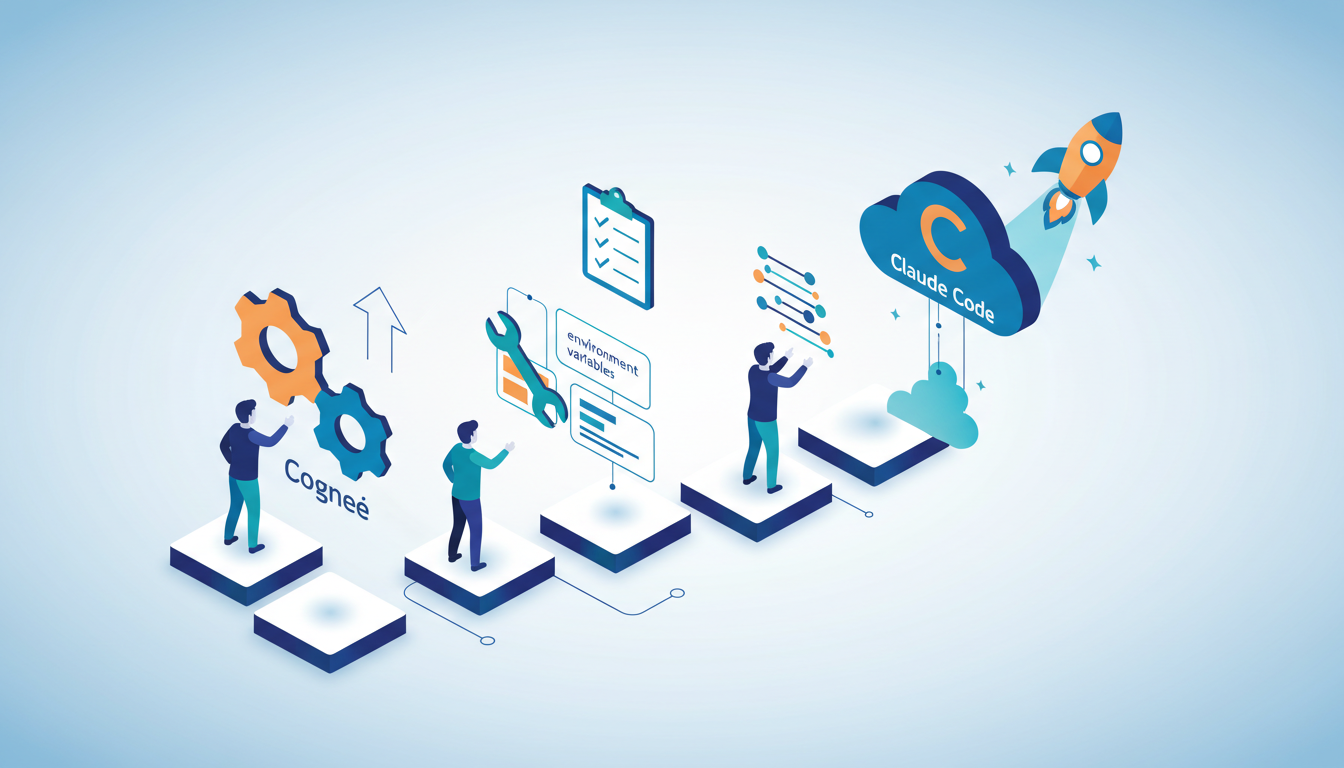
Activating the LLM_API_KEY variable unlocks five distinct lifecycle events that turn Claude Code into a persistent memory engine. SessionStart loads project context immediately. PostToolUse records tool execution outputs, such as bash results, directly into the graph. UserPromptSubmit tags incoming queries with new instructions before processing begins. PreCompact archives old memory right before context overflow occurs. SessionEnd persists critical decisions for future retrieval. These hooks replace stateless chat patterns with continuous reasoning by managing data flow between short-term cache and long-term storage.
This architecture allows Bayer scientists to maintain complex experimental contexts across weeks of coding sessions without manual context reloading. Storage coordination increases because every tool call becomes a permanent node. Unlike simple vector caches, this method ensures that agent reasoning evolves rather than resets, providing the structural depth required for enterprise-grade autonomy.
Installing Cognee and Configuring LLM_API_KEY Environment Variables
Running pip install cognee starts the rapid deployment sequence needed to integrate the topoteretes/cognee-integrations library into the local environment. This single command installs the core framework necessary for persistent agent memory. Setting the LLM_API_KEY environment variable constitutes the mandatory second step to activate memory functionality within Claude Code. Without this specific configuration, the system cannot authenticate against the backend LLM provider to process cognitive ontologies. The Python API uses an async-first architecture, requiring developers to manage concurrency controls like asyncio.Semaphore during high-volume ingestion tasks.
- Install the package via the terminal using the standard pip command.
- Export the
LLM_API_KEYvariable in the shell or IDE settings panel. - Clone the integration repository to access lifecycle hook definitions.
- Import the library and initialize the memory client in the startup script.
The founding team designed this workflow to minimize boilerplate while enforcing strict separation between session and permanent memory layers. Immediate setup speed often conflicts with the complexity of configuring persistent graph backends like FalkorDB for production scale. Default local storage suffices for prototyping but fails under concurrent multi-agent load without external database tuning. This initial configuration enables the five lifecycle hooks that change stateless prompts into continuous reasoning sessions.
Implementation Checklist for SessionStart to SessionEnd Event Handlers
Validate five specific event listeners to prevent context loss during coding sessions.
- Configure SessionStart to retrieve historical dialogue, ensuring the agent loads prior project constraints immediately.
- Deploy PostToolUse hooks that capture bash outputs and file modifications into short-term storage.
- Trigger UserPromptSubmit to archive new instructions before the model processes the request.
- Enable PreCompact to compress memory segments automatically, using concurrency control mechanisms like semaphores during high-volume ingestion.
- Execute SessionEnd routines to persist decision nodes into the permanent graph layer.
| Hook | Primary Function | Data Destination |
|---|---|---|
| SessionStart | Load history | Short-term cache |
| PostToolUse | Record outputs | Session memory |
| UserPromptSubmit | Store instructions | Short-term cache |
| PreCompact | Compress context | Archive layer |
| SessionEnd | Persist decisions | Permanent graph |
Skipping PreCompact leads to immediate context window overflow during large repository scans. The system relies on temporal awareness to order these compressed blocks logically. The agent reverts to stateless behavior without strict adherence to this sequence, losing the cross-session continuity that defines the architecture. Verify each hook fires in the correct order before production deployment.
About
Marcus Chen, Lead Agent Engineer at AI Agents News, brings deep practical expertise to the complex domain of cognitive ontology. Having shipped production multi-agent systems, Chen understands that without a structured understanding of knowledge relationships, agents remain stateless and contextually blind. His daily work evaluating frameworks like LangGraph and LlamaIndex reveals that true agent autonomy relies on graph-native architectures rather than simple vector storage. This article dissects how Cognee implements cognitive ontology to solve the persistent memory crisis, transforming unstructured data into interconnected knowledge networks. Chen's analysis connects theoretical ontology concepts directly to engineering realities, such as cross-session continuity and precise context recall. By using his experience with agentic orchestration, he explains why mapping data as a cognitive graph is necessary for building agents that retain long-term memory. This technical perspective ensures builders grasp not just the "how", but the critical "why" behind adopting cognitive ontology for next-generation AI infrastructure.
Conclusion
Scaling cognitive ontologies breaks when context compression fails to keep pace with ingestion, causing agents to revert to stateless guessing despite complex backend configurations. The hidden operational cost is not token usage; it is the latency penalty introduced when unoptimized memory layers force repeated retrieval cycles during high-concurrency workflows. As enterprises shift from pilots to production by 2027, relying on default local storage or untested event sequences will create unacceptable bottlenecks in scientific and engineering pipelines. You must migrate to a dedicated memory backend before your agent fleet exceeds fifty concurrent sessions, or face compounding accuracy degradation that brute-force indexing cannot fix.
Start by auditing your PreCompact hook latency this week using a simulated load of 500 rapid-fire tool calls. If compression takes longer than 200 milliseconds per block, your system will choke during real-world repository scans, rendering cross-session continuity useless regardless of your graph topology. Prioritize tuning this specific compression threshold over adding new agent capabilities, as memory density directly dictates reasoning depth. Only after stabilizing this compression layer should you expand into multi-agent orchestration, ensuring your infrastructure supports continuous reasoning rather than fragmented prompt-response loops.
Frequently Asked Questions
Cognee increased agent recall accuracy from 60% to 93% using session isolation. The compute cost for this demonstrated accuracy improvement was only $2, proving high efficiency.
Flat vector retrieval stores embeddings without typed relationships, so a fact carries no link to the entity it belongs to. Memory then survives only inside one session: 79% of enterprises have deployed agents, yet most restart from an empty context each time.
Unlike systems achieving 92% accuracy through brute-force indexing, ontology grounding enforces structural constraints on answers. This prioritizes logical consistency over statistical probability to significantly reduce hallucination rates.
A vector database keeps flat embeddings and ranks them by similarity, while a cognitive ontology keeps typed nodes and edges. That structure lets an agent walk from a company to its contract and expiry date, answering which contracts lapse in the next 90 days where similarity ranking cannot.
A session ID scopes short-term working context, while facts marked durable are written into long-term graph nodes. Weeks later the agent still answers questions about last quarter, because the Q3 sales target lives in the graph rather than in the chat buffer.