Agent evaluation needs dual-layer visibility
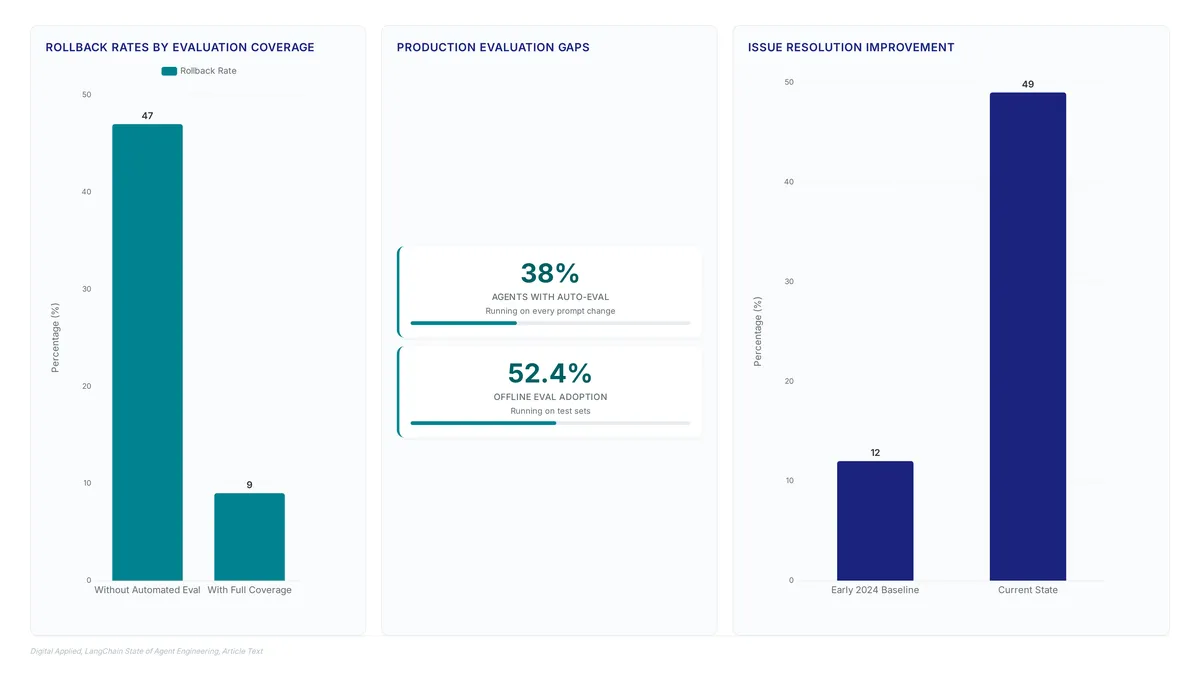
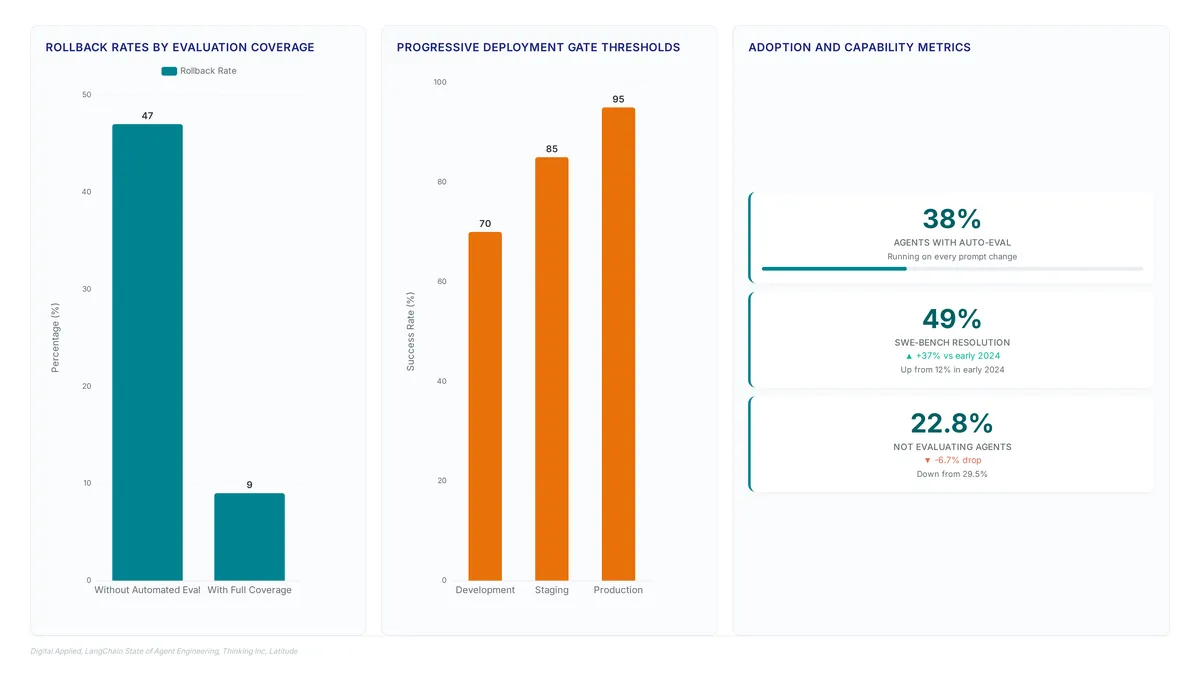
Agents without automated evaluations face a 47% rollback rate, while those with full coverage drop to just 9%. Building a reliable evaluation framework is the only way to prevent the 40% of agentic AI projects destined for cancellation by 2027. Traditional monitoring fails because agents often technically complete tasks while returning corrupted data, creating a false sense of security.
Effective assessment requires distinguishing between trajectory metrics that track reasoning paths and outcome metrics that verify final results. Enterprise agents often see success rates plummet from 60% on single runs to 25% over eight attempts. Relying on simple pass/fail checks is insufficient for production environments. Non-deterministic behavior and cascading errors in multi-turn interactions demand a more granular approach than standard software testing provides.
The working answer is two layers of measurement rather than one: three-tier rubrics scored by calibrated LLM judges to grade the reasoning path, and outcome checks wired into CI/CD so failures surface before users meet them. Calibration comes first, because an uncalibrated judge adds confidence rather than evidence. The sections below cover how that pairing is built and where it strains.
Trajectory and Outcome Metrics: Two Layers of Visibility
Distinguishing Trajectory Metrics from Outcome Metrics in Agent Evaluation
Trajectory metrics map the full execution path by logging every reasoning step, tool call, and decision point. Outcome metrics simply record whether the final task succeeded, such as resolving a dispute or meeting latency requirements. Outcome data confirms operation, yet trajectory analysis exposes the specific cause of failure. Industry standards define production-ready metrics including trajectory_exact_match, trajectory_precision, and trajectory_recall to quantify these sequences. Both dimensions matter because agents achieve varying success rates across multiple runs due to non-deterministic cascading errors.
Blind spots emerge when teams rely only on outcome scores while corrupted data passes inspection. Ignoring trajectory data prevents detection of gradual performance degradation before widespread outages occur. Production systems need dual-layer visibility to separate lucky successes from strong reasoning. Granular path analysis allows operators to isolate whether a failure stems from incorrect tool selection or flawed logical synthesis. Effective evaluation frameworks capture the full scope of agent behavior by implementing both metric classes.
Applying Pre-deployment Validation and Continuous Production Monitoring
Pre-deployment validation determines release readiness by executing test suites against edge cases and adversarial inputs. This process isolates logic errors before they reach production environments. Automated evaluation on every prompt change is the most predictive indicator of an agent's survival in production for 12 months, which is why these checks belong inside the CI/CD pipeline rather than in a pre-release ritual.
Continuous monitoring addresses the distinct challenge of gradual degradation in live systems. Operators implement evaluation flywheels where production traces are enriched with automated scores and flagged for review. This approach converts raw telemetry into actionable intelligence for model updates.
Evaluation depth conflicts with monitoring breadth. Expensive, high-fidelity assessments suit pre-deployment gates, while production requires lightweight, high-frequency checks. Ignoring this two-phase strategy risks either releasing unstable agents or overwhelming observability stacks with costly metrics.
The Risk of Non-deterministic Behaviors Without Automated Evaluation Coverage
Agents lacking automated evaluation coverage face notably higher rollback rates over twelve months compared to fully evaluated systems. This disparity highlights the severe operational risk of deploying non-deterministic behaviors without rigorous validation gates. Identical inputs trigger divergent execution paths, causing outcome-only monitoring to miss the root cause until service degradation occurs. The absence of trajectory analysis means teams cannot distinguish between a lucky success and a strong solution. Organizations without these safeguards waste significant resources reverting unstable releases.
Only 38% of production agents run automated checks on every prompt modification, which leaves the rest exposed to undetected regression. The cost of such failure extends beyond immediate rollbacks; it erodes trust in the agent framework itself. Operators cannot certify that an agent's reasoning remains consistent under load or adversarial conditions without measuring the execution path. Integrating trajectory metrics into deployment pipelines helps mitigate these reliability gaps. Final output quality alone is insufficient for enterprise-grade stability. Teams validate the logical steps leading to a result, not the result itself. This approach prevents the accumulation of technical debt caused by brittle, unverified agent logic.
Architecting Three-Tier Rubrics and Calibrated LLM Judges
Deconstructing Three-Tier Rubrics into 130 Fine-Grained Items
Academic benchmarks validate a three-tier taxonomy built on 7 primary dimensions, 25 sub-dimensions, and 130 fine-grained rubric items as operationalized criteria. This hierarchy turns abstract goals like comprehensiveness into executable specifications through evidence-anchored scoring. Implementation frameworks compile these criteria to enable granular assessment of agent capabilities.
| Tier Level | Scope | Function |
|---|---|---|
| Primary Dimensions | 7 Categories | Define high-level quality attributes |
| Sub-dimensions | 25 Groups | Isolate specific capability domains |
| Operational Items | 130 Criteria | Provide measurable pass/fail checks |
Designing effective rubrics requires breaking broad objectives into measurable units, and the same granularity applies to trajectory metrics, which separates path analysis from final output validation. The drawback is the manual effort of defining every item at that depth without automated generation tools, so assessment depth trades directly against the cost of rubric maintenance.
Operationalizing these items converts subjective judgment into deterministic checks. Deep hierarchies offer improved debugging signals but increase compute overhead. Production systems deploy expensive evaluation methods strategically alongside lightweight checks for broader coverage. This targeted selection prevents evaluation bottlenecks while maintaining high fidelity in reliability testing.
Decomposing Code Quality into Correctness and Maintainability Metrics
Operationalizing Code Quality requires splitting abstract goals into binary checks for edge case handling and complexity limits. For a coding agent, this dimension decomposes into Correctness, Efficiency, and Maintainability, creating specific pass/fail criteria like meeting O(n log n) constraints. Statistical validation converts these evaluation dimensions into measurable yes/no questions verified by examining textual evidence. Without this granularity, LLM-as-judge systems often miss subtle logic errors that pass broad accuracy checks but fail under stress.
Relying solely on automated scoring introduces risk when agreement with domain experts varies. Production plans should include specialized domain evaluation requiring human validation alongside automated judges.
| Metric Category | Measurement Target | Validation Method |
|---|---|---|
| Correctness | Documented edge cases | Unit test execution |
| Efficiency | O(n log n) limits | Static analysis tools |
| Maintainability | Cyclomatic complexity | Line depth inspection |
Deep trajectory analysis slows feedback loops, so rigorous multi-turn coherence checks compete directly with iteration speed. Effective rubric design isolates node-level precision from session-level outcomes to pinpoint exact failure sources. Modern evaluation platforms can run multiple metrics simultaneously at reduced cost, enabling production-scale monitoring.
Mitigating Position Bias and 50% Error Rates in LLM Judges
LLM-as-judge systems exhibit error rates exceeding 50% on complex tasks due to inherent position and length biases. Such systematic skew renders automated grading unreliable for production agents without rigorous statistical correction. Consequently, 74% of organizations rely primarily on human-in-the-loop evaluation alongside automated approaches to validate outputs. Deterministic settings like temperature=0 fail to guarantee consistency, necessitating internal reliability checks across five independent runs using Cronbach's alpha and McDonald's omega tests.
Calibration requires converting abstract dimensions into specific yes/no questions verified by textual evidence. Entropy-based frameworks reweight evaluator scores using small human preference datasets to align automated judges with expert consensus.
| Failure Mode | Root Cause | Mitigation Strategy |
|---|---|---|
| Position Bias | Token probability skew | Randomize presentation order |
| Agreeableness | Sycophantic tendency | Implement minority-veto ensembles |
| High Variance | Non-deterministic sampling | Measure internal consistency |
Teams risk deploying agents with hidden failure modes that pass superficial checks without this statistical grounding. A strong evaluation pipeline lowers the critical error rate relative to an unvalidated baseline. However, achieving that precision demands sacrificing some throughput for validation depth. The constraint lies between rapid iteration cycles and the latency introduced by multi-run consistency testing. Rigorous validation therefore costs compute, and that is the price of catching silent degradation before it spreads. Ignoring these consistency metrics allows undetected drift to corrupt downstream workflows, turning automated grading into a source of false confidence rather than a safety guardrail.
Selecting Domain-Specific Benchmarks Over Generic Standards
Generic vs Domain-Specific Benchmark Survival Criteria
Generic benchmarks test baseline capabilities, while domain-specific benchmarks test survival in production environments. GAIA assesses real-world questions requiring multi-step reasoning and tool use for general-purpose assistants. However, these standard suites often miss the integration failures that cause unreachable services in deployed systems. WebArena addresses this gap by evaluating navigation and e-commerce transactions across realistic web scenarios. SWE-bench Verified further narrows the scope to human-validated bug-fixing tasks from actual GitHub issues.
Generic metrics measure capability; they say little about whether an agent survives contact with a live integration. The distinction that matters is between broad capability testing and targeted survival criteria tied to specific operational risks. Optimal evaluation portfolios combine 2-4 complementary benchmarks to ensure thorough coverage without excessive overhead.
| Dimension | Generic Benchmarks | Domain-Specific Suites |
|---|---|---|
| Primary Focus | Baseline reasoning | Production survival |
| Risk Coverage | General failure modes | Integration failures |
| Validation Depth | Single-run success | Multi-run consistency |
Custom benchmarks become necessary when standard options fail to cover unique domain constraints. Organizations are increasingly adopting structured approaches for production evaluation to move beyond static scores. The benchmarks worth running are the ones that expose specific failure modes, not the ones that lift an aggregate score, and the cost of ignoring domain specificity shows up as undetected behavior deviations.
Deploying WebArena and SWE-bench Verified for Production Agents
Agent performance on SWE-bench Verified has climbed steadily since the suite's release. Benchmark selection follows the operational risk profile of the deployment, not a generic capability score.
| Dimension | Web Automation | Code Generation | General Reasoning |
|---|---|---|---|
| Primary Benchmark | WebArena | SWE-bench Verified | GAIA |
| Key Metric | Transaction Success | Issue Resolution | Multi-step Accuracy |
| Failure Mode | Navigation Loops | Regression Bugs | Hallucinated Steps |
| Validation Source | Simulated Browser | GitHub Issues | Real-world Queries |
Integrating specialized suites into continuous integration pipelines helps ensure trajectory metrics reflect actual user interactions rather than synthetic idealizations.
What Standard Suites Miss in Enterprise Workflows
Standard benchmarks often miss domain-specific risks that trigger costly production outages. Generic suites validate baseline reasoning, yet they frequently overlook integration failures unique to enterprise workflows. For instance, billing API misinterpretation failures were caught in CI only after teams added custom evaluators targeting financial logic. Broad metrics leave exactly those edge cases untested.
Organizations adopting structured frameworks observe that static tests fail to capture flexible service dependencies. Production traces reveal that behavior deviations often stem from upstream API changes rather than model degradation. Custom checks aimed at those dependencies are what keep such regressions from reaching users unnoticed.
Integrating Automated Evaluation into CI/CD Pipelines for Production Safety
Trigger Mechanisms: Commit, Schedule, and Event-Driven Evals
Effective integration requires three distinct trigger mechanisms: commit-based triggers that activate on code changes, prompt modifications, or configuration adjustments. Schedule-based triggers run periodic evaluations daily or weekly to detect model drift from upstream changes. Event-driven triggers respond to deployment events, telemetry anomalies, or user feedback spikes.
- Commit-based validation executes immediately when developers push updates, ensuring no regression reaches the main branch.
- Scheduled regression runs nightly to capture performance decay invisible during active development cycles.
- Event-driven checks activate upon specific production signals, catching failures that static tests miss.
This layered approach prevents costly downstream errors. The same failures, previously visible only after customer complaints, were caught in CI before deployment through rigorous evaluation, preventing downstream financial loss. Relying solely on commit hooks leaves systems vulnerable to data drift occurring between code releases. Immediate feedback loops and periodic audits cover different failure windows, and production safety needs both.
Enforcing Progressive Deployment Gates with Performance Criteria
Progressive deployment gates define minimum performance criteria: development environments might require 70% task success, staging demands 85%, and production requires 95% with specific safety guarantees. This tiered structure prevents undetected failures from reaching end users by enforcing strict quality thresholds at each pipeline stage.
A significant operational risk lies in the downstream costs of failures that only rigorous evaluation catches before release. Strict gatekeeping carries a cost of its own, since some valuable agent behaviors emerge only in edge cases that standard tests never cover. The industry is shifting toward evaluation flywheels where production traces enrich future test sets, gradually tightening these gates without manual intervention.
Validating Guardrails and Cost Efficiency with Galileo AI
Real-time guardrails intercept risky actions before execution. This prevents the downstream financial loss of failures that automated checks would otherwise catch only in CI.
- Deploy the Agent Protect API to block unauthorized tool calls that corrupt data.
- Use Luna-2 Small Language Models for evaluation, delivering 0.87 accuracy at $0.01 per million tokens.
- Measure cost efficiency as reduced labor hours rather than mere token savings.
The limitation of Luna-2 models is their narrow focus on cost versus reasoning depth, requiring human validation for complex logic. AI Agents News recommends pairing low-cost judges with high-stakes human review to mitigate this gap. This approach balances the 98% cost reduction against the risk of undetected reasoning errors in critical paths.
About
Marcus Chen serves as Lead Agent Engineer at AI Agents News, where he focuses on the practical challenges of deploying reliable multi-agent systems. His daily work involves stress-testing orchestration frameworks like CrewAI, AutoGen, and LangGraph, giving him direct insight into why non-deterministic behavior and cascading errors plague production environments. Having shipped complex agent architectures, Chen understands that traditional monitoring often misses subtle data corruption, a gap this article's evaluation framework directly addresses. At AI Agents News, an independent hub dedicated to covering autonomous agents and the tools that build them, Chen uses his hands-on experience with evaluation harnesses to guide engineers through rigorous testing methodologies. This piece reflects his commitment to helping technical leaders move beyond superficial success metrics. By connecting real-world deployment failures to structured assessment strategies, Chen provides the technical depth necessary for builders to validate agent reliability before scaling.
Conclusion
Production stability collapses when teams rely on static benchmarks instead of continuous validation against data drift. The operational reality is that error rates exceeding 50% on complex tasks make human oversight the default bottleneck for nearly three-quarters of organizations. Progressive deployment gates enforce quality thresholds, yet a gate that reads outcomes alone still passes an agent that reached the right answer through the wrong reasoning. That is the whole case for dual-layer visibility, and with automated evaluation on every prompt change running in 38% of agents, most deployments do not have it.
The shape of that second layer is already spelled out above: trajectory logs kept next to outcome results, rubric items granular enough to fail for a stated reason, judges checked for internal consistency before their scores are trusted, and the whole set fired by commits, schedules, and production events instead of by release day. Cheap judges such as the Luna-2 models make that volume affordable, while human review on the high-stakes paths is what stops the cost advantage from turning into unnoticed reasoning errors. Verified metrics, not aggregate scores, are what a deployment decision can rest on.
Frequently Asked Questions
Skipping automated checks leads to a 47% rollback rate compared to just 9% with full coverage. This massive disparity means teams waste resources reverting unstable releases instead of building reliable production systems that survive long term.
Relying only on outcome data hides the root cause when agents succeed by luck rather than strong reasoning. Trajectory analysis exposes these blind spots, preventing corrupted data from passing inspection while appearing successful on surface metrics.
Agents often show 60% success on single runs but drop to 25% over eight attempts due to non-deterministic cascading errors. This volatility requires granular evaluation beyond pass/fail checks to ensure consistent production reliability.
Only 38% of production agents run automated checks on every prompt change, leaving the rest exposed. This gap is critical because such checks are the most predictive indicator of an agent surviving twelve months in production.
Pre-deployment gates require expensive high-fidelity assessments, while production needs lightweight high-frequency checks to avoid overwhelming stacks. Balancing these temporal dimensions prevents releasing unstable agents while maintaining efficient system observability and performance.
References