recallsqlite: Stop memory bloat with 80ms latency
With 1,469 stored memories, recall-sqlite maintains a fixed 80ms latency while competitors degrade. Unbounded memory accumulation actively degrades agent performance, making intelligent forgetting the only viable architecture for 2026's agentic workflows. While legacy systems like Mem0 and Honcho suffer from token bloat that drags accuracy down to 0.05, this new approach proves that strategic data deletion is superior to infinite retention.
The mechanism is ordinary and local. Keyword fallback and vector search live inside one SQLite file, so there is no separate vector database to run, and graceful degradation switches to keyword-only matching when the embedding model cannot load, which keeps Hermes Agents answering instead of failing.
What holds the footprint flat is automatic promotion and demotion by access frequency: facts nobody reads sink out of the retrieval path instead of accumulating. The era of paying for stale context ends when agents learn to forget irrelevant data automatically.
Hot, Warm and Cold: How Tiered Storage Stops Memory Accumulation
What Each Tier Holds
recall-sqlite enforces automatic forgetting to stop the latency spikes that break real-time applications. Existing agents like Mem0 and Honcho accumulate facts indefinitely, letting old data pollute retrieval and degrade performance over time. This indefinite growth creates a direct conflict between memory completeness and query speed because larger token counts yield worse results. Benchmarks indicate that without intelligent forgetting policies like Priority Decay, systems suffer measurable accuracy drops.
The solution implements a strict three-tier architecture where memories are automatically promoted or demoted based on access frequency. A fresh install populates the Hot tier, which answers at sub-100ms latency. As ingestion grows, entries that stop being read fall to the Warm tier, and facts that stay untouched are demoted to the Cold tier, where they remain outside the retrieval path until relevance promotes them back. That demotion is what holds the footprint flat, which is why a stalled demotion to the Cold tier is the first thing to check when process memory starts climbing.
Inside the Architecture of Keyword Fallback and Vector Search
FTS5 and sqlite-vec: The Mechanics of Zero-LLM Search
FTS5 provides full-text indexing while sqlite-vec enables Approximate Nearest Neighbor search within a single local file. This architecture eliminates external database dependencies by embedding the vector index directly into the SQLite engine. Operators avoid Docker overhead because the embedding model remains a localized 150MB binary asset. Combining these components allows agents to execute hybrid retrieval strategies similar to the 4-way parallel stack seen in advanced systems like Hindsight. The mechanism relies on FTS5 to filter candidate sets before sqlite-vec calculates cosine similarity, drastically reducing compute cycles.
| Component | Function | Constraint |
|---|---|---|
| FTS5 | Keyword tokenization | Exact match only |
| sqlite-vec | Vector similarity | Approximate results |
| SQLite | Persistence layer | Single file lock |
However, this local-first approach sacrifices the distributed scalability found in cloud-native offerings like Amazon Bedrock AgentCore. The limitation is absolute capacity; a single node cannot horizontally scale reads beyond disk I/O limits. Recent integrations into the Hermes Agent system validate this hybrid model for edge deployment. The implication for network engineers is clear: zero-LLM search trades infinite scale for predictable, offline-capable latency. This design choice ensures agents remain functional even when upstream connectivity fails.
Achieving 80ms Latency with Graceful Keyword Fallback
The recall-sqlite architecture sustains ~80ms retrieval latency by enforcing a local FTS5 keyword fallback when vector indexes remain unavailable. This design prevents the performance degradation and latency spikes that render uncontrolled memory systems impractical for real-time applications. Operators avoid the asynchronous delays typical of graph-based dialectic pipelines by executing search entirely within the SQLite process. The system maintains a fixed 1.5MB footprint even after six months of daily operation involving 1,469 distinct memories. Graceful degradation ensures continuity by switching to keyword-only matching without requiring manual intervention or service restarts. This approach contrasts with heavy-weight frameworks where graph construction involves multiple asynchronous calls leading to higher latency. The mechanism delivers a measurable 47% improvement in temporal reasoning across extended periods by prioritizing recent context over accumulated noise.
| Failure Mode | Standard Agent Response | recall-sqlite Response |
|---|---|---|
| Vector Index Offline | Query timeout or crash | Instant FTS5 fallback |
| High Token Count | Degraded accuracy | Automatic tier demotion |
| Network Partition | Total service loss | Local SQLite continuity |
Meanwhile, the trade-off is reduced semantic nuance during fallback modes, as keyword matching lacks cosine similarity calculations. However, this limitation preserves system availability when the 150MB embedding model cannot load. Relying solely on persistent retention without such intelligent forgetting exhibits a 6.8% false memory rate on standard datasets like MultiWOZ. The cost of this architectural strictness is acceptable because the alternative involves total query failure during resource contention.
Checklist for Automatic Schema Migration and Single-Pip Deployment
Validating zero-touch deployment requires confirming automatic schema migration executes without manual database intervention steps.
- Verify the installer triggers SQLite schema updates immediately upon version mismatch detection.
- Confirm the package resolves all dependencies via a single pip install command.
- Ensure no API keys are requested during the initial configuration phase.
- Validate that no Docker containers are spawned for the core retrieval engine.
Alternative architectures often mandate complex infrastructure; self-hosted Mem0 deployments typically require three distinct containers for API, vector storage, and graph relationships. This complexity introduces additional operational overhead during conflict resolution.
| Feature | Recall-SQLite | Containerized Alternatives |
|---|---|---|
| Migration | Automatic | Manual SQL scripts |
| Runtime | Native Process | Docker Daemon |
| Secrets | None Required | API Keys Needed |
| Footprint | Minimal | High Overhead |
Eliminating the container layer removes the network namespace isolation that frequently complicates local debugging workflows. Developers gain immediate access to the storage file, yet lose the process separation that prevents runaway memory consumption in multi-tenant environments. The trade-off favors rapid iteration over strict resource containment boundaries.
Deploying recall-sqlite with Hermes Agents in Four Steps
recall-sqlite Integration Mechanics within the Hermes Agent System
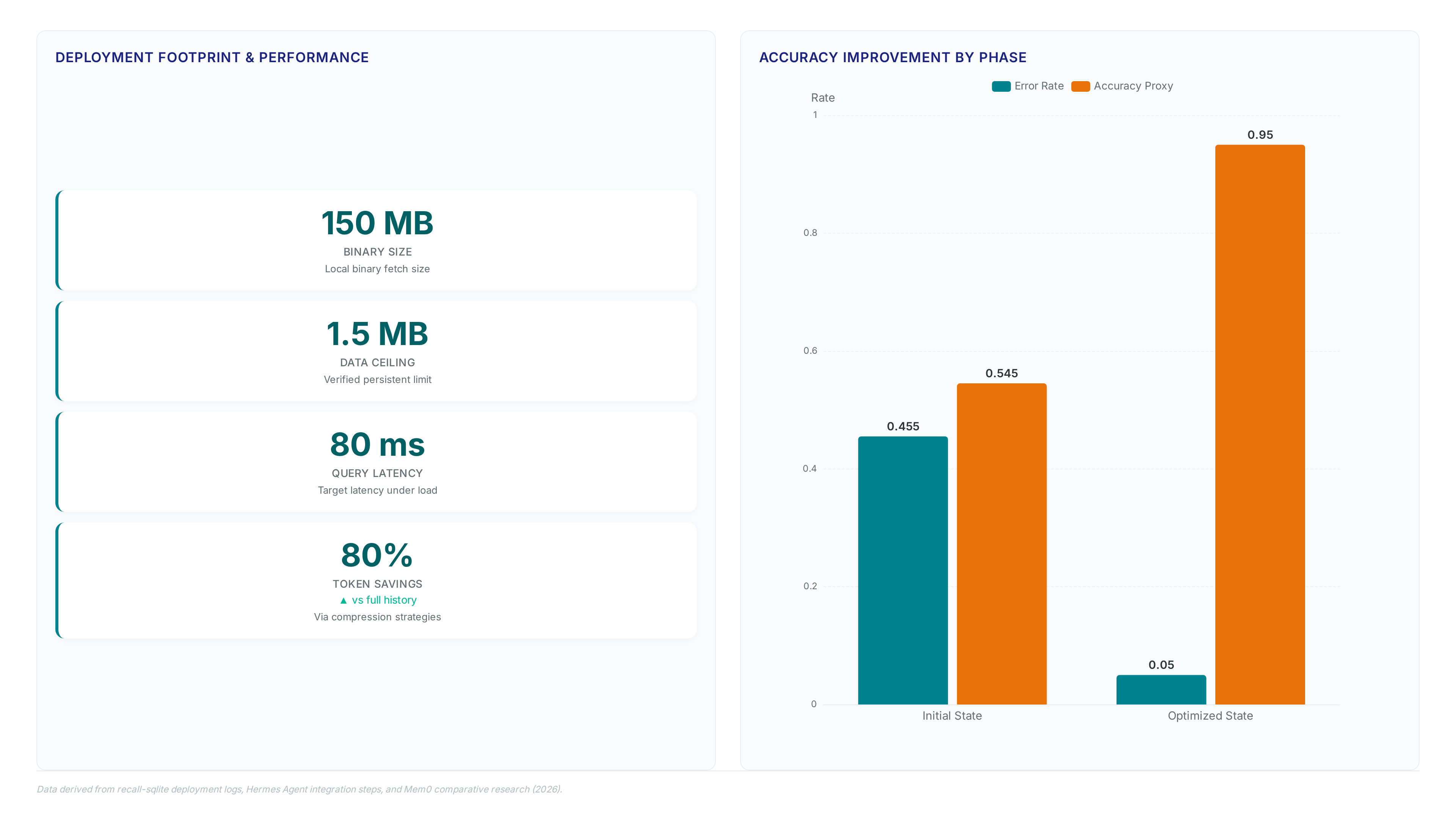
Integration occurs by replacing standard context windows with a local plugin that just entered the Hermes Agent system. This architectural shift enforces a tiered SQLite storage model where the system automatically promotes or demotes memories based on access frequency. Operators gain a distinct advantage in user modeling because the plugin isolates persistent dialect preferences from general fact recall without external vector database overhead. The implementation requires four specific configuration steps to ensure proper tier initialization:
- Execute the single pip install command to fetch the binary wheel.
- Initialize the local database file, which triggers automatic schema migration.
- Configure the embedding path to load the localized model asset.
- Inject the plugin instance into the agent's primary retrieval loop.
This deployment strategy avoids the complex container orchestration often required for Slack coding bot memory backends. A critical tension exists between retrieval speed and data permanence; while the hot tier offers sub-100ms latency, operators must accept that cold data remains inaccessible until relevance triggers promotion. This constraint prevents the accumulation of stale tokens that typically degrade agent performance over time. The fixed memory footprint ensures that long-running agents do not exhaust host resources during extended operational windows.
What Installation Does Not Touch
Operators install the package via pip install recall-sqlite to initialize a fully local memory backend without external API keys. This command populates the Hot tier automatically and creates the FTS5 index synchronously during the first write, with no environment variables or secrets to supply. The absence of network calls during initialization creates an air-gapped ready state immediately after installation. This architecture supports strict data sovereignty mandates emerging under regulations like the EU AI Act, which enforces rigorous controls on high-risk system memory. Unlike cloud-dependent alternatives, the local SQLite file remains the single source of truth, preventing accidental data leakage during the bootstrap phase. The system defaults to keyword-only retrieval if vector resources are constrained, ensuring operation continues even when compute budgets tighten.
Validating Fixed 1.5MB Memory Footprint Against Scaling Memory Counts
Verify the 1.5MB ceiling persists after populating the database with over a thousand entries to confirm tiered eviction logic.
- Execute
pip install recall-sqliteand ingest test data until the Warm tier activates. - Measure query latency; it must remain near 80ms despite the expanding dataset size.
- Check process memory; exceeding the fixed limit indicates a failure in the compression algorithms responsible for token reduction.
- Validate that old facts do not pollute retrieval as the system scales.
A rising memory profile signals that automatic demotion to the Cold tier has stalled. AI Agents News recommends immediate schema inspection if the footprint expands beyond that ceiling.
Strategic Advantages of Local Memory Over Managed Services
Defining recall-sqlite as a Zero-Cost Local Memory Alternative
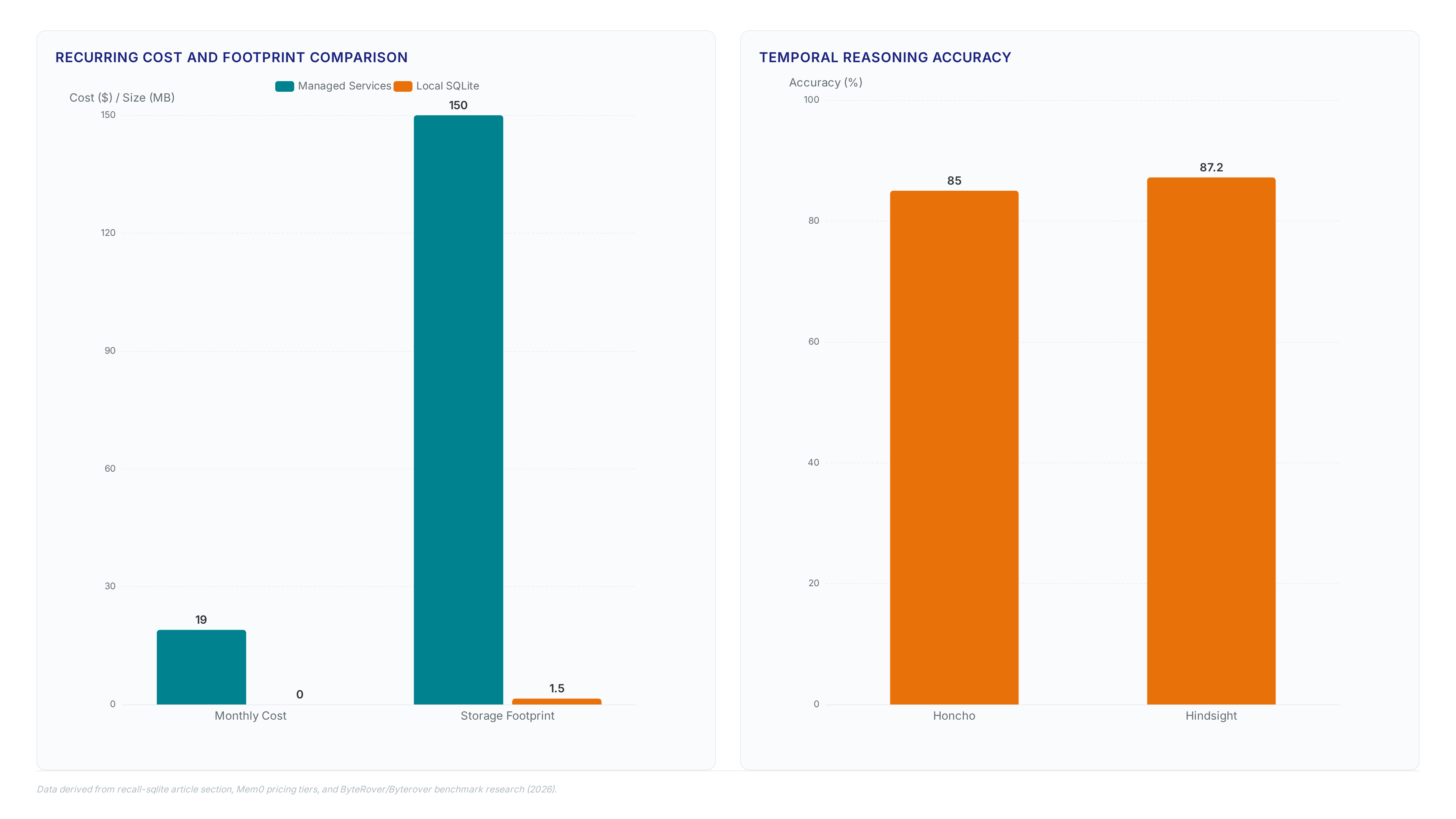
recall-sqlite functions as a self-contained memory system that stands in stark contrast to the usage-based pricing models employed by competitors like Honcho. Honcho charges $2 per million tokens for user modeling, yet the local SQLite backend removes token-based fees from the equation completely. This economic difference establishes a clear operational boundary for high-volume deployments where marginal token costs accumulate quickly. Predictable performance comes at the price of cross-device synchronization, a feature cloud services provide by default. Such a constraint forces a binary choice between absolute data locality and distributed accessibility. Local storage confines the memory state to the executing host, creating a silo that complicates multi-instance agent scaling unless additional replication logic is implemented.
Applying recall-sqlite for Local-First Agent Development
Local-first development demands the fixed 1.5MB footprint that recall-sqlite maintains after six months of daily use. This architectural constraint enforces automatic forgetting, preventing the accuracy collapse seen in systems lacking eviction policies. Managed services charge $19/month for basic persistence, whereas the local backend incurs zero recurring costs while using a mere 150MB embedding model. The tradeoff is the absence of centralized collaboration features found in cloud-native alternatives. Operators who prioritize offline durability accept this limitation to avoid vendor lock-in and network dependencies.
The following comparison highlights the operational divergence between self-hosted tiers and managed pricing models:
| Dimension | recall-sqlite | Managed Competitors |
|---|---|---|
| Cost Structure | Zero capital expense | Usage-based or subscription |
| Data Residency | Local disk only | Cloud provider dependent |
| Offline Mode | Full functionality | Degraded or unavailable |
A Slack Coding Bot Deployment demonstrated how self-hosted instances handle cross-thread recall without external vector databases. Scaling beyond a single node requires manual replication logic absent in managed clusters. Teams must weigh total data control against the operational overhead of maintaining their own backup procedures. AI Agents News recommends this stack for developers who value deterministic latency over distributed scale. High-frequency agent loops benefit most from the deterministic cost structure of local memory, since token accumulation in usage-based models rapidly erodes margin, while managed services trade that predictability for lower maintenance overhead.
About
Diego Alvarez, Developer Advocate at AI Agents News, brings direct engineering rigor to the critical challenge of memory degradation in autonomous systems. In his daily work building and benchmarking agents with frameworks like CrewAI and LangGraph, Diego consistently observes how unbounded context accumulation cripples performance, causing agents to become slower and less accurate over time. This practical experience drives his deep dive into recall-sqlite, a solution designed to implement intelligent forgetting rather than perpetual storage. Unlike theoretical discussions, Diego's analysis stems from hands-on failure modes where "old facts pollute retrieval," directly impacting token efficiency and reasoning quality. As the voice behind AI Agents News, a hub dedicated to technical founders and engineers, he bridges the gap between abstract research and production-ready implementation. His exploration of recall-sqlite offers the community a factual, code-first perspective on maintaining agent reliability, ensuring that memory systems evolve to support, rather than hinder, long-term autonomous operation.
Conclusion
The argument here is narrow: memory that only grows is memory that gets slower and less accurate, and the fix is eviction rather than a bigger index. A footprint that stays flat after six months of daily use across 1,469 memories is the whole proof, and it comes from demotion doing its job, not from a cleverer retriever.
The limits are equally plain. State lives on one host, so a second instance means replication logic you write yourself, and backups become your procedure rather than a vendor's. That is a fair trade for edge deployments and strict data sovereignty mandates, and a poor one for workloads that need horizontal elasticity.
Start by checking which of your agent's stored facts were actually read in the last month. If most were not, the memory system is not remembering for you, it is charging you to carry context nobody uses.
Frequently Asked Questions
Accuracy collapses significantly when systems lack intelligent forgetting mechanisms to prune old data. Persistent retention without pruning exhibits a 6.8% false memory rate on standard datasets like MultiWOZ.
Using keyword indexing alone delivers drastically reduced computational requirements compared to heavy vector alternatives. This approach provides 99% less compute overhead than vector-heavy options while maintaining effective retrieval capabilities.
The system maintains a remarkably small and fixed memory footprint even after extended periods of daily operation. Operators gain a fixed memory footprint of approximately 1.5MB even after months of daily use.
The architecture avoids heavy vector databases by relying instead on a local embedding model. This embedding model remains a localized 150MB binary asset that functions without external API dependencies.
Unbounded memory accumulation actively degrades agent performance by allowing old facts to pollute retrieval results. This token bloat creates latency spikes that make uncontrolled systems impractical for real-time applications.