AI agent logic: skip hype, build real systems
Building effective AI agents in 2026 means ignoring the hype cycle and integrating five specific components. These systems can match the output quality of a junior employee, but only if the creator trains them with precise data, tools, and skills. You need to distinguish between simple task-specific agents and complex multi-agent systems before attempting to build.
An AI agent is software that understands its environment, selects necessary tools, and executes tasks with autonomy. Unlike basic automation, these systems self-correct. They function as team additions, yet they remain strictly limited by the quality of their underlying architecture. Claims that agents solve every problem usually come from people who haven't used them for an extended period.
Single-goal agents scrape competitor blogs. Coordinated multi-agent systems handle research, drafting, and editing simultaneously. To build either, you need goal definition, planning logic, memory architecture, tool design, and feedback loops. These are the fundamental elements. Focus on them to avoid pitfalls and create agents that genuinely enhance content marketing workflows.
The Role of AI Agents in Modern Content Automation
What an AI Agent Actually Is
Static scripts follow rigid paths until they break. An AI agent perceives its environment, selects tools, and executes tasks without constant hand-holding. This software understands context. It self-corrects when errors appear. Output quality matches a junior employee, assuming the creator provides adequate training and constraints.
Complex workflows demand more than linear triggers. Discrete units coordinate to solve problems that exceed single-prompt capabilities. Agents remain only as effective as the creator's ability to define boundaries. This technology enables junior-level autonomy yet demands senior-level oversight in design.
The Three Pillars: Data, MCP Tools, and Skills
Operational autonomy requires integrating the three pillars of data, tools, and skills into a single LLM architecture. Builders must supply a core data layer so the system can synthesize context. Grounded information provides the environmental awareness necessary for decision-making.
The execution layer functions through MCP servers that grant read/write access to external platforms like Slack, Docs, and Notion. These interfaces act as mechanical hands, enabling the agent to query databases or update content directly while connecting to CRM access and SEO tools. Modern frameworks allow models to actively generate search queries and select appropriate instruments for the task at hand.
Cognitive direction comes from skills, which encompass the explicit instructions and knowledge bases defining behavior. Complex workflows often distribute these cognitive loads across specialized roles rather than loading a single prompt with every responsibility.
| Pillar | Function | Implementation Example |
|---|---|---|
| Data | Context Source | Analytics APIs, CRM records |
| Tools | Action Execution | MCP-connected Slack, Notion |
| Skills | Decision Logic | Role-specific prompt engineering |
Tool availability does not guarantee correct usage. Precise skill definitions govern behavior effectively.
The Training Dependency Reality: Why AI Agents Are Not a Universal Solution
An agent remains strictly bound by the quality of its creator's input, and that training dependency is structural rather than temporary. Effectiveness relies entirely on the operator's ability to configure data, tools, and skills pillars before deployment.
Multi-agent orchestration introduces further complexity. Scaling to a team of specialized agents increases the surface area for configuration errors. The limitation is structural. Success demands treating the agent as a reflection of the builder's own process rigor.
Architectural Differences Between Task-Specific and Multi-Agent Systems
Task-Specific vs Multi-Agent Architecture Components
Task-specific agents chase one objective using set tools, such as scraping competitor blogs for Slack summaries. Multi-agent systems coordinate independent units, each wielding its own LLM, tools, and instructions to solve complex workflows like content production. Frameworks like AutoGen demonstrate this distinction by orchestrating teams of specialized agents that converse to complete tasks single loops cannot handle alone.
| Feature | Task-Specific Agents | Multi-Agent Systems |
|---|---|---|
| Goal Scope | Single, narrow objective | Broad, multi-step workflow |
| Coordination | None required | Requires inter-agent handoffs |
| Error Surface | Low; isolated failure modes | High; coordination creates failure points |
| Best Use Case | Repetitive data retrieval | Complex reasoning and drafting |
Adding agents increases orchestration complexity exponentially. A single agent minimizes latency while distributed systems introduce delays through required context passing and validation steps between nodes. An SEO content team might deploy agents for research, writing, and fact-checking, yet this structure demands rigorous planning logic to prevent circular reasoning or data loss during handoffs. Multi-agent systems offer higher capability ceilings but require notably stronger error handling and state management to function reliably in production environments.
Deploying 7-Agent Teams for Technical Content Generation
Complex technical workflows require orchestrating a team of 7 specialized agents including an Architect, Researcher, Writer, and Fact-Checker. This configuration addresses coordination gaps inherent in single-agent loops where context windows often truncate critical reasoning steps. Unlike a task-specific agent that scrapes competitor blog posts for a Slack summary, multi-agent systems distribute cognitive load across independent LLM instances.
| Dimension | Task-Specific Agent | 7-Agent Team |
|---|---|---|
| Scope | Single goal execution | Collaborative workflow |
| Error Surface | Low (linear path) | High (conversational drift) |
| Best Use | Daily summaries | SEO-optimized articles |
| Setup Time | Minutes | Hours to days |
Builders must weigh the latency introduced by inter-agent conversation against the depth of output. A documented use case uses AutoGen to manage these conversations, ensuring each specialist applies distinct instructions before passing data downstream. This complexity creates a fragile dependency chain. If the Researcher retrieves stale data, the Fact-Checker must possess explicit correction tools to halt propagation. Adopt multi-agent orchestration only when the cost of error exceeds the overhead of coordination. Simple retrieval tasks favor a single cloud-hosted agent. This staged approach isolates failure modes early. The constraint balances immediate versatility against long-term maintainability.
Coordinated Reasoning Errors in Multi-Agent Workflows
Coordinated reasoning failures emerge when multiple agents misalign handoffs, creating error cascades impossible in single-agent loops. Task-specific agents execute isolated commands with predictable failure modes. Multi-agent systems introduce compounded risk because each node must correctly interpret context passed by predecessors. Documentation for frameworks like AutoGen highlights that agents require explicit can_handoff_to definitions to orchestrate conversations effectively, yet missing these constraints causes silent workflow stalls.
| Risk Factor | Task-Specific Agent | Multi-Agent System |
|---|---|---|
| Failure Scope | Localized to one tool | Cascades across network |
| Debugging | Direct log tracing | Requires distributed tracing |
| Coordination | None required | High dependency |
Cloud-hosted agents mitigate some infrastructure overhead by managing server availability, but they do not eliminate logical drift between specialized nodes. Self-hosted agents offer granular control over memory architecture but demand rigorous maintenance of the underlying orchestration code. Adding agents increases the surface area for semantic misunderstanding rather than reducing it linearly. Builders must weigh the marginal gain in workflow complexity against the exponential rise in potential coordination points before expanding beyond single-goal architectures. Success in 2026 depends on recognizing that agents working together create new failure modes unseen in isolated deployments.
Executing a Five-Step Formula for Building Content Marketing Agents
A Narrow Goal and the Tool Stack It Needs
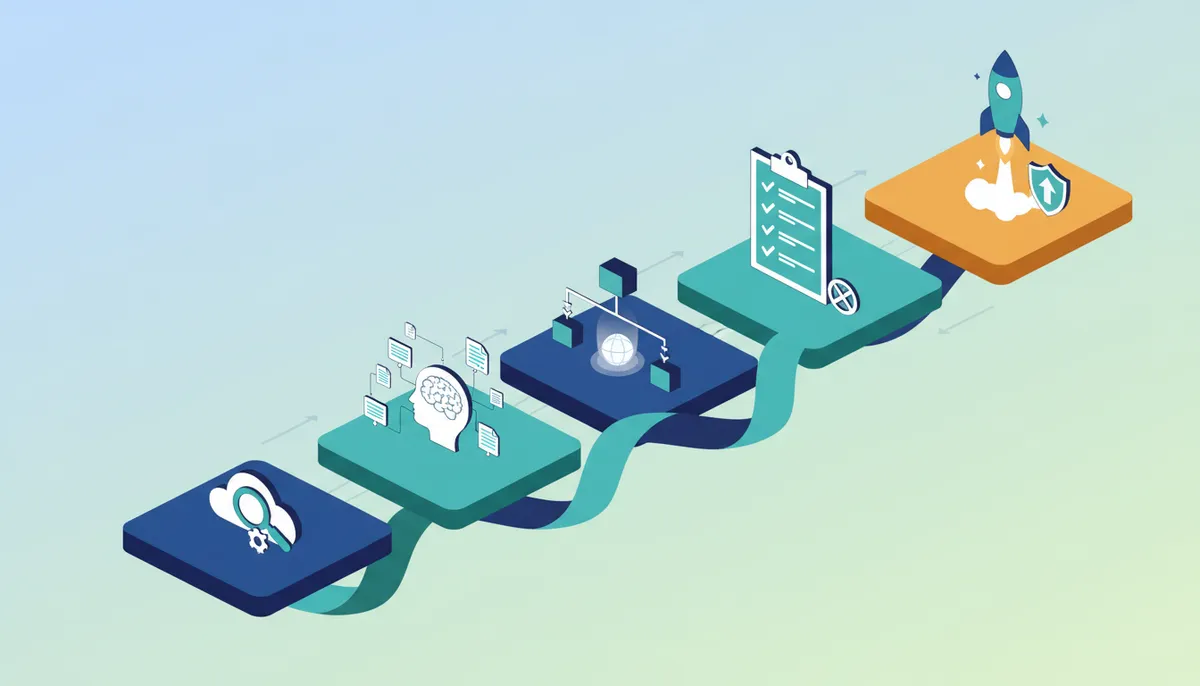
Successful agent architecture begins by defining a narrow operational goal rather than attempting broad autonomy. For Go-To-Market workflows, the objective is specifically to audit existing blog content for SEO gaps and deliver optimization recommendations. This process requires precise data inputs, typically consisting of target blog post URLs and keyword performance metrics exported from Semrush. Without this structured context, the system cannot generate actionable insights.
Builders must configure tool design to enable specific read/write actions across the marketing stack. The standard configuration for this workflow includes:
- Firecrawl for extracting raw text from specified URLs.
- Semrush for validating keyword intent and search volume.
- Google Sheets for logging structured audit results.
- Slack for triggering execution and receiving alerts.
- Gmail for distributing final reports to stakeholders.
Selecting graph-based orchestration allows the agent to manage complex state transitions between scraping and analysis phases. However, connecting too many tools initially increases the risk of hallucinated function calls.
AI Agents News recommends matching the model to the specific pillar of data, tools, or skills it will primarily execute. A mismatch here forces the agent to operate outside its optimal performance envelope, leading to hallucinated metrics. Strategic selection ensures the agent architecture remains strong against the specific failure modes of each underlying large language model.
Validating Agent Skills and Campaign Instructions
Confirm campaign goals and target personas match before deployment to prevent generic outputs. Validation requires verifying that keyword intent logic aligns with the set audience rather than broad search volume.
- Verify goal definition logic breaks high-level briefs into executable sub-tasks using Plan-and-Solve algorithms.
- Ensure feedback loops return action outputs to the context window for closed-loop control systems.
- Test that skills folders contain specific scripts preventing oversized system prompts during execution.
A common failure mode involves agents ignoring negative constraints when skills lack explicit prohibition rules. The cost of skipping this step is measurable in wasted compute cycles on irrelevant drafts. Unlike simple prompt engineering, structured skills allow the agent to access reference files on demand without re-processing the entire conversation history. This architectural choice separates strong agents from basic chatbots that hallucinate brand voice. Builders must treat these instructions as immutable code rather than suggestion boxes. Properly configured, the system maintains consistency across thousands of generated assets without human intervention.
Critical Lessons for Optimizing Agent Performance and Decision-Making
Which Workflows Are Worth Automating
Spending engineering hours on tasks that occur once a week wastes resources. Automation delivers maximum ROI when applied to high-frequency, repeatable workflows rather than sporadic manual interventions. Teams frequently misallocate effort by targeting edge cases lacking the volume to justify orchestration overhead. The strategic error lies in automating low-volume tasks where maintenance costs exceed time savings. Focus instead on defining automation candidates where the recurrence rate ensures continuous value generation.
Not every process requires a bot, a principle that prevents wasted effort on infrequent operations. Ignoring this threshold introduces unnecessary complexity without measurable efficiency gains. The consequence is a fragmented agent system where the maintenance burden outweighs utility. Builders must articulate specific manual steps and define "good output" before encoding logic into an agent. This discipline ensures the resulting system handles state and tool usage correctly. Graph-based orchestration capabilities provide necessary structure for managing complex state in valid high-volume use cases. Such infrastructure remains overkill for trivial tasks. Effective agent design patterns have become the standard way practitioners approach architecture decisions, moving the industry from experimental code to fixed-step orchestration. This approach mitigates the risk of building fragile automations that fail when rare edge cases occur.
Optimizing Tool Usage by Pruning Low-Utility Agent Skills
A single Large Language Model (LLM) enhanced with retrieval, tools, and memory forms the core building block of agentic systems. Modern frameworks enable models to actively generate search queries and select appropriate tools without micromanagement. Active computational behavior can still falter under high-cardinality choices where the probability of selecting a suboptimal function increases. Providing a broad array of low-utility tools forces the agent to expend reasoning tokens on filtering rather than executing the primary task. The cost of maintaining a large tool registry is measurable in reduced task completion rates and increased latency during the planning phase. Operators should audit their tool usage patterns and aggressively prune capabilities that do not directly serve the agent's primary objective. A strategic reduction in available skills often yields higher reliability than attempting to engineer complex routing logic to manage tool clutter. Specific, repeatable designs outperform general-purpose swiss-army knife configurations. Production deployments require a shift toward minimal, highly specialized tool sets tailored to narrow workflow domains.
The Articulation Gap: Why You Cannot Automate What You Cannot Define
Encoding undefined workflows into functional software agents is impossible. This articulation gap creates a hard boundary where automation fails because the builder lacks a manual precedent for the task. Specialists consistently outperform generalists in agent construction since they possess the domain fluency to define good output before delegation. If a human cannot execute the step and identify errors, the resulting agentic system will lack the necessary guardrails for self-correction. Research defines the core building block as an LLM enhanced with retrieval, tools, and memory, yet these components cannot compensate for ambiguous instructions. Practical agent success relies on the creator's ability to explain the task in clear terms. Without this clarity, the model hallucinates logic paths rather than executing precise operations.
The risk extends beyond simple failure; unarticulated tasks generate plausible but incorrect data that corrupts downstream processes. Teams attempting to fix AI agent performance issues often find the root cause is not model capability but vague problem definitions. Documenting the manual process until the definition of "done" becomes objective solves this issue. Only then can the decision-making loop be safely transferred to an autonomous system.
About
Marcus Chen is the Lead Agent Engineer at AI Agents News, where he specializes in orchestrating production multi-agent systems and evaluating framework evolution. His daily work involves rigorously testing tool-use mechanics and memory retention across platforms like CrewAI, AutoGen, and LangGraph, directly informing his perspective on building reliable agents in 2026. Unlike theoretical overviews, this guide reflects Chen's hands-on experience distinguishing reliable autonomous workflows from simple automation scripts. He understands that an agent's effectiveness relies entirely on precise data structuring and tool definition, not just model capability. At AI Agents News, Chen leads technical analysis to help engineers navigate the complex environment of agentic architectures without vendor hype. His insights connect the theoretical definition of agents to the practical realities of deployment, ensuring builders focus on the critical pillars of data, tools, and skills required to create software automation that performs at a junior employee level.
Conclusion
Scaling ai agent deployments reveals that operational fragility often stems from undefined workflows rather than model limitations. When teams attempt to automate tasks lacking clear manual precedents, they incur a hidden debt of plausible but incorrect data that corrupts downstream processes. This articulation gap creates a ceiling where additional tooling only accelerates failure rates instead of improving throughput. Organizations must recognize that building reliable systems requires freezing the human workflow before writing any automation logic.
Halt all new agent development for broad, undefined business functions until existing narrow-domain pilots achieve full definition clarity. Do not expand scope while the core logic remains ambiguous, as general-purpose configurations will consistently underperform specialized, repeatable designs. The window for successful deployment relies on strict adherence to documented manual processes where "done" is an objective metric.
Start by selecting one stalled pilot project this week and mapping its exact human execution steps without assuming any AI inference. If you cannot write the step-by-step logic that guarantees a correct outcome, that task is not ready for delegation. Focus your immediate engineering resources on refining these definitions rather than adding more retrieval tools or memory layers. Only after the manual process is immutable should you encode it into an agentic system.
Frequently Asked Questions
Agents fail when creators lack training skills, producing poor output. Success rates drop sharply because output quality tracks the instructions, data, and tools the human operator supplies.
No, one agent matches only a junior employee's output quality. You need multiple specialized units to handle complex workflows that exceed the capabilities of a single automated script.
No single figure applies to every build. Cost depends on whether you run a cloud-hosted platform or self-hosted code, and on how many model calls and tools the workflow consumes.
An agent needs access to data, tools, and skills to operate effectively. Without these three core pillars, the software cannot understand its environment or execute tasks autonomously.
Beginners should build single task-specific agents before attempting complex orchestration. Multi-agent systems introduce coordination errors that require advanced reasoning to manage across different specialized roles successfully.
References