Agent architecture: five components before scaling
An effective AI agent requires five critical components before scaling, not just a single model. Those components are goal definition, planning logic, memory architecture, tool design, and feedback loops, and the agent architecture holds only when all five are configured before the system scales.
Most developers fail because they treat agents as simple chatbots rather than engineered systems. Research from AmQuest Education confirms that these five elements must be established immediately to prevent chaotic outputs. Without rigid planning logic and set feedback loops, an entity cannot reliably execute multi-step workflows or correct its own errors in real-time.
Skipping goal definition leaves the planning logic without a terminal state, which is how agents fall into infinite retry cycles and burn compute. Memory architecture and tool design decide the rest: state that survives beyond a single session, and interfaces precise enough that the agent calls an API instead of guessing its parameters.
Defining the AI Agent Architecture and Core Components
Anthropic's Three Augmentations for LLM Agents
An LLM becomes an agent only when enhanced by retrieval, tools, and memory augmentations. Research identifies these three specific capabilities as the basic building block required to change static language models into flexible systems. Traditional scripts follow rigid linear paths, yet this architecture allows the model to actively query external data, execute functions, and retain context across sessions. The industry has coalesced around this pattern-based thinking as the standard approach for stabilizing agent behavior against variable inputs approach.
Relying solely on these augmentations without rigorous planning logic creates a significant operational risk. The components enable action, yet the absence of a structured feedback loop often leads to infinite retry cycles when tools fail or data is missing. This limitation forces engineers to implement external guardrails rather than relying on the model's inherent reasoning. Consequently, the definition of an agent shifts from a simple function caller to a system requiring strict orchestration layers to manage state.
| Component | Function | Constraint |
|---|---|---|
| Retrieval | Accesses external knowledge bases | Latency impacts response time |
| Tools | Executes actions via API calls | Requires precise schema definitions |
| Memory | Retains conversation history | Context window limits apply |
Adding these layers increases complexity exponentially. Effective deployment requires balancing these augmentations with strong evaluation frameworks to prevent unintended actions.
Applying the Five-Point Design Checklist
Effective AI agent design demands five precise configurations before scaling to complex business contexts.
Builders must establish goal definition to bound the system's objective function, preventing drift during long-horizon tasks. The planning logic lacks a terminal state for optimization without this anchor. Planning logic then decomposes these goals into executable steps, acting as the reasoning engine that navigates uncertainty. Anthropic defines the basic building block via three augmentations, while the AmQuest Education framework expands this to five operational pillars for greater granularity. Memory architecture must retain state not for context, but for correcting errors via feedback loops.
| Component | Function | Risk if Omitted |
|---|---|---|
| Goal Definition | Sets objective boundaries | Task drift |
| Planning Logic | Executes reasoning chains | Linear failure |
| Memory Architecture | Retains system state | Context loss |
| Tool Design | Defines interface actions | Inability to act |
| Feedback Loops | Corrects execution errors | Unchecked hallucination |
Tool design requires strict interface definitions so the agent interacts with APIs rather than guessing parameters. Adding more tools increases the attack surface for prompt injection, where malicious strings hijack instructions. Feedback loops must include human-in-the-loop checkpoints for irreversible operations. Defining these loops often requires sacrificing speed for safety; a system waiting for confirmation cannot operate in real-time milliseconds. Autonomous efficiency conflicts with controlled reliability.
Prompt engineering alone cannot fix architectural gaps in memory or planning. The industry shift toward graph-based state management reflects this need for structured oversight. Ignoring memory architecture leads to repetitive failure cycles where the agent never learns from previous errors. A common oversight involves neglecting the interaction between memory retention and tool safety, creating vectors where stored context influences tool selection unpredictably.
Deterministic Chains Versus Agentic Patterns
Deterministic chains execute fixed steps where step N output becomes step N+1 input, creating rigid linear paths unsuited for flexible contexts. This step-wise execution pattern functions reliably only when every variable and edge case is pre-set by the developer. True agentic patterns apply an LLM reasoning engine to dynamically select tools and replan based on intermediate results rather than following a hardcoded script. Adaptability marks the fundamental distinction. Scripts fail silently when encountering unanticipated inputs, whereas agents can query memory or invoke alternative tools to recover. Deterministic automation offers predictability, yet it lacks the planning logic required to navigate non-linear business processes without explicit branching for every possibility.
| Feature | Deterministic Chain | Agentic Pattern |
|---|---|---|
| Flow Control | Fixed, linear sequence | Flexible, graph-based routing |
| Error Handling | Pre-set exceptions only | Autonomous re-planning |
| Context Usage | Local step input only | Global memory and retrieval |
| Adaptability | Low (fixed at design time) | High (runtime adjustment) |
Adopting agentic patterns introduces latency and cost variability that deterministic scripts do not face, necessitating strict guardrails on tool invocation frequency. Replacing a stable script with an agent adds complexity that is only justified when task inputs are inherently unpredictable, so deterministic chains stay the better choice when audit trails and reproducibility outweigh the need for autonomous adaptation. AI Agents News recommends evaluating the variance in your input data before committing to an agentic architecture.
Mechanics of Agent Decision Making and Memory Systems
Retrieval Is Not Persistent Memory
Simple retrieval differs fundamentally from persistent memory architecture, which maintains long-term state across sessions. Agents fail to retain context without this distinction, reverting to default behaviors that ignore prior interactions. Deterministic chains hit the same wall from the other side: memory architecture must store intermediate outputs explicitly, or the workflow cannot backtrack when a later step invalidates an earlier one.
Immediate tool usage often conflicts with long-term state consistency. Builders must configure feedback loops to correct errors where the reasoning engine misinterprets stored context.
Trading Autonomy Against Control in Agent Design
Engineers must verify goal definition clarity before enabling autonomous tool design interactions to prevent uncontrolled execution loops. The five-pillar checklist is more granular than pattern-based models that focus primarily on retrieval and basic tools. When memory architecture is correctly implemented, the system retains state across sessions rather than resetting context after every function call. Excessive reliance on deterministic chains can limit adaptability in flexible environments where stochastic reasoning is superior. Strict planning logic enforcement creates tension with the flexibility required for novel problem solving. Minor hallucinations compound rapidly into catastrophic failures if feedback loops lack sufficient error correction mechanisms. The following table compares implementation priorities for different operational modes:
| Component | High Autonomy Focus | High Control Focus |
|---|---|---|
| Goal Definition | Abstract objectives | Strict constraints |
| Memory Architecture | Long-term retention | Session-only scope |
| Feedback Loops | Self-correction | Human-in-the-loop |
| Tool Design | Flexible selection | Pre-approved list |
Poorly set goals destabilize the entire agentic system regardless of model size: with no terminal state to reach, the planning logic has nothing to optimize toward and the retry cycle never closes.
Assembling the Stack: Orchestration, Control, and Voice
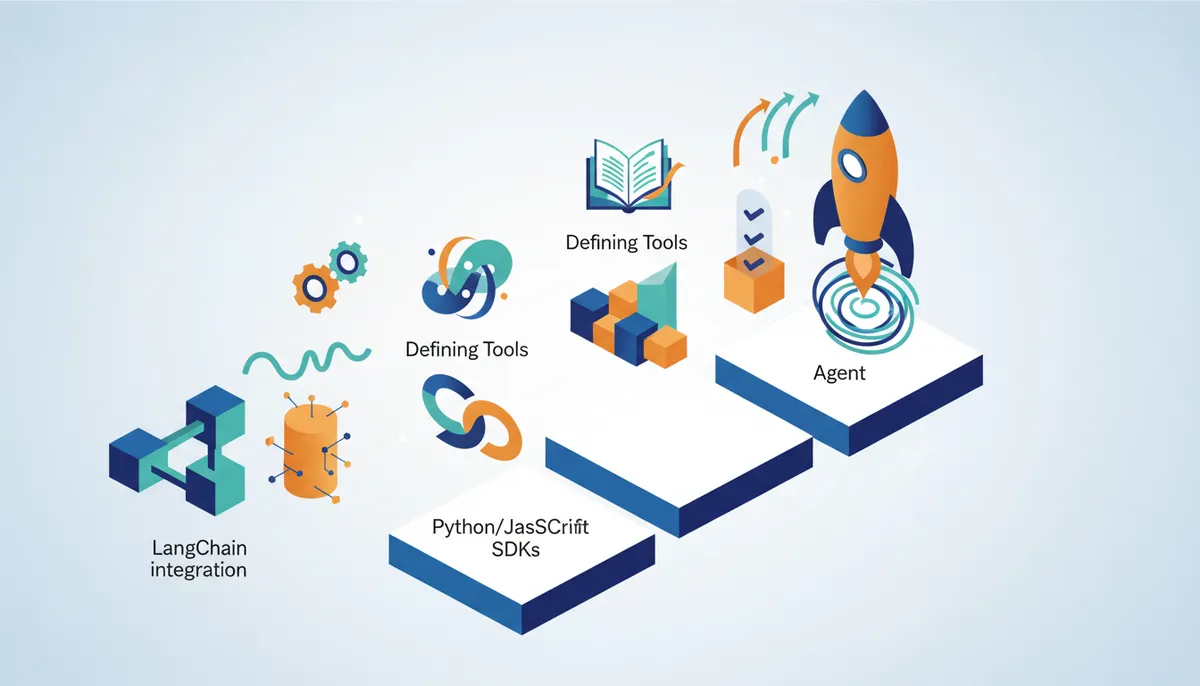
Curated open-source lists document over 40 distinct packages spanning orchestration, computer control, and voice capabilities. Builders must distinguish between orchestration layers like CrewAI, which manage multi-agent logic, and control tools such as Browser Use that handle direct environmental interaction. This segmentation allows engineers to mix specific functions without inheriting unnecessary overhead from unused features.
- Identify the required coordination pattern for your specific workflow topology.
- Select an orchestration framework that supports your desired state management style.
- Integrate computer control modules to interact with legacy systems lacking APIs.
- Append voice capabilities as a distinct interface layer to expand interaction modes.
The trade-off is increased integration complexity; decoupled components require explicit interface definitions to prevent context loss during handoffs. Unlike unified suites, this approach demands rigorous testing of data passing between the planning logic and execution modules.
Evaluating Business Value and Mitigating Operational Risks
When Agentic Complexity Pays for Itself

Agentic systems earn their overhead on legacy infrastructure lacking APIs, where computer-use capabilities enable interaction via screen interpretation. On high-volume, stable data the planning logic and feedback loops add nothing but a more complex operational baseline.
The limitation is clear: agent complexity introduces latency and cost that rigid scripts avoid. If a workflow does not require variable resolution, the additional complexity may not justify the investment.
Containing Prompt Injection Through Tool Scope and Feedback Loops
Tool design dictates interface definitions for external system interactions, and inadequate scoping here allows excessive permissions that increase security risks. An agent with access to your email, your calendar, and your code repository can do a lot of damage with one bad instruction. Prompt injection, where a malicious string in the environment hijacks the agent's instructions, is a real attack vector.
Feedback loops are the containment layer here: an agent that cannot self-correct also cannot notice that its instructions were replaced.
Mitigating Hallucination Risks in LLM-Based Reasoning Engines
Anthropic's research grounds agentic systems in those same three augmentations. Without rigid constraints on these modules, the model prioritizes linguistic plausibility over factual accuracy during planning logic execution. This behavior manifests as confident assertions regarding non-existent data points or API responses.
Omitting the verification step allows errors to propagate through subsequent tool design calls. A significant tension exists between response latency and accuracy; adding validation layers increases compute time but prevents cascading failures.
Builders must treat unverified generations as potential faults rather than features. Implementing a "reject option" where the agent declines to answer rather than guessing reduces downstream repair costs. This approach shifts the failure mode from silent corruption to explicit uncertainty.
About
Sofia Berg serves as Research Editor at AI Agents News, where she specializes in translating complex academic papers into actionable insights for engineers. Her deep expertise in multi-agent systems and evaluation benchmarks like SWE-bench makes her uniquely qualified to dissect the technical realities behind building autonomous agents. Sofia's daily work involves rigorously analyzing primary sources to separate genuine architectural advances from marketing hype. At AI Agents News, she ensures that discussions around agent frameworks and orchestration strategies remain grounded in factual accuracy and reproducible results rather than speculation. By focusing on methodological limitations and concrete performance metrics, Sofia helps technical founders and ML engineers navigate the rapidly evolving environment of agentic AI with clarity, ensuring their build decisions are informed by rigorous research rather than unverified claims.
Conclusion
Scaling AI agents reveals that operational fragility stems not from model size but from the components skipped before scaling: goals that never bound the objective, feedback loops with nothing to catch, and tool interfaces loose enough that the agent guesses at parameters. When agents execute tools without intermediate validation, a single hallucinated parameter triggers cascading failures across the entire workflow. The immediate cost of skipping these checks is not merely inaccurate output but the compounding expense of manual intervention required to untangle corrupted state histories. Teams must prioritize architectural rigidity over raw speed to ensure reliable autonomy.
Deploy production-grade agents only after implementing a mandatory "reject option" that forces the system to declare uncertainty rather than fabricate data. This constraint transforms potential silent failures into manageable exceptions, preserving data integrity even at the expense of latency. Do not scale agent concurrency until feedback loops consistently catch and correct deviations before tool execution occurs.
Frequently Asked Questions
All five: goal definition, planning logic, memory architecture, tool design, and feedback loops. Goal definition comes first because it gives the planning logic a terminal state; without it the agent retries until it burns compute.
Retrieval, tools, and memory: the model queries external data, executes functions, and keeps context across sessions. Those three enable action but not control, which is why the five-pillar framing adds planning logic and feedback loops on top of them.
Errors compound instead of being caught: minor hallucinations turn into cascading failures and retry cycles never terminate. The correction costs speed, because human-in-the-loop checkpoints on irreversible operations make the agent wait for confirmation.
Curated lists now document over 40 distinct packages for orchestration and control. This maturity allows builders to select specific tools for voice capabilities or computer control tasks.
Strict definitions prevent the agent from guessing parameters during API calls. Adding more tools without this precision increases the attack surface for prompt injection significantly.
References