Agent memory types: Why most systems miss 5 of 7
Most teams have engineered only two memory types when seven distinct systems are required for true agent autonomy.
The prevailing agent architecture is fundamentally broken because the underlying LLM acts as a pure function with zero internal state, forcing engineers to wrap it in external layers that incur token costs on every single turn. While ChatGPT users perceive continuity, the system merely re-sends history, meaning the vast majority of deployments rely on an expanding conversation history and RAG vectors that fail to make the agent smarter over time. Driven by agentic AI maturation and cloud-native dominance expected by 2027, the split matters: working memory evaporates after a session, parametric knowledge stays frozen in weights, and episodic and semantic storage follow different mechanics.
The Role of Distinct Memory Types in Modern Agent Architecture
The Seven Memory Types: From Working Context to Parametric Weights
The Large Language Model acts as a pure function that retains no state between calls, requiring external layers to simulate memory. This architectural constraint forces engineers to build seven distinct storage mechanisms rather than relying on a single context window. Most deployed systems currently implement only Working and Retrieval memory, ignoring the five types required for long-term adaptation. The distinction between memory types determines whether an agent merely recalls data or actually learns from errors. Episodic memory logs specific past events to prevent repeating failures, whereas Semantic memory stores static domain facts independent of time. Procedural memory encodes the know-how of tool usage and workflows, while Parametric memory refers strictly to knowledge baked into the model weights. Prospective memory handles future intentions scheduled for later execution, bridging short-term triggers with long-term goals.
| Memory Type | Duration | Primary Function |
|---|---|---|
| Working | Short | Active context window content |
| Semantic | Long | Stable facts and preferences |
| Episodic | Long | Logged history of events |
| Procedural | Long | Skills and workflow patterns |
| Retrieval | Both | Similarity-based knowledge fetch |
| Parametric | Long | Frozen model weights |
| Prospective | Both | Scheduled future intentions |
Industry adoption lags behind these theoretical frameworks. A sharp tension exists between token costs for Working Memory and the latency of retrieving Episodic Memory from external stores. Operators must balance immediate context breadth against the computational expense of re-sending history on every request. Neglecting Procedural or Episodic layers results in agents that cannot improve performance over time. The failure to separate these concerns leads to architectures where context limits cap intelligence growth. Proven design requires treating each memory type as a separate engineering problem with distinct persistence requirements.
Temporal Axes: Managing Short-Term Context vs Long-Term External Stores
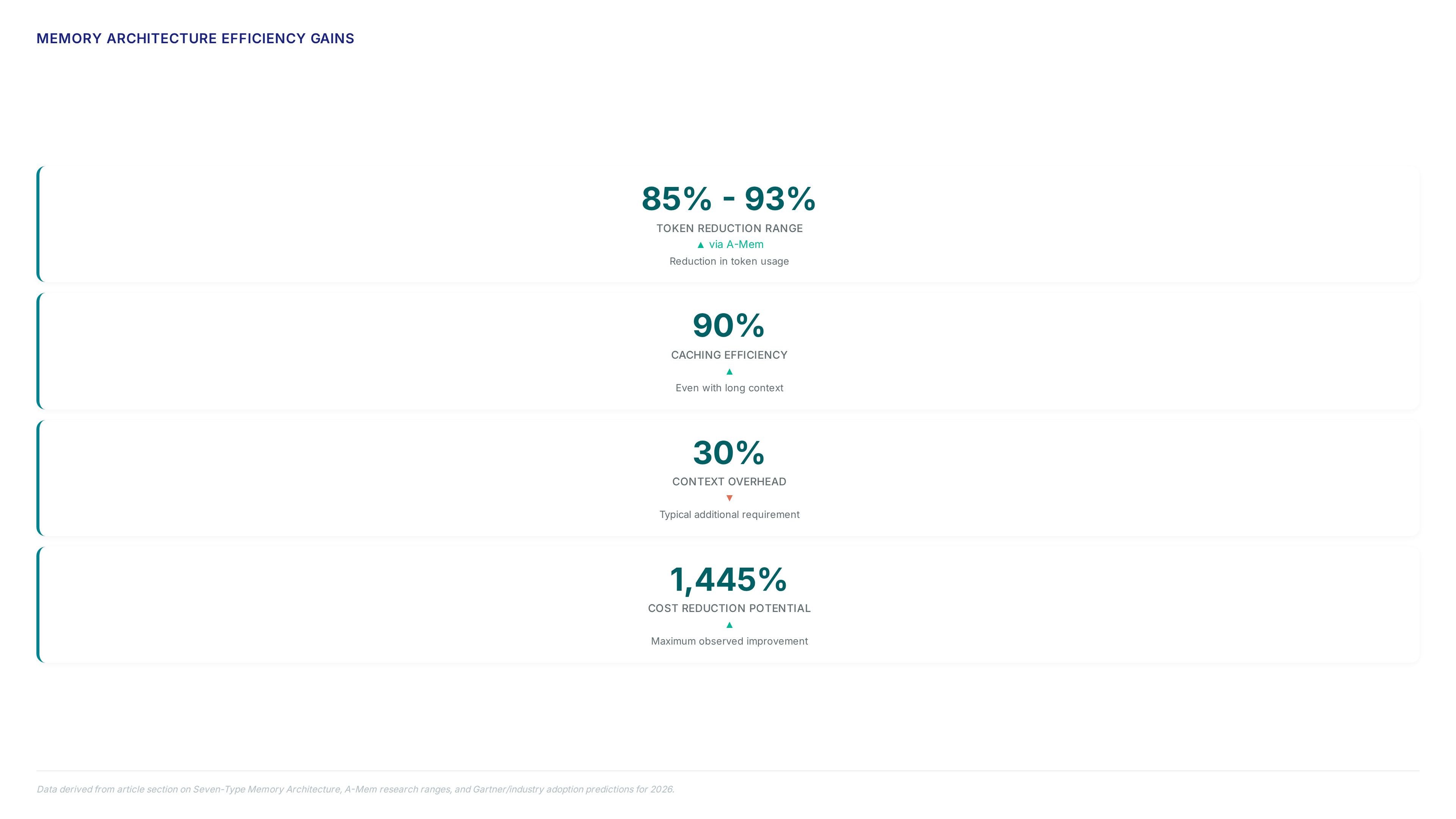
Short-term Working memory resides strictly within the context window until the session terminates and evaporates completely. This ephemeral storage enables rapid reasoning but incurs quadratic cost growth as conversation length expands, even with 90% prompt caching discounts applied by vendors. Operators must distinguish this transient buffer from persistent external stores designed for session continuity across days or weeks. Long-term architectures rely on dedicated layers like Mem0 to maintain state without re-feeding entire histories into the model. The per-turn read cost for such managed systems sits near $0.0013 per read, a fraction of the expense required to resend expanding token counts. A sharp tension exists between the speed of local context and the durability of external databases.
AI Agents News recommends separating these stores immediately to avoid architectural debt. The cost of ignoring semantic or prospective layers is an agent that recalls data but never learns.
Inside Agent Memory: Data Flow and Consolidation Mechanics
Mechanics: Working Memory as a Bounded Context Window
A 50-turn conversation re-sends the first message fifty times, creating quadratic cost scaling rather than linear growth. This transient Working Memory functions strictly as a bounded buffer where the model receives the full context window on every inference call. The Large Language Model acts as a stateless function, meaning the application layer must reconstruct the entire conversation history for each turn. The financial impact accrues rapidly because every turn re-bills the entire history as input tokens. Engineers often mistake larger native windows for a solution, yet extending the window simply increases the payload size for every subsequent request. A private beta from Cloudflare attempts to mitigate this by extracting data without filling the window, though most systems still rely on full history transmission. The standard taxonomy defines this layer as ephemeral, distinguishing it from persistent semantic stores that survive session termination.
| Feature | Working Memory | Semantic Memory |
|---|---|---|
| Duration | Session-only | Persistent |
| Cost Model | Per-turn input tokens | Storage + Read |
| Access | Full re-send required | Selective retrieval |
The architectural tension lies between maintaining conversational coherence and minimizing token expenditure. Increasing the context limit does not solve the re-transmission problem; it merely delays the truncation point while increasing the per-call bill. Operators must implement explicit eviction policies or summarization strategies to prevent the context window from becoming a financial liability. Without these controls, the system pays repeatedly for static information that never changes.
Executing the Consolidation Loop with Mem0 and Cognee
Translating episodic logs into semantic rules requires a dedicated consolidation loop that raw vector stores cannot execute natively. This process transforms transient event data into persistent knowledge, moving beyond simple retrieval to actual system learning. Engineers deploying Mem0 observe this mechanism in action, where the system achieves high accuracy on the LOCOMO benchmark by managing user-specific persistence across sessions. The graph-enhanced variant, Mem0g, pushes this performance higher while maintaining a median latency of 0.71 seconds. Such metrics indicate that specialized memory layers outperform generic context stuffing for long-term consistency. Alternatively, Cognee stores knowledge as nodes and edges rather than flat embeddings. This architectural choice fundamentally alters how agents handle complex relational reasoning compared to pure vector approaches. The decision between structured graph storage and vector similarity depends entirely on whether the application demands strict relationship tracing or fuzzy semantic matching.
| Feature | Vector-First (RAG) | Graph-Native (Cognee) | Managed Layer (Mem0) |
|---|---|---|---|
| Primary Structure | Flat embeddings | Nodes and edges | Hybrid (Vector + Graph) |
| Consolidation | Manual ETL required | Native graph updates | Automated CRUD ops |
| Best Use Case | Document search | Relational reasoning | User personalization |
| Latency Profile | Variable | High for traversal | Low (0.71s median) |
Operators must recognize that episodic consolidation is not automatic; it requires explicit engineering to move data from short-term logs to long-term stores. Without this separation, agents remain stuck in a loop of re-processing identical failures. The cost of ignoring this distinction is a system that simulates memory without actually retaining lessons. AI Agents News recommends validating the storage backend against specific relational requirements before selecting a tool.
RAG as Plumbing and the Relevance Gap
Treating Retrieval-Augmented Generation as memory fails because vector proximity does not guarantee logical answer relevance, creating a specific hallucination vector. The gap between vector space closeness and actual answer relevance is where many hallucination bugs originate, forcing operators to distinguish retrieval plumbing from true cognitive storage. Unlike procedural memory which encodes valid workflows, raw RAG chunks lack the structural integrity to prevent an agent from executing invalid steps based on semantically similar but logically incorrect precedents. This distinction matters because high retrieval scores often mask low factual accuracy, leading operators to trust incorrect context. Temporal understanding remains another blind spot for standard vector stores. Relying solely on similarity search without temporal or relational constraints results in agents that repeat past mistakes rather than learning from them. The cost of this architectural shortcut is measurable in degraded decision quality over time.
Measurable ROI from Separating Memory Stores in Production Systems
The Consolidation Loop: Abstracting Episodes into Semantic Rules
Raw episodic memory logs become durable semantic rules through a cycle of encoding, retrieval, abstraction, and eviction. This process stops systems from re-processing identical historical failures on every request by promoting frequent patterns into static semantic rules. Teams log episodes constantly, yet few close this loop back into durable instructions, leaving agents to repeat expensive mistakes indefinitely. The graph-enhanced variant Mem0g achieves superior accuracy on standard benchmarks compared to vector-only approaches because structured relation tracking improves pattern extraction. Token reduction techniques using linked notes can achieve up to 85% compression, drastically lowering the cost of maintaining long-term context in production environments. Computational overhead during the abstraction phase presents a constraint, as the system must analyze multiple episodes before committing a rule. Operators implement strict eviction policies to prevent semantic bloat, since unchecked rule accumulation degrades retrieval precision over time. Network engineering teams face rising costs scaling linearly with usage while intelligence remains stagnant without an automated consolidation layer. AI Agents News recommends separating these stores to break the cycle of re-learning. True case-based reasoning requires this distinct architectural step rather than relying on simple similarity search.
Mapping Memory Types to Specific Tools Like LangGraph and Neo4j
LangGraph checkpointers persist thread state to prevent data loss during process restarts. This mechanism addresses the ephemeral nature of working memory by saving exact execution points externally. Persistence does not reduce the token cost of re-sending the full history on every inference call. Operators must implement explicit eviction strategies alongside state saving to manage input payload sizes effectively.
Episodic requirements demand an append-only log paired with a similarity index for retrieval. Implementations often apply Postgres or Neo4j to store these event sequences and enable complex relationship queries. Raw logging rarely triggers automatic rule updates without a dedicated consolidation loop. Most deployments capture events but fail to promote successful patterns into durable procedural constraints.
| Memory Type | Primary Tool | Access Pattern |
|---|---|---|
| Working | LangGraph | Bounded Buffer |
| Episodic | Neo4j | Append-Only Log |
| Procedural | Redis | Exact Key Lookup |
Procedural memory relies on exact key lookups best served by low-latency stores like Redis. This design ensures strict adherence to set workflows without semantic drift. Rigidity is the limitation; updating procedural rules requires explicit write operations rather than emergent learning. Production systems separate these stores to avoid the relevance gaps found in monolithic vector approaches. AI Agents News recommends distinct storage backends to isolate failure domains and optimize read costs per memory type.
The Quadratic Cost Trap of Full History in 50-Turn Conversations
Retaining full conversation history forces operators to re-transmit turn one 50 times in a standard 50-turn exchange, creating a quadratic cost curve. This architectural pattern treats the context window as infinite storage, yet cost scales with the square of conversation length rather than linearly. Providers like Cloudflare now offer managed services to extract data without bloating the active window, directly addressing this financial leakage. Token reduction techniques using linked notes can achieve up to 85% savings, whereas unoptimized history accumulation drains budgets rapidly. Architectural complexity is the price; engineers must implement explicit eviction policies rather than trusting provider defaults. Ignoring this dynamic results in unsustainable operational expenditures as agent autonomy increases. AI Agents News advises separating transient working memory from persistent stores immediately to prevent budget overruns. By early 2026, organizations ignoring these separation principles will face severe efficiency penalties compared to competitors who optimized their memory stacks early.
Migrating to a Seven-Type Memory Architecture in Five Steps
Defining the Seven-Type Memory Architecture and Tool Mapping
Proven agent design separates Working, Semantic, Episodic, Procedural, Retrieval, Parametric, and Prospective stores to avoid quadratic cost traps. This taxonomy distinguishes active context from durable knowledge using principles from cognitive science.
Operators must map each type to specific infrastructure rather than collapsing all state into a vector database. Semantic memory requires a hybrid of structured fields and fuzzy vector recall to prevent source-of-truth conflicts. Episodic memory demands an append-only log that supports the four-stage cycle of encoding, retrieval, abstraction, and eviction. Conflating Procedural rules with Episodic logs forces the agent to re-derive valid workflows from raw history on every turn. This architectural error increases latency and causes the system to repeat past mistakes indefinitely. Separation ensures that Parametric knowledge in model weights remains distinct from volatile session data. AI Agents News recommends implementing Prospective schedulers only after stabilizing the core storage layers.
Avoiding Source-of-Truth Conflicts in Semantic Memory Stores
Source-of-truth conflict emerges as the primary failure mode when multiple agents maintain contradictory versions of the same fact, creating a data-governance problem wearing a memory costume. This inconsistency corrupts the semantic memory layer, forcing operators to choose between stale data and chaotic overwrites during concurrent updates. Consolidating vector search and transactional consistency into a single database instance eliminates the need for separate vector database licenses while enforcing strict write arbitration. Without this unified core, systems fracture under the weight of ungoverned writes from competing agent threads.
Operators must implement a consolidated architecture to prevent these governance failures through specific steps:
- Deploy a unified storage engine that handles both structured state and fuzzy recall simultaneously.
- Enforce transactional locks on profile updates to prevent concurrent write collisions.
- Route all read and write operations through a single governed memory core to ensure atomicity.
The cost of ignoring this consolidation is measurable data corruption that no amount of prompt engineering can fix. Enterprises requiring strict audit trails cannot rely on disjointed vector stores lacking transactional guarantees. AI Agents News recommends centralizing these stores immediately to avoid irreversible data-governance failures.
Executing the Five-Step Migration to Distinct Memory Stores
Migration begins by capping Working memory to force reliance on external stores rather than expanding context limits. Teams must first isolate stable facts into Semantic storage to prevent source-of-truth conflicts during concurrent agent operations. The second step separates Episodic logs into an append-only format using Postgres for durable event recording. Step three involves locking Procedural rules into exact-key lookup stores like Redis to maintain consistent workflow execution. Operators add Prospective capabilities in step four by integrating a scheduler such as Temporal for future-task management. The final step implements a consolidation loop that promotes successful episodic patterns into procedural rules automatically.
- Limit context window size to trigger external retrieval.
- Deploy separate databases for facts, events, and rules.
- Configure exact-match lookups for procedural workflows.
- Attach time-based triggers for prospective task execution.
- Enable automated promotion of events to static rules.
A tension exists between immediate retrieval speed and the latency of consolidating lessons into permanent rules. Using linked notes can achieve up to 85% compression, drastically lowering the cost. The cost of ignoring this architecture is quadratic growth in token spend alongside stagnant agent intelligence.
About
Sofia Berg serves as Research Editor at AI Agents News, where she specializes in translating complex multi-agent research into actionable insights for engineering teams. Her daily work involves rigorously evaluating agentic frameworks and benchmarks like SWE-bench, giving her a unique vantage point on the structural limitations of current LLM implementations. This article dissects the "seven memory problems" facing developers, a direct result of Berg's deep dive into why standard RAG and conversation history often fail to provide true statefulness. Because she constantly analyzes how autonomous systems coordinate and retain context, she identifies that most engineering efforts address only two of seven critical memory types. By connecting theoretical constraints of pure function models to practical orchestration challenges, Berg clarifies why token costs escalate and how builders can architect more reliable systems. Her analysis bridges the gap between academic findings on agent memory and the real-world needs of software engineers building reliable, stateful applications.
Conclusion
Scaling agent memory reveals a harsh reality: token economics will crush unoptimized architectures long before latency becomes the primary bottleneck. While specialized retrievers like Mem0g offer marginal accuracy gains, the real breakthrough lies in compression strategies that reduce input volume by over 85% through linked notes, directly countering the quadratic cost explosion of expanding conversation histories. As cloud-native LLM architectures dominate enterprise deployments by 2027, the operational burden will shift from model selection to governance overhead, where disjointed stores fail to meet regulatory audit requirements. Organizations must treat memory separation not as an optimization but as a fundamental prerequisite for survival in an agentic system.
Deploy a distinct Postgres-based episodic store for all agent interactions by the end of Q3 to establish an immutable audit trail before regulatory mandates tighten. This specific architectural shift prevents the compounding debt of unstructured logs that plague current pilot programs. Start this week by auditing your current token consumption against episodic growth rates to calculate the exact burn rate of your unmanaged context windows. This data point provides the financial justification needed to secure budget for the necessary database segregation. Ignoring this separation guarantees that your agent's intelligence will plateau while costs escalate uncontrollably.
Frequently Asked Questions
Costs rise because the entire history is re-sent every turn. This quadratic growth happens even with 90% prompt caching discounts applied by vendors to reduce the expensive token usage.
Managed systems charge approximately $0.0013 per read operation. This price is a fraction of the expense required to resend growing token counts repeatedly into the model context window.
Most teams only build working and retrieval memory, ignoring five other types. This gap prevents agents from turning yesterday's mistakes into tomorrow's rules for better long-term performance.
Separating stores allows agents to learn from errors rather than just recalling data. This architectural shift enables the system to achieve significantly higher accuracy on complex benchmarks compared to basic setups.
Working memory resides strictly within the context window and evaporates completely. Unlike long-term stores, this ephemeral data disappears entirely once the specific user session terminates.