Agent adoption hits 51% as midsized firms lead
With 51% of professionals already deploying agents in production, the era of experimental AI has abruptly ended. LangChain data puts mid-sized companies with 100 to 2,000 employees ahead of that pace at 63%, proving that agility often beats scale in the race for agentic capabilities. 78% of surveyed organizations have active plans to implement these systems soon, indicating that the remaining hesitation is merely a matter of timing rather than skepticism. The technology is no longer defined by simple chat interfaces but by systems where Large Language Models dictate the actual control flow of complex applications.
Behind those adoption numbers sits a harder one: only 23% of organizations scale agentic systems enterprise-wide, and detailed tracing of individual agent steps is present in only 62%. Where an LLM decides the control flow, a hallucinated function call can delete production data, so architectural guardrails and observability decide whether a deployment survives production, not model quality.
Defining the Modern AI Agent and Its Autonomous Capabilities
LLM Control Flow vs Standard Chat Completion
LangChain defines an AI agent as a system that uses an LLM to decide the control flow of an application. This distinction separates autonomous execution from standard chat completions that simply generate text. A standard completion outputs tokens based on input prompts without altering surrounding software logic. An agent using LLM control flow selects tools, queries databases, or routes tasks dynamically.
Organizations now shift from simple chat interfaces toward multi-agent collaboration frameworks. These advanced systems coordinate complex workflows rather than answering isolated queries. Developers often choose between building custom code or adopting a thorough, full-stack toolkit to manage this complexity efficiently. The constraint involves increased architectural overhead; granting an LLM authority over application paths introduces failure modes absent in read-only text generation. A hallucinated function call in an agent can delete production data, whereas a hallucinated sentence in a chatbot only misinforms. This risk necessitates rigorous tracing and guardrails before deploying agents that manage state.
Multi-Agent Routing and Supervisor Delegation
Multi-agent routing distributes subtasks across specialized models to execute complex reasoning chains. This orchestration framework replaces brittle automation scripts that fail when encountering exceptions, allowing systems to handle ambiguity through human-like reasoning. A supervisor agent delegates specific domains to subordinate workers instead of a single model attempting every step. It manages state and verifies outputs before proceeding.
Research indicates that multi-agent collaboration frameworks now outperform single ReAct agents in large-scale domain tasks, though model selection impacts efficacy. Implementations of ReAct agents often perform poorly with OpenAI models compared to Gemini because the former omits supporting reasoning text in tool calls. This architectural shift enables the automation of administrative workflows that previously required constant human intervention.
Autonomy Grows Faster Than the Ability to Trace It
The economic incentive for this transition is substantial, with projections estimating $2.9 trillion in annual U.S. Value by 2030. Widespread deployment faces a control paradox: as autonomy increases, the need for tracing mechanisms grows linearly. By 2028, at least 15% of day-to-day work decisions will occur autonomously, yet current production environments lack standardized visibility into agent decision paths. Operators must balance agent autonomy against the risk of unmonitored action loops. Delegated reasoning can compound errors quicker than human reviewers can detect them without rigorous guardrails. Multi-agent systems offer superior adaptability but demand notably more complex observability stacks than traditional microservices.
Engineers struggle to reconstruct why an agent selected a specific tool or skipped a validation step when the reasoning chain exists only as transient token generation.
Stakeholders demand accountability, yet nearly 60% of leaders cite integrating agents with legacy systems as a primary barrier to visibility. The cost of this blindness is a widening governance gap where only one in five firms possesses a mature model for oversight. Organizations cannot verify if an agent's action aligns with policy or represents a hallucinated deviation without clear audit trails.
Current tracing tools capture inputs and outputs but rarely the intermediate reasoning state. This structural limitation means explaining agent behavior will rely on post-hoc reconstruction rather than definitive logs until observability platforms evolve to snapshot the full context window. AI Agents News notes that this gap forces operators to choose between restricting agent autonomy or accepting unexplainable risks.
Current Adoption Trends and High-Value Use Cases Across Industries
Defining the Agent Deployment Gap in Enterprise
Mid-sized firms with 100 - 2000 employees lead production usage at 63%, yet only 23% scale agentic systems enterprise-wide. This disparity defines the deployment gap, where experimental success fails to translate into governed infrastructure. The transition requires shifting from single-task automation to complex multi-agent collaboration frameworks that manage state across domains. External benchmarks reveal deeper maturity issues beyond simple usage metrics. Gartner's 2026 CIO survey places deployed-agent adoption at 17%, suggesting many "production" claims lack rigorous validation. True scaling demands the kind of structured integration seen in rare Level 3 agentic AI deployments, the maturity tier where agents act autonomously inside strictly bounded risk domains. Without such constraints, autonomy introduces unmanageable failure modes. Organizations often deploy LLM control flow without the tracing necessary to debug non-deterministic errors. While 90% of non-tech companies plan implementations, few possess the governance layers required for safety. The limitation is clear: autonomy without observability creates liability rather than value. Operators must prioritize human oversight mechanisms before expanding agent permissions.
High-Value Use Cases: Research Summarization and Customer Service
Research and summarization tasks dominate current agent deployments at 58%, distilling vast data volumes into actionable intelligence. This research and summarization capability allows knowledge workers to bypass manual literature reviews, though relying solely on LLM summaries risks missing detailed context without human verification. Operators must implement strict retrieval validation to prevent hallucinated citations from corrupting downstream decisions. Customer service represents another substantial vector, with 45.8% of organizations deploying agents there. These systems handle routine tickets autonomously, yet the cost involves complex escalation logic when queries deviate from trained patterns.
Architecting Reliable Agents Through Guardrails and Observability
Offline vs Online Evaluation Metrics for LLM Applications
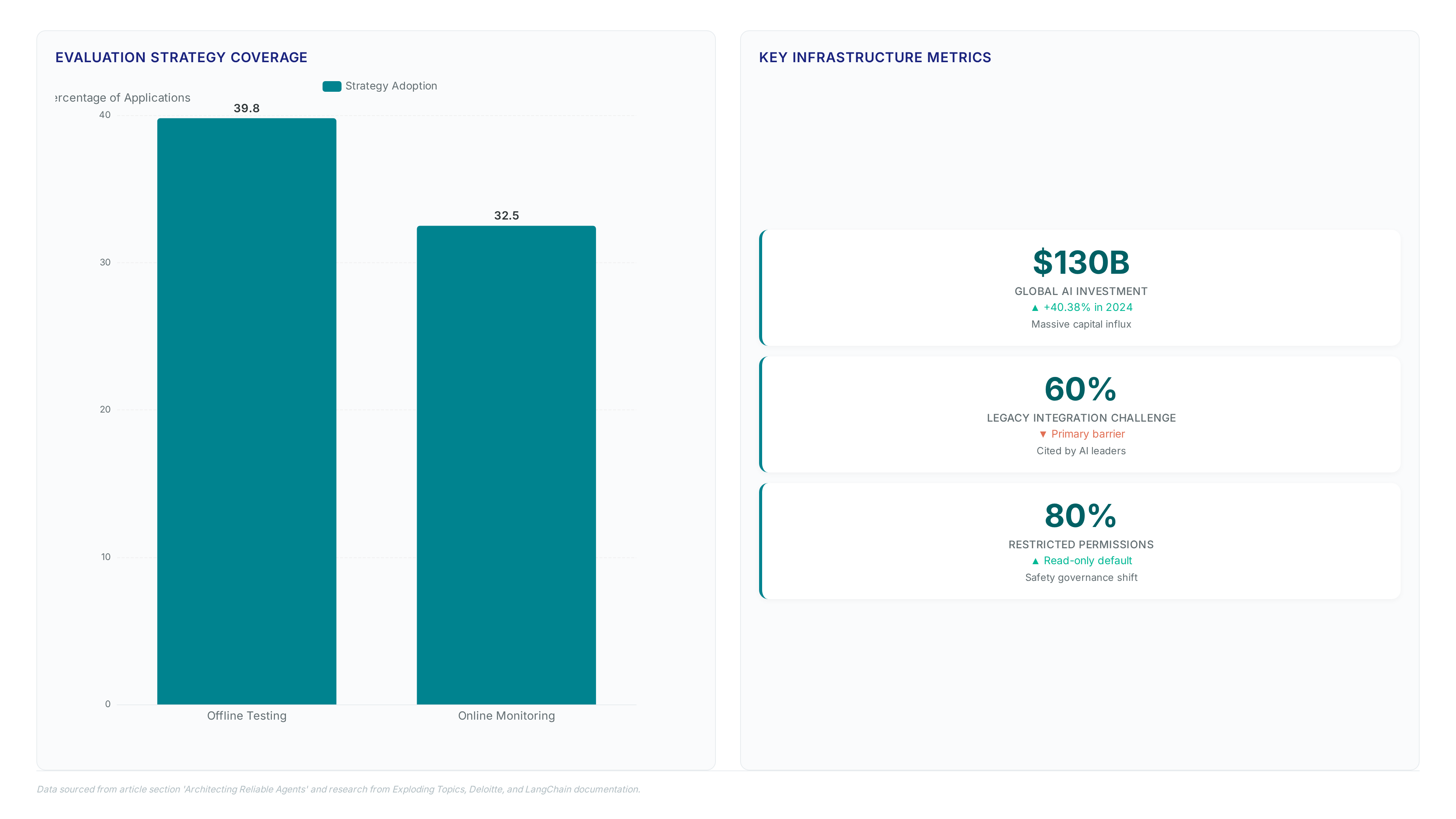
Offline evaluation captures 39.8% of testing strategies, prioritizing static dataset benchmarks over live traffic analysis. This approach relies on pre-production gating where human experts manually verify response quality before deployment. Many organizations deploy human experts to audit outputs, adding a layer of qualitative validation that automated scorers miss. Static tests cannot predict emergent failure modes in flexible conversations because latency remains a fixed constraint.
Conversely, online evaluation monitors 32.5% of applications, assessing performance against real user interactions. This method demands rigorous observability and tracing to capture context drift during execution. Without detailed step-by-step logs, operators cannot reconstruct the decision path leading to a hallucination. Bad answers reach end users before mitigation logic triggers when teams rely solely on live monitoring. Teams often struggle with the knowledge required to instrument proper feedback loops across hybrid environments. Blind spots in agent reliability emerge from reliance on a single metric type. Operators must combine offline safety checks with online performance monitoring to close the governance gap.
Implementing Read-Only Tool Permissions and Human Approval Gates
Few respondents allow agents to read, write, and delete freely, forcing a shift toward restricted tool permissions. Most teams restrict agents to read-only permissions or require human approval for significant actions like writing or deleting to prevent unauthorized state changes. Removing write access to critical databases entirely stops an agent from going off course.
Organizational scale dictates the implementation strategy. Large enterprises (2000+ employees) prefer "read-only" permissions and pair guardrails with offline evaluations. Smaller entities focus more on tracing to understand application behavior before enforcing strict gates.
| Control Strategy | Primary Mechanism | Best Fit |
|---|---|---|
| Read-Only Access | Blocks write/delete API calls | Large Enterprises |
| Human Approval | Requires manual sign-off for writes | High-Risk Actions |
| Detailed Tracing | Logs every tool call for audit | Startups |
Operators must define exactly when to allow write permissions for agents, typically limiting them to non-destructive logging or draft generation. Human-in-the-loop approval slows throughput but prevents catastrophic data loss. Context poisoning can trigger unintended deletions that backup systems cannot instantly reverse without these gates. Organizations implementing detailed tracing gain visibility into these failure modes before they escalate. Rigid guardrails reduce autonomy, yet the alternative permits unchecked modification of production data. AI Agents News recommends pairing read-only defaults with explicit elevation protocols for write operations.
Performance Quality Risks and Legacy System Integration Barriers
Performance quality ranks as the primary barrier to production deployment, overshadowing cost concerns by more than double. Stochastic generation variance causes identical prompts to yield divergent logic paths, creating the technical root cause. Operators must implement deterministic post-processing to stabilize these outputs, though this adds latency.
Legacy integration presents a parallel structural hurdle. Modern neural agents struggle to parse stateful, non-RESTful interfaces common in core banking or telecom switches.
| Integration Challenge | Technical Constraint | Operational Impact |
|---|---|---|
| Protocol Mismatch | gRPC vs. SOAP | High latency translation layers |
| State Management | Stateless LLM vs. Session DB | Context loss during handoffs |
| Authentication | OAuth2 vs. Cert-based | Complex credential rotation |
Cost uncertainty further complicates the business case, with unclear value propositions cited as primary reasons for project termination. The Symbolic/Classical planning required for legacy handshakes conflicts with pure Neural/Generative orchestration models. This architectural divergence forces teams to choose between rewriting core systems or accepting brittle adapter layers. Agent reliability remains below the threshold required for autonomous operation in critical paths without resolving these interface mismatches. AI Agents News recommends prioritizing interface stability over model size to mitigate these integration failures.
Deploying Production-Ready Agents with Human Oversight
Defining Agent Observability and Detailed Tracing Capabilities
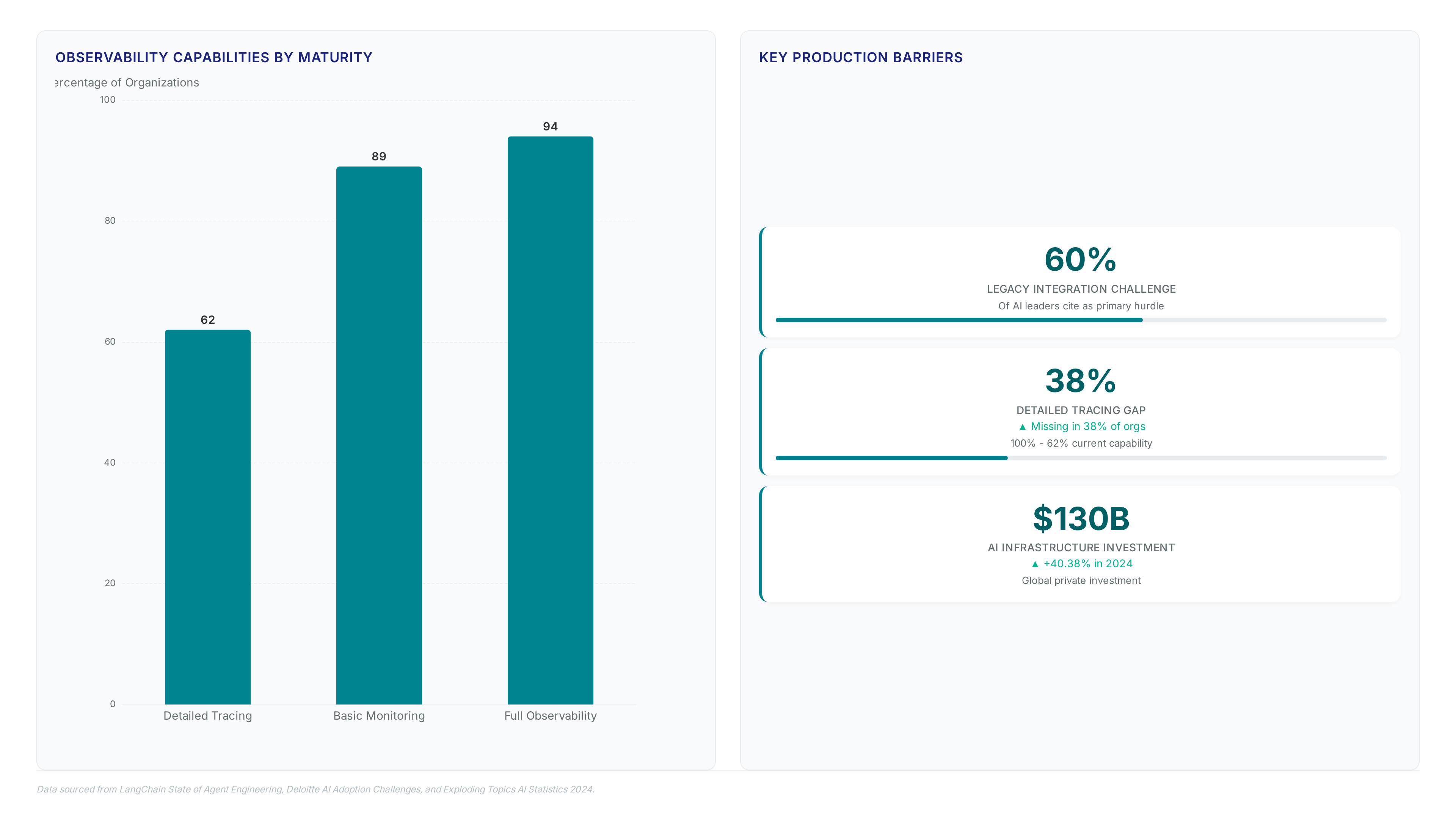
Production readiness demands detailed tracing to inspect individual agent steps and tool calls, a capability currently present in only 62% of organizations. Basic monitoring tracks system uptime, whereas deep observability reconstructs the specific decision path an LLM took to reach a conclusion. Without this granularity, debugging stochastic failures becomes impossible. The mechanism relies on capturing every internal state transition within the LangChain components such as chains and retrievers.
- Capture the full decision path by logging every tool invocation and parameter.
- Implement stateful workflows using graph-based orchestration to maintain context across turns.
- Correlate trace IDs with business logic to identify where context poisoning originates.
The trade-off is latency; thorough logging adds overhead that can degrade real-time response times. Enterprises with deployed agents reach 94% observability adoption, proving that visibility scales with maturity. Operators must accept this performance tax to gain actionable insights into agent behavior. Blind autonomy remains unacceptable for critical infrastructure.
Implementation: Validating Legacy Connectivity Before Enabling Agent Traffic
Validate legacy connectivity by confirming API schemas match agent tool definitions before enabling traffic flow.
- Map existing database fields to the agent's required input structures to prevent context clash.
- Test latency thresholds against the cloud platform hosting the orchestration logic.
- Restrict write permissions until offline evaluation scores exceed baseline accuracy targets.
| Check Point | Validation Method | Failure Mode |
|---|---|---|
| Schema Match | Static Analysis | Context Poisoning |
| Latency | Load Test | Timeout Errors |
| Permission Scope | Audit Log | Unauthorized Delete |
Only one company in recent studies reached Level 3 integration by operating within a lower-risk analytic domain that avoided strict legacy qualification requirements. This outcome highlights a critical tension: greenfield deployments bypass integration debt entirely, whereas brownfield sites must absorb significant engineering costs to align modern agents with antiquated backends. Operators ignoring this disparity face extended timelines where agents remain stuck in pilot purgatory. The governance gap widens when teams skip these steps, leaving autonomous systems without set boundaries. AI Agents News recommends enforcing these gates to prevent uncontrolled state mutations in production environments.
About
Marcus Chen serves as Lead Agent Engineer at AI Agents News, where he daily architects and evaluates production-grade multi-agent systems. His direct experience shipping complex orchestration logic using frameworks like CrewAI, AutoGen, and LangGraph uniquely positions him to analyze the rapid transition of AI agents from niche experiments to enterprise staples. Unlike theoretical observers, Chen tests these tools against real-world constraints, tracking every release to understand how tool use and function calling actually perform under load. This hands-on engineering background allows him to critically assess the survey data showing the projected acceleration of agent adoption through 2028. At AI Agents News, an independent hub dedicated to technical founders and engineers, Chen translates raw framework updates and industry moves into actionable insights. His analysis bridges the gap between hype and implementation, offering builders the precise, comparative data needed to navigate the evolving environment of autonomous agents.
Conclusion
Production adoption turned out to be the easy half, and enterprise-wide scale is the real measure; the gap between pilot success and that scale reveals a harsh reality: integration debt becomes the primary bottleneck, not model intelligence. While greenfield projects demonstrate speed, brownfield environments face exponential complexity when agents interact with legacy backends lacking deterministic guarantees. The cost of maintaining these hybrid systems escalates rapidly as nondeterministic errors require constant human arbitration, eroding the very efficiency gains promised by automation. Teams relying on loose guardrails will find their operations paralyzed by the sheer volume of edge cases that only emerge under production load.
Organizations must commit to a hybrid architecture strategy by Q3 2026, explicitly isolating high-risk agentic decisions from core legacy transactional systems. Do not attempt a full "lift and shift" of autonomous logic onto antiquated infrastructure; instead, build dedicated abstraction layers that enforce strict schema validation before any agent action reaches critical databases. This approach accepts that total autonomy is currently impractical for complex historical systems.
Start this week by auditing your top three legacy API endpoints for state-mutation risks. Document exactly which fields allow destructive writes and immediately implement read-only proxies for any agent prototypes currently in development. This specific constraint prevents catastrophic data corruption while you engineer proper governance gates.
Frequently Asked Questions
Mid-sized companies with 100 to 2,000 employees lead production usage at 63%, outpacing both smaller startups and larger enterprises. Scale is the harder half of the story: only 23% of organizations run agentic systems enterprise-wide, so leading in deployment is not the same as leading in governed infrastructure.
Research and summarization dominate at 58% of deployments, with customer service second at 45.8%. Both carry a validation cost: summaries need strict retrieval checks to keep hallucinated citations out of downstream decisions, and service agents need escalation logic for queries that deviate from trained patterns.
While 90% of non-tech companies plan implementation, few possess the governance layers required for safety. That is the practical blocker rather than appetite: autonomy without observability creates liability instead of value, so the plans outrun the tracing needed to run them.
Survey data indicates 51% of respondents currently run agents in production. External benchmarks are less generous: Gartner's 2026 CIO survey places deployed-agent adoption at 17%, which suggests many production claims lack rigorous validation.
78% of surveyed organizations have active plans to implement these systems soon, so the remaining hesitation is a matter of timing. What those plans meet first is performance quality, which ranks as the primary barrier to production deployment and overshadows cost concerns by more than double.