Agent orchestration: code-based flow vs LLM planning
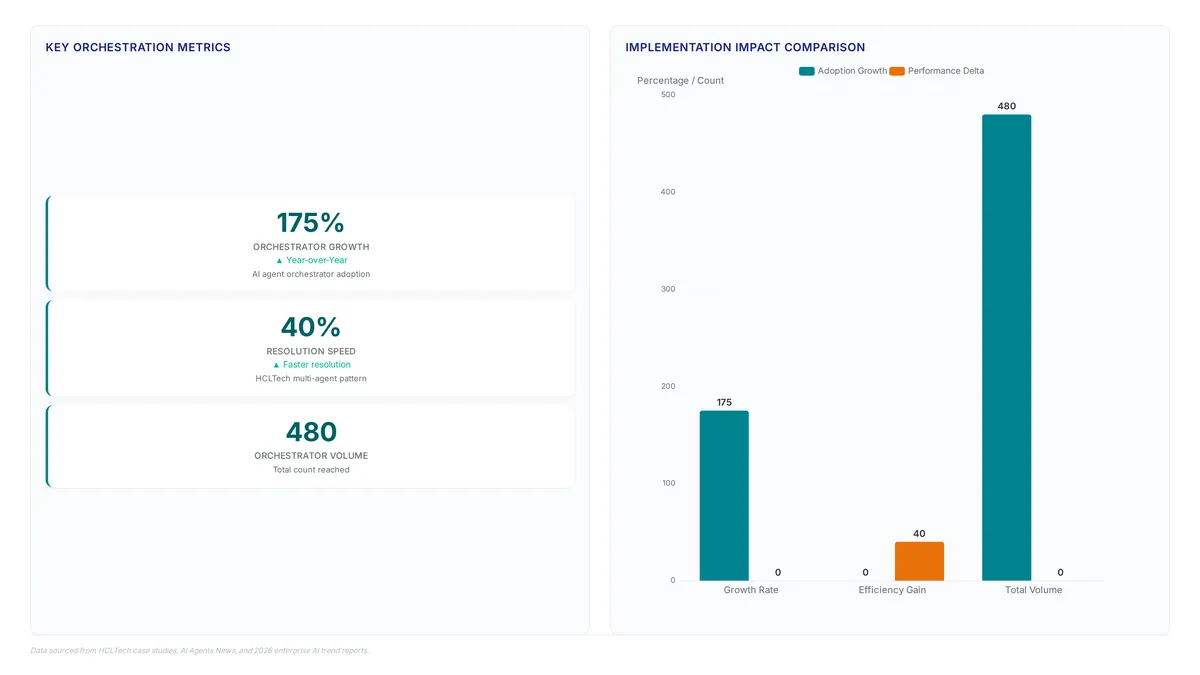
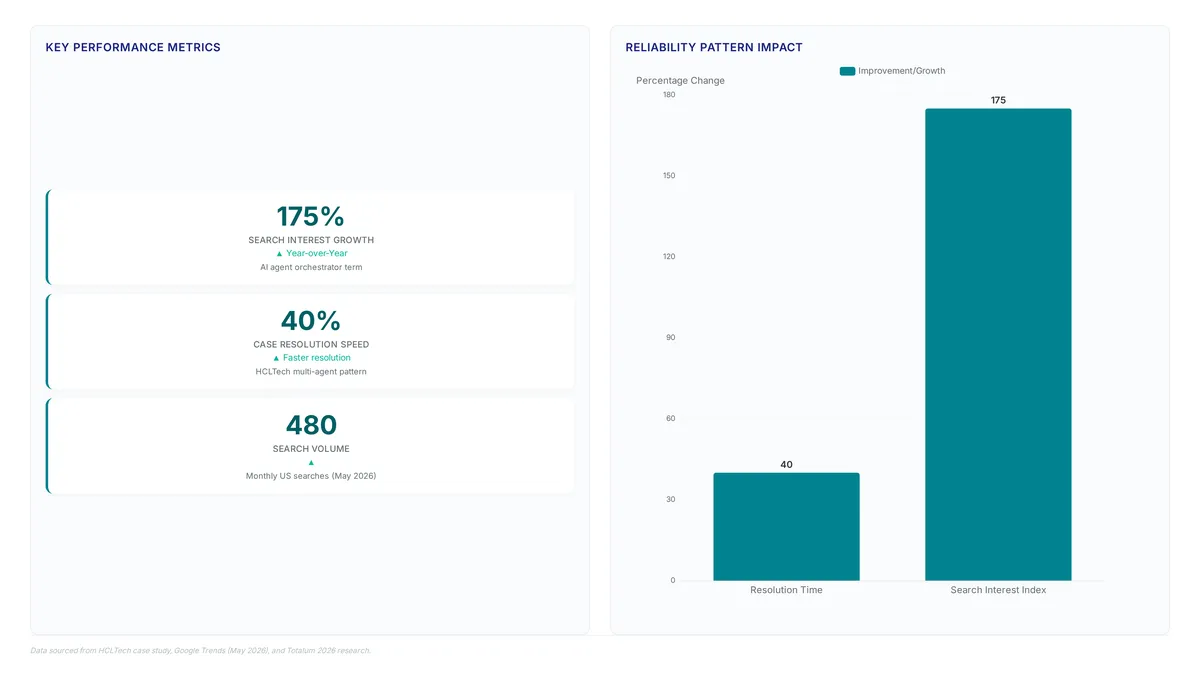
Search interest for "AI agent orchestrator" hit 480 monthly US searches by May 2026. That surge marks a pivot: agent orchestration is no longer experimental; it is critical infrastructure. Reliable multi-agent systems demand structured flow control between specialized units.
Success hinges on distinguishing LLM-driven planning, where the model autonomously grabs tools like web search, from rigid code-based control that hardcodes decision paths. HCLTech didn't just tweak prompts; they implemented specific orchestration patterns to achieve a 40% faster case resolution time. The choice is binary and structural: deploy handoffs to let a specialist agent hijack the conversation, or use the Agent.as_tool pattern for bounded subtasks managed by a central controller.
For architects building with LangGraph or the OpenAI Agents SDK, this mechanics check is mandatory. The difference between a chaotic loop and a functional application often comes down to one decision: do you trust the model to route, or do you force the code to decide?
The Role of Agent Orchestration in Modern Multi-Agent Systems
Defining Agent Orchestration: Flow, Order, and Decision Logic
Agent orchestration dictates execution sequence, agent selection, and the logic governing state transitions. It is the mechanism that converts probabilistic LLM reasoning into deterministic application flow. Search interest for 'AI agent orchestrator' grew 175% year-over-year. The definition is simple: managing flow, order, and decision logic to tame unpredictable LLM behaviors.
Control patterns generally split into two camps. First, let the LLM plan steps autonomously. Second, enforce flow via code. Code-based orchestration wins on speed, cost, and performance predictability. LLM-driven planning only excels in open-ended scenarios requiring flexible tool use.
Relying solely on LLM-based planning invites variability that code-based state machines eliminate. If your workflow demands predictability, you need code-based guards. If it demands exploration, model autonomy works. But do not pretend a single prompt can do both reliably.
Applying Agents as Tools vs Handoffs in Python SDKs
The Python SDK forces a choice: delegate subtasks via Agents as tools or transfer the conversation via Handoffs. Agents as tools keeps a manager agent in the driver's seat, invoking specialists through Agent.as_tool. Use this when a single entity must own the final answer or enforce shared guardrails across multiple bounded subtasks. Handoffs employ a triage agent to route the interaction to a specialist, making that specialist the active agent for the remainder of the turn. This is optimal when routing logic dictates workflow progression and the chosen specialist must own the subsequent interaction directly.
| Pattern | Control Ownership | Best Use Case |
|---|---|---|
| Agents as tools | Manager Agent | Bounded subtasks; unified output synthesis |
| Handoffs | Specialist Agent | Direct response requirements; focused prompts |
Architects often struggle between maintaining global context and minimizing prompt complexity. A manager aggregating all tool outputs combines multiple specialist responses, whereas full handoffs transfer the active role entirely. You can combine these: a triage agent hands off to a specialist that subsequently calls other agents as tools for narrow computations. Detailed implementations of these composition patterns emphasize code-based orchestration to ensure determinism over purely probabilistic LLM planning. The rule is strict: if the manager must narrate results, use tools. If the specialist must drive the dialogue, use handoffs.
Scaling Risks: Human-in-the-Loop Constraints and Agent Limits
Human review capacity, not technical agent count, binds production scaling. A practical limit for production systems involves managing 10-20 agents across multiple functions, as oversight bandwidth restricts further expansion. Labor costs for supervision often exceed compute expenses in human-in-the-loop scenarios.
Mitigation requires strict agent specialization to reduce cognitive load on human reviewers. Deploy hierarchical delegation patterns where a single triage agent routes requests, ensuring specialists handle only narrow, well-set domains. Production systems often apply a "Supervisor + Specialists" pattern where specialization is prioritized over prompt bloat to ensure reliability.
| Risk Factor | Mitigation Strategy |
|---|---|
| Review Bottleneck | Limit active agents to 10-20 per function |
| Opaque Failures | Enforce deterministic code paths for critical steps |
| High Labor Cost | Optimize oversight workflows before adding agents |
Align agent count with available human review capacity. The shift from single-agent loops to complex systems is driven by task complexity exceeding context windows, yet this introduces new coordination overhead. Prioritize optimizing human oversight workflows over maximizing autonomous agent quantity. Validate supervisor/worker topologies against actual human throughput limits before deployment.
Mechanics of LLM-Driven Planning Versus Code-Based Control
LLM Autonomy vs Code Determinism in Agent Planning
Control flow defines the mechanical split between model intelligence and application logic. An agent functions as an LLM equipped with instructions, tools, and handoffs, enabling autonomous planning for open-ended tasks by acquiring data and delegating via sub-agents. This pattern depends entirely on the model for decision-making, demanding heavy investment in prompts and evals to sustain reliability.
Orchestrating via code shifts authority to the developer, rendering execution deterministic across speed, cost, and performance metrics. The approach uses structured outputs to produce inspectable data, permitting the host to route logic through rigid categories instead of probabilistic reasoning. Engineers frequently employ Python primitives like asyncio.gather to execute parallel tasks, securing predictable latency that pure model loops fail to guarantee.
| Feature | LLM Orchestration | Code Orchestration |
|---|---|---|
| Control Owner | Model (Runtime) | Developer (Pre-set) |
| Predictability | Low (Probabilistic) | High (Deterministic) |
| Best Use Case | Open-ended exploration | Fixed workflows |
Code-based control struggles with novel scenarios falling outside pre-set branches. Pure LLM planning risks infinite loops absent strict guardrails. Flexibility clashes with reliability; selecting the wrong pattern forces operators to over-engineer simple tasks or under-engineer complex reasoning. Analyze task variance before pattern selection because migrating from a deterministic chain to autonomous planning later demands significant architectural refactoring. AI Agents News suggests reserving full autonomy for problems where the solution path remains unknown at deploy time.
Executing Parallel Tasks with Asyncio and While Loops
Simultaneous agent execution becomes possible when subtasks lack interdependencies, thanks to Python primitives like asyncio.gather. Distributing work across concurrent threads cuts total latency by avoiding sequential waiting periods. Developers wrap individual agent run calls within the gather function, maximizing throughput during independent operations. Parallel execution consumes notably more tokens per cycle though, necessitating strict budget caps to prevent cost overruns.
Feedback loops adopt a while loop structure where a worker agent generates output and an evaluator agent validates it against criteria. The cycle repeats until the evaluator confirms the result passes quality checks or a maximum iteration count is reached. This method forces convergence on complex tasks where a single pass often misses precision standards. Unbounded loops risk infinite execution if evaluator logic contains flaws or criteria remain unmet.
Source documentation confirms these patterns allow code to enforce deterministic speed and performance constraints that pure LLM planning cannot guarantee. Practical implementations of these workflows appear in the examples/agent_patterns repository for reference. Operators must balance the determinism of code-controlled loops against the computational expense of repeated evaluation calls.
| Pattern | Mechanism | Constraint |
|---|---|---|
| Parallel Execution | asyncio.gather runs agents concurrently | Token budget multiplies by agent count |
| Evaluation Loop | while loop repeats until criteria met | Risk of infinite cycles without exit |
Tool Usage Patterns: Web Search vs Structured Data Outputs
Flexible tools like web search and computer use drive LLM discovery through open-ended information spaces. These capabilities let an agent autonomously plan steps, using file search and retrieval to access proprietary data connections without rigid pre-definition. Flexibility introduces output format variability though, making downstream processing unreliable for strict engineering workflows.
Code-based orchestration fixes agent routing errors by enforcing structured outputs that generate well-formed data for immediate inspection. Developers change raw model responses into categorized inputs, effectively chaining multiple agents by converting one output into the next deterministic step. This pattern decomposes complex tasks, such as blog generation, into distinct research, outlining, and writing phases that code can validate.
| Feature | LLM-Driven Discovery | Code-Based Control |
|---|---|---|
| Primary Input | Flexible tools (search, computer use) | Structured output schemas |
| Control Flow | Autonomous planning via prompts | Deterministic code logic |
| Best Use Case | Open-ended exploration | Reliable data transformation |
| Failure Mode | Prompt drift or hallucination | Schema validation errors |
Auditing decision paths proves difficult when models deviate from intended tool usage in pure LLM planning. Relying solely on code reduces the system's ability to handle novel scenarios requiring computer use for unexpected data sources. Balance these approaches; relying entirely on autonomous planning risks unbounded token consumption, while over-engineering code constraints stifles the model's adaptive reasoning. The optimal architecture often employs code to define the workflow boundaries while allowing LLMs to execute specific tools within those guardrails.
Strategic Implementation of Handoffs and Agent-as-Tool Patterns
Manager Control vs Direct Response in Agent Patterns
Retaining a manager agent allows the system to aggregate specialist outputs through Agent.as_tool without surrendering conversation state. This architecture forces a single entity to enforce shared guardrails and synthesize final answers, preventing fragmented user experiences during complex workflows. Centralizing control requires the manager to process every subtask response before replying to the user. Deploy this pattern when bounded subtasks require strict validation before inclusion in the primary context window.
Transferring active ownership to a specialist immediately after triage defines the Handoffs approach. Direct response generation occurs without manager narration. This pattern works best when the specialist must respond directly, keep prompts focused, or swap instructions without the manager narrating the result. The limitation is that the triage agent routes the conversation to a specialist, and that specialist becomes the active agent for the rest of the turn.
Workflow priorities determine the choice between unified output consistency and specialist autonomy. Visual builders now support these configurations, allowing non-technical users to define workflow logic without writing code, though code-based orchestration remains superior for deterministic performance. Detailed implementation strategies regarding these composition patterns appear in the Tools documentation to explain manager-style orchestration primitives. AI Agents News recommends evaluating prompt complexity; having specialized agents that excel in one task is preferable to relying on a general purpose agent expected to be good at anything.
Optimizing Agent Reliability Through Feedback Loops and Prompt Engineering
Feedback Loops: Evaluator Agents and Prompt Refinement Cycles
Running an agent in a while loop with a separate evaluator creates a self-correcting workflow that halts only when output meets strict validation criteria. This mechanism shifts reliability from probabilistic prompt engineering to deterministic code-based control, addressing task complexity that exceeds single context windows. The process requires a primary worker agent to generate content and a secondary evaluator agent to assess it against set rules, triggering refinement cycles until the evaluator approves the result.
- Define clear pass/fail criteria for the evaluator agent to inspect structured outputs.
- Execute the worker agent and pass its response to the evaluator within a code loop.
- If validation fails, feed the error message back to the worker for immediate revision.
- Terminate the loop only when the evaluator confirms the output satisfies all constraints.
Specialization beats prompt bloat by assigning narrow roles to distinct agents rather than overloading a single model instruction set. However, this architecture increases token consumption because every failed validation cycle incurs the cost of two additional model calls. Operators must balance the desire for perfect output against the latency and expense of repeated inference passes. For builders managing these systems, AI Agents News recommends monitoring rejection rates to tune evaluator strictness. The trade-off is measurable: higher accuracy demands more compute resources per completed task.
Implementing Structured Outputs for Agent Decision Accuracy
Classifying inputs into rigid JSON schemas transforms probabilistic LLM reasoning into deterministic routing logic that code can inspect. By forcing agents to emit structured data rather than free text, developers resolve routing errors where natural language ambiguity causes agents to select incorrect downstream functions. This approach shifts orchestration from purely model-based guessing to code-verified decision trees, significantly improving speed and cost predictability.
- Define a strict Pydantic model or JSON schema representing valid routing categories and required parameters.
- Configure the agent's response format to enforce this schema, preventing malformed output generation.
- Parse the resulting JSON in your application layer to execute precise function calls or handoffs.
| Failure Mode | Unstructured Output | Structured Output |
|---|---|---|
| Routing Logic | Substring matching fails on variations | Exact enum matching guarantees accuracy |
| Error Handling | Complex regex required | Native parsing exceptions |
| Context Usage | High token consumption for explanations | Minimal token overhead |
A critical limitation arises when input queries fall outside predefined categories; the system must handle schema validation failures gracefully rather than crashing. Unlike hierarchical delegation which relies on the LLM to navigate tree structures dynamically, structured outputs require exhaustive category definitions upfront. This trade-off sacrifices some adaptability for guaranteed interface contracts between agents. Deploy this pattern when task domains are bounded and routing correctness outweighs the need for open-ended exploration. For thorough examples of these primitives, consult the Quickstart guide. Monitoring parsed fields provides immediate visibility into classification distribution, enabling rapid iteration on category definitions without reviewing raw chat logs.
Validation Checklist for Production Agent Reliability
Production reliability starts with a fixed list of pass/fail criteria set before any agent execution begins. Fleet size stays bound by human review capacity rather than technical scaling limits, because oversight fatigue degrades system safety during high-volume operations.
- Define explicit validation schemas using Pydantic models to force structured outputs for every decision point.
- Implement a critique loop where a dedicated evaluator agent rejects outputs until they meet static rules.
- Restrict tool contracts to read-only operations by default, requiring manual approval for any write actions.
- Log all handoff events to trace exactly where context was lost or misinterpreted between specialists.
The table below contrasts validation strategies for different orchestration modes.
| Strategy | Best For | Limitation |
|---|---|---|
| Evaluator Loop | Complex reasoning tasks | Increases latency per request |
| Structured Output | Routing and classification | Requires rigid schema definition |
| Human-in-Loop | High-stakes financial actions | Bound by reviewer availability |
A critical tension exists between automation speed and the cost of human oversight; as fleets grow, labor costs for validation often exceed compute expenses. This shift implies that optimizing for token efficiency yields diminishing returns if the evaluation bottleneck remains manual. Prioritize reducing the frequency of human interventions through improved self-correction mechanisms. For deeper implementation patterns, consult the Running agents guide. AI Agents News recommends testing these loops against edge cases before full deployment.
About
Marcus Chen, Lead Agent Engineer at AI Agents News, brings direct engineering rigor to the complex topic of agent orchestration. Having shipped production multi-agent systems, Chen understands the critical tradeoffs between LLM-driven planning and code-set workflows that dictate system reliability. His daily work involves evaluating frameworks like LangGraph, AutoGen, and CrewAI release-by-release, focusing specifically on how agents coordinate tool use and manage state transitions. This hands-on experience allows him to dissect orchestration patterns without vendor hype, grounding technical analysis in real-world deployment constraints rather than theoretical capabilities. At AI Agents News, an independent hub for technical founders and engineers, Chen's role is to translate these architectural nuances into actionable guidance. By connecting deep familiarity with function calling mechanics and evaluation harnesses to the article's thesis, he ensures builders can make informed decisions on structuring agent flows for their specific application needs.
Conclusion
Scaling agent fleets exposes a hard truth: latency from evaluation loops often outweighs the cost of compute, making purely probabilistic flows unsustainable for critical paths. The industry shift toward determinism via state machines is not merely architectural preference but an operational necessity to cap human review costs. While interest in orchestration tools surges, teams that rely on giant prompts without bounded decision states will face compounding failure rates as complexity grows. You must transition from reactive debugging to proactive flow control where LLMs handle only bounded decisions within rigid structures.
Adopt a hybrid architecture immediately by implementing state machines for all multi-step workflows before your next substantial deployment cycle. This approach isolates non-deterministic behavior, ensuring that context loss during handoffs does not cascade into system-wide errors. Start this week by auditing your current agent definitions to identify any write-capable tools lacking explicit Pydantic validation schemas. Replace open-ended text generation with structured output constraints for every routing decision. This specific constraint forces the system to fail safely rather than hallucinate actions, directly addressing the bottleneck where manual oversight becomes prohibitively expensive. Reliable automation demands that you treat flow control as a distinct layer separate from intelligence generation.
Frequently Asked Questions
Implementing specific orchestration patterns yields significantly quicker resolution times for complex cases. HCLTech reported a 40% faster case resolution time after adopting these structured workflows instead of relying on generic prompting methods.
Human review capacity limits practical management to a specific range of concurrent agents. Production systems typically handle between ten and twenty agents across multiple functions before human oversight becomes a bottleneck.
Code-based orchestration provides superior determinism regarding speed, cost, and overall performance metrics. This approach is necessary when tasks require predictable outcomes rather than the open-ended flexibility offered by autonomous model planning.
Four controls carry production reliability: validation schemas at every decision point, a critique loop with a dedicated evaluator, read-only tool contracts by default, and logs of every handoff event.
Market demand has surged dramatically as the technology shifts from experimental to critical infrastructure. Search interest for AI agent orchestrator grew 175% year-over-year, reaching 480 monthly US searches by May 2026.
References