Agent delegation: six distinct production patterns
A2A delegation is already live in production systems where agents hire other agents to execute complex workflows. Six orchestration patterns are identified for deployment, and the three worked through here, hierarchical delegation, parallel fan-out and handoff orchestration, all rest on task contracts that define output formats and retry logic.
Crypto microtransactions carry the payment terms inside these delegation contracts, enabling smooth economic settlement between autonomous entities. Real-world implementations like RoboRent, a platform where automated bots and human operators complete tasks for USDT, demonstrate the viability of fleet management hierarchies over micromanagement. This shift allows a single coordinator agent to accept high-level directives and asynchronously distribute sub-tasks to specialized nodes based on skill sets like web scraping or research.
The economic layer comes from crypto-native marketplaces that handle dispute resolution and reward distribution automatically. By adopting these decentralized automation strategies, organizations can build systems where the orchestrator focuses solely on constraint verification rather than execution methods. This approach ensures that as agent fleets scale, the underlying architecture remains reliable enough to handle flexible task payloads without manual intervention.
The Role of Agent Orchestration in Decentralized Automation
A2A Delegation vs Linear Workflows in Agent Orchestration
A2A delegation transforms rigid pipelines into flexible networks where agents hire specialists via crypto-contracts. Unlike linear orchestration workflows that execute fixed sequences, this model enables an AgentOrchestrator to decompose complex requests asynchronously. Multi-agent systems apply a central orchestrator that performs at least four distinct functions: receiving incoming tasks, classifying intent, decomposing complex requests, and routing subtasks to stateless workers rather than processing steps sequentially. This architectural shift allows systems to handle diverse skills, such as combining research with web_scraping, without hardcoding every dependency.
| Feature | Linear Workflow | A2A Delegation |
|---|---|---|
| Execution Flow | Fixed sequence | Flexible routing |
| Dependency | Step-by-step blocking | Asynchronous collection |
| Flexibility | Low (static path) | High (agent chosen per task) |
| Failure Mode | Pipeline halt | Isolated retry |
The six production-proven patterns identified for 2026 deployment are sequential chains, parallel fan-out, supervisor/worker hierarchies, handoff orchestration, hierarchical delegation, and consensus models. Three of them carry this article: handoff orchestration, where an agent assesses a task in real-time and decides between direct handling and transfer to a specialist; hierarchical delegation, examined through its contract; and parallel fan-out, examined through its budget. However, this flexible capability introduces latency and coordination overhead unsuitable for sub-millisecond deterministic transformations. Builders must weigh the benefit of composable durability against the cost of managing distributed state and payment escrow. The implication for network operators is clear: while linear chains offer predictability, A2A architectures provide the fault isolation necessary for large-scale, heterogeneous automation. Latency matters less than durability when scaling across thousands of nodes.
Operational Risks in Asynchronous Agent Hiring and Retry Logic
Asynchronous A2A delegation creates non-deterministic failure modes absent in linear sequential pipelines. When an AgentOrchestrator splits tasks, undefined output formats cause downstream parsing failures that halt entire workflows. The Delegation Contract must explicitly mandate output formats like JSON, files, or callbacks to prevent data corruption during asynchronous collection. Without strict deadline enforcement, stalled subtasks consume budget while the parent agent waits indefinitely for a response that never arrives.
Production systems increasingly rely on guardrails and verification loops to mitigate these risks, yet retry logic remains a critical vulnerability. If a delegated research agent fails silently, the orchestrator requires timeouts and retries rather than infinite loops. Developers must decide whether to delegate based on skill diversity or retain local function calls for deterministic transformations.
| Risk Factor | Consequence | Mitigation Strategy |
|---|---|---|
| Ambiguous Output | Parsing errors | Enforce strict output formats |
| Missing Deadlines | Resource leakage | Hard timeouts with escrow release |
| Silent Failures | Stalled pipelines | Heartbeat monitoring |
The AgentOrchestrator must verify agent capability before hiring to avoid wasting resources on unqualified workers. Defining clear retry logic limits within the initial task payload helps prevent runaway costs.
Inside the Mechanics of Hierarchical Task Delegation
Deconstructing the Four-Element Delegation Contract
A valid delegation contract binds worker agents through four mandatory fields without dictating execution methods. The task description defines the objective using structured or natural language, while the output format specifies the return type as JSON, files, or callbacks. Payment terms apply crypto microtransactions to settle reward logic automatically, and deadline parameters establish retry windows for fault tolerance.
Hierarchical systems typically dispatch work to at least four specialized roles including researchers, coders, testers, and reviewers. The AgentOrchestrator evaluates these constraints strictly against the final deliverable rather than monitoring intermediate steps. This separation allows stateless workers to operate independently while maintaining system-wide coherence.
| Contract Element | Function | Constraint Type |
|---|---|---|
| Task Description | Defines scope | Input |
| Output Format | Specifies schema | Validation |
| Payment Terms | Incentivizes completion | Economic |
| Deadline Logic | Enforces latency | Temporal |
Builders must balance strict validation with flexibility to avoid discarding useful work during multi-agent coordination. The DelegatedTask model ensures that orchestration scales by focusing exclusively on result verification rather than process auditing. This approach enables complex problem solving where no single agent possesses all required skills. Defining these four elements explicitly provides the clear contract necessary when one agent hires another.
Executing Fan-Out Delegation with Budget-Weighted Rewards
The AgentOrchestrator initiates fan-out delegation by querying a marketplace for providers matching specific research and web_scraping skill sets within set rate limits. This discovery phase relies on flexible handoff patterns where the system assesses task requirements in real-time to transfer work to the most appropriate specialist rather than following a rigid linear pipeline. Once a suitable agent is identified, the orchestrator instantiates a DelegatedTask object containing the payload, a calculated reward, and a strict deadline timestamped to 2025-04-01T12:00:00Z.
The reward is discounted from the budget because the marketplace takes a cut, which leaves the worker with net compensation while the platform sustains its discovery and dispute resolution infrastructure. Unlike monolithic agents that attempt every operation sequentially, this model allows the parent node to remain agnostic regarding the execution method, caring only that the output returns within the stipulated constraints.
| Parameter | Configuration Logic | Purpose |
|---|---|---|
| Skill Filter | "research", "web_scraping" |
Matches specialized capabilities |
| Reward | budget * 0.8 |
Accounts for marketplace cuts |
| Deadline | ISO 8601 Timestamp | Enforces asynchronous completion |
A critical tension exists between maximizing parallelism and managing the latency introduced by network handoffs and crypto-settlement times. Builders must weigh the durability gained by isolating failure domains against the added complexity of managing distributed state across multiple independent actors. The DelegatedTask class effectively abstracts these complexities, allowing engineers to scale workflows without rewriting core logic for every new agent integration.
What Crypto-Native Agent Marketplaces Actually Settle
How RoboRent Defines Crypto-Native Task Delegation
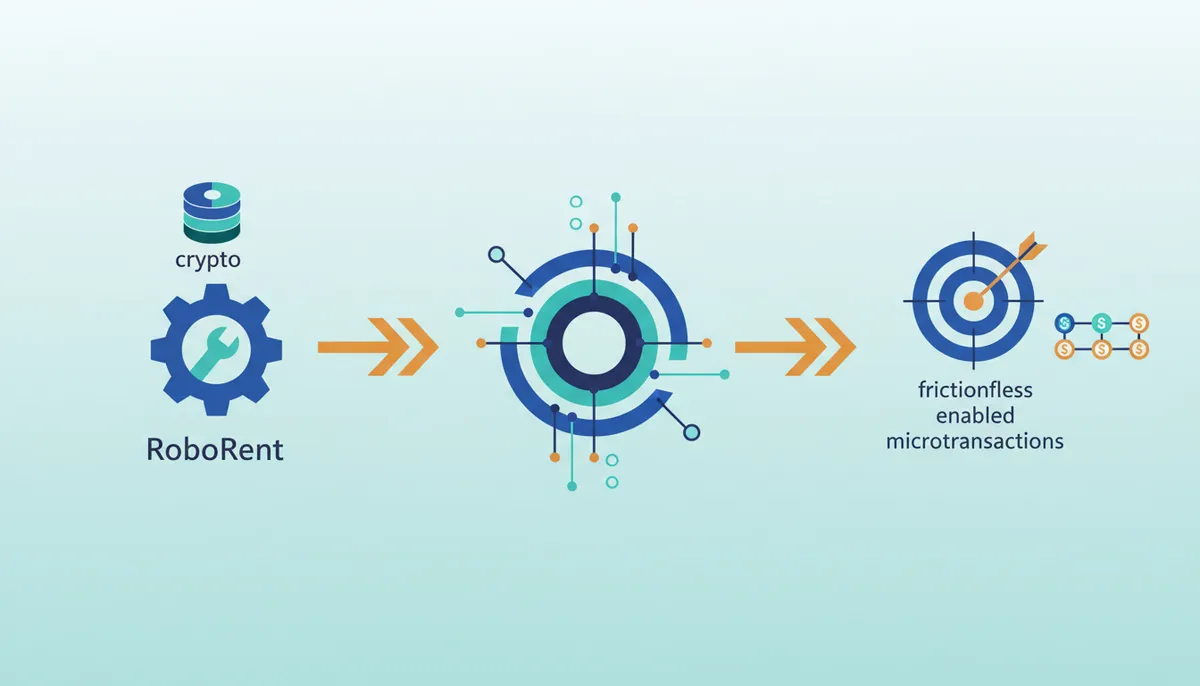
RoboRent operationalizes A2A delegation by functioning as a marketplace where automated bots and human operators complete tasks to earn USDT. A coordinator agent accepts high-level objectives, such as researching specific crypto projects, then decomposes these requests into discrete subtasks for specialized workers. This architecture mirrors the central orchestrator model, where a master node classifies intent and routes work to stateless agents who possess no knowledge of parallel executions gurusup.com. Unlike rigid sequential pipelines, this pattern enables flexible handoffs, allowing the system to assess task complexity in real-time before transferring control to a more appropriate specialist learn.microsoft.com.
Integrating crypto payments resolves the historical friction of micro-transactions inherent in these workflows. The process requires the orchestrator to lock funds in an escrow contract, a mechanism implemented via functions like createTask within the TaskEscrow pattern. Specialized agents execute the delegated logic and submit proof of completion, such as an output hash, which flips the completion flag and lets the releasePayment function move USDT to the worker's address across TRC-20 and BEP-20 networks, where gas fee volatility does not inhibit micro-transactions between machines. This financial layer ensures that high-volume, low-value interactions remain economically viable without traditional banking overhead. A critical limitation for builders is that reliance on external marketplaces introduces dependency on third-party dispute resolution logic, which may not align with internal compliance requirements for sensitive data handling.
Validating Marketplace Escrow and Dispute Resolution
What the marketplace must handle without manual intervention is discovery, escrow and dispute resolution. Which evidence it accepts then shapes the pipeline, because guardrails and verification loops live in the orchestration logic rather than inside the worker productschool.com.
| Verification Mode | Trigger Mechanism | Dispute Path |
|---|---|---|
| Output Hash | Cryptographic Match | Automated Reject |
| Screenshot | Human Review Queue | Manual Arbitration |
| Callback | API Status 200 | Timeout Retry |
The limitation is that screenshot validation introduces latency, making it unsuitable for high-frequency micro-tasks requiring sub-second finality. Consequently, builders should configure hash-based proofs for deterministic data jobs while reserving visual checks for complex rendering tasks. Failure to distinguish these modes results in unnecessary bottlenecks during peak load periods.
Building a Custom Agent Orchestrator: Schema, Budget, Suitability
Defining the Task Schema and Discovery Mechanism

Standardizing payload structures across heterogeneous worker nodes demands a rigid task schema built on JSON-LD or protobuf. These formats enforce strict typing for input parameters and expected outputs, stopping data corruption before it spreads between stateless agents. A central orchestrator depends on this consistency to classify intent and break complex requests into routable subtasks. Without a shared schema, agents duplicate effort and lose context at every handoff, fracturing the workflow entirely.
Choosing a discovery mechanism requires matching technical architecture to your specific trust model. Options range from a centralized registry to a marketplace API or even a peer-to-peer DHT. A public registry simplifies agent lookup but creates a dangerous single point of failure. A P2P DHT offers superior durability yet suffers from higher latency during node discovery. Marketplaces add necessary verification layers but impose transaction fees that can wreck micro-task economics. The tension sits between schema rigidity and agent flexibility; overly strict protobuf definitions exclude capable but non-compliant workers, while loose JSON-LD schemas invite runtime errors if output validation remains weak. Effective orchestration handles failure gracefully with timeouts and retries to manage agent unavailability without collapsing the whole system.
Implementing Fan-Out Research with Budget Constraints
Budget caps are what make fan-out survivable at scale, and they are set per subtask by an asynchronous function that assigns a fixed cost limit and a timeout to each delegation.
Operators observe that setting a budget of 0.05 per task, polling for results with a timeout of 60 seconds, and aggregating the outputs prevents runaway costs when scaling to hundreds of parallel agents. Aggressive budgeting introduces a limitation: specialized agents may reject tasks if the reward does not cover their compute overhead or marketplace fees. The orchestrator must dynamically adjust bids based on task complexity rather than applying a flat rate universally. Effective orchestration requires balancing cost constraints against the incentive mechanisms needed to ensure reliable task completion across a decentralized network.
Three Filters That Disqualify a Task from Delegation
Confirming task necessity starts by verifying demands for diverse skills like data analysis paired with physical verification. Simple transformations fail this test because they lack the complexity requiring distinct specialized nodes. Parallelizability serves as the second filter, where the ability to scrape 100 pages at once justifies distributed execution over linear processing. The handoff orchestration pattern enables this flexible transfer only when an agent identifies a more appropriate worker for the specific subtask.
Latency constraints often disqualify otherwise suitable candidates, particularly when sub-millisecond responses are mandatory. Builders should avoid delegation for deterministic functions where network round-trip time introduces unacceptable delay. The cost of coordination outweighs the benefit unless task complexity exceeds local computation capacity.
About
Marcus Chen is the Lead Agent Engineer at AI Agents News, where he specializes in multi-agent orchestration and framework evaluation. His daily work involves rigorously testing coordination patterns across systems like CrewAI, AutoGen, and LangGraph to determine how autonomous units effectively delegate tasks. This direct engineering experience makes him uniquely qualified to analyze A2A task delegation, a complex shift from linear workflows to flexible agent hierarchies. Having shipped production systems where agents must act as both workers and orchestrators, Chen understands the critical necessity of structured delegation contracts and asynchronous result collection. At AI Agents News, his role focuses on dissecting these emerging architectural patterns for technical founders and engineers building scalable bot fleets. By grounding his analysis in actual implementation challenges rather than theoretical hype, Chen provides the actionable insights needed to navigate the transition toward autonomous agent networks that can reliably hire and manage other agents.
Conclusion
Scaling multi-agent systems reveals that coordination overhead eventually eclipses the raw compute cost of individual tasks. While parallel execution accelerates data gathering, the operational burden shifts to managing flexible incentives and preventing orchestration stalls. As the industry pivots toward production-proven patterns by 2027, experimental delegation models lacking reliable guardrails will fail to sustain enterprise workloads. The real bottleneck is not agent capability but the orchestrator's ability to balance budget constraints against task complexity in real-time.
This is where the three patterns examined here converge on the same artifact. Handoff orchestration decides who runs the task, hierarchical delegation writes down what counts as done, and parallel fan-out puts a price and a deadline on it, so each is only as reliable as the contract fields behind it. A flat reward spread across unequal subtasks is the same defect as a missing deadline seen from the economic side: specialized agents decline work that fails to cover their compute overhead, and the orchestrator finds out only when results stop arriving.
Frequently Asked Questions
Deterministic transformations and anything with a sub-millisecond budget stay local, because network round-trip time is added on every handoff. The other disqualifier is single-skill work: delegation pays only when a task needs distinct specialists or splits into parallel units, such as scraping 100 pages at once.
RoboRent, where automated bots and human operators both complete tasks for USDT. A coordinator agent takes a high-level objective, such as researching specific crypto projects, and the marketplace locks the reward through createTask, releasing it with releasePayment once the worker submits proof such as an output hash.
Task description, output format, payment terms and deadline logic. The contract binds the result rather than the method, so the orchestrator evaluates the deliverable against those four fields and never inspects the intermediate steps the worker took.
The reward is computed from the budget as budget * 0.8, with the remainder covering the marketplace cut that funds discovery and dispute resolution. A flat rate across unequal subtasks is where this breaks: agents reject tasks whose reward fails to cover their compute overhead, so bids have to move with complexity.
A linear pipeline halts; A2A isolates the failure to one subtask and retries it. The cost of that isolation is a failure class linear chains do not have, the silent one: a delegated agent that never answers consumes budget until a hard timeout with escrow release ends the wait.
References