Function calling explained: JSON plans, not code execution
Learn how function calling uses structured JSON to anchor AI to real data, eliminating hallucinations through a strict four-step execution cycle.
Framework reviews, autonomous coders and multi-agent systems — tracked and explained by the AI Agents News desk.
Learn how function calling uses structured JSON to anchor AI to real data, eliminating hallucinations through a strict four-step execution cycle.
Learn to build an agente de IA using LangChain's ReAct pattern. Discover how the four critical components create reliable, stateful automation.
Microsoft Agent Framework reached version 1.0 GA in mid-2026, replacing stateless loops with durable, graph-based workflows for Python and .NET teams.
Explore 1,672 commits of executable lessons on agent memory, context engineering, and securing systems against injection attacks.
Data shows single agents falter near 20,000 documents. Learn the ReAct pattern and memory thresholds for robust multi-agent architecture.
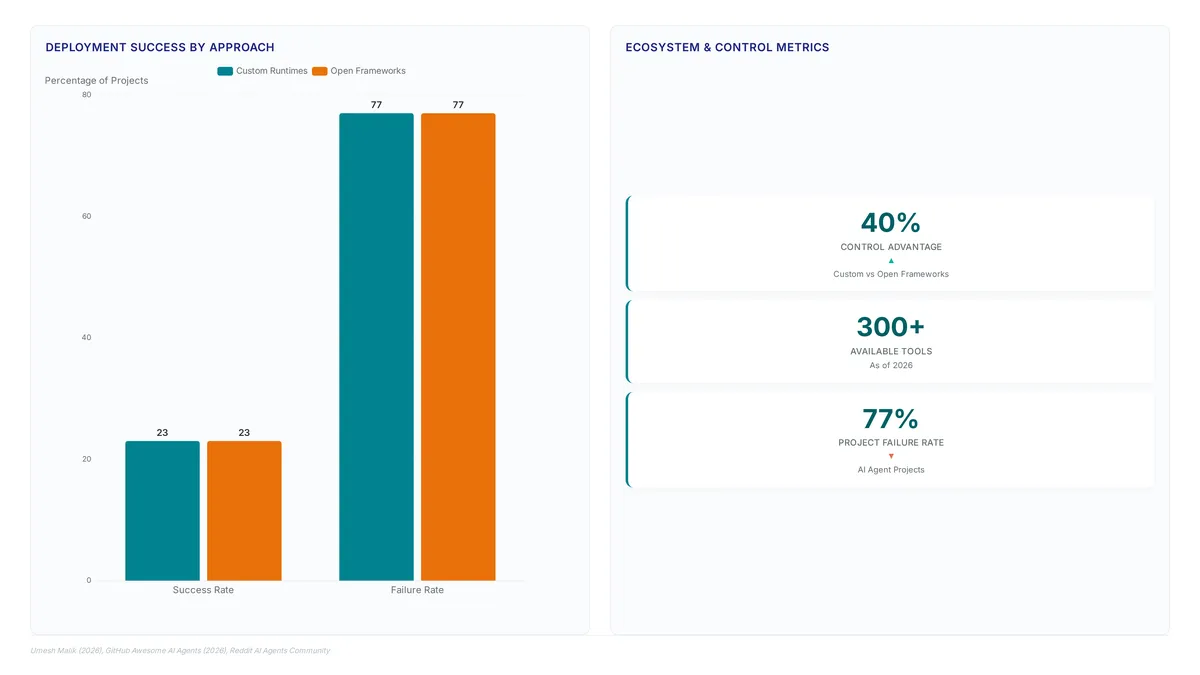
Seventy-seven percent of AI agent projects fail to reach production, leaving only a fraction of deployments operational according to recent 2026 data.
OpenHands hits 77% on SWEBench Verified using a stateless event-driven architecture. Learn how the append-only EventLog enables robust coding agents.
Manage OpenHands, Claude Code, and Codex in one self-hosted interface. Learn how the system handles 16.1K-view workflows without cloud lock-in.
Claude Code's $20 monthly fee unlocks terminal-based agents, but the 132.3k-star ecosystem demands strict security oversight for production use.
Agent OS indexes existing repos to stop style drift, turning 170,000 GitHub stars into a system that enforces codebase standards before generation.
Cut GPT-5.5 output costs at $30 per million tokens by fixing agent architecture and stopping redundant file reads across sessions.
Learn how loop engineering replaces manual prompting with autonomous cycles, preventing seven-figure token bills through strict verification logic.