AI Agent: Build Secure Systems with LangChain
Build an AI agent by connecting a large language model to external tools via the LangChain framework. LangChain functions as an open-source layer atop LangGraph, providing the necessary orchestration to turn static models into flexible systems capable of perceiving their environment and acting upon it.
Four parts decide whether the result is an agent or a demo: the LLM engine, the tools it may call, the orchestration loop that keeps them cycling, and the memory checkpoints that survive a restart. The create_agent function wires the first three and LangGraph holds the state, so the remaining decision is how much of the host those tools may touch.
That decision is the security model of the whole build. The file agent below runs inside a temporary directory with an explicit list of capabilities, which is what keeps a natural language command from reaching anything outside the sandbox.
The Role of the AI Agent and LLM Orchestration in LangChain
The AI Agent as an LLM Reasoning Engine
An AI agent is not a glorified chatbot; it is a control system. It receives a request, reasons about the next logical step and, crucially, executes an external action. Whether it calls an API or runs a local script, the agent interacts with the environment, processes the result and feeds it back into the context. This cycle of observation and action repeats until the task is complete.
LangChain abstracts this loop by natively implementing the ReAct framework, which structures the interaction between thought and action. Under the hood, LangGraph handles low-level orchestration, holding state and ensuring deterministic workflows. Without persistent checkpoints, the agent loses track of previous iterations, breaking the reasoning chain. Engineers must design explicit state recovery mechanisms to maintain coherence across long sessions.
The technical distinction is binary: a chatbot generates text; an agent modifies system state. This capability enables the automation of multi-step workflows that demand dynamic validation of intermediate results. Effective implementation requires restricting tool permissions to mitigate the security risks inherent in autonomous execution.
Multi-Agent Architectural Patterns in LangChain
Specialized collaboration in distributed architectures is defined by four patterns: Subagents, Handoffs, Skills and Router. LangChain supports these schemes to coordinate complex tasks without sharing unnecessary global state. The Subagents architecture lets a main agent delegate specific tasks, an excellent design for parallel execution and fault isolation, where each subagent keeps its own context.
Handoffs dynamically modify system behavior by transferring full control to another agent, unlike the temporary delegation used by subagents. The Skills pattern loads specialized prompts on demand within the context of a single agent, optimizing token use. Finally, the Router classifies the initial input to direct the request to the most suitable specialized agent.
Practical implementation of these systems cuts development time to minutes when preconfigured templates for common use cases are used. That speed contrasts with building orchestration loops manually from scratch. Operational complexity rises significantly when managing latency across multiple cascading model calls. The choice of pattern depends strictly on whether the task requires context isolation or state continuity.
| Pattern | Control Mechanism | Ideal Use Case |
|---|---|---|
| Subagents | Delegation with return | Parallel modular tasks |
| Handoffs | Full transfer of control | Sequential workflows |
| Skills | Dynamic context loading | Variable knowledge domains |
| Router | Input classification | General purpose systems |
The maturity of the ecosystem in 2026 indicates that the challenge is no longer building agents, but deploying them reliably and at scale. The ability to plug in any model or tool suggests a connectivity scope that is unlimited by design. Engineers must assess whether the coordination overhead justifies specializing each node in the network.
LangChain Versus LangGraph: Where Each Layer Ends
LangChain implements the native ReAct loop, while LangGraph handles durable state orchestration. The high-level framework abstracts the decision logic, and this upper layer runs on top of LangGraph, providing a reliable execution environment for complex workflows that require persistence.
Lifecycle control marks the key technical distinction. LangChain makes it easy to iterate quickly over tools and models, which suits prototypes that validate the reasoning ability of the LLM. Production architectures that demand explicit long-term memory management or granular debugging of the state graph require the low-level LangGraph APIs. Consolidating testing tools and guardrails inside the ecosystem reduces the need for costly external validation infrastructure.
| Feature | LangChain Approach | LangGraph Approach |
|---|---|---|
| Abstraction Level | High (ready-made agents) | Low (manual graph definition) |
| State Management | Implicit within the session | Explicit and persistent |
| Use Case | Rapid prototyping | Enterprise workflows |
LangChain's dependency on the LangGraph runtime means that migration between abstractions is native, not a full refactor. Developers must judge whether the complexity of the flow justifies leaving the create_agent templates for manual definition of nodes and edges. The industry standardization observed in 2026 confirms that both components are now essential for scalable stacks without vendor lock-in.
Internal Architecture of create_agent and the ReAct Data Flow
The Mechanics of create_agent and the Automated ReAct Loop
The create_agent function encapsulates the ReAct orchestration logic. This abstraction removes the need to manually define the reasoning cycle that earlier implementations demanded. The system takes a large language model and a list of tools to instantiate an executor that automatically manages state and action selection. Unlike create_react_agent, which exposed the internal thought and action steps, the modern approach delegates those transitions to an underlying finite state machine.
The process follows a strict deterministic sequence:
- The system receives user input and appends it to the conversation history.
- The model generates a response that either requests a specific tool or issues a final conclusion.
- The executor invokes the tool, such as the file operations of the
FileManagementToolkit, and captures the output. - The result is fed back into the context for the next reasoning iteration.
The tools enable safe interactions, such as managing files inside isolated temporary directories, which prevents unauthorized access to the operating system. That convenience introduces extra latency at every tool step because of state serialization and input schema validation. Engineers must balance task complexity against the computational cost of multiple model calls. Adopting this standardized pattern makes it easier to deploy agents capable of running sequential tasks without continuous human supervision.
Execution Flow: From the LLM Request to the Tool
The cycle begins when the system receives a request and asks the LLM to decide the next action through a structured prompt. This reasoning engine analyzes the current context and generates a specific function call if the task requires it.
- The agent receives the user input and adds it to the persistent conversation history.
- The model processes the context and decides to invoke a tool such as
FileManagementToolkitto operate on files. - Execution happens inside a secure temporary directory, isolating the main file system from accidental modification.
- The tool result is returned to the model, which processes the output to formulate the final answer or plan the next step.
This iterative loop continues until the agent determines that the task is complete or reaches an iteration limit. The ability to execute real actions is what separates agentic systems from traditional chatbots that only generate text. This autonomy introduces security risks if the permissions of the tools available to the agent are not restricted. Limiting access to a specific root directory is a necessary practice to prevent unauthorized operations on the host system. Efficient orchestration of these components makes it possible to deploy applications that handle external data reliably.
Obsolescence of create_react_agent Versus the Default Approach
The create_react_agent API is a legacy method that requires reasoning loops to be built explicitly. create_agent operates as the default standard for modern orchestration. This evolution removes the need to manually define the internal states of the ReAct agent, reducing integration complexity for models such as Google Gemini. The industry has shifted its quantitative focus from experimental viability toward the efficient, scalable deployment of dependable workflows.
| Feature | create_react_agent (Legacy) |
create_agent (Default) |
|---|---|---|
| State Management | Requires explicit manual definition | Automatic through LangGraph |
| Model Integration | Verbose prompt configuration | Native with init_chat_model |
| Underlying Architecture | Custom loop logic | Durable finite state machine |
Developers can connect Google Gemini by installing the langchain-google-genai package and initializing the model through init_chat_model. This unified approach avoids the maintenance overhead of obsolete reasoning templates. Relying on manual implementations introduces failure points in memory management that the new API resolves through native checkpoints. Migrating existing systems requires validating that custom tools comply with the strict input schemas of the new executor. Excessive abstraction can obscure the debugging of failures in the action sequence if operators do not understand the underlying state machine.
Secure Implementation of a File Management Agent with Temporary Directories
Defining the FileManagementToolkit and Temporary Directories
Isolating agent operations inside a temporary directory is the primary security measure for local file management. Tools let the LLM execute real actions by connecting the model with the underlying operating system, going beyond static text generation. This tutorial builds a file manager using FileManagementToolkit from the langchain-community package. Best practice confines the agent to a temporary directory through TemporaryDirectory from the Python standard library. Such a setup contains the operations, preventing accidental modification of critical system files or of user data unrelated to the task.
Initialization requires defining a specific root_dir along with an explicit list of capabilities such as read_file, write_file and list_directory. Reducing the available tools minimizes the attack surface and blocks execution outside the defined scope. This modularity eases connectivity within the framework without exposing the whole system. Treating every tool as a system privilege that requires strict containment prevents unauthorized interaction with sensitive parts of the file system.
Sequential Execution: List, Write sample-file.txt and Verify
The first agent invocation requires a natural language message that triggers the ReAct reasoning cycle. To validate the temporary directory setup, the operator sends the instruction "List the files in the current working directory". The model processes the request, identifies list_directory as the necessary action and executes the call, returning an empty list that confirms the setup. After this check, the command "Create a file named sample-file.txt" is issued. Here the LLM determines that it must use the write_file tool, generating the default content and writing to disk inside the isolated sandbox. The agent interprets these commands, calls the list_directory and write_file tools, and provides immediate feedback.
This flow shows how the framework orchestrates interactions between the logic of the model and operating system functions. The final step requires listing the directory again to confirm that sample-file.txt physically exists.
- Run
agent.invoke("List the files")to establish the state baseline. - Call
agent.invoke("Create a file named sample-file.txt")to trigger the write. - Validate the result with a second call to
list_directory.
The agent follows a cycle in which the LLM decides the action, the corresponding tool runs and the result is processed to formulate the next step. This behavior illustrates the need for iterative debugging in integrated development environments, where native guardrails help identify syntax errors in function calls before deployment.
Prerequisites: Python 3, Pip and the LangGraph Packages
Installing Python 3 and Pip is the non-negotiable prerequisite before any agent implementation. On Debian/Ubuntu systems, operators must run sudo apt update followed by sudo apt install python3 python3-pip to guarantee up-to-date system dependencies. Having these base tools is necessary in order to install the required packages.
Beyond those basics, modern orchestration requires three distinct components: the core langchain framework, the community utilities in langchain-community and the state graph engine langgraph. The last of these is strictly necessary for the modern agent creation API, separating stateful capabilities from simple generic wrappers. Version 1.2.0 of langgraph introduces checkpoints that are critical for production flows.
Persisting agent state is the other half of that requirement: it lets the agent remember past interactions within a conversation thread. Validating these versions avoids dependency conflicts during tool initialization.
Deploying Autonomous Agents with Persistent Memory and Multi-Agent Patterns
State Persistence with MemorySaver and Thread IDs
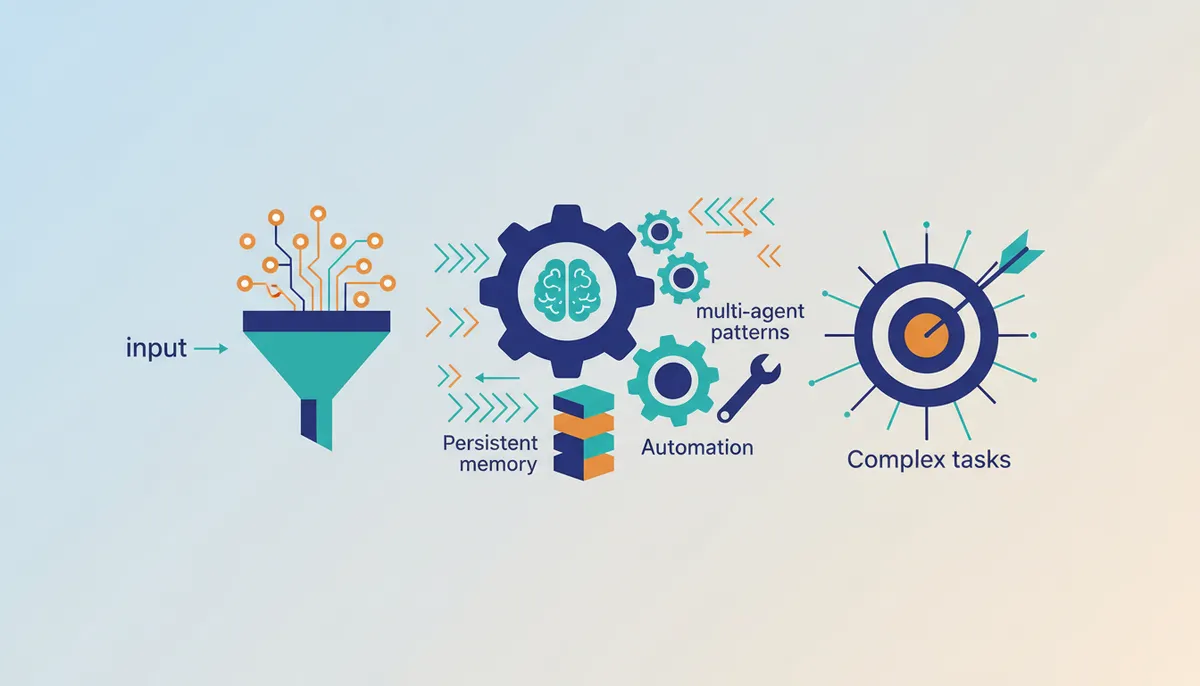
Injecting a checkpointer object into the agent constructor maintains coherence across successive interactions. LangGraph provides the MemorySaver class, an in-memory solution designed for local testing where minimal latency is the priority and long-term persistence is secondary. Enabling this feature requires including a unique thread_id inside the configurable dictionary, which acts as the logical identifier of the session. Without that specific identifier, the system fails to link subsequent messages to the stored history, causing a total loss of operational context.
Relying exclusively on in-memory storage creates a severe operational risk: any restart of the server process instantly wipes the entire accumulated conversation history. This limitation forces engineers to move toward disk persistence or external databases for production workloads that demand durability. Managing the thread identifier correctly allows multiple users to interact with the same agent deployment without cross-contamination of data.
Implementing Multi-Agent Patterns: Subagents and Routers
A routing step classifies the input and directs the flow toward specialized agents according to task complexity. In the subagent configuration, a main agent coordinates subordinate units by treating them as executable tools, an approach that eases context isolation and allows distributed development of operational logic. The router pattern acts as an initial dispatcher that segments requests before assigning them to specialized workers, avoiding cognitive overload in a single language model.
Integrating these architectures into production environments, such as those implemented by the fintech company Klarna, shows that reliability is the priority in high-volume financial workflows. Orchestrating multiple agents introduces the risk of infinite loops if termination conditions are not strictly defined. The extra latency accumulated by every context hop between agents is the cost of this architecture. Engineers must carefully balance subagent granularity against the response time limits of the system. The choice between a static router and an LLM-based one depends entirely on the expected variability in end user input.
Deployment Validation: From MemorySaver to PostgresSaver
Migrating to production requires replacing MemorySaver with persistent storage such as PostgresSaver to avoid data loss when the service restarts.
- Import the checkpointer from
langgraph.checkpoint.memoryand initialize it before rebuilding the agent object with the same AI tools configuration. - Configure environment variables through
os.getenvto manage credentials without exposing them in source code, a standard security practice. - Validate that the
thread_idpersists correctly across sessions to maintain the coherence of the conversation history on the new backend.
Integrated environments allow complex flows to be debugged before final deployment, consolidating the testing infrastructure inside the usual IDE. Disk persistence introduces I/O latency that does not exist in purely in-memory implementations. This constraint forces engineers to size the underlying database properly to support the expected concurrent load. Skipping this step results in silent bottlenecks that degrade system responsiveness under real load.
| Component | Development | Production |
|---|---|---|
| Storage | Volatile memory | Persistent database |
| Risk | Total loss on restart | Requires maintenance |
| Scalability | Limited to one node | Scales horizontally |
AI Agents News recommends strictly verifying database connectivity before enabling end user traffic.
About
Marcus Chen, Lead Agent Engineer at AI Agents News, brings direct engineering rigor to the complex environment of autonomous agents. His daily work involves shipping production multi-agent systems and conducting granular evaluations of orchestration frameworks like LangGraph, CrewAI, and AutoGen. This hands-on experience with tool use, function calling, and agent memory allows him to dissect technical tutorials with a focus on real-world reliability rather than theoretical potential. At AI Agents News, an independent hub dedicated to covering the infrastructure powering AI agents, Marcus ensures that build guides and framework reviews provide actionable intelligence for software engineers. By grounding his analysis in concrete version capabilities and architectural trade-offs, he helps technical founders and engineering leaders navigate the shift from simple LLM text generation to reliable, action-oriented agentic systems without the noise of vendor marketing.
Conclusion
The build itself is small: create_agent supplies the loop, FileManagementToolkit supplies the hands, and TemporaryDirectory decides how much of the host those hands can reach. Everything that makes the result production-grade sits in those last two choices rather than in the model.
Persistence is the second half of the same decision. MemorySaver is a testing convenience that a single restart erases, so a flow exposed to real traffic needs PostgresSaver behind the same thread_id, with credentials read from environment variables and not from the source file. Size that database for the concurrent load it will actually carry, because disk persistence buys durability and charges I/O latency for it.
Frequently Asked Questions
You must install Python 3 and Pip before adding any packages. The guide lists two specific system commands required to update repositories and install these dependencies on Debian based systems.
Developers need to install three core packages to enable full functionality. These include the central framework, community tools, and the orchestration layer necessary for modern agent creation patterns.
It forces the model to execute tools and process results in a loop. This structured cycle of reasoning and acting continues repeatedly until the system completes the set user task.
It prevents the agent from accessing unauthorized parts of the host system. Creating a safe working directory ensures the autonomous system operates within strict boundaries while handling file commands.
Preconfigured templates allow developers to construct agents in mere minutes. This speed significantly reduces the effort compared to manually building complex orchestration loops and state management from scratch.
References