vLLM semantic router: Fix 18% misrouting errors
An 18% misrouting rate in a simple keyword script proves that static regex lists fail at intent classification. The original setup, relying on a 100-line Python proxy to sort requests between Ollama, OpenAI, and Gemini, wasted roughly $24 monthly while adding 45ms of latency. As CompTIA reports, 94% of companies are prioritizing AI training, yet basic infrastructure still crumbles under natural language nuance, misclassifying "explain async/await in Rust" as a simple query. The solution lies in the vLLM Semantic Router, which uses a 130MB mmBERT embedding model to analyze semantic meaning rather than scanning for keywords like "think" or "code".
Embedding-based intent classification removes that error floor by comparing prompt vectors against set model capabilities instead of scanning for magic words. In a homelab the same swap turns a fragile chain of if-elif statements into a cost-optimized semantic router that holds up across mixed languages and complex reasoning tasks.
The Role of Embedding-Based Intent Classification in Modern AI Gateways
vLLM Semantic Router as an Envoy ExtProc Sidecar
Intercepting HTTP bodies before token generation begins, the vLLM Semantic Router operates as an Envoy External Processor sidecar. This architecture moves routing logic from the network edge directly into the inference serving layer, enabling decisions based on semantic meaning rather than brittle keyword matching. AgentGateway pauses incoming requests to transmit the prompt body to the router's gRPC endpoint, receiving a mutated header like x-selected-model to direct traffic accurately.
Unlike proxy-level routers operating at layer 4 or 7, this system uses a ModernBERT-based classifier to evaluate query complexity against natural language model descriptions. The embedded classification engine, often a compact mmBERT variant described as a '2D Matryoshka', compares prompt embeddings to YAML-set capabilities using cosine similarity. If the sidecar becomes unreachable, the entire request path stalls until timeout thresholds trigger, unlike stateless keyword filters that fail open. Network operators must therefore provision high-availability replicas for the ExtProc service to maintain gateway reliability.
Routing Pi Agent Requests to Ollama, OpenAI, and Gemini
Embedding-based routing replaces brittle keyword lists with vector similarity checks against model capability descriptions. The Pi agent system now directs coding queries to qwen2.5-coder:7b on local Ollama, reserving gpt-4o for complex logic and gemini-2.5-flash for rapid general tasks.
The classification engine uses a ModernBERT-based classifier to analyze query intent and complexity before selecting a target backend. By comparing prompt embeddings to natural language model descriptions, the system achieved a 48.5% token consumption reduction compared to the previous static routing logic. Real-world validation from a multi-model cost experiment confirms that auto-routing across diverse providers significantly optimizes spend versus single-model defaults.
AI Agents News recommends validating model descriptions against edge-case prompts before production deployment to minimize classification drift.
Keyword lists fail because they match surface tokens rather than underlying intent: a prompt containing "think" triggers heavy reasoning models even for trivial dinner plans, and mixed-language inputs never match ASCII-only lists. ModernBERT classifiers resolve this by mapping prompts to vector space and comparing query embeddings against model capability descriptions using cosine similarity. In homelab trials that cut misrouted traffic to 3%, dropped routing latency from 45ms to 1-3ms once the Python proxy hop disappeared, and pulled monthly API spend from ~$24 down to $14.
Advanced implementations apply multi-dimensional decision engines to extract intent probability. These systems outperform simple local keyword rules by analyzing semantic depth. The trade-off is the requirement for embedded model storage. Operators must allocate memory for the classifier weights. This constraint prevents deployment on memory-constrained edge devices under limited RAM. The architectural shift moves intelligence from the network edge to the inference layer. AI Agents News notes this pattern is becoming standard for cost-sensitive deployments.
Inside the Request Lifecycle of an AgentGateway and vLLM Integration
Defining the Multi-Factor Routing Algorithm and Model Cards
The 'MoM' routing decision executes a multi_factor algorithm weighting quality at 0.1, latency at 0.4, and cost at 0.5 to select targets. This mathematical approach replaces brittle keyword matching with continuous cost-aware request routing that prioritizes efficiency over raw capability for every token. Model cards define the decision surface, specifying that qwen-coder possesses 7B parameters and a 32768 context window optimized for programming tasks. Conversely, gpt-4o handles complex reasoning, while gemini-flash provides a massive context for general queries.
| Model | Parameters | Context Window | Primary Use Case |
|---|---|---|---|
| qwen-coder | 7B | 32768 | Programming tasks |
| gpt-4o | Not disclosed | 128000 | Deep reasoning |
| gemini-flash | Not disclosed | 1000000 | Fast general tasks |
Startup logs confirm 14 selection algorithms exist, yet the system defaults to multi-factor balancing to prevent expensive model over-provisioning. However, this precision requires accurate model descriptions; vague cards degrade the embedding-based intent classification accuracy significantly. Operators must weigh the latency penalty of complex calculations against the financial waste of misrouted tokens. The AgentGateway then enforces these decisions by mutating headers before the request reaches the backend. This architecture ensures that a continuous-operation agent system like OpenClaw Deployment maintains majority local execution while retaining cloud fallback options. The trade-off is rigid dependency on correct parameter definitions within the configuration file.
Tracing a Python Fibonacci Request Through gRPC ExtProc
Real-world testing showed the Semantic Router classifying a prompt in 1ms. When a request arrives asking to "Write me a Python function to compute fibonacci numbers using memoization," the system immediately identifies the intent as qwen-coder. This classification occurs via a ModernBERT-based classifier that analyzes query complexity before any token generation begins. The routing_latency_ms records exactly 1, confirming the gRPC ExtProc handshake adds negligible overhead compared to legacy proxy hops.
AgentGateway then directs the traffic to local-ollama running the qwen2.5-coder:7b model. The full round trip completes in 22537ms, generating 366 output tokens from 41 input tokens. The architectural shift eliminates the brittle Python script layer entirely.
| Metric | Legacy Script | gRPC ExtProc |
|---|---|---|
| Logic | Keyword matching | Vector embedding |
| Latency | ~45ms | 1ms |
| Failure Mode | False negatives | Embedding drift |
Operational friction increases if the embedding model lacks specific technical vocabulary for niche libraries. Network operators must verify that the classification engine includes domain-specific terms to prevent valid coding requests from falling back to expensive cloud endpoints.
What Changes When the Proxy Hop Becomes a Sidecar
Replacing the Python proxy hop with an Envoy External Processor sidecar eliminates the separate process context switch, allowing the gateway to pause the request, query the embedding model via gRPC, and resume with a mutated header instantly. The legacy script required manual weekly updates to keyword lists, whereas the semantic approach relies on static YAML definitions of model capabilities. In contrast, the system now supports cost-aware request routing by matching prompt embeddings against natural language model descriptions. This prevents the "think about dinner" error where reasoning engines were wastefully invoked for simple queries. A critical tension exists between local resource constraints and cloud dependency; while the router minimizes cloud calls, an extproc connection failure forces a fail-open strategy that defaults to cloud providers. This ensures availability but risks brief cost spikes if the local classifier becomes unreachable. The reduction in misrouted traffic directly correlates to the observed cost savings, validating the move from string matching to vector similarity.
Deploying a Cost-Optimized Semantic Router in a Homelab Environment
Application: The vLLM Semantic Router and AgentGateway Architecture
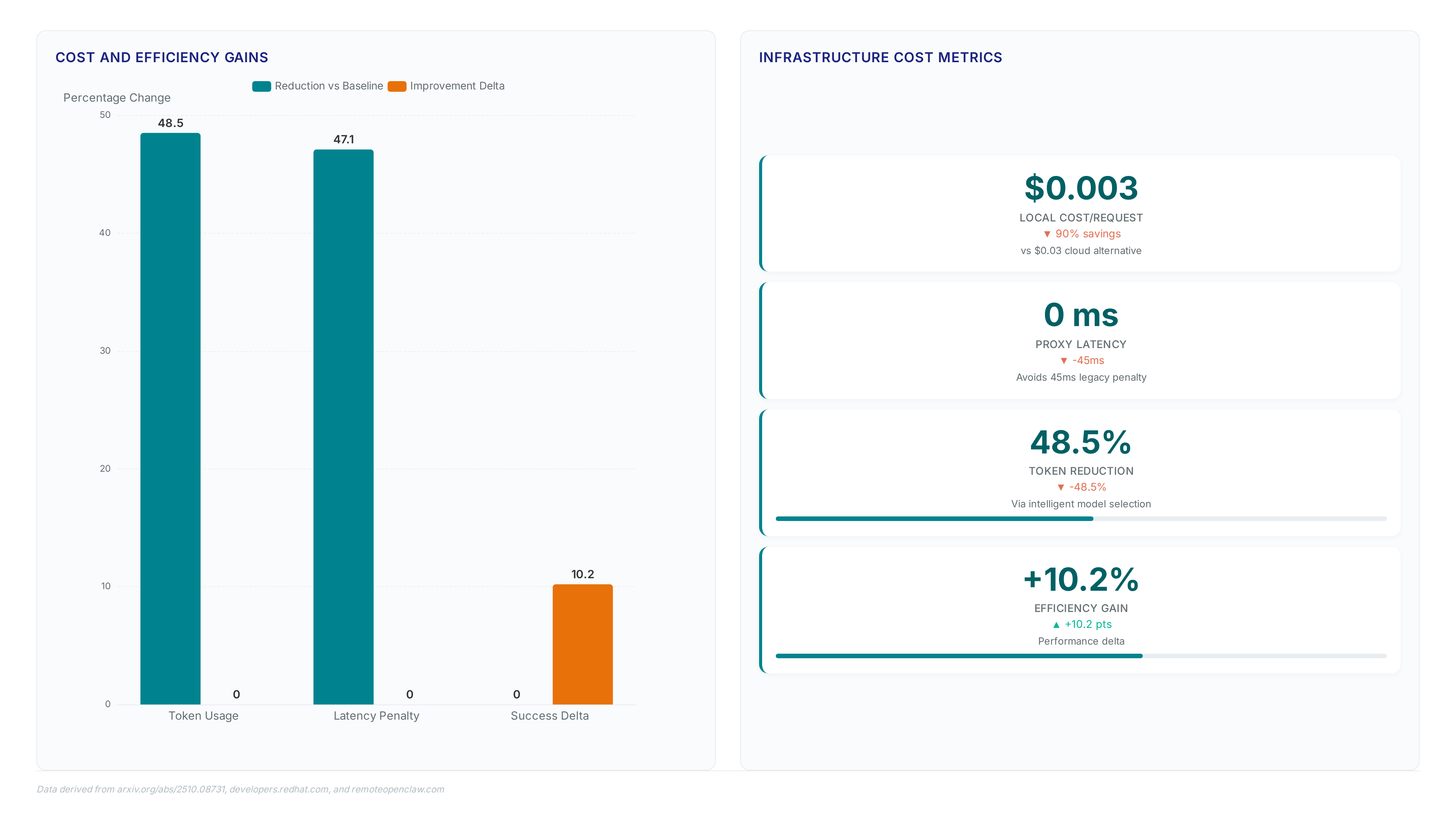
Production-grade infrastructure replaces brittle Python scripts with an Envoy External Processor sidecar architecture. This design embeds routing logic directly into the data plane, removing the context-switch overhead that plagued legacy keyword scanners. The vLLM Semantic Router functions as a specialized gRPC server implemented in Go and Rust, analyzing prompt embeddings to mutate request headers before forwarding. AgentGateway, a Gateway API data plane built-in Rust, pauses incoming traffic to await these semantic decisions, ensuring precise model selection without separate proxy hops. Unlike regional deployments, this stack governs interactions across heterogeneous inference stacks globally, optimizing token economics by preventing expensive model over-provisioning. Operational data indicates that correct routing saves money, as local inference costs roughly $0.003 per request, while cloud alternatives bill every call at metered rates.
The architectural tension lies in the initial complexity of defining natural language model cards versus the long-term stability of static YAML configurations. Keyword scripts require weekly maintenance, yet the semantic approach shifts the burden to upfront capability description. This constraint yields a system where routing latency stays minimal. Future iterations may incorporate session-aware features to further refine multi-turn workflow handling.
Model Cards Decide Whether Semantic Routing Works
Relying on embedding similarity introduces a dependency on model card quality; vague descriptions degrade routing accuracy. Operators must define clear semantic boundaries in YAML to prevent ambiguity. This tension between flexibility and specificity means the value of semantic routing depends entirely on the clarity of your model definitions. Static rules differ notably because semantic anchors require upfront conceptual work but eliminate ongoing maintenance. AI Agents News recommends this architecture for any homelab seeking production-grade stability without the overhead of manual keyword management.
Operational Roadmap: Observability and Session-Aware Agentic Routing
Maturing the homelab deployment requires integrating OpenTelemetry -compatible spans emitted by AgentGateway into Jaeger and Prometheus stacks. Without this visibility, operators cannot distinguish between model inference lag and routing bottlenecks during multi-turn interactions. The next critical step involves enabling Session-Aware Agentic Routing to manage router-owned session memory for complex workflows. This feature prevents broken continuations by locking non-portable IDs across request cycles. Local models remain the primary target for coding tasks and iterative debugging where data privacy matters most. Cloud fallbacks activate only when prompt complexity exceeds local context windows or specialized reasoning is required. Implementing these controls reduces the risk of sending sensitive internal logs to public endpoints.
The limitation here is increased resource consumption on the host machine due to trace storage and active session tables. AI Agents News recommends monitoring disk I/O closely when enabling full trace verbosity. Operators must balance granular observability against the finite storage available in typical homelab environments.
Configuring Multi-Model Routing Policies via YAML and Envoy ExtProc
Implementation: Defining MoM Multi-Factor Weights and Model Cards in config.yaml
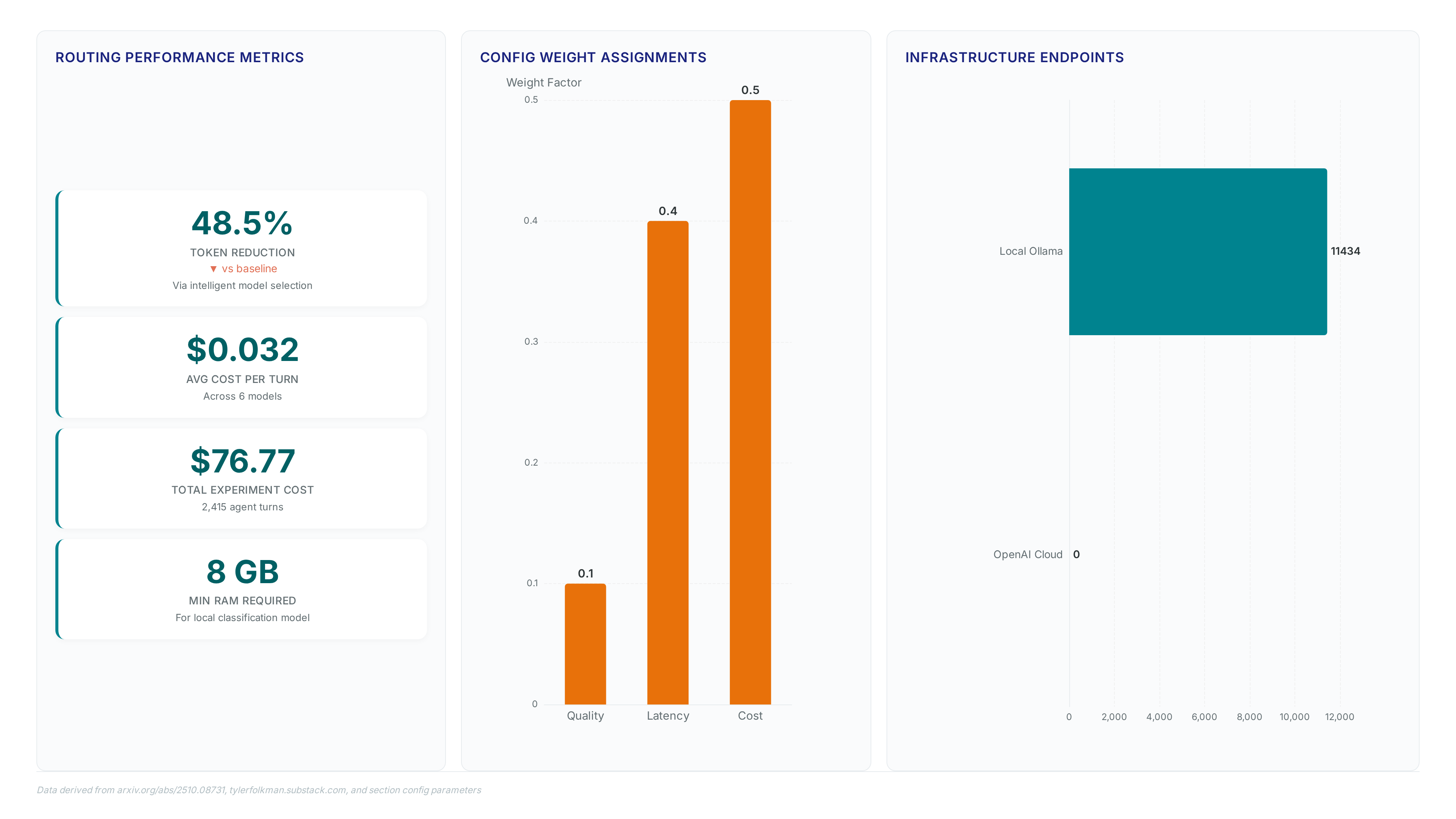
Defining the MoM routing decision in config.yaml requires explicit weight assignments for quality (0.1), latency (0.4), and cost (0.5) to function. This multi-factor algorithm replaces brittle keyword lists with a multi-dimensional decision engine that evaluates intent probability against model descriptions. Operators must specify parameter counts and context windows within each model card to enable accurate semantic matching.
Embedding-based classification reduces token consumption by selecting smaller models for simple queries, directly lowering operational expenses. However, assigning a 0.5 weight to cost factors may inadvertently route complex reasoning tasks to cheaper, less capable models if descriptions lack specificity. This trade-off demands precise natural language definitions for each model's capabilities to prevent performance degradation.
| Factor | Weight | Operational Impact |
|---|---|---|
| Quality | 0.1 | Minimal influence on selection |
| Latency | 0.4 | Prioritizes fast response times |
| Cost | 0.5 | Dominates routing logic |
Over-weighting cost creates a tension where the system favors cheap models even when high-fidelity reasoning is required, potentially increasing error rates for edge-case prompts. AI Agents News recommends auditing model descriptions quarterly to align semantic anchors with actual performance characteristics.
Executing Envoy ExtProc Integration with Local Ollama and Cloud Providers
Defining local-ollama at host.docker.internal:11434 alongside openai-cloud endpoints in config.yaml establishes the physical routing topology. This configuration anchors the Security Posture by keeping proprietary logic within the local network boundary rather than expanding the attack surface across a multi-hop chain.
- Populate the
providersblock with specific backend references for gemini-cloud atgenerativelanguage.googleapis.com/v1beta/openai. - Assign natural language descriptions to gpt-4o model cards, noting its strengths for complex reasoning tasks.
- Apply the
multi_factoralgorithm to weigh latency and cost against quality metrics dynamically. - Verify that the AgentGateway sidecar listens on gRPC port 50051 for header mutations.
Patching the Go FFI Dispatch for Apple Silicon
This configuration will not start on a local Apple Silicon host until one dispatch bug is patched, because the Go layer invokes batched embeddings unconditionally for every model type.
- Inspect the Go source for unconditional
GetEmbeddingBatchedinvocations across all model types. - Apply the conditional guard to restrict batched calls strictly to qwen3 architectures.
- Validate that fallback paths execute
GetEmbeddingWithModelTypefor remaining models like mmBERT.
Ignoring the guard means total routing failure at startup, as the FFI layer cannot coerce incompatible batch structures; cloud-only setups never surface the mismatch. This constraint highlights a tension between performance optimization and hardware compatibility; batched operations improve throughput but require strict type alignment in the FFI boundary. Successful deployment depends on matching the dispatch logic to the specific capabilities of the underlying Rust FFI backend.
About
Marcus Chen, Lead Agent Engineer at AI Agents News, brings direct production experience in orchestrating complex multi-agent systems to his analysis of the vLLM Semantic Router. Having shipped systems where precise request distribution is critical, Chen understands the limitations of rigid, keyword-based routing mechanisms that often plague early-stage agent deployments. His daily work involves evaluating frameworks like CrewAI and LangGraph, where he frequently encounters the need for flexible, context-aware dispatching rather than simple string matching. By integrating vLLM's semantic capabilities, Chen demonstrates how engineers can replace brittle logic with intelligent routing that scales. As AI Agents News covers the evolving environment of autonomous agents, Chen's technical deep dive provides the concrete, comparative data builders need to upgrade their own architectures from fragile prototypes to reliable, production-ready systems.
Conclusion
The 18% misrouting floor was never a tuning problem; it was the ceiling of matching surface tokens instead of meaning. Swapping the keyword proxy for an embedding classifier moves routing from string comparison to vector similarity, and the homelab numbers follow: less misrouted traffic, lower latency, a smaller monthly bill. What the change actually buys is a gateway you can reason about, because routing behaviour now lives in natural language model cards rather than in a growing chain of if-elif statements.
That relocates the maintenance burden rather than deleting it. Keyword lists demanded weekly edits; model cards demand precision up front, and vague descriptions degrade classification exactly where edge-case prompts live. Local deployments add one more obligation, since mixed silicon exposes low-level binding assumptions that homogeneous cloud clusters never surface. Write the model cards carefully, audit them when routing drifts, and restrict batched embedding calls to verified model types before the router carries production traffic.
Frequently Asked Questions
You can significantly reduce your monthly API spend by optimizing model selection. Reports show costs dropping from $24 to $14 after migration, proving that intelligent routing eliminates waste.
Yes, embedding-based classification drastically lowers error rates compared to legacy scripts. While old methods had an 18% misrouting rate, the new system reduced misrouted traffic to just 3%.
Eliminating the external Python process removes network latency entirely from the routing path. This architectural shift dropped routing latency from 45ms down to 1-3ms in homelab trials.
Intelligent model selection ensures prompts use only necessary tokens for each specific task. This approach achieved a 48.5% token consumption reduction compared to previous static routing logic.
The system uses a compact mmBERT variant known as a 2D Matryoshka for efficient analysis. This entire embedding model requires only 130MB of memory to operate effectively.