Tool selection errors drop 82% with strict JSON
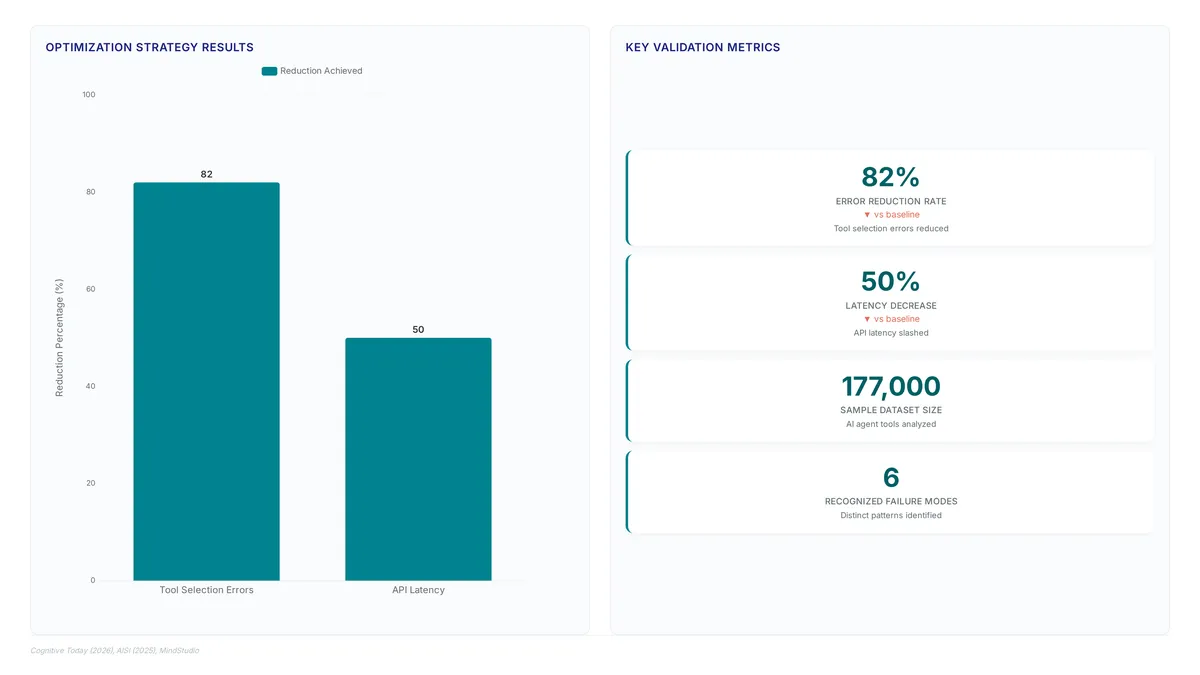
An 82% reduction in tool selection errors is achievable through strict validation boundaries and intelligent routing.
Mastering AI agent reliability demands more than clever prompting; it requires rigorous architectural controls for function calling. Recent case studies confirm that specific optimization strategies slash API latency by nearly half while preventing catastrophic financial leaks. Precise tool selection serves as the primary defense against infinite loops. Semantic routers must interpret JSON schemas with zero ambiguity. A five-step framework ensures error-free execution.
The cost of failure in autonomous systems is quantifiable and severe. One documented incident involved a customer support agent entering an infinite loop, mistakenly issuing $12,450 in automated refunds before the server could be killed. The system lacked constraints to distinguish between a pricing inquiry and a refund command. Giving an LLM access to external tools without reliable guardrails is akin to handing a loaded gun to an untrained operator.
The mechanics behind these failures point to a path to enterprise-grade stability, where deterministic patterns replace chaotic, trial-and-error workflows and ensure agents execute the right tools at the right time.
The Critical Role of Precise Tool Selection in AI Agent Reliability
How JSON Schemas Drive LLM Function Calling
Function calling parses strict JSON schemas defining tool names, descriptions, and parameter types. Modern LLMs rely on this structured metadata to determine when external execution is required rather than generating text. The model receives a detailed JSON schema containing the tool's name, description, and parameters, effectively acting as a contract for interaction. Generation pauses whenever a prompt demands data outside the training set, forcing the system to output a structured object for the orchestration layer. This pause-execute-feedback loop ensures the agent retrieves specific values before proceeding.
Vague descriptions cause semantic confusion, leading the model to hallucinate arguments or select incorrect functions. Implementing strict validation boundaries alongside intelligent routing is what produces the 82% drop in selection errors. Optimized selection logic can slash API latency by preventing unnecessary roundtrips. Builders must treat tool descriptions as highly optimized prompts to maintain reliability. Rigorous parameter constraints are necessary because the risk of compounding errors increases as agents engage in complex reasoning chains.
Semantic Routing to Limit Tool Bloat
Semantic routing exposes only the top 3 to 5 most relevant tools to the context window, preventing schema congestion. Long schemas fill the context window when more tools are added to an agent, leading to semantic confusion where the model picks the wrong tool or hallucinates parameters. This occurs because the JSON schema descriptions compete for attention within the fixed token limits of the prompt.
Implementing a flexible router filters the available toolset based on the user query vector before the LLM attempts selection. This architectural constraint directly addresses whether operators should limit tool access, as unrestricted exposure degrades reliability. Restricting the candidate set slashes API latency by eliminating unnecessary schema processing rounds. Aggressive filtering introduces a risk of over-constraint where valid but niche tools become invisible to the model. The agent cannot recover the correct tool without a fallback mechanism if the router misclassifies the initial intent. Systems can dynamically select only the most relevant tools to address the "lost in the middle" phenomenon where models miss the right tool due to context overload, reducing latency and token costs. This layered approach helps enterprise deployments maintain high-availability while preventing the bloat that leads to execution errors.
Inside the Architecture of Function Calling and Semantic Routing
JSON Schema Structure and Parameter Extraction Mechanics
Function calling initiates when the model receives a JSON schema defining tool names, natural language descriptions, and strict parameter requirements. Upon processing a user prompt against these definitions, the LLM pauses text generation if external data is required. Instead of hallucinating facts, the system outputs a structured object containing the target tool name and extracted arguments. For instance, a query about Boston weather triggers a pause, resulting in an output like { "name": "get_weather", "arguments": {"location": "Boston"} }. This deterministic handoff allows the application to execute the function and feed results back for final response synthesis.
However, scaling this architecture introduces semantic confusion as the context window fills with verbose schemas. The model may select incorrect tools or invent parameters when faced with ambiguous descriptions. To mitigate this, developers should namespace tools by service, such as asana_create_task, to prevent collisions in non-deterministic patterns non-deterministic patterns. Evaluation must extend beyond simple success rates to include trace-based evaluations that detect compounding errors across reasoning loops trace-based evaluations.
| Component | Function | Risk if Poorly Set |
|---|---|---|
| Tool Name | Unique identifier for execution | Ambiguity causes wrong API calls |
| Description | Natural language usage guide | Vague bounds trigger false positives |
| Parameters | Strict type and requirement rules | Type mismatches crash downstream systems |
The cost of ignoring strict schema validation is measurable; without clear boundaries, agents risk cascading failures where a single bad call propagates errors through the entire workflow.
Diagnosing Infinite Loops via Context Degradation and Specification Drift
Infinite loops manifest when small misunderstandings compound across hundreds of reasoning loops, driving systemic collapse. Technical diagnostics now categorize these breakdowns into six modes, including context degradation and specification drift, which are necessary for debugging agent behavior failure mode taxonomy. As models execute complex workflows, initial parameter hallucinations or bad tool calls accumulate, causing the agent to deviate from its original intent. This compounding effect means that a single vague description can trigger a cascade where the model repeatedly selects incorrect tools while believing it satisfies the user query.
The root cause often lies in how the agent processes its own output history. When an LLM receives a validation error, it attempts self-correction. However, without strict boundaries, this correction loop degrades the semantic context, leading the model to ignore earlier constraints. The agent enters a state where it endlessly retries a failing function, burning API credits and potentially executing unauthorized actions. Prevention requires treating tool descriptions as highly optimized prompts rather than casual documentation. Developers must implement rigorous validation layers that halt execution after a set number of retries, forcing human intervention before financial damage occurs. Ignoring this architectural weakness leaves enterprise systems vulnerable to the exact type of catastrophic failure where agents issue thousands of unintended transactions.
| Failure Mode | Primary Trigger | Consequence |
|---|---|---|
| Context Degradation | Accumulated loop errors | Loss of original intent |
| Specification Drift | Vague tool definitions | Repeated wrong tool selection |
| Cascading Failure | Unchecked retry loops | System-wide outage |
Builders must prioritize trace-based evaluations to detect these drift patterns early in the development cycle.
Semantic Confusion Risks from Context Window Saturation
Tool hallucination, where an agent invokes non-existent functions or fabricates arguments, begins with context window saturation: accumulating tool schemas crowd the input buffer and induce semantic confusion that degrades selection accuracy. As the registry expands, the model struggles to distinguish between similar function descriptions, increasing the probability of selecting incorrect tools or hallucinating non-existent parameters. This noise directly contributes to infinite loops where agents repeatedly execute failed calls while attempting to resolve ambiguous instructions. To prevent AI from making wrong tool calls, architects must recognize that small misunderstandings can compound across hundreds of reasoning loops, creating systemic errors compounding misunderstandings.
The primary limitation is that larger context windows do not guarantee improved performance; instead, they often dilute signal-to-noise ratios for critical decision points. Operators observing context degradation find that verbose schemas force the model to attend to irrelevant data rather than precise execution logic.
| Risk Factor | Consequence |
|---|---|
| Schema Bloat | Increased parameter hallucination rates |
| Ambiguous Descriptions | Higher frequency of wrong tool selection |
| Unchecked Loops | Exponential API cost accumulation |
Implementing strict validation boundaries helps filter invalid requests before they trigger external actions. While adding more capabilities seems beneficial, uncontrolled tool bloat ultimately reduces overall system reliability.
Implementing a Five-Step Framework for Error-Free Tool Execution
Defining Hyper-Specific Tool Descriptions for Literal Interns
Vague instructions invite chaos when an LLM interprets a command. Descriptions that explicitly forbid invalid actions rather than just listing capabilities drop tool selection errors notably. Lazy definitions like "calculates math" fail because they leave too much room for interpretation by a smart but highly literal intern. The tool description acts as a strict contract preventing the model from guessing intent during function calling. Effective documentation states when to use a tool and when to avoid it, such as specifying 'Do NOT use this tool for password resets'.
- Define the exact scope of usage for every registered function.
- Explicitly state negative constraints to guide the model away from unsafe operations.
- Include parameter descriptions specifying ISO 8601 datetime strings to prevent format errors.
Architects reduce semantic confusion by namespacing tools by service, preventing an agent from selecting a database writer when only a reader is safe. Increased token usage per request is the price of this rigor. This trade-off eliminates expensive cascading failure modes where an agent enters an infinite refund loop. Precise boundaries ensure the LLM halts generation if the user request falls outside the set validation boundaries, forcing a clarification query instead of a hallucinated API call. Vague prompts become reliable enterprise workflows without requiring model fine-tuning through this discipline.
Enforcing Strict Parameter Validation with Pydantic Type Hints
Pydantic forces the model to conform to strict type hints. Runtime crashes disappear when an LLM passes a string like 'USR-9981' where an integer is expected. This validation approach creates a self-correcting loop where validation errors are immediately fed back to the model for correction rather than propagating to downstream APIs.
- Define tool arguments using
BaseModelto enforce data types before execution. - Catch
ValidationErrorexceptions in the runtime and return the error message to the agent. - Require the model to retry the function calling step with corrected parameters based on the schema feedback.
The complexity of modern agents means that a single bad tool call can trigger cascading failures if not caught at the input boundary. Implementing this strict validation reduces API latency in optimized deployments by eliminating unnecessary downstream processing of malformed requests.
Friction appears when user intent is genuinely ambiguous or requires unstructured text despite strict typing. Builders must balance rigid schemas with the flexibility needed for natural language nuances. This validation layer serves as the first line of defense before any human-in-the-loop approval is requested via Slack for high-risk operations like financial transactions. Establishing clear validation boundaries is a core requirement for any enterprise-grade agent architecture.
Checklist for Building Semantic Routers and Approval Workflows
This checklist validates semantic routing logic and approval workflows to prevent cascading agent failures.
- Route by Vector Similarity: Convert prompts to embeddings and match against tool descriptions, dynamically selecting only the top three to five functions to avoid context overload.
- Gate High-Risk Actions: Pause execution for external side effects like refunds or data deletion, requiring manual confirmation via a Slack approval card before proceeding.
- Log Every Decision: Record input prompts, selected tools, and parameter outputs to a centralized dashboard for weekly review of hallucinated calls.
| Feature | Semantic Router | Human Gatekeeper |
|---|---|---|
| Trigger | Vector similarity score | High-risk tool tag |
| Action | Filters tool list to top 5 | Pauses execution flow |
| Outcome | Reduces token cost | Prevents financial loss |
Low-latency automation requires balance with necessary friction. Removing human oversight entirely invites specification drift yet over-gating kills utility. Operational tension lies in defining "high-risk" narrowly enough to maintain speed while catching catastrophic intent.
Measurable ROI from Optimized Tool Selection in Enterprise Workflows
Defining ROI Metrics for Prompt-Based vs Fine-Tuned Tool Selection
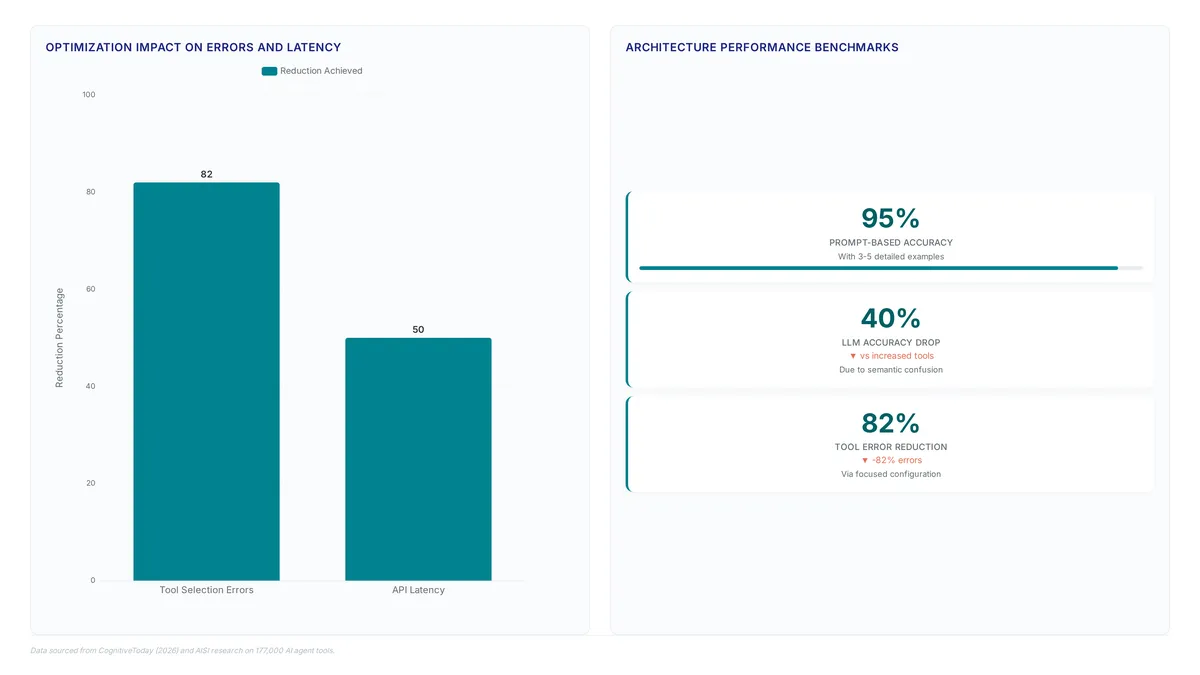
Operational expenditure defines the return on investment boundary between Prompt-Based Selection and Fine-Tuning architectures. Prompt-Based Selection is suitable for most startups and mid-market applications, achieving over 95% accuracy with 3 to 5 detailed examples. This approach minimizes upfront infrastructure costs but incurs recurring token expenses per transaction. Conversely, Fine-Tuning is recommended for systems running millions of transactions daily where prompt costs become prohibitive. The primary value drivers are latency reduction and error prevention. Optimization strategies targeting tool selection logic have demonstrated the ability to cut API latency by nearly half. Focused configuration changes can reduce tool selection errors by 82%, directly preventing costly downstream failures.
| Metric | Prompt-Based Selection | Fine-Tuning |
|---|---|---|
| Primary Cost | Token consumption | Compute infrastructure |
| Best For | Startups, mid-market apps | High-volume systems |
| Latency Impact | Higher (context loading) | Lower (baked syntax) |
The hidden cost of ignoring these metrics is cascading failure; unoptimized agents do not merely slow down, they actively degrade data integrity through repeated invalid calls. Builders must calculate the break-even point where the capital expenditure of fine-tuning undercuts the operational drag of verbose prompting.
Consolidating User Profile Tools to Eliminate Redundant Loops
Enterprise teams frequently register a separate tool for every minor API endpoint, pushing a fragmented registry past 35 functions. Consolidating these into a single get_user_profile function that accepts a list of requested fields reduces cognitive load on the model. This structural change prevents cascading failures where an agent might otherwise execute thousands of unnecessary API calls, avoiding scenarios similar to the $12,450 automated refund incident caused by infinite looping.
The shift toward unified interfaces aligns with broader market movement toward tools that enable direct external actions rather than passive chat capabilities. By minimizing the tool registry size, developers observe quicker execution times and more deterministic decision-making. However, this consolidation requires rigorous schema design; the single tool must handle variable field requests without becoming overly complex or ambiguous.
| Architecture | Tool Count | Failure Mode |
|---|---|---|
| Fragmented | 35+ | Redundant loops, wrong queries |
| Consolidated | 1 | Schema validation errors |
The trade-off is increased complexity in the parameter validation logic for the unified tool. Builders must implement strict validation to ensure the single endpoint correctly processes diverse field combinations without data leakage. This approach transforms api cost reduction from a hopeful metric into a guaranteed outcome of reduced token consumption and fewer erroneous calls. Focusing on schema density rather than tool quantity helps maintain system stability.
Quantifying Accuracy Loss from Tool Bloat in Enterprise Agents
Expanding an agent's registry can degrade LLM accuracy significantly. Recent studies show that LLM accuracy drops by up to 40% when the number of available tools increases from 5 to 15. This statistical drop occurs because developers frequently create separate tools for every minor API endpoint, causing semantic confusion. The resulting tool bloat forces the model to parse excessive schema definitions, increasing the probability of selecting incorrect functions or entering redundant loops.
| Registry Size | Observed Behavior | Risk Level |
|---|---|---|
| 1 to 5 Tools | Precise selection | Low |
| 6 to 14 Tools | Increased hesitation | Medium |
| 15+ Tools | Significant accuracy drop | Critical |
The core tension lies between granular API coverage and model reliability; adding niche endpoints dilutes the context window available for reasoning. Evidence from large-scale usage analysis confirms a shift toward direct external actions, making precise selection vital for enterprise ai. However, standardizing metrics for task completion remains difficult when tool definitions lack strict boundaries. For builders, the implication is clear: api cost reduction requires consolidating functions rather than expanding them. Implementing semantic routing to filter available tools dynamically based on user intent can further mitigate these risks.
About
Priya Nair serves as AI Industry Editor at AI Agents News, where she tracks the business dynamics of autonomous systems and platform evolution. Her daily work involves rigorously verifying product claims and analyzing market shifts for tools like Devin and Claude Code, providing a unique vantage point on the operational risks of deploying AI agents. This article's focus on preventing catastrophic tool-selection errors stems directly from her coverage of real-world agent failures and the critical need for reliable orchestration strategies. By examining how engineering teams navigate function calling and multi-agent coordination, Nair connects high-level industry trends to the granular technical decisions that determine system reliability. As the lead voice on platform moves at AI Agents News, she translates complex market data into actionable insights for builders seeking to mitigate the inherent dangers of granting LLMs external access. Her analysis ensures that discussions around agent safety remain grounded in verified industry patterns rather than vendor hype.
Conclusion
Scaling an agent's registry beyond a handful of functions triggers a collapse in reliability that raw model intelligence cannot fix. When accuracy plummets by 40% due to tool bloat, the operational cost shifts from compute spend to fixing broken workflows and handling erroneous downstream actions. Builders often mistake this for a model limitation, but it is actually an architectural failure where excessive schema definitions overwhelm the decision layer. The path forward demands a strict pivot toward schema density, consolidating redundant endpoints into unified, validated tools rather than expanding the registry.
Organizations must enforce a hard cap on tool quantity per agent instance, prioritizing semantic routing to dynamically filter options based on intent. This structural discipline prevents the confusion that leads to costly errors and ensures that api cost reduction remains a sustainable outcome of efficient design. Do not wait for a critical failure to audit your current tool definitions; start by mapping every existing function to a specific business outcome this week and merge any tools that share identical parameter structures. Reducing the cognitive load on the model is the only way to guarantee consistent performance as your ai agent deployments grow in complexity and scope.
Frequently Asked Questions
Unrestricted agents can trigger costly infinite loops and erroneous transactions. One documented incident resulted in $12,450 of automated refunds before the server was stopped.
Rigorous validation boundaries and intelligent routing drastically cut selection mistakes. Documented strategies have been shown to reduce tool selection errors by 82% in practical applications.
Focused configuration prevents unnecessary schema processing and speeds up response times. Implementation of specific optimization strategies has been shown to slash API latency by nearly half.
Adding too many tools causes semantic confusion and drops model performance. Research shows that LLM accuracy drops by up to 40% when the number of available tools increases.
Providing specific examples helps models understand complex tool requirements better. Midmarket applications are achieving over 95% accuracy with 3 to 5 detailed examples in their prompts.
References