Single-Agent Logic Extracts Missing Keywords
A single AI agent extracts keywords and rewrites bullet points to bypass automated screening in seconds. This guide argues that single-agent architectures effectively solve resume optimization by aligning candidate experience with strict Applicant Tracking Systems. The workflow runs on CrewAI and AWS Bedrock: it reads the job description and names the framing the resume is missing.
The article details a practical implementation where the agent produces a JD Summary and lists Matching Skills like LLM or Terraform. Instead of generic advice, the system outputs specific Career Guidance based on the gap between your history and the role requirements. This approach addresses the common failure where qualified candidates lack the exact terminology required by hiring algorithms.
CrewAI carries the orchestration and tool calls behind this workflow, and the same logic runs on AWS EC2 behind a Streamlit web UI. The result is a tool that makes a resume speak the specific language of the job description before a human ever sees it.
The Role of Single-Agent Architectures in Modern Resume Optimization
Defining the AI Agent Role in ATS Keyword Extraction
An AI agent operates as an autonomous unit set by a specific Role, Goal, and Backstory to execute tasks without continuous human intervention. Standard large language models generate static text responses, yet this architecture actively uses tools to extract precise keyword data from job descriptions. Traditional applications often fail because candidates possess necessary skills but omit the specific framing required by Applicant Tracking Systems. Engineers deploying an open-source framework construct systems that identify these linguistic gaps rather than merely rewriting prose. Parsing unstructured job descriptions allows the system to output structured skill gap analysis alongside tailored bullet points. Simple chatbots offer generic advice, whereas a set agent orchestrates a sequence to summarize requirements, identifies missing technology terms like RAG or Kubernetes, and reformulates experience to match. This targeted approach addresses the screening filters used by most enterprises before human review occurs. Latency risks emerge if the underlying model struggles with complex context windows containing both resume text and job specifications. The constraint for this simplified, single-pass architecture is reduced orchestration overhead at the potential cost of deep, multi-step verification found in larger swarms. Builders prioritize prompt engineering rigor over complex multi-agent topology when speed and cost are primary constraints.
Operational Modes of the Resume Tailor Agent
The CrewAI framework orchestrates a single autonomous unit to execute distinct analysis tasks based on input availability. This single-agent architecture avoids complex multi-agent handoffs, relying instead on precise system prompts to switch contexts between full resume Tailoring and Job Description (JD) only analysis. Providing both a JD and a resume prompts the agent to generate a JD Summary containing 5-6 sentences detailing role requirements. It extracts Matching Skills such as LLM, MCP, RAG, Kubernetes, and Terraform, then identifies specific skill gaps and provides career guidance. Omitting the resume results in output containing only the JD summary, demanded key technologies, and a preparation path. This approach contrasts with multi-agent orchestrations that distribute roles across specialized entities for complex workflows. Scope limitations prevent a single agent from simultaneously fact-checking and rewriting without increasing latency or hallucination risk. Linear execution ensures quicker inference times on Amazon Bedrock for resume tailoring. While CrewAI simplifies the production process, the quality of the Tailored Resume depends entirely on the specificity of the input prompt rather than emergent collaboration. Speed and cost-efficiency take precedence over the redundancy of peer-review mechanisms found in larger swarms: resume tailoring is linear keyword extraction, not collaborative debate, so it gains nothing from inter-agent handoffs.
Inside the CrewAI and Bedrock Integration Workflow
CrewAI Sequential Process and Bedrock Nova Pro Data Flow
Input from the Streamlit interface triggers the CrewAI orchestrator to load persona definitions from agents.yaml and task variables from tasks.yaml. The system executes a sequential process where the crew.py module constructs a prompt containing the job description and resume text before routing the request to Amazon Bedrock Nova Pro. This architecture relies on the sequential process model to carry state from job description parsing through to the tailored output without requiring manual intervention during inference.
| Component | Configuration Source | Function |
|---|---|---|
| Agent Persona | agents.yaml |
Defines the "Senior Resume Tailor" role and constraints |
| Task Logic | tasks.yaml |
Maps {job_description} and {resume} variables to prompts |
| Inference Engine | .env file |
Specifies bedrock/us.amazon.nova-pro-v1:0 as the target model |
| Orchestration | crew.py |
Enforces Process.sequential execution and verbose logging |
Operators must note that while the integration allows agents to adhere to existing security frameworks, the sequential nature introduces latency as each task waits for the previous context window to close. The Amazon Nova Pro model processes these structured inputs to generate ATS-compliant bullet points, but the strict ordering prevents parallel task execution which could otherwise reduce time-to-result for large batches. This design choice prioritizes context accuracy over throughput, ensuring the tailoring logic strictly follows the set career guidance steps.
Configuring agents.yaml Personas and tasks.yaml Variables for Resume Tailoring
The agents.yaml file defines the Senior Resume Tailor persona with 15+ years of tech recruiting experience to ground LLM reasoning. This configuration sets the behavioral baseline for the agent before it processes any user input. Task definitions in tasks.yaml apply flexible variables like {job_description}, {resume}, {years_experience}, and {expertise_level} to adapt output for specific career stages ranging from Fresher to Architect. CrewAI integrates with LiteLLM to handle LLM routing, allowing the system to switch providers by changing environment variables rather than rewriting code. The mapping between input variables and persona constraints determines whether the output focuses on core skills or leadership narratives.
| Variable | Purpose | Impact on Output |
|---|---|---|
{job_description} |
Target role context | Aligns keywords with ATS filters |
{expertise_level} |
Career stage marker | Adjusts tone from learning to leading |
{years_experience} |
Tenure quantification | Validates seniority claims in bullets |
A critical limitation arises if the {expertise_level} variable conflicts with the {years_experience} value, potentially confusing the model's tone calibration. Operators must validate that input data remains consistent to prevent contradictory career advice. Enterprises invested in the AWS system apply this integration to deploy agents that adhere to existing security and compliance frameworks. Precise variable definition ensures the generated resume speaks the specific language required by automated screening systems.
Environment Setup for AWS Bedrock Access and crewai[bedrock] Installation
Requesting model access in the AWS console is the mandatory first step before any code execution, as Amazon Nova Pro remains disabled by default for new accounts. Operators must verify this enablement to avoid immediate inference failures during agent initialization. The dependency tree requires installing the specific Bedrock extras via uv add "crewai[bedrock]" rather than the base package alone. A missing extras declaration triggers a ModuleNotFoundError when the orchestrator attempts to load cloud-specific providers.
Configuration validity depends on exact environment variable matching in the .env file.
| Variable | Required Value | Purpose |
|---|---|---|
MODEL |
bedrock/us.amazon.nova-pro-v1:0 |
Routes inference to the correct foundation model endpoint |
AWS_REGION_NAME |
us-east-1 |
Specifies the geographic region for Bedrock API calls |
Compute resources must meet minimum thresholds, specifically an EC2 t3.medium instance or equivalent Linux machine running Amazon Linux 2023. This architecture uses existing cloud credits for underlying compute costs while using the open-source orchestration layer. Skipping the explicit model request or region specification results in silent authentication errors rather than clear dependency failures.
Deploying a Resume Tailoring Agent on AWS EC2
CrewAI CLI Scaffolding and Bedrock Nova Pro Configuration
Run crewai create crew resume_tailor --classic to generate the project skeleton containing YAML definitions and Python entry points. This command opens an interactive menu where selecting provider option 9 sets the backend to bedrock. Choosing model option 28 pins the inference engine to bedrock/us.amazon.nova-pro-v1:0, aligning the setup with AWS-native credential chains. Access to Amazon Nova Pro requires explicit approval in the AWS console before the configuration returns valid responses. The resulting file structure isolates agent logic within crew.py while keeping task declarations in tasks.yaml.
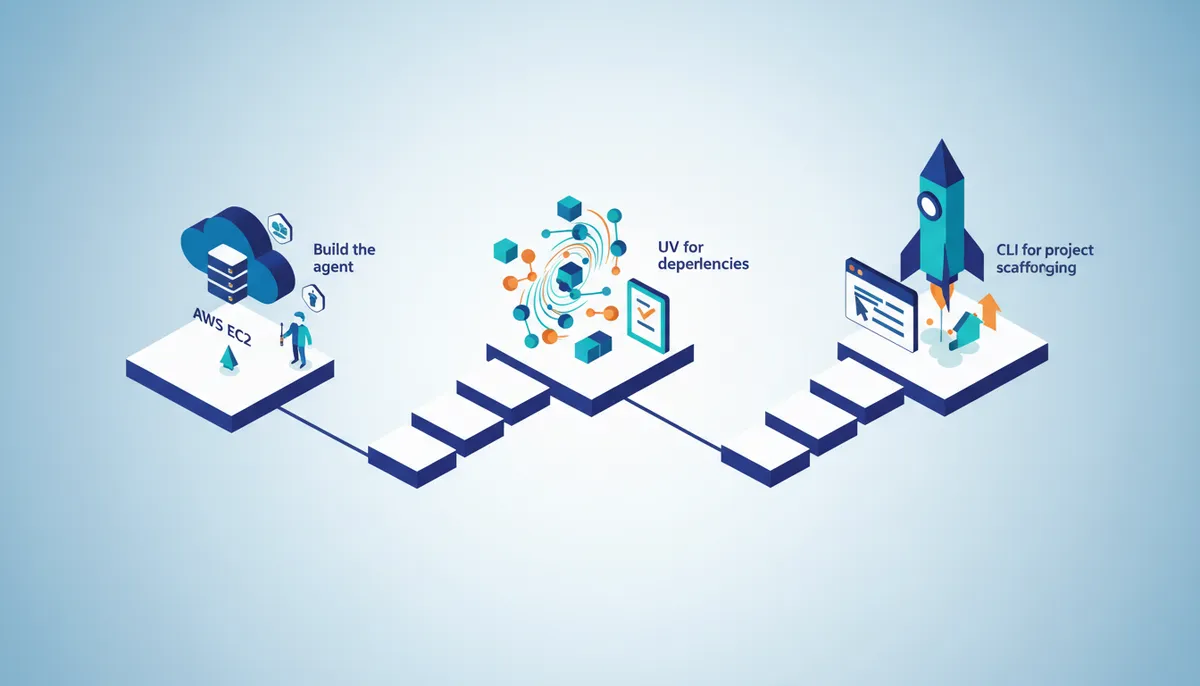
- Run the scaffolding command to create the base directory tree.
- Select the bedrock provider from the numbered list during initialization.
- Choose the specific Nova Pro model identifier to finalize the LLM binding.
- Ensure the installation includes the
crewai-clipackage to access the command-line interface, using the--with crewaiflag to link the CLI to the core library.
Explicit selection removes the ambiguity often caused by environment variable overrides in multi-cloud environments. Teams integrating this workflow into CI/CD pipelines maintain configuration integrity by standardizing environment setup. Enterprises use existing cloud credits instead of managing separate API keys through this integration scope. Correct setup here guarantees the Streamlit interface connects to a validated model endpoint later without runtime authentication failures.
Deploying Streamlit App on EC2 with Port 8501 Security Rules
Expose the user interface by binding Streamlit to 0.0.0.0 and opening port 8501 inside the EC2 security group. Start the local server with uv run streamlit run streamlit_app.py --server.address 0.0.0.0 --server.port 8501. This flag combination permits external internet traffic to reach the application process running inside the virtual private cloud. Default Streamlit behavior binds to localhost, blocking all remote connections regardless of firewall rules.
- Navigate to the EC2 console and select the active instance hosting the agent.
- Modify the inbound rules of the attached security group to allow TCP traffic on port 8501.
- Restrict the source IP range to your specific corporate network or home IP instead of
0.0.0.0/0.
This restriction serves as a necessary control layer since default Streamlit deployments lack built-in authentication. Opening port 8501 to the public internet without IP whitelisting exposes CrewAI orchestration logic to unauthenticated execution attempts. Direct exposure via security groups remains a common failure mode for developers prioritizing speed over defense, even though some architectures place agents behind API gateways. Security groups function as the primary perimeter defense for these generative workloads. Converting such agents into microservices offers improved isolation for distributed patterns, yet strict port management remains the immediate requirement. Validating inbound rules before every deployment cycle prevents accidental data exposure.
Validating pyproject.toml Dependencies and .env Secret Storage
Correct dependency pinning in pyproject.toml stops runtime failures when importing Bedrock-specific toolkits.
| Target | Required Setting | Purpose |
|---|---|---|
pyproject.toml |
crewai>=1.14.0,<2.0.0 with bedrock,tools extras |
Enables Bedrock extra dependencies and stable versioning |
.env |
MODEL_NAME=bedrock/us.amazon.nova-pro-v1:0 |
Specifies inference engine |
| CLI Flag | --with crewai |
Links CLI to core library |
Verify these settings before running the Streamlit interface to avoid connectivity errors. Version locking keeps agentic frameworks compatible with underlying cloud infrastructure updates.
What the Agent Outputs and How to Validate It
Defining the Five-Section Output Structure for ATS Alignment
Distilling role requirements before mapping candidate experience happens inside the JD Summary, where the agent generates exactly 5-6 sentences. This concise overview feeds a Matching Skills section that extracts specific technology keywords like LLM, MCP, RAG, Kubernetes, or Terraform for immediate highlighting. Absent elements appear as short bullet points within the Skill Gaps output to guide rapid upskilling. Career Guidance follows with actionable preparation steps, such as obtaining certifications or building projects with specific tools. Finally, the Tailored Resume delivers rewritten bullet points optimized for automated screening systems.
| Section | Function | Format |
|---|---|---|
| JD Summary | Distills role needs | 5-6 sentences |
| Matching Skills | Highlights keywords | Tech list |
| Skill Gaps | Identifies missing items | Bullet points |
| Career Guidance | Suggests preparation | Action bullets |
| Tailored Resume | Rewrites experience | Copy-paste text |
The five sections work as one pass: the JD Summary sets the target, Matching Skills and Skill Gaps split the candidate history against it, and Career Guidance plus the Tailored Resume turn that split into next steps.
Applying Mid-Level Expertise Constraints to Senior GenAI Developer Roles
Adjusting suggestions to the user's level, ranging from Fresher to Architect, becomes possible by setting the expertise constraint. Prioritizing specific domain depth over generic seniority claims occurred when applying an AI Engineer's profile to a Senior GenAI Developer role during testing.
| Constraint Level | Output Focus | Risk Mitigation |
|---|---|---|
| Senior | Strategic oversight, team leadership | Over-promising on management experience |
| Mid-Level | Code quality, pipeline optimization | Underselling total years of service |
Generated Tailored Resume bullets remain defensible during technical interviews by sticking to verifiable tool usage. Multi-agent orchestration can produce content through collaborative workflows, yet a single-agent architecture with precise expertise constraints offers simpler code, quicker execution, and lower costs for individual applicants. Accurate identification of missing MLOps or RAG specifics happens without inflating the candidate's actual background.
Validating JD Requirement Coverage Against LLM and RAG Pipeline Demands
Operators must verify that the Skill Gaps output explicitly flags missing elements before finalizing documents. Processing inputs like LLMs and MLOps triggers cross-referencing against the candidate's Python and LangChain background to identify specific deficits. Generated Career Guidance should suggest concrete upskilling paths, such as mastering open-source orchestration tools, rather than generic advice.
| Requirement | Validation Check | Action if Missing |
| LLM Scaling | Checks for parameter awareness | Add model selection criteria |
| RAG Pipeline | Verifies vector DB experience | Suggest retrieval pattern study |
| MCP Integration | Confirms protocol knowledge | Recommend connector documentation |
The same check runs across the LLM, RAG, MCP, LlamaIndex and MLOps requirements these postings list: whatever the resume never names becomes a flagged gap with a concrete upskilling step.
About
Priya Nair serves as the AI Industry Editor at AI Agents News, where she tracks the business dynamics and product evolution of autonomous systems. While her daily reporting focuses on market moves and platform launches, this specific guide bridges the gap between high-level industry trends and practical engineering application. By detailing how to construct a resume-tailoring agent using CrewAI and AWS Bedrock, the article translates the abstract concept of Agentic AI into a tangible workflow that engineers can immediately replicate. This hands-on approach complements her editorial mission to provide builders with actionable intelligence rather than mere hype. Her oversight of the broader agent system ensures that the tutorial uses current, industry-standard tools effectively. Through AI Agents News, Nair connects complex technical execution with the strategic realities faced by software teams, demonstrating how autonomous agents are shifting from experimental concepts to necessary productivity tools in the modern cloud architecture environment.
Conclusion
Scaling AI agent adoption beyond single-user experiments reveals a critical fracture point: the operational overhead of maintaining complex multi-agent swarms often outweighs their collaborative benefits for individual practitioners. While the market evolves rapidly, the hidden cost lies in debugging emergent behaviors rather than delivering value. Enterprises and individuals alike must recognize that architectural simplicity currently outperforms raw orchestration power when the goal is reliable, defensible output. The strategic error involves deploying complex frameworks before mastering the fundamental constraints of a single, well-tuned model.
Adopt a cautious, iterative approach by committing to single-agent architectures for all individual productivity tasks over the next quarter. Reserve multi-agent coordination strictly for scenarios where distinct, isolated functions fail to achieve the desired outcome after rigorous testing. This discipline prevents the accumulation of technical debt before it becomes unmanageable. You should start by auditing your current automation workflows this week to identify any multi-step processes that a single AI agent with precise expertise constraints could execute more reliably. Replace any unnecessary collaborative loops with direct, linear prompts that prioritize speed and verifiability over theoretical sophistication. This focused reduction in complexity ensures that your tools remain assets rather than liabilities.
Frequently Asked Questions
The agent outputs a summary and key technologies instead of tailored bullets. This mode provides a preparation path for candidates who lack a current document to analyze.
The system produces a JD Summary consisting of exactly 5 to 6 sentences. This concise format details role requirements without overwhelming the user with excessive text.
No, this architecture prioritizes speed over the redundancy of peer-review mechanisms. It avoids the latency found in complex orchestrations by executing tasks in a single linear pass.
It identifies matching skills like LLM, MCP, RAG, Kubernetes, and Terraform. These extracted terms ensure your resume speaks the specific language required by hiring algorithms.
It reformulates your experience to include exact terminology required by screening filters. This addresses the common failure where qualified candidates get filtered out before human review.
References