SandboxRecord cuts latency in OpenHands cloud 1.38
OpenHands release cloud-1.38.0 cuts redundant latency by using SandboxRecord to bypass runtime API calls during webhook authentication.
This isn't just a minor tweak; it's a fundamental re-architecting of how cloud-native developer environments verify agents. We are moving away from expensive, repetitive network handshakes toward efficient, local state validation. Gartner forecasts that 40% of enterprise applications will embed task-specific AI agents by the end of 2026. If that prediction holds, the infrastructure supporting these autonomous workers cannot afford unnecessary I/O bottlenecks. The OpenHands team, led by CEO Bobby Brennan, understands that scaling agent operations requires stripping away the friction inherent in early architectural patterns.
The SandboxRecord object has moved from a metadata container to the trust anchor of the authentication path: commit 7029348 in release cloud-1.38.0 makes the verifier read local container state instead of querying the runtime API. The gain is not theoretical. Removing a network round-trip from every authorization check is what lets the platform hold thousands of concurrent agents rather than a single-user instance.
The Role of SandboxRecord in Modern Cloud Developer Environments
Defining SandboxRecord and the OpenHands Cloud Architecture
OpenHands Cloud is the hosted SaaS environment announced March 31, 2025 that eliminates webhook authentication latency. The architecture replaces standard runtime API calls with direct SandboxRecord verification to validate agent state. This shift removes network round-trips during high-frequency authorization checks, a bottleneck observed in earlier iterations originating as OpenDevin in early 2024. Direct record access prevents the cumulative delay inherent in querying external services for every transaction.
The system now supports three primary deployment modes, including local Docker execution and self-hosted Kubernetes via Helm charts. However, relying on static records instead of flexible API responses introduces a consistency cost. State synchronization must occur strictly at creation time because the authorization path no longer queries live status. Operators managing distributed clusters must guarantee SandboxRecord integrity across nodes to prevent stale permission grants. The platform has accumulated over 72,000 stars by mid-2026, reflecting demand for this low-latency approach. Skipping the API layer reduces dependency on external service availability during peak load. AI Agents News notes that such structural changes define the next-generation of agent runtimes.
The OpenHands Software Agent SDK underpins this capacity, allowing users to define agents in code and execute them across distributed environments without sequential bottlenecks. Engineering teams report productivity gains of up to 50× across hundreds of repositories by eliminating these latency spikes. The architecture supports thousands of concurrent agents in the cloud, whereas previous designs faltered under the weight of simultaneous authentication requests. This performance leap distinguishes the open platform from proprietary systems locked to single IDE ecosystems.
| Feature | OpenHands Cloud | Proprietary Alternatives |
|---|---|---|
| Concurrency Model | Thousands of agents | Limited by fixed allocations |
| Cost Structure | Pay per inference | Fixed task fees |
| Integration | Multi-LLM support | Single model system |
However, the elimination of runtime calls requires strict adherence to SandboxRecord integrity; corrupted records cause immediate authorization failures rather than graceful timeouts. Operators must ensure database consistency before enabling this mode in production. The limitation is clear: latency vanishes, but the system loses the ability to dynamically re-validate state against an external source during execution. Self-hosted deployments using frontier models typically incur API costs between $0.15 and $0.60 per task, making the efficiency gain financially material at scale. AI Agents News recommends validating record synchronization workflows prior to broad rollout. This variable expense model contrasts sharply with the fixed-fee structures of proprietary competitors like Devin AI.
Inside Webhook Authentication via SandboxRecord in Release 1.38.0
SandboxRecord Validation Mechanics in Release 1.38.0
User tofarr committed the SandboxRecord verification logic on 09 Jun at 21:38, removing the runtime API call entirely. The mechanism replaces external HTTP queries with direct memory access to the Docker container state, validating agent identity against local metadata rather than a remote service endpoint. This architectural shift prevents network round-trips during high-frequency authorization checks, a bottleneck that previously constrained concurrency in the hosted SaaS version.
The flow is simple:
- The webhook receives an agent request.
- The system reads the local SandboxRecord state.
- Authentication succeeds or fails based on immediate state comparison.
Direct state inspection eliminates the latency variance inherent in querying external services for every transaction. The limitation is that this optimization requires strict synchronization between the control plane and the sandbox host, increasing the complexity of the Series A funded infrastructure. Operators gain throughput but lose the decoupled safety net of a centralized auth service.
| Validation Method | Latency Source | Failure Mode |
|---|---|---|
| Runtime API Call | Network I/O | Timeout / Service Outage |
| SandboxRecord | Memory Access | State Desynchronization |
The cost of this speed is the risk of state drift; if the local record lags behind the true agent state, the system grants access based on stale data. This trade-off forces a choice between raw performance and the absolute consistency guaranteed by synchronous remote verification.
Deploying SandboxRecord Auth on Kubernetes and Docker
Operators deploying via Helm charts on Kubernetes see authentication resolve immediately because the verifier reads container metadata directly from node memory: the receiver intercepts the request header, queries the local Docker daemon for the sandbox identifier, and accepts the request when the local state matches the expected signature. Without that path the system issues an external HTTP query for every authentication event, and the penalty grows linearly with concurrency. When the maximum number of concurrent runtimes is hit, the Cloud API silently pauses older sandboxes, compounding delay with context-switching overhead.
Operators configuring custom environment variables to expose internal endpoints often overlook the added latency of traversing the network stack for local metadata. The cost is measurable: at prevailing H100 on-demand rates, every second of avoided wait time preserves capital otherwise burned on idle compute. Direct state inspection remains the only method to guarantee sub-millisecond authentication under load. Failure to implement this skip results in queuing artifacts that degrade the perceived responsiveness of the entire agent swarm.
Measurable ROI from Skipping Runtime API Calls in OpenHands
What Skipping the Runtime Call Is Worth
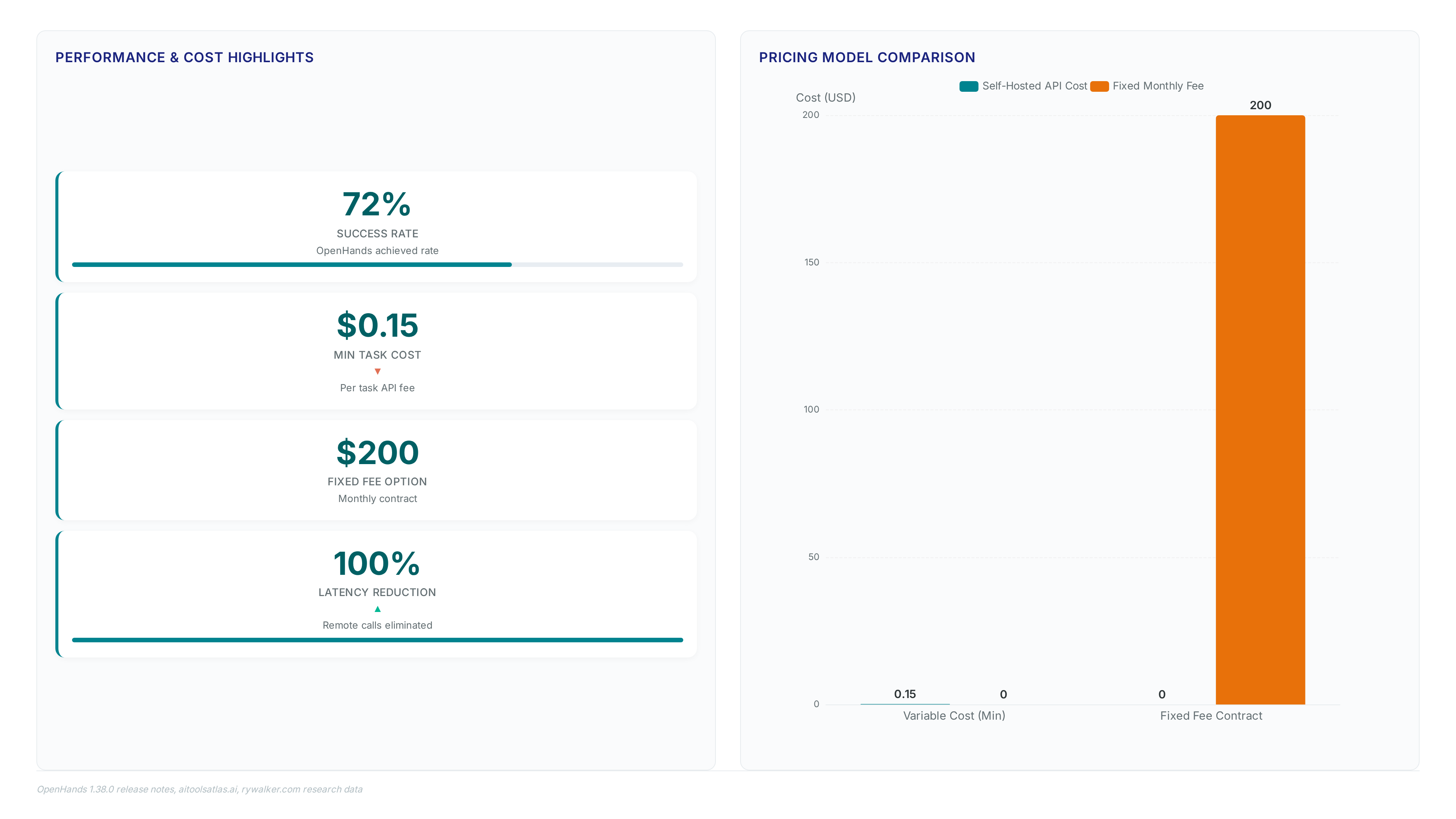
The payoff is measured in avoided network I/O. Operators scaling to thousands of concurrent agents see immediate gains because the system no longer waits for the Cloud API to resolve identity claims, and direct state inspection prevents the silent pausing of older sandboxes seen under heavy load. Unlike LangChain, which often requires custom coding to orchestrate such low-level optimizations, OpenHands embeds this efficiency directly into the agent runtime. The boundary is narrow: the optimization applies strictly to the managed Cloud SaaS and specific Docker configurations, leaving standard IDE plugins like Cursor without equivalent native sandboxing. AI Agents News recommends prioritizing this architecture when latency bounds are strict.
The cost of this architecture is strict coupling to the underlying orchestration layer, and the financial impact becomes acute during high-frequency agent loops where marginal cost differences compound rapidly. Operators using custom pricing models for enterprise features avoid the penalty of paying for unused capacity inherent in flat-rate subscriptions. A single fixed-fee contract might cost $200 monthly regardless of activity, whereas a variable model scales down to near-zero during idle periods.
However, predicting monthly spend requires rigorous monitoring of token consumption rates. The trade-off is operational overhead; teams must track API usage metrics to prevent budget overruns that fixed fees inherently prevent. Enterprises should evaluate their agent concurrency patterns before migrating from legacy SaaS tools.
Implementing Optimized Webhook Authentication for Scale
Enabling Local SandboxRecord Auth on Kubernetes
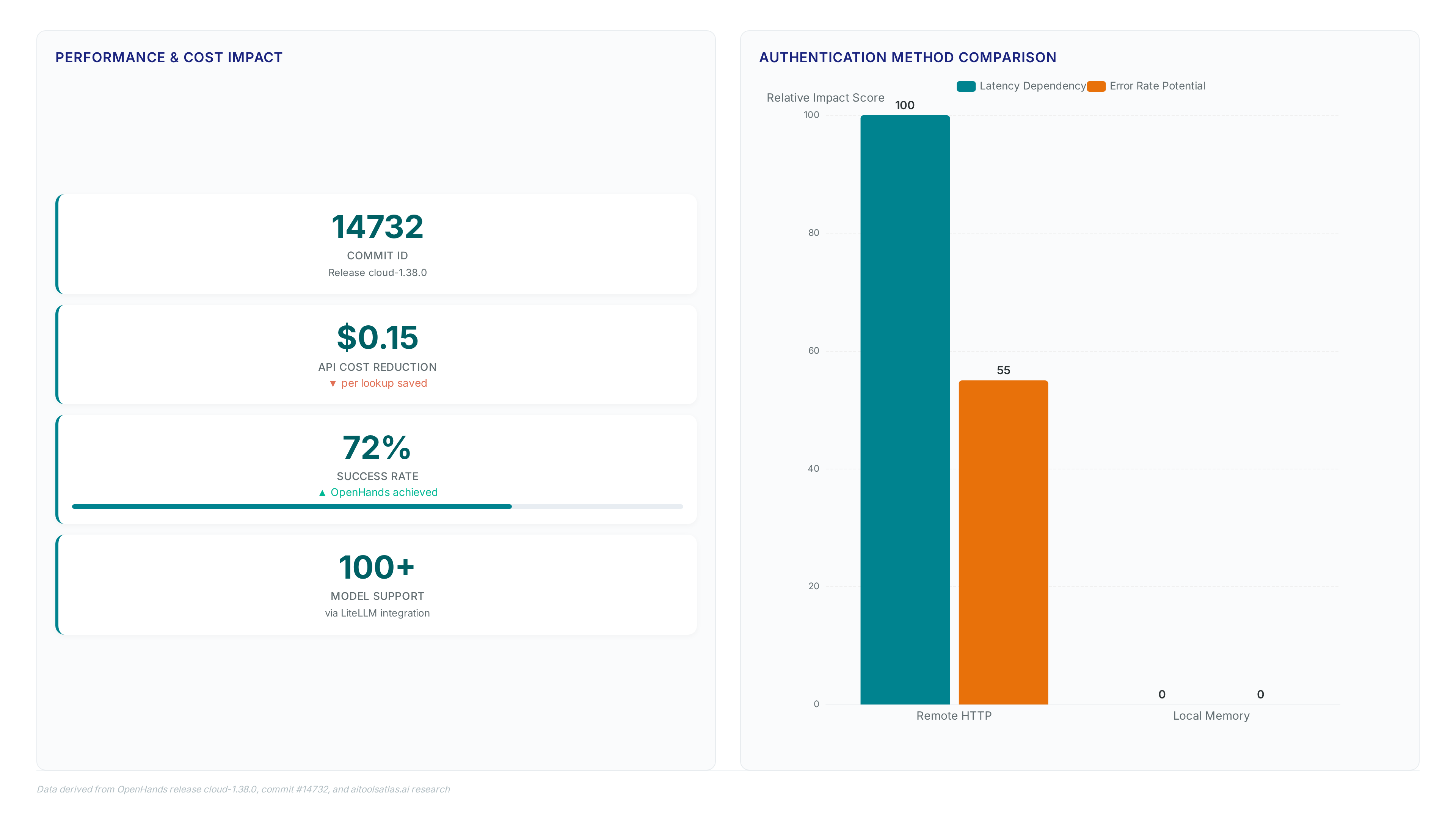
Deployment requires the helm chart configuration to enable direct SandboxRecord memory inspection within the container namespace.
- Update the
values.yamlfile to setauth.methodtosandbox-record-local, disabling external webhook polling entirely. - Apply the updated manifest to the Kubernetes cluster, ensuring pods restart with the new Docker isolation flags active.
- Verify the sandboxed execution environment rejects unauthorized requests without generating network logs for authentication checks.
This configuration uses the platform's ability to support self-hosted Kubernetes options while maintaining strict agent separation from the host system.
About
Sofia Berg, Research Editor at AI Agents News, specializes in translating complex multi-agent research and benchmark data into actionable insights for engineering teams. Her daily work involves rigorous analysis of arXiv papers and performance metrics like SWE-bench, making her uniquely qualified to dissect the technical nuances of OpenHands release cloud-1.38.0. This specific update, which optimizes webhook authentication by skipping runtime API calls via SandboxRecord, directly impacts the latency and scalability of coding agents, a core focus of her coverage. At AI Agents News, Berg evaluates how framework-level improvements in projects like OpenHands affect real-world agent orchestration. By connecting low-level commit changes to broader system performance, she provides the technical context engineers need to understand why skipping redundant API calls matters for building efficient, high-throughput autonomous systems. Her analysis ensures builders can separate genuine architectural gains from mere hype.
Conclusion
Release cloud-1.38.0 makes one trade deliberately. Authentication stops asking a remote service and starts reading local SandboxRecord state, which is what lets a single deployment carry thousands of concurrent agents instead of queuing behind network I/O. The bill comes due in consistency: a corrupted or lagging record fails authorization outright instead of timing out gracefully, and the control plane and the sandbox host have to stay synchronized for the guarantee to hold. Teams that can keep records consistent across nodes get sub-millisecond authentication under load; teams that cannot are better served by the remote check they were about to remove.
Frequently Asked Questions
Self-hosted tasks using frontier models typically cost between $0.15 and $0.60 per task in API fees. This variable expense model makes efficiency gains from skipping runtime calls financially significant at scale.
Gartner forecasts that 40% of enterprise applications will embed task-specific AI agents by the end of 2026. This rapid adoption drives the need for low-latency architectures like SandboxRecord.
Eliminating runtime API calls removes network round-trips during high-frequency authorization checks. This shift prevents cumulative delays inherent in querying external services for every single transaction within the environment.
Corrupted records cause immediate authorization failures rather than graceful timeouts when runtime calls are skipped. Operators must guarantee database consistency across nodes to prevent these stale permission grants.
OpenHands operates on a bring-your-own-key model where users pay only for underlying LLM inference costs. This contrasts with fixed-fee contracts that charge a set amount regardless of activity levels.