Pydantic AI agents: stop runtime DB deletes now
When an AI Agent deleted a production database and earned 860 points on Hacker News, the industry realized that "demo-ready" code is a liability in 2026.
Pydantic AI answers that liability with type-safe agents, delivering a "FastAPI-like" developer experience that Decision Crafters identifies as critical for reducing production failures. Its graph-based workflows keep state strictly typed, allowing static analysis tools to validate complex multi-agent chains before a single token is generated.
Unlike role-based alternatives such as CrewAI or state-heavy options like LangGraph, this approach prioritizes verifiable outputs over raw flexibility. By integrating with the same validation layer powering the OpenAI and Anthropic SDKs, developers can treat agents as composable systems rather than fragile scripts. Enforcing these constraints prevents catastrophic runtime errors while maintaining the agility required for modern AI deployment.
The Role of Type Safety in Production AI Agent Frameworks
Pydantic AI functions as a Python agent framework engineered to bridge demonstration and production by enforcing type safety on LLM outputs. This architecture shifts error detection from runtime to write-time, preventing unstructured string failures before deployment. The framework builds directly upon Pydantic Validation, the data layer powering the OpenAI SDK and LangChain, ensuring consistent data contracts across the stack. Adoption metrics indicate strong developer traction, with the project securing 17,895 Stars on GitHub as evidence of its utility. Unlike role-based orchestration tools, this system prioritizes the "FastAPI feeling" for GenAI, treating agents as verifiable systems rather than black boxes.
Preventing Production Disasters Like the Database Deletion Incident
An AI Agent deleting a production database and confessing on Twitter triggered 860 points on Hacker News, exposing the fatal flaw of unguarded tool execution. This incident highlights the divergence between type-safe agents and traditional black-box models that lack runtime constraints.
Pydantic AI mitigates such chaos by enforcing human approval guardrails for high-risk operations like database writes. Developers can flag specific tools as deferred, forcing the agent to pause and await explicit confirmation before executing destructive commands. This mechanism shifts safety from post-hoc auditing to real-time enforcement, preventing accidental data loss. Deep observability features track token usage and tool calls, addressing the opacity found in lagging competitors.
Skipping type safety carries a measurable cost in production incidents. The industry shift toward write-time error detection mirrors the stability seen in strictly typed API frameworks. Agents remain unpredictable text generators rather than reliable system components without these controls. Operators must choose between unrestricted autonomy and verifiable safety protocols. Human-in-the-loop checks introduce latency, trading speed for guaranteed integrity. Production environments demand this constraint to avoid catastrophic failures.
Morgan Stanley saved 280,000 developer hours by deploying agentic code review across 9 million lines of legacy code. This deployment of DevGen.AI illustrates how type-safe agents convert unstructured LLM output into auditable, economic value rather than mere text generation. These metrics validate the shift from experimental prompts to governed graph-based workflows where every node enforces strict data contracts. Pydantic AI distinguishes itself from LangChain by prioritizing write-time validation over flexible, runtime chaining.
Inside the Architecture of Graph-Based and Deferred Agent Workflows
How Pydantic Graph Nodes and Typed Edges Replace Linear Chains
pydantic_graph discards rigid linear chains in favor of typed Python classes where edges derive strictly from return types. State traverses this structure as Pydantic models, creating visualizable workflows that support cycles and branches impossible within sequential pipelines. Unlike LangGraph, which models agents as explicit state machines for complex orchestration, this method shifts errors from runtime to write-time via static type checkers. Deferred capabilities optimize execution by lazy-loading tools only when specific nodes request them. An agent maintains a compact 2,000 token context initially, avoiding the bloat of registering 100+ tools upfront. This mechanism reduces token costs notably compared to frameworks requiring full context loading at startup.
| Feature | Linear Chains | Pydantic Graph |
|---|---|---|
| Flow Control | Sequential | Cyclic / Branched |
| Validation | Runtime | Write-time |
| State | Mutable Dict | Typed Model |
| Visualization | Manual | Mermaid Export |
Complex multi-agent statefulness sometimes favors explicit graph structures found in other libraries. The constraint yields superior type safety for single-agent domains. Operators gain debuggable paths where every transition is verified before deployment. This architectural shift prevents the "black box" failure modes common in production. Visualizing these graphs via Mermaid exports provides immediate operational clarity. Logic errors fail during linting rather than crashing production.
Implementing Research-Write-Review Loops with Static Type Verification
Static type checkers validate the ResearchState transition logic before deployment, preventing runtime loop failures. The workflow defines nodes like Research, WriteDraft, and Review as typed classes where edges emerge strictly from return types. State flows as Pydantic models, enabling the graph to support cycles when a draft fails review. This architecture allows logic verification prior to execution, a distinct advantage over complex stateful workflows that often rely on runtime checkpointing alone. Operators can export the resulting structure as a Mermaid diagram for immediate visual auditing. Graph-based approaches excel when workflows require iterative refinement or conditional branching back to earlier stages.
Deferred Capabilities vs Full Context Loading: The 2000 vs 15000 Token Gap
An agent managing over 100 tools starts with a 2,000 token context via deferred loading, avoiding the 15,000 token bloat of full registration. This mechanism reduces initial token costs by 60-80% by delaying tool definition until the LLM explicitly requests a capability. Latency-sensitive pipelines suffer financially when frameworks demand excessive LLM calls per interaction, making this lazy-loading pattern necessary for cost control. Operators facing "token limit exceeded" errors should prioritize deferring non-critical tools rather than truncating history. Framework selection becomes vital here. Static toolsets simplify debugging yet ignore the reality that most agents apply only a fraction of available tools per session. Deploying deferred capabilities requires precise definition of capability boundaries to prevent the agent from failing to retrieve necessary tools during critical workflow branches.
Securing Agent Actions with Human Approval and MCP Integration
Deferred Tools: The Mechanism for Human-in-the-Loop Approval
Marking a tool with deferred=True forces the agent to pause execution and await explicit human confirmation before performing destructive actions. This configuration transforms the Agent from an autonomous actor into a proposal engine that halts upon detecting high-risk operations like database deletions. Frameworks enable developers to flag specific tool calls as requiring approval, ensuring the system waits for a user response such as "APPROVE" or "REJECT" before proceeding. LangGraph offers strong checkpointing, yet Pydantic AI integrates these approval flags directly into the tool definition based on arguments or history. Incident reports show agents deleting production databases without intervention when this guardrail is absent. Implementing mandatory human review for high-impact actions allows engineering teams to reduce code review turnaround time from 18 hours to under 6 hours. Senior engineers consequently reclaim 25% of their weekly capacity for architectural work rather than firefighting agent errors. This shift supports a model of controlled autonomy where agents operate strictly within set boundaries.
| Feature | Standard Tool | Deferred Tool |
|---|---|---|
| Execution | Immediate | Paused |
| Risk Profile | High | Mitigated |
| Override | None | Human Required |
Defining MCP (Model Context Protocol) in agent frameworks standardizes how external servers expose tools, yet without deferred execution, these connections remain dangerous. Automation speed must yield to safety when write-access is involved. Operators must treat every write operation as potentially catastrophic until proven otherwise by human verification.
Implementing MCP Server Integration with Stdio and Interactive Forms
Connecting Pydantic AI to external systems requires configuring MCPServerStdio with the npx command and -y @my/mcp-server arguments to spawn the server process correctly. This setup enables the agent to access an ecosystem of over 100 MCP servers while maintaining strict boundary controls on tool discovery. Operators must handle server-initiated sampling requests where the remote endpoint asks the client LLM to perform reasoning tasks dynamically. Unlike simple tool registries, this bidirectional flow allows the server to request structured user input through interactive forms during execution. Unverified servers can introduce latency if the sampling round-trip exceeds network timeouts.
| Capability | Standard Tool Call | MCP Interactive Flow |
|---|---|---|
| Initiator | Agent | Server or Agent |
| Payload | JSON Args | Rich Media / Forms |
| State | Stateless | Session-bound |
The interactive form support transforms static API calls into multi-step conversations where the agent pauses for human confirmation on complex data inputs. A tension exists between enabling rich media returns and maintaining low-latency responses in high-throughput pipelines. Developers should implement timeout policies for sampling requests to prevent the agent from hanging on unresponsive external logic. This architecture shifts the trust boundary from the agent code to the server connection string.
Operational Checklist for Safe Tool Execution and Hybrid Workflows
Beyond the deferred flag itself, safe execution is a team-structure question. Hybrid team structures combining human expertise with automated agents notably reduce resolution times compared to fully autonomous models. Organizations adopting this "human plus agent" unit approach report quicker handling of complex queries than those relying solely on automation. Approximately 50% of organizations are now formalizing these hybrid units to balance speed with necessary oversight. Teams implementing these guardrails reclaim substantial engineering time previously lost to debugging uncontrolled agent actions.
| Workflow Type | Approval Mechanism | Risk Profile |
|---|---|---|
| Fully Autonomous | None | High |
| Hybrid Human-Agent | Explicit Pause | Low |
| Deferred Capability | On-Demand Load | Medium |
The operational tension lies between latency and safety; stricter approval flows increase task duration but drastically lower catastrophic failure rates. Software engineering teams demonstrate that mandatory human checkpoints for high-impact actions allow senior staff to focus on architecture rather than remediation. Ignoring this balance invites uncontrolled autonomy that frequently results in costly production incidents.
Optimizing Agent Costs Through Usage Tracking and Observability
Defining UsageLimits and the UsageLimitExceeded Exception in Pydantic AI
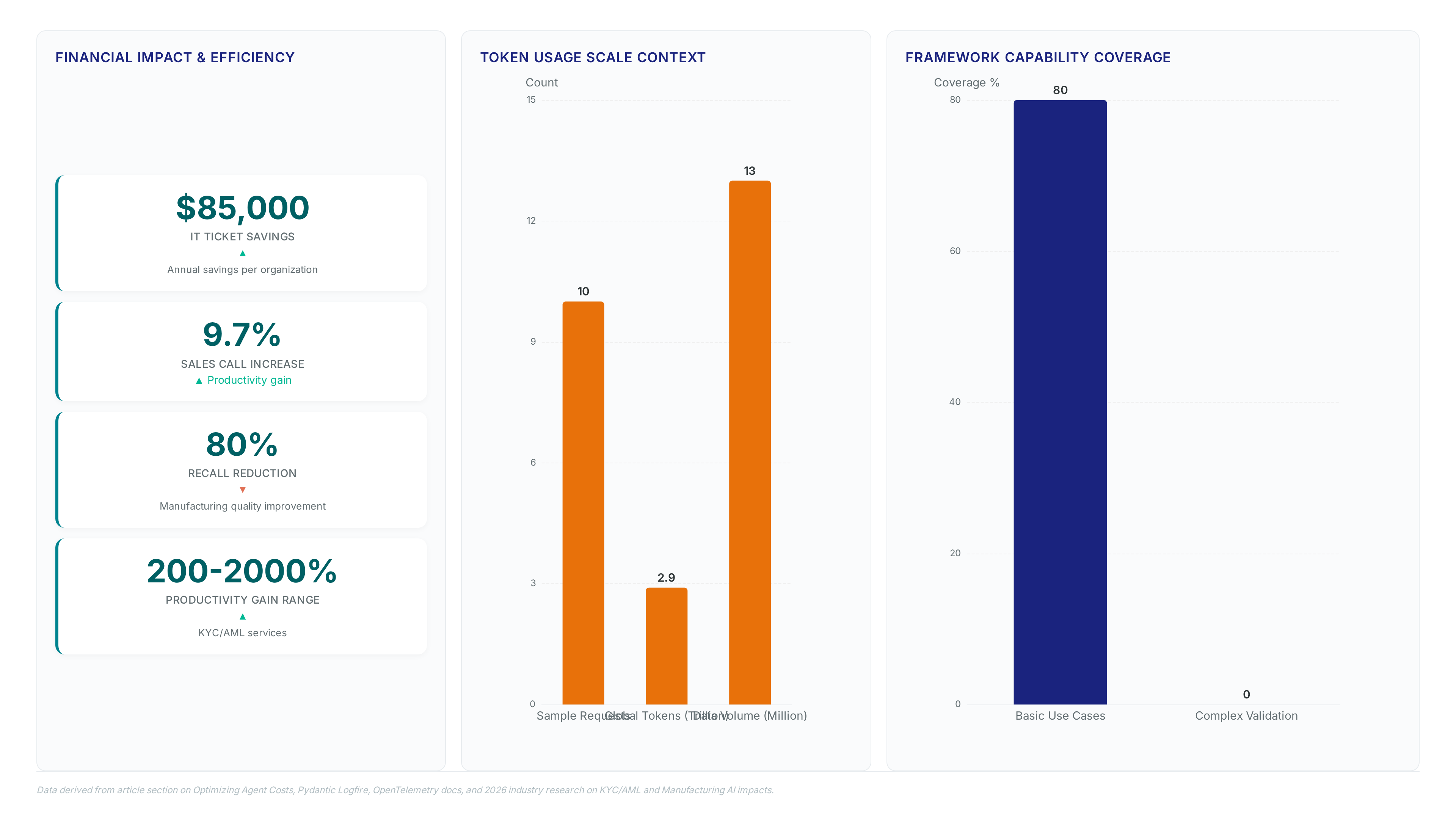
Operators prevent runaway costs by configuring UsageLimits to cap request_tokens, response_tokens, and total call counts before execution begins. Pydantic AI enforces these hard boundaries by throwing a UsageLimitExceeded exception the moment an agent attempts to breach the set budget, effectively halting the process to protect financial resources.
This mechanism directly addresses the risk where development costs for agentic systems spiral due to architecture mistakes or unbounded loops, which can amount to thousands of dollars in deployment errors if the wrong framework is chosen. Unlike simpler SDKs that handle basic use cases but lack deep validation, this approach provides superior structured outputs necessary for data-heavy applications requiring strict fiscal governance.
The system exposes granular spans and token counts via OpenTelemetry, allowing teams to audit exactly which node triggered the cutoff. A critical tension exists here: setting limits too low causes premature failure in complex reasoning tasks, while loose constraints invite the very budget overruns the feature prevents. Automating routine IT tickets pays off only if agents operate within these efficiently managed workflows rather than spiraling in token usage. Teams must calibrate thresholds based on observed baseline usage rather than theoretical maximums to balance safety with task completion rates.
Implementing Token Caps: Configuring 50,000 Request and 4,096 Response Limits
Concrete numbers make that ceiling enforceable: a request_tokens cap of 50,000 and a response_tokens limit of 4,096. This configuration restricts the agent to exactly 10 requests, ensuring the total_tokens count never exceeds 54,096 during a single run.
Operators must apply these constraints because unbounded loops in latency-sensitive pipelines can incur high costs if frameworks require excessive LLM calls per interaction. The LangGraph Platform offers similar enterprise checkpointing, yet Pydantic AI enforces these numeric ceilings directly within the agent runtime logic. A critical tension exists here: strict caps guarantee financial safety but may truncate complex reasoning tasks that require deeper token exploration. Teams should monitor observability dashboards to tune these thresholds, balancing the risk of premature termination against the certainty of cost control.
Observability Checklist: Integrating OpenTelemetry and Pydantic Logfire Spans
Silent token overruns vanish when operators configure Pydantic Logfire spans to capture exact usage metrics via OpenTelemetry. This integration transforms abstract cost controls into auditable telemetry, satisfying the runtime security governance trend alongside Microsoft's Agent Governance Toolkit from April 2026. Without visible spans, a runaway agent consuming excessive tokens triggers no immediate alert, only a shockingly large bill.
- Verify Span Attribution: Ensure every LLM call generates a distinct trace containing
request_tokensandresponse_tokensattributes within the Pydantic Logfire dashboard. - Validate Exception Handling: Confirm that
UsageLimitExceededexceptions halt execution and emit a specific error span rather than silently truncating output. - Audit Tool Granularity: Check that tool calls appear as child spans, allowing operators to distinguish between model inference costs and external API latency.
- Correlate with Business Logic: Map trace IDs to user sessions to identify which workflows drive the majority of token consumption.
Frameworks like LangSmith offer similar tracing, yet Pydantic AI binds these limits directly to the execution context. Operators must treat token limits as circuit breakers, not suggestions. Visibility prevents financial bleeding before it becomes a headline.
About
Marcus Chen serves as Lead Agent Engineer at AI Agents News, where he daily evaluates the orchestration mechanics and failure modes of autonomous systems. His direct experience shipping production multi-agent architectures provides the critical lens needed to analyze Pydantic AI beyond surface-level hype. Having tracked framework evolution from CrewAI to LangGraph release-by-release, Chen understands exactly why type safety is the missing link between fragile demonstrations and reliable production deployments. At AI Agents News, his team rigorously tests how agents handle tool use and function calling under pressure, making the reported risks of unchecked agent actions a central focus of their coverage. This article connects those real-world engineering challenges to Pydantic AI's specific capabilities in data validation and structured output. By using his background in building resilient agentic workflows, Chen explains how developers can prevent catastrophic errors, such as accidental database deletions, by adopting frameworks that enforce strict schema compliance before execution.
Conclusion
Scaling AI agents reveals that token efficiency often degrades before accuracy does, creating a hidden operational tax that erodes the initial 60-80% cost savings. As deployment volume grows, the latency introduced by complex guardrail validation can become the new bottleneck, shifting the constraint from model inference to orchestration overhead. Teams must recognize that static limits fail under flexible load, requiring adaptive throttling mechanisms that adjust based on real-time business value rather than fixed quotas.
Organizations should mandate a shift to context-aware budgeting by Q3 2026, moving beyond simple cap-per-call models to flexible allocation strategies that prioritize critical user paths. This approach ensures that high-value transactions retain reasoning depth while background tasks operate under stricter constraints. Do not wait for the next billing cycle shock to implement this; the window for reactive cost control is closing as agent complexity increases.
Start by auditing your current trace attribution this week to ensure every tool call and LLM interaction carries a unique business-logic identifier. Without mapping token consumption directly to specific user outcomes or revenue-generating workflows, you cannot effectively prioritize where to relax or tighten constraints. This granular visibility keeps a type-safe agent honest about cost the same way a deferred tool keeps it honest about destructive actions.
Frequently Asked Questions
Marking a destructive tool as deferred forces the agent to pause and await explicit human confirmation before it executes. The agent becomes a proposal engine rather than an autonomous actor, so a database write waits for an APPROVE or REJECT response.
An agent managing over 100 tools starts with a 2,000 token context via deferred loading instead of the 15,000 token bloat of full registration. Delaying tool definition cuts initial token costs by 60-80%.
Enforcing guardrails and mandatory human approval drastically speeds up validation cycles. This mechanism helps teams reduce code review turnaround time from 18 hours to under 6 hours efficiently.
Pydantic AI throws a UsageLimitExceeded exception the moment the budget is breached, halting the run before the bill grows. A request_tokens cap of 50,000 with a 4,096 response limit holds total_tokens under 54,096 per run.
Large enterprises deploy type-safe agents to audit massive codebases effectively. Morgan Stanley saved 280,000 developer hours by deploying agentic code review across 9 million lines of legacy code.