Agent framework choices: LangGraph vs CrewAI
With 85% of organizations integrating AI agents into workflows, selecting the right AI agent framework dictates system viability. The market has shifted from passive tools to autonomous systems, making the choice of architecture critical for scaling beyond simple prototypes. The core architectures behind LangChain, AutoGen, LangGraph, and CrewAI diverge on one question: how much of the agent's state you are willing to declare yourself. LangGraph makes every transition explicit and audit-ready, CrewAI delegates to roles and hides the graph, and that single decision governs whether multi-agent systems hold together under latency and context limits.
McKinsey reports that 23% of organizations are already scaling these agentic systems while another 39% actively experiment. Business process automation leads adoption at 64% of deployments, proving the utility of these frameworks in production. Understanding these dynamics is necessary as the industry moves toward reliable, stateful workflows.
Core Architectures Defining Modern AI Agent Frameworks
Defining AI Agent Frameworks and RAG-Centric Architectures
An AI agent framework binds large language models, external tools, and prompt strategies into systems that execute autonomous tasks instead of generating static chat responses. These architectures act as the reasoning engine for flexible action. Market data confirms this transition from experimentation to production, with projections reaching $50.31 billion by 2030 at a 45.8% CAGR. A RAG-centric agent grounds its output in retrieved external data, a pattern where LlamaIndex excels through specialized retrieval pipelines despite limited multi-agent support. AutoGen moves the other way, letting distinct agents solve problems collectively inside a conversation, and CrewAI extends that logic via team-based orchestration that assigns roles and runs sequential tasks.
Single-agent RAG systems handle isolated queries well enough, yet enterprise workflows now demand stateful coordination across multiple specialized agents. Developers must balance the simplicity of retrieval tools against the overhead required for collaborative autonomy. Selection directly dictates development velocity and system reliability as applications scale.
Deploying Stateful Workflows with LangGraph and CrewAI
Stateful workflows operate as finite state machines where graph nodes preserve context across multi-step logical loops. LangGraph models agents this way by offering explicit state management and human-in-the-loop checkpoints, although this architectural rigor creates a steep learning curve for new developers. Multi-agent collaboration relies on role delegation rather than singular state transitions. CrewAI distinguishes itself through team-based orchestration that allows distinct agent instances to communicate and assign tasks dynamically without complex graph definitions. Current adoption metrics indicate widespread integration of agents into workflows, yet many teams struggle with coordination overhead.
LangGraph provides graph-based control flow and parallel node execution, while CrewAI offers an easier learning curve for team-based patterns. Developer momentum currently favors LangGraph, which surpasses CrewAI in GitHub stars according to community benchmarks. This shift suggests an expanding preference for stateful complex workflows in production systems. Builders must weigh the need for explicit state management against the speed of role-based configuration. Selecting the appropriate abstraction layer prevents architectural limitations as projects grow.
LangChain vs AutoGen: Selecting Frameworks for Multi-Agent Scale
Choosing between LangChain and AutoGen depends on whether the architecture requires modular chains or native conversation loops. LangChain provides a general-purpose foundation where developers construct linear sequences. AutoGen from Microsoft enables autonomous multi-agent collaboration through conversational patterns. Microsoft merged AutoGen with Semantic Kernel in October 2025, signaling a consolidation of tools within the Microsoft AI stack. LangChain relies on LangGraph for multi-agent capabilities. AutoGen features multi-agent collaboration as a core function.
| Feature | LangChain | AutoGen |
|---|---|---|
| Primary Pattern | Linear Chains | Conversational Loops |
| Multi-Agent | Via LangGraph | Native Core |
| Best Use Case | RAG Pipelines | Collaborative Tasks |
The cost of choosing general modularity can include additional configuration for stateful interactions. LangChain excels at connecting disparate tools in a sequence. Microsoft's framework focuses on conversational primitives out of the box. Rapid market growth implies scaling scenarios where architectural fit becomes critical. Teams gain broad integration options with LangChain but may require different approaches for flexible agent swarms. Engineering groups building collaborative problem-solving agents often evaluate AutoGen for its native multi-agent design. The distinction lies in the inherent structure: LangChain offers flexibility for chains, while AutoGen is optimized for peer-to-peer agent dialogue.
Mechanics of Orchestration and State Management in Leading Tools
LangChain Expression Language and Finite State Machine Fundamentals
LangChain uses a modular layout for chains, agents, memory, and tools alongside the LangChain Expression Language (LCEL). LCEL builds declarative chains where components link via a pipe operator to speed up linear LLM workflow prototyping. This syntax hides asynchronous execution and streaming logic so developers compose retrieval-augmented generation pipelines without handling low-level threading. Every component acts as a runnable interface that standardizes interactions between prompts, models, and output parsers.
LangGraph takes a different path by modeling agents as explicit finite state machines. Nodes serve as computational units while edges define conditional transitions. A shared state object persists across the whole graph, allowing cycles where an agent retries a tool call or asks for human help. Teams constructing autonomous systems often switch to graph definitions once task complexity outgrows single-pass reasoning limits.
The rule that falls out of this is short: LCEL for simple data retrieval, stateful graphs for workflows that need iterative refinement.
Mechanics: Deploying Conditional Workflows with LangGraph Checkpoints and AutoGen Async Execution
LangGraph places human-in-the-loop checkpoints that halt execution for approval in workflows prone to retries. The framework treats agents as finite state machines, letting developers specify exact transitions between nodes instead of depending on linear chains. This granular control creates a steep learning curve demanding graph theory knowledge that general prototyping tools skip. Operators weigh the value of audit-ready state trails against the work required to define transition logic early. AutoGen runs asynchronous tasks to handle concurrent conversations between specialized agents without stopping the main thread. This method enables code execution where one agent writes scripts while another checks output simultaneously.
Navigating Steep Learning Curves and Debugging Complexity in Agent Frameworks
LangGraph requires graph theory skills that general prototyping tools like LangChain do not demand. Such rigidity guarantees audit-ready trails yet blocks teams used to linear chain composition. Consolidating AutoGen and Semantic Kernel suggests Microsoft addresses orchestration complexity by merging agent logic with kernel execution. AutoGen operators face unique problems where conversational loops between agents cause unpredictable token usage and hide failure points. Teams must balance explicit state management needs against prototype iteration speed. Observers recommend testing framework choice against specific workflow complexity rather than feature checklists.
Implementing Multi-Agent Systems and Stateful Workflows
LangGraph State Machines and CrewAI Role-Based Agent Definitions
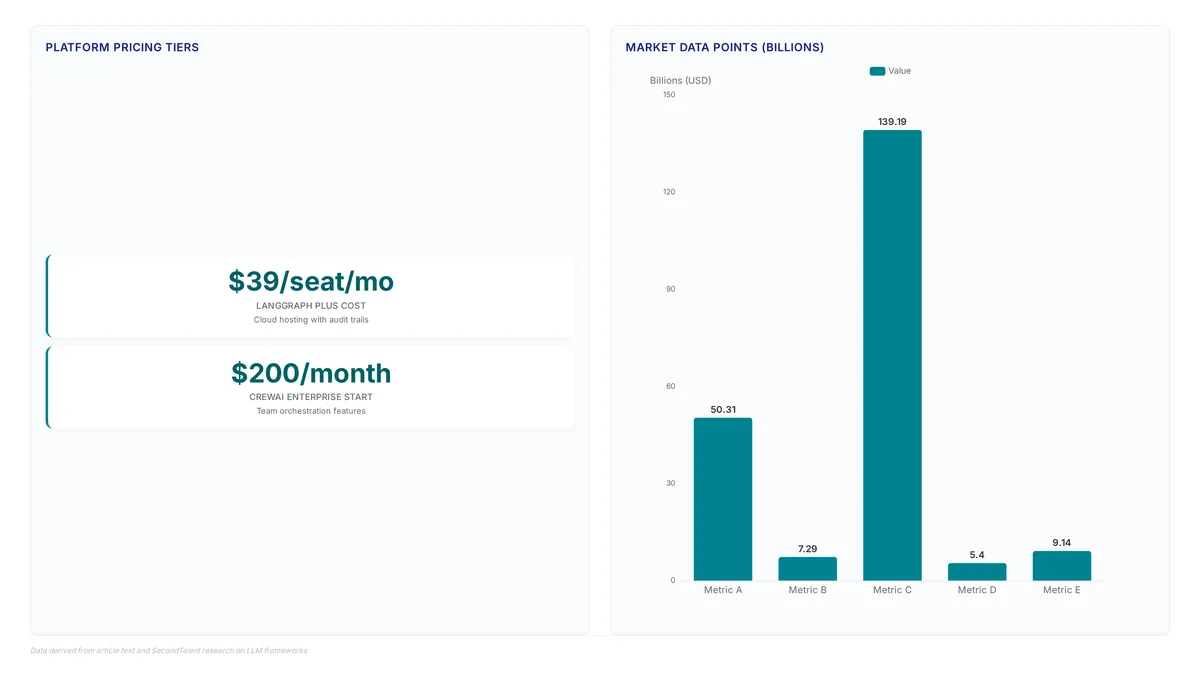
LangGraph implements explicit finite state machines to manage complex, conditional workflows where every transition requires set logic. Builders construct these systems by mapping nodes to specific functions and edges to deterministic rules, ensuring the agent never enters an undefined state without a retry policy. This architecture suits high-stakes environments where audit trails and precise control flow override rapid prototyping needs. Defining every possible state transition creates significant upfront overhead compared to linear chains.
CrewAI adopts a role-based design where distinct agents function as specialized team members like Planners or Researchers. This approach relies on team-based orchestration patterns to delegate tasks autonomously rather than enforcing rigid state graphs. Developers define agents with specific goals and backstories, allowing the framework to handle the underlying conversation management and tool selection dynamically. Reduced visibility into the exact execution path occurs during runtime debugging. LangGraph offers superior control for deterministic processes. CrewAI accelerates development for collaborative tasks where rigid state enforcement is unnecessary. The choice depends on whether the workflow demands strict state guarantees, including parallel node execution and complex retry policies, or the speed of role-based collaboration, which offers less flexibility than LangChain once custom logic falls outside the team metaphor.
Implementing RAG with LlamaIndex and Team Orchestration in CrewAI
Builders initialize LlamaIndex pipelines by applying sophisticated chunking strategies to parse enterprise documents into searchable segments. This indexing mechanism transforms raw text into structured data nodes that agents query during retrieval operations. Complex index types demand careful tuning of window sizes to prevent context fragmentation. Operators gain precise control over how knowledge bases serve information to downstream models.
Orchestration shifts to CrewAI when deploying role-based agents for coordinated sales automation or marketing generation. This framework uses team-based orchestration capabilities where distinct instances like Researchers and Writers delegate tasks autonomously. Unlike single-agent loops, this architecture distributes cognitive load across specialized personas to execute multi-step campaigns. The abstraction simplifies development at the cost of granular state control found in graph-based alternatives. Teams must weigh rapid prototyping needs against the requirement for explicit workflow definitions in high-stakes environments.
To deploy a marketing crew, configure the team structure around distinct roles and sequential tasks, which enables scalable multi-agent collaboration patterns for consistent output; custom logic still requires overriding default agent behaviors. AI Agents News recommends this stack for teams prioritizing speed over deep state customization.
Operational Risks and Observability in Production Deployments
Defining Observability Gaps in Multi-Agent Debugging
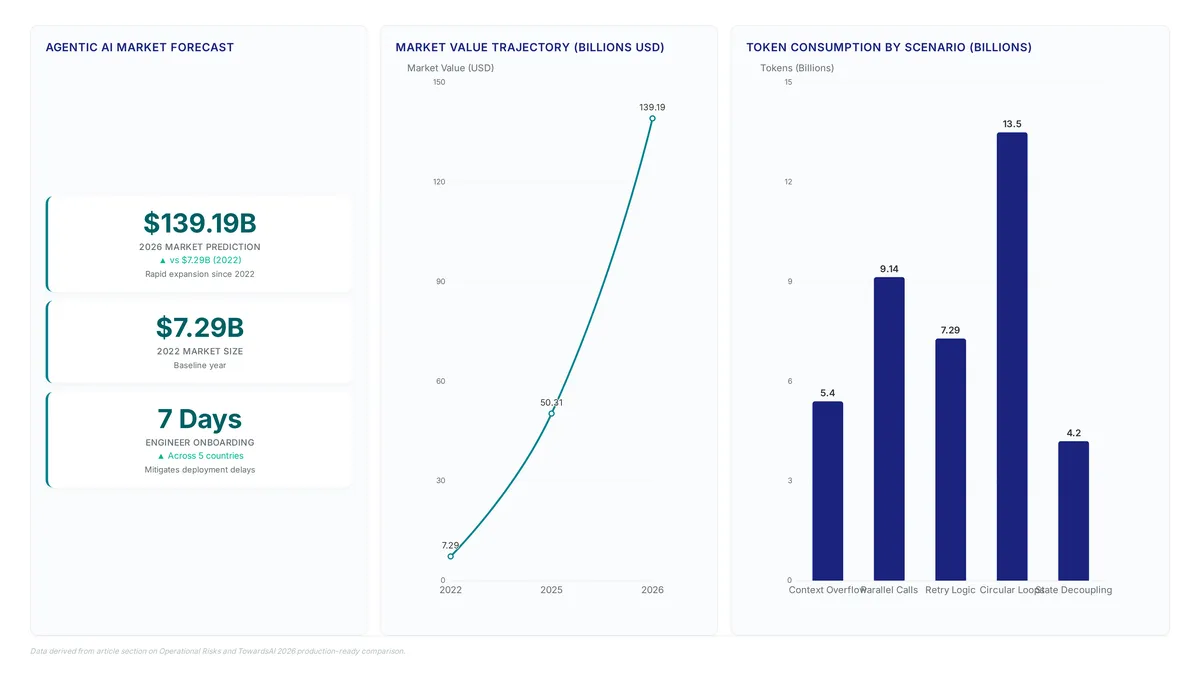
Standard logging fails because distributed state across autonomous nodes prevents linear trace reconstruction. In AutoGen, complex multi-agent conversations generate non-deterministic dialogue patterns that obscure root causes without specialized tracing capabilities. Traditional timestamped entries cannot capture the causal chain when agents negotiate tool usage or modify shared context dynamically. The industry evolved rapidly from a narrow selection of three frameworks to a crowded market where every substantial lab now offers distinct solutions. This expansion complicates debugging as teams mix orchestration styles without unified visibility standards. Hidden costs emerge when token consumption spikes during circular agent loops.
Implementing LangSmith for Stateful Workflow Tracing
Tracing conditional branches in LangGraph requires binding the trace ID to the graph state before executing the first node. Without this binding, LangSmith cannot reconstruct the causal chain when human-in-the-loop checkpoints interrupt the execution flow. Operators deploying to production environments face a specific architectural limitation: asynchronous agent scaling often decouples the trace context from the worker process, resulting in fragmented spans that obscure latency bottlenecks. Hidden operational costs frequently emerge during stateful deployments:
- Context overflow causes trace truncation when conversation history exceeds token limits.
- Parallel tool calls generate overlapping spans that confuse linear timeline views.
- Retry logic creates duplicate trace entries that inflate apparent request volume.
- Network overhead degrades performance when verbose span collection runs on the critical path.
The shift toward production-ready comparisons indicates that enterprises now prioritize total cost of ownership over raw feature counts when selecting observability stacks. Multi-agent frameworks excel at complex orchestration yet introduce non-deterministic dialogue patterns that standard logging cannot resolve. A tension exists between granular tracing depth and system throughput. Enabling verbose span collection for every agent interaction can degrade performance by adding network overhead to the critical path. Teams must configure sampling rates dynamically, capturing all traces during error states while reducing fidelity during steady-state operations. This selective approach balances the need for forensic data against the resource constraints of high-scale deployments.
Checklist for Mitigating Architectural Limitations in Agent Scaling
Teams must weigh framework complexity against what they can realistically operate before scaling autonomous systems. Long-range forecasts extending to 2034 predict the agentic AI market could reach $139.19 billion, yet operational readiness often lags behind that projected valuation. Enterprises are evaluating these frameworks based on production readiness, which includes an assessment of total cost of ownership relative to the complexity of tasks the agents can perform.
- Debugging complexity: Non-deterministic flows in tools like AutoGen require advanced tracing to fix debugging issues in complex agents.
- Orchestration overhead: Team-based orchestration introduces latency that single-agent prototypes do not exhibit.
- State management: Missing checkpoints in stateful workflows lead to unrecoverable context loss.
The drawback is measurable when teams lack personnel capable of managing stateful workflows effectively, because architectural limitations frequently surface only after deployment, when the fix needs someone who already understands the graph. AI Agents News recommends verifying infrastructure elasticity before committing to role-based prototypes.
About
Marcus Chen serves as Lead Agent Engineer at AI Agents News, where he daily evaluates and deploys production multi-agent systems. This hands-on experience directly informs his analysis of the rapidly evolving AI agent framework environment. Having shipped complex orchestration workflows using tools like CrewAI, AutoGen, and LangGraph, Marcus understands the critical differences between marketing claims and actual tool-use capabilities. His work requires rigorous testing of function calling, agent memory, and coordination mechanics, ensuring his insights reflect real-world engineering constraints rather than theoretical potential. At AI Agents News, a hub dedicated to technical founders and engineers, Marcus uses this practical expertise to dissect framework updates and benchmark results. By focusing on concrete version changes and architectural merits, he helps the community navigate the shift from passive AI tools to autonomous systems capable of genuine reasoning and planning without the usual industry hype.
Conclusion
The choice between LangGraph and CrewAI is a choice about when you pay. LangGraph takes payment upfront: every node, every edge, every retry policy declared before the first run, and in return the execution path stays deterministic and audit-ready. CrewAI defers payment to debugging time, since role-based agents produce a working crew quickly but leave the exact runtime path harder to reconstruct.
Neither wins on features. The workflow decides: strict state guarantees wherever an undefined state is unacceptable, role-based orchestration where iteration speed matters more than a full graph. LangChain stays the general chain builder underneath both, and AutoGen covers conversational, peer-to-peer collaboration natively. Test that choice against the complexity of your own workflow rather than a feature checklist, and coherent state stops being the thing that limits how far the system scales.
Frequently Asked Questions
The AI agent market is projected to reach $50.31 billion by 2030. This massive growth indicates that selecting a scalable framework now is critical for organizations aiming to compete in an increasingly autonomous future landscape.
It justifies itself when the workflow needs audit-ready state trails, human-in-the-loop checkpoints, parallel node execution, and retry policies. Mapping every node transition upfront is real work, and it pays off only where an undefined state is unacceptable.
Granular state control and runtime visibility. Role-based agents such as Researchers or Writers delegate tasks without full state graphs, which speeds development but makes the exact execution path harder to reconstruct while debugging.
Business process automation drives 64% of current agent deployments. This high percentage suggests that frameworks excelling at sequential task execution and tool integration will deliver more immediate operational value than experimental conversational models.
AutoGen carries multi-agent collaboration as a core function, while LangChain reaches multi-agent capability through LangGraph. Teams building peer-to-peer agent dialogue tend to evaluate AutoGen first, and teams chaining tools in sequence stay with LangChain.
References