OpenHands cloud-1.37.3: Fixing Event Callback Indexing
OpenHands version cloud-1.37.3 delivers a specific database optimization via commit d942174 to fix event_callback indexing.
The OpenHands platform carries serious weight in the current landscape, boasting 78.9k stars and 10k forks. While the broader project has sprinted from its OpenDevin origins to version 1.7.0 by May 2026, this specific cloud-1.37.3 tag isn't about new agent tricks. It is a backend stability patch. The update targets loading errors inside the platform's own interface, where views stall while event callback lookups run unindexed. By executing a targeted CREATE INDEX command within the event callback system, maintainers aim to kill the bottlenecks causing these interface failures.
The patch is one schema change, not a feature: commit d942174 adds the missing index behind those stalled views, tagged by aivong-openhands on 04 Jun. Two consequences follow for anyone deploying it. Check that the local checkout matches the commit rather than the version label, and read the loading error on the release page as a client-side failure instead of a missing binary.
From OpenDevin to a Self-Hosted Agent Platform
OpenHands Evolution from OpenDevin to Cloud-Native Agent
OpenHands started as the OpenDevin project in early 2024. It has since matured into a self-hosted, MIT-licensed software engineering agent. As of May 2026, the platform operates as version 1.7.0, treating AI agents as standard microservices within Kubernetes clusters. This architectural shift supports a resolution rate of 68.4% on 500 verified software engineering tasks, compared to Devin's 45.8%. The numbers reflect broad adoption: 78.9k stars and 10k forks.
Unlike subscription-based competitors, the self-hosted model slashes the cost per resolved task to between $0.20 and $1.05 by leveraging existing GPU infrastructure rather than paying vendor markup. Realizing these economic gains requires operators to manage their own container orchestration and model backends. Such work introduces operational overhead absent in SaaS offerings. Enterprises increasingly deploy the tool via Helm charts to maintain data sovereignty and avoid US CLOUD Act jurisdiction over proprietary codebases. Builders gain full control over execution logic and data privacy. They must assume responsibility for resource profiling and cluster maintenance. It establishes a viable path for organizations seeking high-performance coding agents without per-task cloud lock-in or external data exposure.
Deploying OpenHands on GPU Cloud with Devstral Models
Deploying OpenHands on GPU cloud infrastructure with Devstral models yields a 46.8% SWE-bench Verified score, short of the 68.4% the platform reaches on the same 500-task benchmark. This configuration establishes a self-hosted baseline for cloud development that bypasses proprietary API limits. Operators configure the agent server to pull open-weight models, enabling direct control over the inference stack. Pricing structures here contrast sharply with high-margin SaaS subscriptions that charge premiums for data transit and model access.
Shifting to self-hosting introduces operational complexity regarding model quantization and memory management on consumer-grade GPUs. Managed services do not demand such careful attention to hardware specifications to ensure stable inference performance. Lower variable costs demand higher initial engineering effort to stabilize the runtime environment. Teams gain data sovereignty by keeping code within their VPC, effectively removing risks associated with third-party data handling policies. This approach suits organizations prioritizing long-term cost predictability over immediate plug-and-play convenience. The architecture supports scalable automation where the agent logic decouples from the underlying large language model provider.
Builders should verify GPU compatibility before deploying the Docker container to ensure optimal throughput. The result is a sovereign development environment capable of executing complex engineering tasks without external dependency.
Inside the cloud-1.37.3 Release Architecture and Commit History
The d942174 Commit and event_callback Index Mechanics
The release tag cloud-1.37.3 maps directly to commit d942174, which implements a plain CREATE INDEX statement for the event_callback table. This specific update, tracked as PLTF-2895 in pull request #14651, replaces complex migration logic with a direct database operation to stabilize event ingestion. By simplifying the schema change, the system reduces lock contention during high-volume agent interactions.
| Component | Previous Behavior | Updated Mechanism |
|---|---|---|
| Migration Strategy | Complex application-side logic | Direct CREATE INDEX statement |
| Target Object | event_callback table | Same table, optimized access |
| Operational Risk | Higher failure rate during deploy | Reduced transactional overhead |
Applying direct index operations requires strict version alignment between the application code and the underlying PostgreSQL instance to avoid syntax errors. If the database version lags behind the expected specification, the deployment pipeline may halt, leaving the event queue unprocessed. Operators must verify their managed database service supports the specific index parameters before upgrading.
This architectural shift means that future GitHub resolver events will process with lower latency, provided the index maintains efficiency as the event log grows. The trade-off is reduced flexibility; reverting this change now requires a full table rewrite rather than a simple schema rollback. Builders relying on the OpenHands Cloud platform benefit from this stability but lose the ability to hot-patch index definitions without downtime. Validate backup restoration procedures before applying this tag to production clusters.
Tracking Version Updates via GitHub Tags and Timestamps
Verifying release authenticity requires cross-referencing the tag cloud-1.37.3 with commit d942174 and its precise timestamp. The aivong-openhands user stamped this revision on 04 Jun at 20:32, establishing an immutable anchor for the event_callback index update. Operators must validate that their local checkout matches this specific commit hash to ensure they are running the corrected migration logic rather than an intermediate build.
- Navigate to the repository tags view to locate the specific version string.
- Confirm the associated commit hash matches d942174 exactly.
- Verify the committer identity and time match the 04 Jun 20:32 record.
This manual verification step prevents the accidental deployment of unverified binaries that may lack critical database fixes. While automated dependency tools often trust the latest semantic version, they can miss transient tagging errors or force-pushes that alter history. Relying solely on version numbers without checking the underlying git metadata introduces supply chain risk. The discrepancy between a displayed version and its actual commit content remains a frequent source of environment drift in distributed teams. Teams should treat the git commit hash as the primary key for asset validation, not the semantic version label alone.
Interpreting Asset Loading Errors in Release Metadata
The release assets section for cloud-1.37.3 reports two files despite displaying a loading error message. This discrepancy indicates a client-side rendering failure rather than missing binary artifacts. Operators troubleshooting this issue should ignore the "Uh oh!" prompt and verify the tag exists, as the underlying commit d942174 remains valid. The error often stems from transient API rate limits when fetching large repository histories.
- Confirm the tag cloud-1.37.3 is visible in the version list.
- Inspect the network tab for 403 Forbidden errors on asset endpoints.
- Validate the commit hash matches d942174 to ensure integrity.
While the interface fails, the event_callback index update remains secure. However, reliance on flexible JavaScript loading introduces fragility in automated pipelines that parse release pages. Teams depending on strict artifact verification must download directly via Git references instead of the web UI. This approach bypasses the broken loading state entirely. Pin specific commit hashes for production deployments to avoid UI-induced ambiguity.
Release Metadata for cloud-1.37.3 at a Glance
Tag, Commit, Author and Timestamp
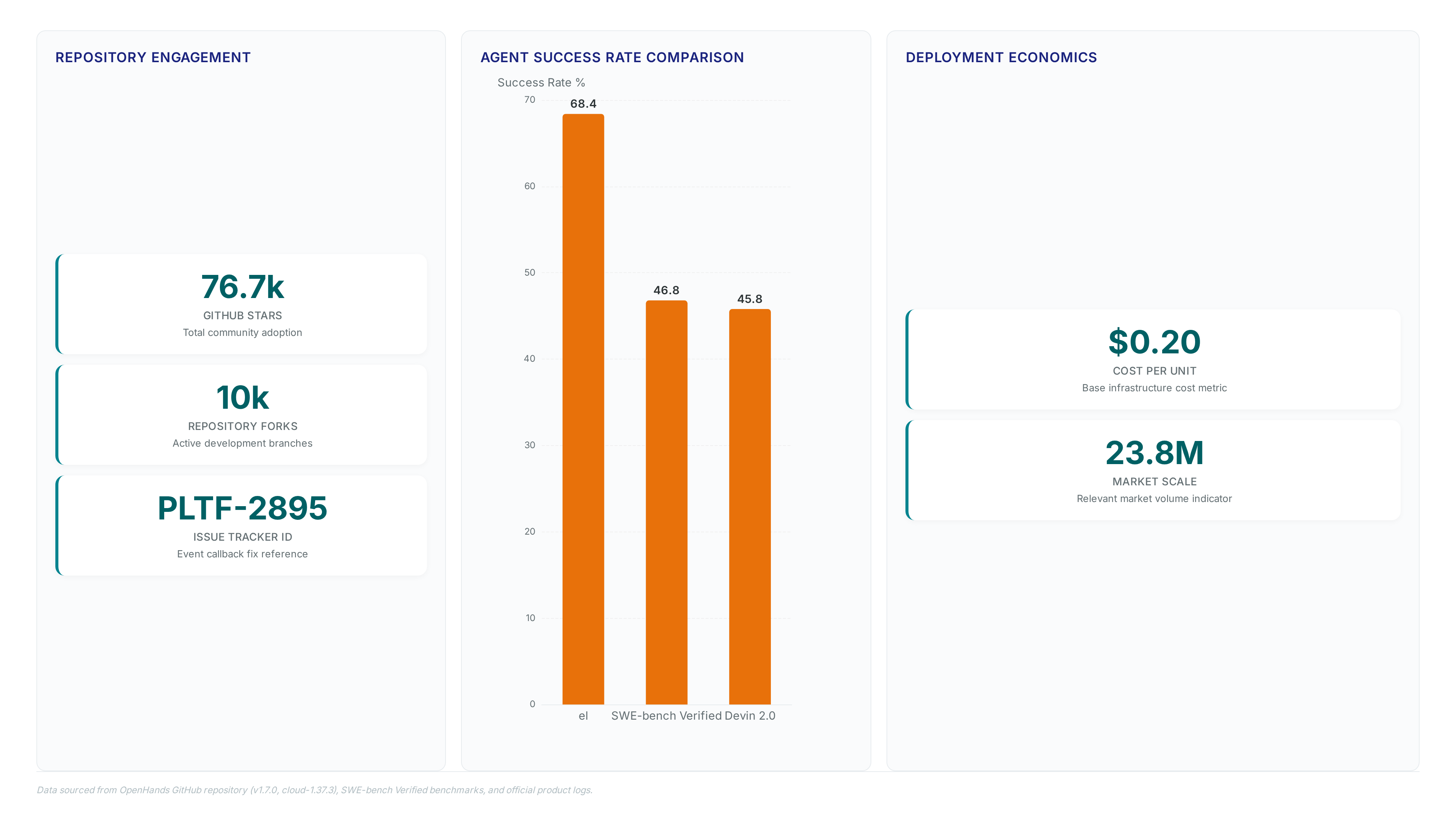
One tag, one commit, one schema change; the table below is the record a deployment should be checked against.
| Attribute | Specification |
|---|---|
| Tag | cloud-1.37.3 |
| Commit | d942174 |
| Author | aivong-openhands |
| Timestamp | 04 Jun 20:32 |
| Change | PLTF-2895: event_callback index |
Teams using Kubernetes Native Deployment should validate chart versions against this hash rather than the floating tag name, and treat the loading error in the release assets section as a rendering failure rather than proof that the attached files are missing.
Performance Gains and Cost Efficiency Benchmarks of the Latest Release
What the SWE-bench Verified Resolution Rate Measures
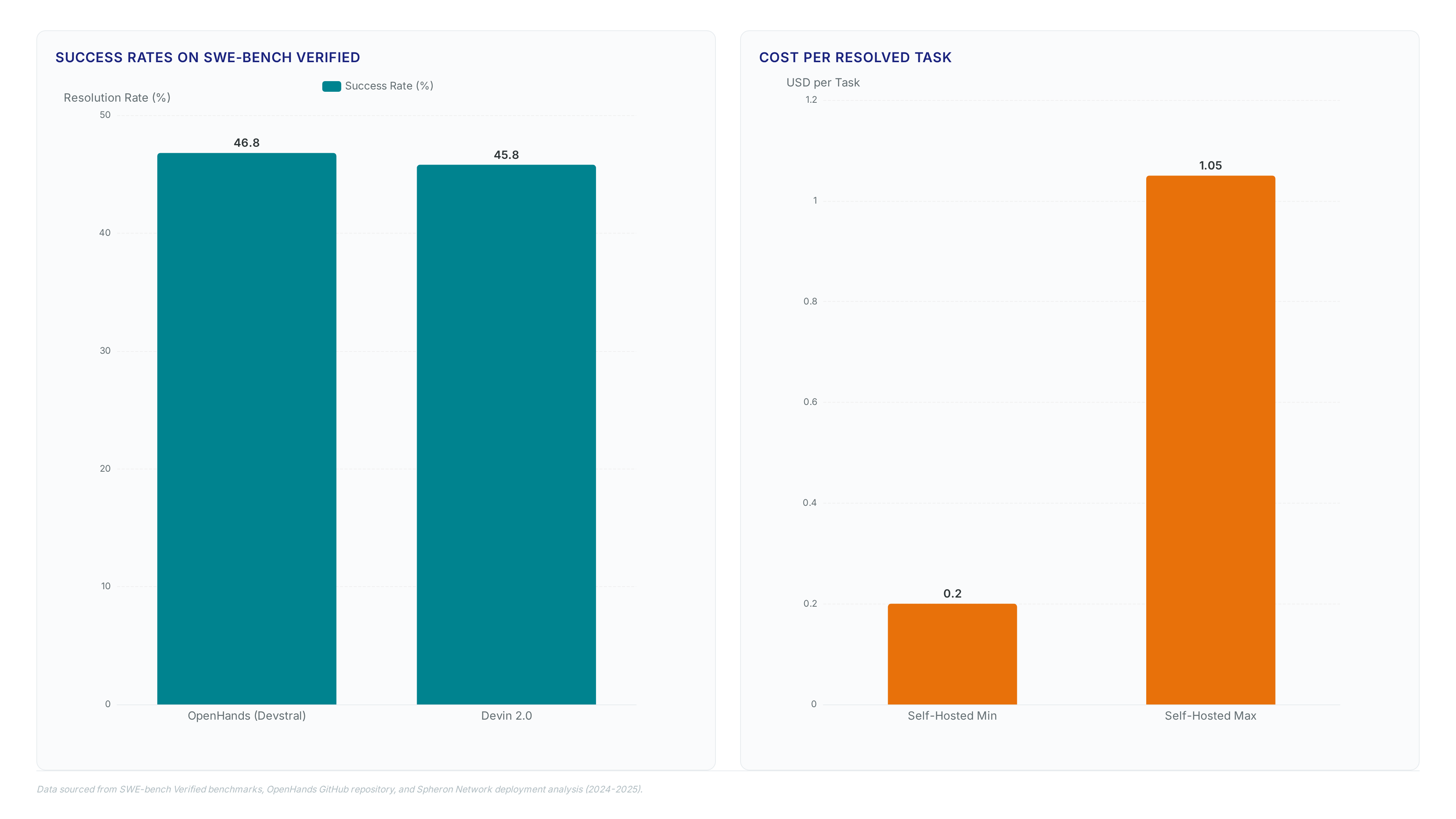
Five hundred discrete software engineering tasks comprise the SWE-bench Verified benchmark, demanding full repository context for every attempt. Resolution rates track the percentage of these 500 tasks an agent finishes without human help, acting as the main yardstick for autonomous performance. A gap emerges between peak accuracy and model sovereignty. Operators who prioritize data control often accept a lower resolution ceiling to dodge external API dependencies. This metric isolates reasoning capability yet skips the time cost of tool invocation and context retrieval. Teams evaluating deployment strategies should test both configurations against internal workloads before standardizing.
Calculating Cost Per Resolved Task on Self-Hosted GPU Cloud
Raw GPU rental rates must be separated from vendor markups hidden inside subscription models to determine operational expenditure. Devin uses a subscription-based pricing structure that masks underlying compute costs, whereas self-hosted deployments reveal the true economic variable: the cost per resolved task. Direct pass-through of infrastructure fees defines the $0.20 to $1.05 per resolved task range, removing the premium charged for managed orchestration layers.
Operational overhead presents the main constraint. Builders must configure monitoring systems to track task success rates manually instead of leaning on vendor dashboards. Automated fallback policies are absent. A spike in model hallucinations can drain cloud credits without producing valid code patches. Economic efficiency hinges entirely on the stability of the underlying inference engine and the accuracy of task validation logic. Teams lacking strong evaluation pipelines may see their effective cost per useful result exceed managed services despite lower base rates. Audit token consumption against resolved issues weekly to prevent budget overruns in flexible cloud environments.
About
Diego Alvarez serves as Developer Advocate at AI Agents News, where he specializes in hands-on framework analysis and practical build guides. His daily work involves rigorously testing coding agent frameworks like OpenHands, making him uniquely qualified to dissect the technical nuances of the cloud-1.37.3 release. While covering the system, Diego focuses on concrete implementation details rather than marketing hype, directly aligning with this article's focus on specific database optimizations like the event_callback index update. At AI Agents News, an independent hub for engineers evaluating autonomous systems, Diego's role requires him to identify how changes impact real-world reliability and performance. This specific release analysis stems from his routine evaluation of how framework updates affect multi-agent coordination and tool use. By connecting his direct experience building and breaking agents to this technical update, Diego provides the precise, actionable context developers need to understand the significance of version cloud-1.37.3 within the broader environment of coding agent infrastructure.
Conclusion
The value of cloud-1.37.3 is narrow and checkable: a single CREATE INDEX on the event_callback table, carried by commit d942174, removing the unindexed lookups that stalled views in the interface. Validate the hash rather than the tag, and the fix is either present or it is not.
The economics around that patch stay a separate decision. Self-hosting trades a per-task subscription for raw GPU cycles and hands the operator every failure mode a vendor dashboard used to absorb, so the saving survives only where evaluation pipelines are treated as production assets. Audit token consumption against resolved issues before concluding that the cheaper stack is cheaper.
Frequently Asked Questions
Self-hosting reduces costs to between $0.20 and $1.05 per resolved task. This pricing model requires operators to manage their own container orchestration instead of paying vendor markups found in subscription services.
The platform achieves a 68.4% resolution rate on verified software engineering tasks. This performance significantly exceeds Devin's 45.8% score, offering organizations a more effective autonomous agent for complex coding workflows.
Configuring the system with Devstral models yields a 46.8% SWE-bench Verified score. This setup allows teams to bypass proprietary API limits while maintaining a self-hosted baseline for cloud development operations.
Interface stalls in the OpenHands UI stem from missing database indexes on event callbacks, which cloud-1.37.3 fixes with a targeted CREATE INDEX command. The loading message on the GitHub release page is a separate client-side rendering issue.
Operators must handle resource profiling and cluster maintenance themselves. While this avoids per-task cloud lock-in, it demands mature DevOps practices to stabilize the runtime environment effectively.
References