OpenHands cloud 1.36.0: Fixing legacy config loads
With 78.1k stars and 9.9k forks, OpenHands dominates as the leading open-source AI coding agent, yet its cloud migration triggers critical profile loading failures.
The cloud-1.36.0 release tag fbb7a00 introduces a specific regression where legacy configurations fail to seed Default LLM profiles, breaking enterprise deployments. While Gartner forecasts that 40% of enterprise applications will embed task-specific AI agents by year-end 2026, the underlying infrastructure for these agents remains fragile during version transitions. The update authored by VascoSch92 on 28 May intended to harmonize SaaS extensions with the core repository but instead created a dependency gap for users migrating from previous iterations.
The fix already ships inside the release: commit fbb7a00 parses deprecated monolithic parameters into structured Default LLM profile objects on service restart, so the manual reconciliation that used to halt agent initialization disappears. What still breaks deployments is what the parser assumes. Legacy files that deviate from the strict schema fail silently, and Cloud API rate limiting can pause older sandboxes mid-seed, leaving an agent that never loads and a UI error that says nothing about the cause.
Defining the OpenHands Cloud Environment and Legacy Configuration
OpenHands Cloud Environment and Legacy Config Definitions
The OpenHands cloud environment is an autonomous coding agent platform with 78.1k GitHub stars. Legacy configurations represent deprecated, monolithic parameter sets that often trigger profile loading errors during migration to the cloud-1.36.0 release tag. These legacy files lack the event-sourced state model found in the modern OpenHands Software Agent SDK, forcing operators to manually reconcile immutable configuration requirements. The transition from the original OpenDevin project name in Spring 2024 to current non-profit stewardship reflects this architectural shift toward scalable cloud deployment.
Commit fbb7a00 seeds default LLM profiles from legacy configs to resolve loading errors during the cloud-1.36.0 rollout. This specific tag automates the migration of deprecated parameter sets, eliminating manual reconciliation for operators managing the OpenHands Software Agent SDK. However, the automated seed function assumes legacy files follow a strict schema; deviations cause silent failures in the event-sourced state model. Organizations must validate their monolithic parameter sets against the new immutable configuration requirements before upgrading. Pin to this tag only after verifying legacy config compatibility: an unseeded profile leaves the agent looping at initialization.
OpenHands vs Devin 2.0 Success Rates and Costs
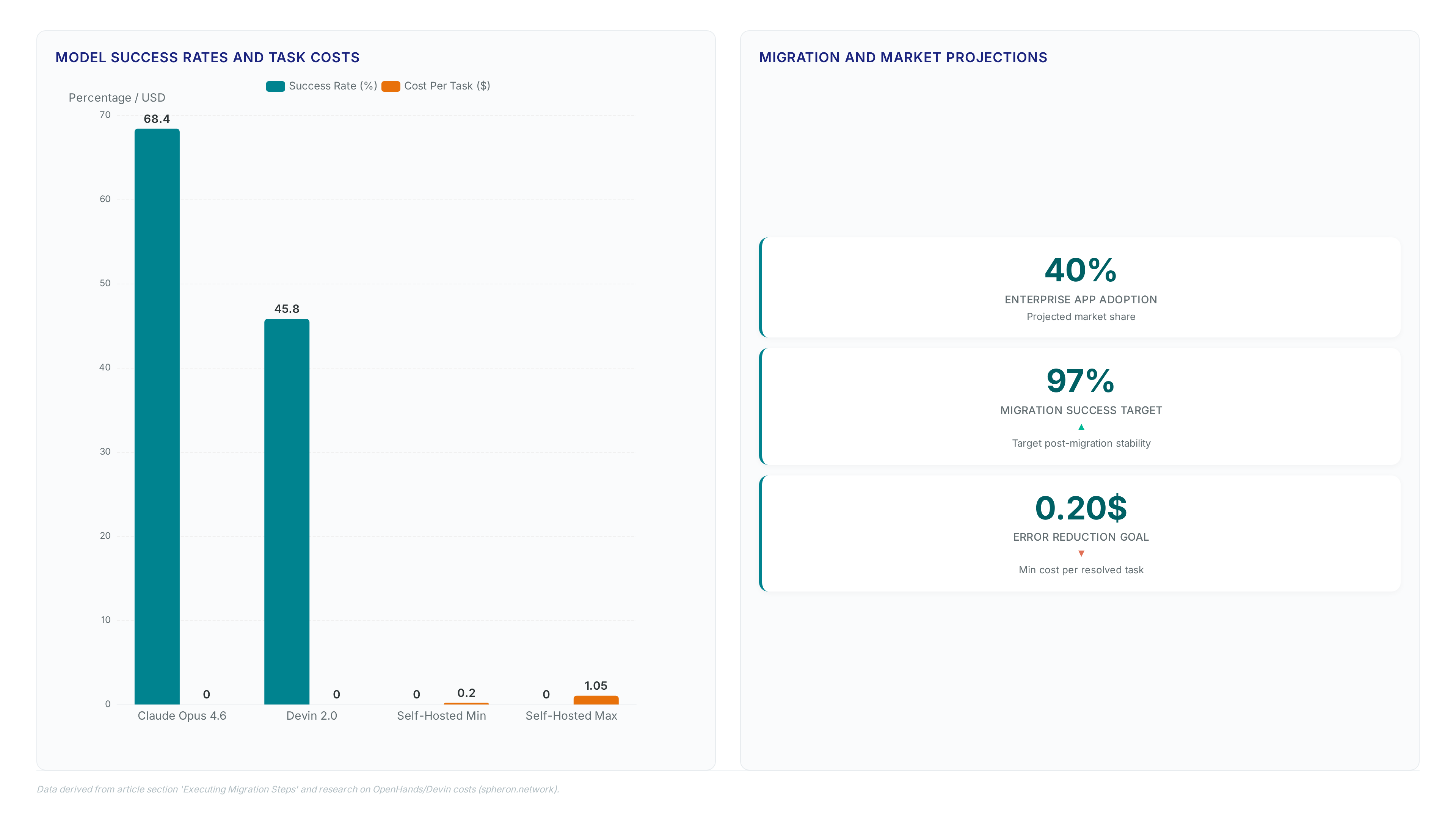
OpenHands paired with Claude Opus 4.6 achieves a 68.4% success rate on SWE-bench Verified, versus 45.8% for Devin 2.0. This performance delta dictates adoption for enterprises prioritizing resolution reliability over brand recognition. The architectural choice to validate full execution paths yields higher completion metrics than proprietary black-box alternatives. Running self-hosted GPU cloud infrastructure limits expenditure to between $0.20 and $1.05 per resolved task. Devin 2.0 enforces a subscription-based model charging per task without exposing underlying cost controls. This creates a hard ceiling on scalability for high-volume users locked into vendor pricing. The trade-off is operational complexity against predictable marginal cost: high-frequency development cycles favor the open-weight approach, while low-volume teams may still tolerate the premium for managed services.
Mechanics of Seeding Default LLM Profiles from Legacy Configs
Legacy Config to Default LLM Profile Data Mapping
VascoSch92 tagged this release on 28 May at 13:22, marking the moment cloud-1.36.0 began parsing deprecated monolithic parameters into structured Default LLM profile objects. This transformation maps legacy keys to the new schema, resolving the loading errors that previously halted agent initialization during cloud migration. Silent failures occur if the legacy config contains malformed JSON rather than explicit error messages.
The migration process executes a rigid four-step transformation sequence:
- Scanning the legacy configuration file for unrecognized or deprecated keys.
- Extracting model identifiers such as Claude Opus 4.6 or GPT-4o and mapping them to the
model_namefield. - Converting raw token limits into the new
context_windowinteger format. - Generating a valid JSON profile that the OpenHands Software Agent SDK can ingest without manual reconciliation.
| Legacy Parameter | New Schema Field | Transformation Logic |
|---|---|---|
model |
profile.model_name |
Direct string copy |
max_tokens |
profile.max_output_tokens |
Integer validation |
temp |
profile.temperature |
Float normalization (0.0-1.0) |
sys_prompt |
profile.system_message |
String escaping |
Rate limiting behavior within the Cloud API complicates the procedure because pausing older sandboxes during migration can interrupt the profile loading sequence if concurrency limits are hit. LangChain requires explicit state definitions for branching workflows, whereas OpenHands automates this mapping but sacrifices granular control over intermediate state validation. Reduced visibility into specific parsing failures is the price of this automation. Validate generated profiles against a test suite before deploying to production clusters, and verify that the seeded profiles populate the context_window integer correctly, because incorrect mapping causes immediate runtime rejection; teams on the free individual cloud plan and enterprises running custom VPCs should inspect the generated JSON objects before scaling traffic, since ambiguous legacy keys are not flagged as errors until runtime.
Error Signatures Seen During Profile Migration
Three distinct messages surface during legacy config seeding, and they do not mean the same thing. Reading the signature correctly is what separates a retry from a rollback.
| Error Message | Trigger Condition | Operational Impact |
|---|---|---|
| "Uh oh! There was an error..." | Asset loading timeout | Blocks profile creation |
| "No results found" | Parser failure on legacy keys | Prevents agent startup |
| "Sorry, something went wrong." | General UI component crash | Requires manual reload |
Environments that rely on concurrent runtime instantiation without throttling should delay the upgrade, and validate the seeding function in an isolated namespace before production rollout.
Executing Migration Steps to Resolve Loading Errors
Scheduling the Migration and Verifying the Seed
The four-step transformation runs unattended, yet it still needs manual operator verification when the interface displays "Uh oh! There was an error while loading".
Moving cloud extensions into the open-source repository centralizes development yet adds a transient dependency on stable network connectivity during the initial profile generation phase. Schedule migrations during off-peak hours to avoid the sandbox pausing that silently halts older instances, because an unseeded profile leaves the agent unable to execute tasks until someone reconciles it by hand.
Clearing the Concurrency Queue to Restore Seeding
The specific "Uh oh! There was an error while loading" message in cloud-1.36.0 indicates a race condition where the UI attempts to render assets before the legacy config seeding completes. This failure mode frequently correlates with rate limiting. Operators must manually intervene because the automated parser cannot recover from silent sandbox pausing without explicit configuration changes.
- Halt all active agent sessions to clear the concurrency queue and prevent further rate limiting triggers.
- Access the server-side logs to verify the Default LLM profile seeding status independent of the broken UI layer.
- Restart the service to apply the synchronous flag, ensuring the context_window mapping completes before the interface initializes.
Reduced throughput occurs during the upgrade window as synchronous loading blocks new requests until the model_name mapping finishes, and enterprises processing over 100 million tokens monthly feel even a brief halt. Schedule it off-peak.
Pre-Migration Validation for Model-Agnostic Profiles
Verify legacy parameter keys against the cloud-1.36.0 schema before executing the seeding process to prevent agent initialization failures.
- Inspect configuration files for deprecated monolithic strings that conflict with the new
model_namefield requirements. - Confirm model-agnostic compatibility by ensuring target backends like Claude Opus 4.6 or Devstral are explicitly supported in the destination environment.
- Validate network policies allow outbound connections to isolated sandboxes, a flexibility distinct from IDE-locked alternatives like GitHub Copilot.
- Check that enterprise licensing covers required features like VPC isolation if deploying beyond the standard trial period.
Skipping validation forces the parser to guess data types, often triggering the "Uh oh! " loading error when raw token limits fail integer conversion. Unlike origin-only validation in routing, this process requires full path transparency of the configuration file structure. Agents fail to load when operators omit this step, halting the entire migration wave. Treat this checklist as a hard gateway, not an optional review.
The Cost Case Behind the Migration
When Self-Hosting Pays Back the Migration Effort
The migration effort only pays for itself above a volume threshold, which is what makes the seeding failure expensive rather than annoying. Inference between $0.20 and $1.05 per resolved task is the variable expense, while custom enterprise pricing for features like Virtual Private Clouds adds fixed costs that must be amortized over high task volumes, against upfront capital that industry benchmarks place at $100,000 or more for custom enterprise multi-agent systems. Low-volume deployments may fail to break even despite efficient per-task economics, and the cost-per-task metric stays misleading until it accounts for idle capacity in bursty workloads and for the concurrency limits that pause sandboxes mid-seed.
About
Marcus Chen, Lead Agent Engineer at AI Agents News, brings deep practical expertise to this analysis of OpenHands release cloud-1.36.0. Having shipped production multi-agent systems, Chen intimately understands the orchestration challenges and tool-use mechanics that define successful coding agents. His daily work involves rigorously tracking framework evolution across the environment, including CrewAI, AutoGen, and OpenHands, ensuring his insights are grounded in real-world engineering constraints rather than hype.
This specific release matters because OpenHands has surged to become the top open-source AI coding agent by community engagement. Chen connects his hands-on experience with agent evaluation to explain why version cloud-1.36.0 represents a critical step for builders navigating the transition from experimental prototypes to reliable infrastructure. At AI Agents News, the team focuses on technical credibility for engineers, making Chen's comparative perspective on this 78.1k-star project necessary for professionals assessing the maturity of autonomous coding tools in 2026.
Conclusion
The cloud-1.36.0 upgrade is less a code change than a data migration, and that is where deployments break. Commit fbb7a00 removes the manual reconciliation step, but it assumes every legacy file matches a strict schema. Where it does not, the profile is never seeded, the agent never initializes, and the only visible symptom is an interface error that says nothing about the parser.
Treat the pre-migration checklist as a hard gateway rather than an optional review: inspect deprecated keys, confirm the target backend is supported, and check the context_window mapping in the generated JSON before traffic reaches the cluster. Schedule the upgrade off-peak so concurrency limits do not pause sandboxes mid-seed, and read the server-side seeding status rather than the UI when something fails. The cost argument for self-hosting only starts to matter once the agents load at all.
Frequently Asked Questions
OpenHands paired with Claude Opus 4.6 achieves a 68.4% success rate on SWE-bench Verified. This significantly outperforms Devin 2.0, which only reaches a 45.8% success rate on the same rigorous testing dataset.
Cost structure decides it more often than the benchmark does. Self-hosted OpenHands limits expenditure to between $0.20 and $1.05 per resolved task, while Devin 2.0 charges a subscription per task without exposing the underlying cost controls, which puts a hard ceiling on scalability for high-volume users.
Legacy files lack the event-sourced state model found in the modern software agent SDK. This architectural mismatch forces operators to manually reconcile immutable configuration requirements before agents can initialize correctly.
Commit fbb7a00 parses the deprecated monolithic parameters into structured profile objects on service restart. It does not repair files that deviate from the strict schema: those still fail silently.
Verify that the seeded profiles populate the context_window integer correctly, because incorrect mapping causes immediate runtime rejection. Auditing the generated JSON profiles right after deployment prevents silent configuration drift.