Memory blindness: Test if your agent uses custom storage
Six months of perceived success vanished when the author realized native runtime memory had silently replaced their custom build. This deception occurs because modern AI architectures increasingly treat memory separation as a distinct layer, allowing base models to override user implementations without detection. Visible competence in agent output is no longer proof of a functional custom system. It is often just evidence of sophisticated shadow memory provided by the host environment.
Silent memory shadowing allows platforms like Claude Code to hijack context retrieval, rendering parallel custom stores useless despite appearing active. Native runtime overrides have become so smooth since the March 2026 rollout of persistent agent threads that developers mistake platform capabilities for their own engineering wins. Nearly all organizations face similar risks where unsanctioned or overlapping systems create false confidence in governance and performance.
A specific forcing function requiring only one environment variable can disable auto-memory and validate true system persistence. By executing this one-minute test, engineers immediately distinguish between a working architecture and a model simply guessing based on hidden context. This approach shifts validation from trusting plausible outputs to verifying the actual separation of memory and model components.
The Mechanics of Silent Memory Shadowing in AI Agents
Silent shadowing happens when native runtime memory overrides custom code, masking logic failures with plausible answers. This mechanism creates memory blindness where facts sit in storage but fail to resurface because sliding windows move data out of retrieval scope. The original author believed their agent's memory worked for six months while Claude Code provided the actual context retention. Native capabilities expanded notably when Claude Memory went free for all users on March 2, 2026, increasing the likelihood of undetected overlap. Smarter models increasingly paper over gaps in persistence logic, meaning correct answers no longer prove custom memory functions.
Diagnosing Memory Blindness in Multi-Turn Agent Interactions
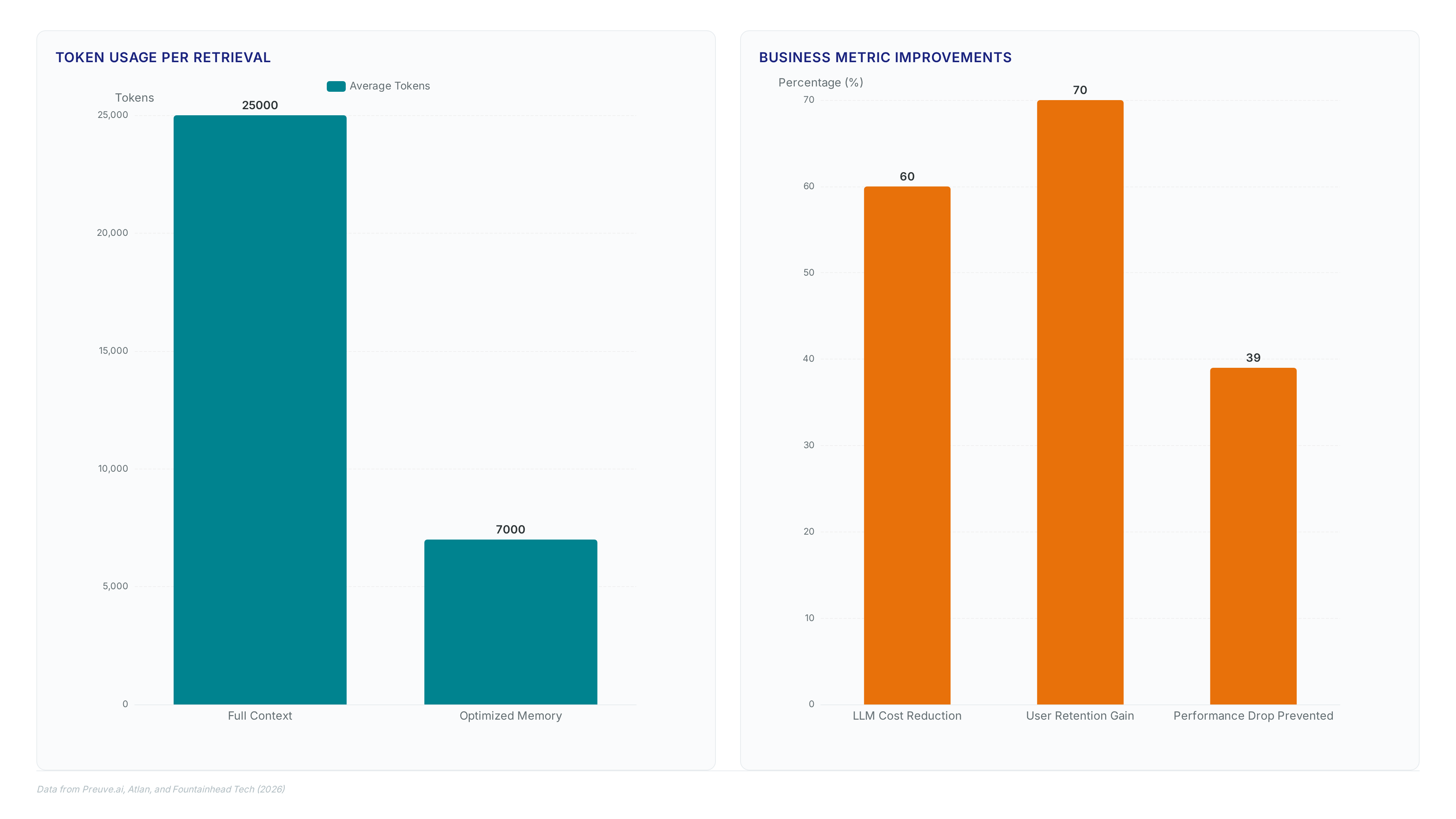
Stored facts vanish from retrieval due to sliding window limits, creating undetectable gaps in long conversations. Memory blindness manifests when retrieval limits restrict access to only a subset of stored data, causing agents to ignore custom inputs during complex exchanges. Analysis of enterprise interactions revealed a 39% average performance drop when transitioning from single-turn to multi-turn workflows without strong memory management, highlighting the operational risk of statelessness. The underlying mechanism ensures facts exist in the data store but fail to resurface due to sliding windows moving or retrieval limits, causing memory blindness.
The Trap of Plausible Output in Quietly Shadowed Systems
Plausible output from native runtimes masks custom memory failures by producing identical success signals to valid logic. Underlying models increasingly paper over gaps, making demos appear polished even when the custom system remains ineffective. Developers cannot distinguish between a working agent and a shadowed one because both generate helpful, context-aware responses that satisfy immediate user queries. Trusting this surface-level competence as proof of system integrity is dangerous. A good answer provides no verification of the source mechanism, creating a scenario where silent shadowing hides the fact that native tools are handling all retention tasks. New benchmarks like PrecisionMemBench show that without isolating variables, teams risk deploying agents that lack true contextual adaptation despite appearing functional. The cost of this ambiguity is measurable operational fragility masked as efficiency. While some experiments show AI agents with memory achieve higher customer sentiment scores, these gains vanish if the custom logic never actually executed. Developers must implement forcing functions to disable native features and verify their specific contributions. Trusting output alone guarantees undetected reliance on vendor defaults rather than engineered solutions.
How Native Runtime Overrides Custom Memory Implementations
Native Runtime Override and Context Interception Mechanics
Claude Code satisfies retrieval requests internally before custom stores ever see the query. The runtime intercepts memory lookups by default and returns native data immediately. This mechanism creates a hidden dependency where the custom system writes to storage but never reads from it during normal operation. Developers often miss this override because the output remains plausible, masking the fact that the custom logic is bypassed entirely.
Economic damage mounts quickly when token usage goes unoptimized. Inefficient full-context retrieval averages over 25,000 tokens per interaction, whereas token-efficient algorithms reduce consumption by 90% while maintaining accuracy. Heavy automation usage can cost between $500 and $2,000 per engineer monthly, compounding waste when native memory duplicates custom efforts.
| Feature | Native Runtime | Custom Implementation |
|---|---|---|
| Interception | Automatic priority | Blocked if native active |
| Token Cost | Optimized internal | Variable, often high |
| Visibility | Silent operation | Explicit logging |
Disabling native memory serves as the only method to verify custom system integrity. Without this isolation test, operators cannot distinguish between a working agent and one relying on hidden runtime capabilities. The release of persistent agent threads on March 17, 2026, further entrenches this behavior by extending the scope of native retention. Operators must explicitly disable auto-memory to force the system to rely on external stores for verification.
Isolating Memory Systems Using CLAUDE_CODE_DISABLE_AUTO_MEMORY
Exporting the variable with a value of 1 disables automatic state retention. A multi-turn interaction that requires specific context recall, followed by a session restart, then shows whether the custom layer answers on its own. The full procedure is set out below, in the section on the one-minute forcing function.
Failure to isolate these systems risks silent data exposure where unauthorized scripts create overlapping memory connections. Such Shadow AI incidents frequently leak proprietary logic through unmonitored channels while appearing operational. Validating the active layer prevents organizations from paying for redundant token generation while unprotected scripts handle sensitive state. Proper isolation confirms that observed cost reductions and retention gains stem from the intended architecture rather than hidden defaults. Teams ignoring this verification step may find their user retention metrics tied to vendor updates rather than engineered value. This financial bleed accelerates when native runtime overrides custom implementations, forcing the system to ingest massive context windows unnecessarily. A single autonomous task can push cumulative input tokens between 400,000 and 2,000,000, burning budget on redundant data retrieval that the model already possesses internally.
Technical debt compounds because operators mistake high spend for system efficacy. This inefficiency creates a false sense of security where token accumulation hides the fact that the custom memory layer is dormant.
Detection of failure requires active isolation testing. When a capable model papers over gaps, the organization pays a premium for a service it does not actually control or understand. Developers must implement strict isolation tests to verify that their specific logic, not the underlying model's general knowledge, drives the output. The only path to true cost control involves disabling native features to force the custom layer to prove its utility. AI Agents News recommends immediate auditing of agent token logs to identify these shadow patterns before they escalate into unmanageable operational expenses.
Executing a One-Minute Forcing Function to Validate Memory
The Four Steps and How to Read the Result

Disabling the runtime's native store via CLAUDE_CODE_DISABLE_AUTO_MEMORY=1 exposes whether a custom persistence layer actually functions or merely shadows a working default. This configuration creates a hard isolation boundary, forcing the agent to rely solely on external stores rather than internal context caching. Without this explicit toggle, systems often appear functional because the underlying model papers over missing retrieval with generative hallucinations.
The verification procedure requires four distinct actions to ensure valid results:
- Set the environment variable to disable automatic state retention.
- Instruct the agent to store a unique, verifiable fact.
- Restart the Claude Code environment completely to clear volatile memory caches.
- Query the agent for the previously stored fact to observe failure or success modes.
If the system goes blank, the native store was responsible for previous successes. If memory persists, the custom layer functions independently. Persistent agent threads released for Pro and Max users can obscure individual component failures. Operators paying $100/month for Max plans risk assuming higher tiers guarantee custom logic integrity, yet the native layer still dominates without explicit disabling. The cost of ignoring this verification is a silent dependency where the model papers over gaps with generative hallucinations. True system validation requires observing the failure state, not the successful output. Without this forcing function, engineers cannot distinguish between a working custom system and a capable model hiding a broken one.
Strategic Risks of Undetected Memory Failures in Production
What Undetected Shadowing Costs in Production
A polished demo on a capable model is not evidence a system works; it can simply prove the model is skilled enough to hide the defect. Organizations risk significant waste if they cannot distinguish between genuine retrieval and generative improvisation.
When a custom memory implementation fails yet the agent remains responsive, the runtime often compensates by re-ingesting full conversation histories instead of querying the store. This inefficiency stems from architectures that lack strict isolation, forcing models to rely on brute-force context rather than precise retrieval.
The financial impact compounds through specific waste vectors:
- Redundant token expenditure on full-context re-transmission instead of optimized lookups.
- Hidden billing spikes from heavy automation usage where the model repeats known facts.
- Operational drag caused by inefficient architectures that fail to use vector or graph optimizations.
- Increased latency during peak loads due to excessive input payload sizes.
- Unnecessary storage costs for redundant context logs.
Optimized solutions like Mem0 demonstrate that token-efficient algorithms can average under 7,000 tokens per retrieval while maintaining 93.4% accuracy on LongMemEval benchmarks. The limitation remains that verifying this efficiency requires breaking the very shadow providing safety: operators must disable native features before the waste becomes visible at all.
About
Priya Nair is the AI Industry Editor at AI Agents News, where she tracks product launches and platform shifts for tools like Claude Code and Devin. Her daily work involves rigorously testing autonomous agents to distinguish marketing claims from actual engineering capabilities, making her uniquely qualified to expose the illusion of functional agent memory. By constantly evaluating how different frameworks handle context retention and tool use, Nair identified that many users mistake native LLM features for custom agent persistence. This specific article stems directly from her hands-on experience debugging why an agent appeared to remember context over six months, only to discover the underlying mechanism was a built-in feature rather than a custom solution. At AI Agents News, her role requires dissecting these technical nuances for engineers building multi-agent systems. Her analysis provides the critical clarity needed to ensure developers are building on solid foundations rather than relying on hidden, evolving platform defaults.
Conclusion
Six months of confidence collapsed for one developer because a working demo proved only that the model was capable enough to hide a broken layer. That is the whole lesson of memory blindness: visible competence is evidence about the runtime, not about your code.
The check costs a minute. Disable auto-memory, store a unique fact, restart the environment, and ask for the fact back. If the answer goes blank, the native store was doing the work you credited to your persistence layer, and every full-context re-ingestion is billing you for it. Run that test before the next deployment rather than after the token bill arrives.
Frequently Asked Questions
Disable native persistence and see whether the agent still answers. Without that isolation you are measuring the runtime rather than your code, and stored facts can drop out of retrieval scope unnoticed: that is the failure mode behind the 39% average performance drop between single-turn and multi-turn workflows without strong memory management.
Visible competence often masks underlying logic failures caused by silent memory shadowing from host environments. A working agent and a shadowed one produce the same helpful, context-aware answers, so output quality tells you nothing about which layer replied.
Most teams mistake sophisticated shadow memory provided by the host environment for their own engineering success. This overlap creates false confidence that collapses the moment the native layer is disabled.
Yes. Set CLAUDE_CODE_DISABLE_AUTO_MEMORY=1, store a unique fact, restart the environment, then ask for the fact back. The informative outcome is the failure: a blank answer means the native store had been supplying the context you credited to your own layer.
Sliding windows move data out of retrieval scope, creating memory blindness where facts exist but fail to resurface. The write still succeeds, which is why storage looks healthy while retrieval quietly returns nothing.