Local agent setup: Gemma 4, Ollama, and Tavily
Deploying a tool-using agent locally requires integrating Gemma 4 with Ollama to enable functional web research.
Static chatbots recite training data. Real utility arrives when models access external sources. While many developers stall at text generation, establishing this architecture allows an NVIDIA RTX 2000 Ada laptop with just 8 GB of VRAM to perform complex evidence gathering previously reserved for cloud-heavy solutions.
The stack is small on purpose: Gemma 4 served by Ollama, the OpenAI Agents SDK driving the loop, and Tavily MCP as the only external dependency, with no proprietary cloud APIs anywhere in the path. Follow this pattern to replicate the setup for other models like the Qwen family or servers such as LM Studio.
The Role of Tool-Using Agents in Modern Local Inference
Defining the Tool-Using Agent and Local Agentic Pattern
Static chat models rely entirely on parametric memory. A tool-using agent executes external functions like Tavily web search MCP to gather fresh evidence. This capability transforms a local LLM into a flexible researcher that synthesizes answers with citations rather than reciting pre-trained weights. Shuai Guo describes a local agentic pattern deploying Gemma 4 via Ollama within the OpenAI Agents SDK runtime to achieve this orchestration. The model invokes specific APIs for real-time retrieval, bridging offline inference and live information access.
| Component | Function |
|---|---|
| Ollama | Serves the local Gemma 4 model endpoint |
| OpenAI Agents SDK | Orchestrates the agent loop and tool calls |
| Tavily MCP | Provides verified web search capabilities |
The API-Bank benchmark evaluates tool-use reliability across 53 distinct common APIs to test functional consistency. Operators managing network dependencies and API authentication locally shift failure modes from model hallucination to tool execution errors. This constraint enables local-first AI workflows maintaining privacy while accessing current data, a balance critical for sensitive environments prohibiting cloud offloading. The result validates claims against live sources rather than static training cutoffs.
Deploying Gemma 4 E4B with OpenAI Agents SDK for Evidence Synthesis
This configuration wraps the Gemma 4 E4B variant in the OpenAI Agents SDK to orchestrate evidence gathering. Shuai Guo's implementation pulls the specific gemma4:e4b tag via Ollama and routes it through an OpenAI-compatible client pointing to localhost:11434. The runtime executes a mini deep research agent loop querying the Tavily web search MCP before synthesizing answers with citations. This setup forces the model to validate claims against live data rather than relying on static parametric memory.
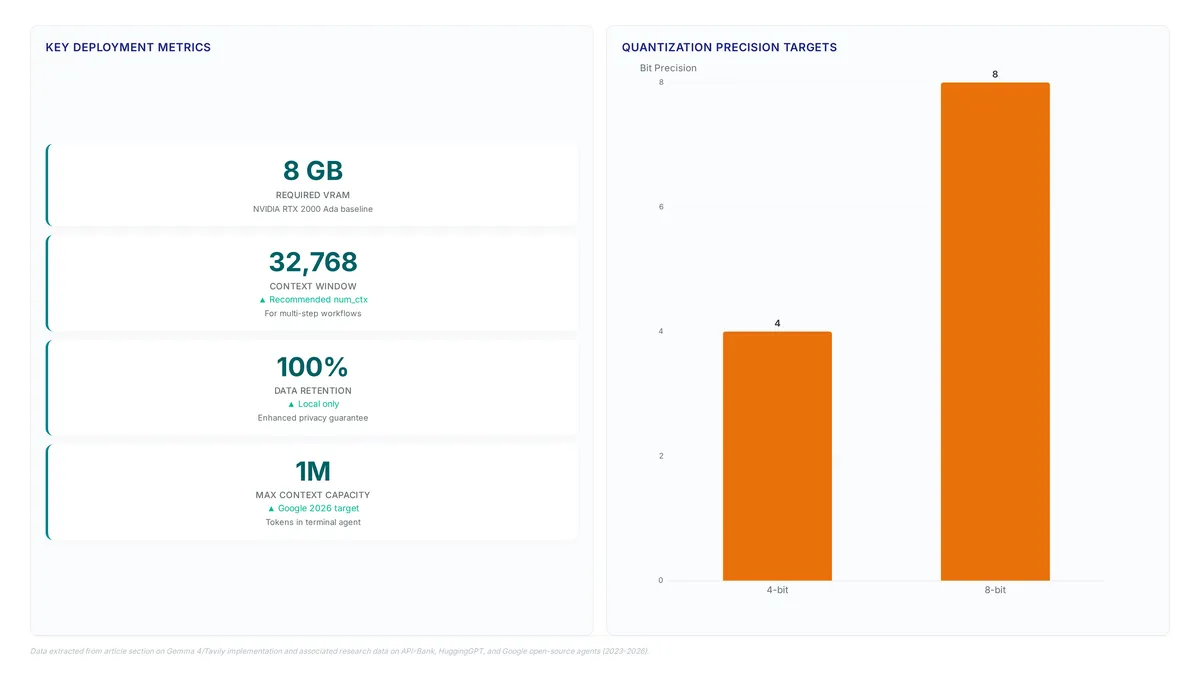
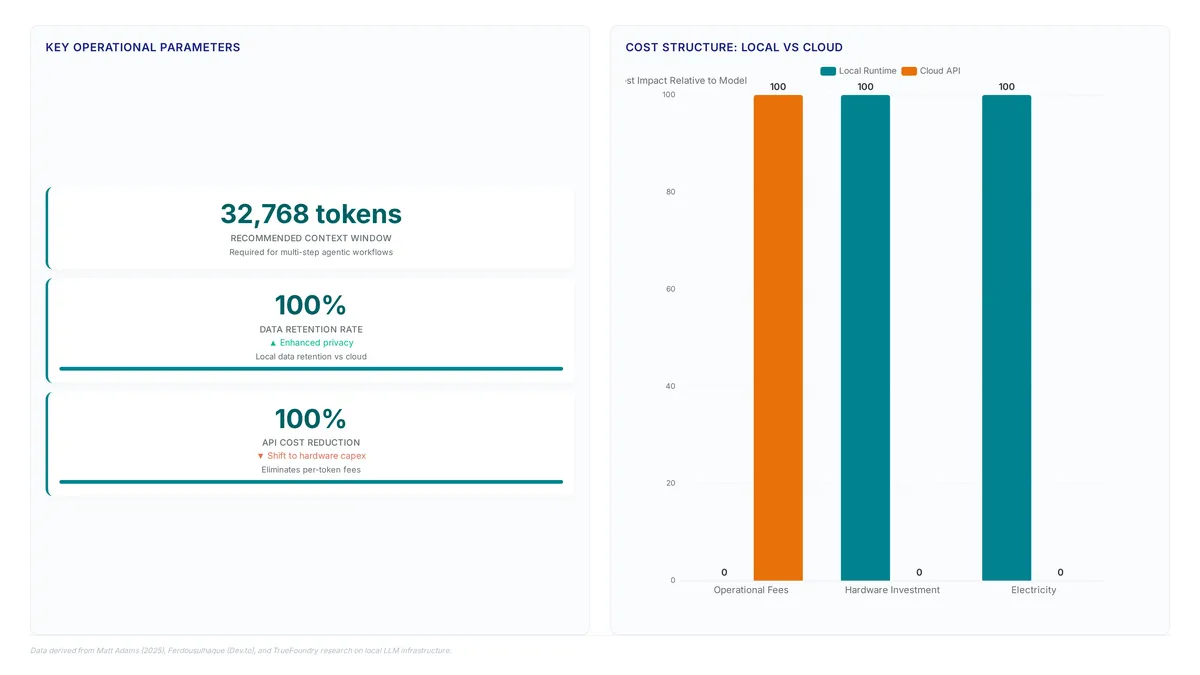
Privacy and offline capabilities make local deployment competitive for sensitive data environments compared to cloud agents. A critical technical constraint involves context management; practitioners must increase the num_ctx parameter to 32,768 tokens to ensure sufficient memory for multi-step agentic workflows. Increased VRAM consumption limits concurrent sessions on hardware with 8 GB capacity.
| Decision Factor | Local Agent (Ollama) | Cloud Agent |
|---|---|---|
| Data Privacy | High (On-premise) | Variable |
| Latency | Direct hardware access | API bound |
| Context Window | Hardware limited | Provider set |
Builders select this architecture when objectives require verifiable sourcing and strict data containment. The resulting system transforms a static language model into a flexible research tool capable of citing sources.
Hardware and Quantization Requirements for Local LLM Agents
Running tool-using agents locally demands strict memory management via 4-bit or 8-bit quantization to fit within consumer GPU limits. This compression reduces the memory footprint, allowing complex workflows on hardware like the author's NVIDIA RTX 2000 Ada Laptop GPU without enterprise costs. While Gemma 4 edge variants target these constrained environments, the pattern remains reusable for other model families. Quantizing models to 4-bit or 8-bit formats allows agents to run on consumer-grade GPUs rather than requiring expensive enterprise-grade hardware, notably lowering the barrier to entry.
| Constraint | Local Strategy | Cloud Alternative |
|---|---|---|
| Memory | 4-bit/8-bit quantization | Full precision available |
| Privacy | Full local retention | Data leaves perimeter |
| Cost | Upfront hardware only | Per-token API fees |
Builders apply local runtimes like Ollama or LM Studio to validate agent logic before scaling. This approach eliminates operational usage fees, shifting expenditure to fixed electrical and hardware investments.
Architecture of a Local Research Agent Stack
The OpenAI Agents SDK handles local inference by wrapping Gemma 4 inside an OpenAIChatCompletionsModel that points to Ollama. This setup forces the runtime into iterative reasoning loops instead of simple single-turn completions. Code defines behavior through a RESEARCH_AGENT_INSTRUCTIONS variable that strictly forbids using parametric memory for time-sensitive facts.
Connections to Tavily web search MCP servers happen inside an asynchronous context manager, so tools stay inaccessible outside the specific async with block scope. Tool definitions load before the agent loop starts, keeping initialization separate from execution. The outcome is a stable pipeline built for set research tasks. Builders get a verifiable evidence chain while staying inside a structured runtime environment.
Implementing a Deep Research Agent with Gemma 4 and Tavily
Gemma 4 E4B and Ollama Local Endpoint Architecture
Running the Gemma 4 E4B variant starts by launching Ollama from the Windows Start menu to wake the local API endpoint. This model choice targets edge-local agentic workflows where tight memory limits block larger parameter counts. Operators must pull the exact tag gemma4:e4b so the orchestration layer accepts the connection without errors.
- Install the runtime environment using the official installer or package manager.
- Execute the startup sequence via the Start menu to expose port 11434.
- Pull the model weights using the command
ollama pull gemma4:e4b.
The local API endpoint structure copies OpenAI's schema, letting the OpenAI Agents SDK route requests without changing a single line of code. Local execution guarantees data sovereignty but moves the burden of availability monitoring entirely to the host machine. Cloud endpoints restart automatically; local servers do not. The E4B designation signals optimization for these constrained environments, balancing reasoning depth against the limited VRAM found on laptop GPUs.
Configuring the AsyncOpenAI Client for the Ollama Endpoint
Pointing the AsyncOpenAI client to localhost:11434/v1 shifts inference traffic from cloud servers directly to the local machine. This configuration needs the api_key parameter set to "ollama", a static placeholder that satisfies the SDK authentication field without triggering remote validation checks. Developers must match the MODEL_NAME variable to the pulled tag, such as gemma4:e4b, or tool invocation fails immediately.
- Initialize the client with the local base URL and placeholder key.
- Wrap the connection using OpenAIChatCompletionsModel to enable agent loops.
- Verify the Ollama process is active via the system Start menu on Windows.
The resulting setup allows the OpenAI Agents SDK to treat the local instance as a compliant endpoint for iterative reasoning. This mimicry of cloud APIs creates a specific constraint: the local host lacks automatic scaling found in managed services. Any network change affecting port 11434 breaks the agent's access to the model, and the Ollama service must be up before the agent runtime initializes. Operators assume total responsibility for uptime and for the quantization artifacts inherent in edge variants.
| Parameter | Value | Purpose |
|---|---|---|
base_url |
localhost:11434/v1 |
Routes traffic locally |
api_key |
"ollama" |
Bypasses remote auth |
model |
gemma4:e4b |
Identifies edge variant |
This approach demands rigorous version control of the underlying model weights, and latency varies notably by hardware capability. For machines with more constrained resources than the author's 8 GB VRAM setup, the lighter E2B variant is available.
Registering the Tavily MCP Server and Scoping Tool Names
Enable the include_server_in_tool_names flag to stop namespace collisions between local functions and remote MCP tools. This configuration forces the OpenAI Agents SDK to prefix tool identifiers with their server source, ensuring the agent runtime routes search queries to Tavily MCP rather than attempting internal resolution.
Builders must validate their setup against this checklist before executing agentic loops:
- Confirm
tavily_serverappears explicitly in the MCP Servers list. - Set MCP Config to
{"include_server_in_tool_names": True}. - Ensure the agent instructions define the research behavior clearly.
| Configuration Key | Required Value | Operational Impact |
|---|---|---|
mcp_servers |
"tavily_server" |
Registers the external search provider |
include_server_in_tool_names |
True |
Scopes tool calls to specific servers |
Tool discovery is not automatic; explicit configuration is required when integrating external MCP tools. This architectural choice isolates failure domains effectively. Builders should verify the tool list output before running the full research loop. The stack described uses Tavily as one convenient MCP tool, but the same pattern works with other MCP-compatible tools.
Operational Outcomes of Agentic Workflows in Local Environments
Tracing the ToolCallItem and MessageOutputItem Execution Flow
Step 01 initiates a ToolCallItem where the local model invokes mcp_tavily__tavily_search with the specific query regarding World Cup 2026 group stage stakes. This discrete function call forces the Gemma 4 instance to pause generation and await external data, effectively converting a static completion into a flexible retrieval operation. The subsequent ToolCallOutputItem returns raw search snippets, which the agent parses before synthesizing a final MessageOutputItem. In this trace, the system identified the Colombia vs. DR Congo fixture as the critical match, citing Daniel Munoz's goal as the decisive factor.
| Trace Step | Object Type | Function |
|---|---|---|
| 1 | ToolCallItem | Executes web search via MCP |
| 2 | ToolCallOutputItem | Returns raw search snippets |
| 3 | MessageOutputItem | Synthesizes final answer |
Operators must note that the OpenAI Agents SDK relies on this strict sequencing to maintain state; skipping the output validation step risks hallucinating sources when evidence is sparse. Unlike cloud-only implementations, local execution introduces latency during the tool-handling phase, requiring larger context windows to store intermediate search results without truncation. Builders can replicate this pattern for other domains by swapping the search tool while retaining the same research workflow architecture. The cost is increased memory pressure on the host GPU, as the model must hold both the prompt history and the retrieved documents simultaneously during the synthesis phase. A single round of retrieval also inherits the quality of the initial query: if the Tavily MCP server returns ambiguous snippets, the agent cannot separate similar fixtures without an explicit follow-up instruction.
Extending Local Agents with Planning-Reflection Workflows and MCP Tools
Transitioning from simple chat to strong research requires stronger instructions and planning-reflection loops. The base pattern deploys a Gemma 4 E4B model via Ollama, wrapped in the OpenAI Agents SDK with Tavily MCP for search. Complex queries demand self-correction mechanisms where agents review output quality before finalizing answers. Implementing a loop that retries generation until evidence suffices creates a more reliable infrastructure behind making local LLM agents actually useful. Relying solely on single-pass searches risks missing detailed context that multi-step planning would uncover. Builders should extend this architecture by adding iterative reflection steps or integrating additional MCP servers beyond web search. The drawback is increased latency per query in exchange for higher factual accuracy. The system remains a reactive tool rather than a proactive researcher without these enhancements. AI Agents News recommends validating that planning-reflection workflows are active before scaling deployment to production environments.
About
Diego Alvarez serves as Developer Advocate at AI Agents News, where he specializes in hands-on build guides and framework comparisons. His daily work involves constructing end-to-end agents using libraries like CrewAI and LangGraph, making him uniquely qualified to dissect the transition from a local LLM to a tool-using agent. In this article, Diego uses his practical experience with Ollama and the OpenAI Agents SDK to demonstrate how engineers can build reliable, evidence-gathering systems without cloud dependency. By testing edge-friendly models like Gemma 4 against real-world constraints, he provides the concrete technical detail necessary for builders to understand orchestration and failure modes. His role at AI Agents News focuses on stripping away hype to reveal what actually works in production. This guide reflects his commitment to helping developers move from theoretical concepts to runnable implementations, complete with honest assessments of cost and reliability for those evaluating local agentic patterns.
Conclusion
The build itself is short: pull the gemma4:e4b tag, point an AsyncOpenAI client at localhost:11434/v1, wrap it in OpenAIChatCompletionsModel, and register the Tavily MCP server with tool names scoped to their source. What the trace shows is that the interesting part is not the model but the loop around it: the ToolCallItem forces retrieval, and the MessageOutputItem is only ever as good as the snippets that came back.
That is where the hardware bites. During synthesis the machine holds the prompt history and the retrieved documents at once, so the 32,768-token context that makes multi-step research possible is also what caps concurrency on an 8 GB card. The lighter E2B variant buys memory back at the cost of reasoning depth. Local execution keeps the data on the machine and removes per-token fees, and in exchange hands you an uptime problem that a cloud endpoint would have absorbed: the Ollama process has to be up before the agent runtime starts, every time.
Frequently Asked Questions
You need hardware with 8 GB capacity to run the standard Gemma 4 E4B variant effectively. The pressure comes from the context setting: multi-step agent loops need 32,768 tokens, and that reservation is what fills the card, so machines below that line should switch to the lighter E2B variant.
Local agents keep the model and the retrieved documents on your own machine, so retention is total for the data itself. The trade is not privacy but availability: a managed endpoint restarts itself, while a stopped Ollama process takes the agent down until someone notices.
Practitioners typically use 4-bit or 8-bit variants, which trade numerical precision for a much smaller memory footprint and are what put complex workflows inside consumer GPU limits at all. The residual cost is the quantization artifacts inherent in edge variants, which the operator absorbs along with uptime.
Local orchestration adds no per-token fees, since the SDK runs against your own Ollama endpoint. Authentication is a formality: the client's API key field takes a static placeholder that satisfies the SDK without triggering remote validation, so no billing account sits behind the call.
Increased VRAM consumption strictly limits concurrent sessions on hardware with 8 GB capacity. The peak arrives during synthesis rather than at load, because at that moment the model holds the prompt history and the retrieved documents together, so a session that started comfortably can still run out of room.
References