Fable 5 orchestration: Why we route planning only
Fable 5 leads Cursor evals but ranks as the most expensive per task, forcing a shift to multi-model orchestration. This flexible orchestration strategy maximizes efficiency without sacrificing output quality.
The industry reaction to the Fable 5 relaunch was immediate. Anthropic reinstated the model with visible safety fallbacks that occasionally route requests to Opus 4.8. Substantial platforms like Devin and Perplexity integrated the model across cloud and CLI environments while simultaneously adopting end-to-end orchestration to mitigate cost and latency issues. Builders now use Fable 5 strictly for planning while offloading verification work to other systems.
Performance metrics tell the real story. Fable 5 achieved a 16.10% score on the Remote Labor Index, contrasting with Sonnet 5's ranking on AA-Briefcase despite higher turn counts. The trade-offs between model orchestration approaches define the emerging role of GLM-5.2 in coding stacks. This data-driven review clarifies why llm orchestration has become the standard for sustainable agent infrastructure in 2026.
Why One Frontier Model Cannot Carry the Stack
Multi-Model Orchestration and Wiki-Structured Memory Set
Relying on a single frontier system is economically unsustainable. Diverse AI models now coordinate to handle distinct planning and execution tasks. Builders route high-value reasoning to capable models while delegating implementation work to cheaper, quicker alternatives. Raw performance metrics must be balanced against the cost of running multi-million token tasks. Simple pre-classifiers fail for complex engineering problems because reliable routing often requires solving the task first. Operators must design explicit combination strategies to avoid the inefficiency of monolithic model dependence.
Wiki-structured memory serves as a simple, extensible substrate that prevents agents from losing working context between threads. Unlike retrieval-only systems, this pattern supports reconciliation where candidate memories are transformed against existing data to resolve contradictions before commitment. Governing permission-aware, shared memory in enterprise settings adds complexity compared to storing local markdown files. This structured approach enables the sustained context required for end-to-end project development across hundreds of interaction turns.
Resolving Contradictions via Weaviate Engram and SkillComposer
Weaviate's Engram mechanism prevents context corruption by extracting candidate memories, transforming them against existing memory, and committing only resolved contradictions. Increased write-latency during the transformation phase creates a constraint operators must balance against read consistency requirements.
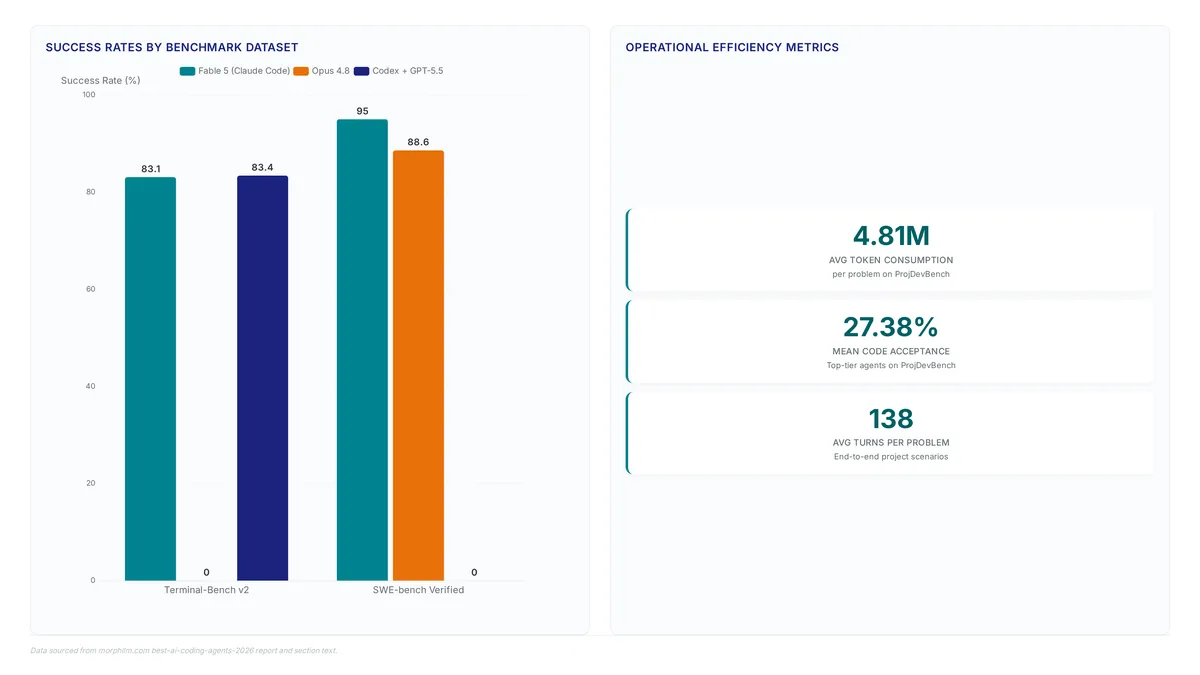
Structured composition replaces naive tool selection with joint autoregressive planning. SkillComposer treats capability invocation as a unified generation task, reporting significant gains on SkillsBench over baseline orchestration. On the SWE-bench Verified dataset, the Fable 5 model leads competitors with a high success rate, demonstrating the efficacy of coordinated execution. Precise skill definitions drive this performance; ambiguous specifications degrade coordination efficiency.
| Feature | Naive Approach | Structured Composition |
|---|---|---|
| Selection Logic | Independent Classification | Joint Autoregressive |
| Context Handling | Raw Log Retrieval | Transformed Memory |
| Failure Mode | Contradictory Outputs | Specification Gaps |
Verbose reasoning requires strict memory governance to remain viable given the average consumption of millions of tokens per problem. AI coding agents using models like Fable 5 average 138 turns per problem to reach a solution in end-to-end project development scenarios measured by ProjDevBench. Long-running agents accumulate logical errors that compound across turns without reconciliation layers like Engram. Builders must implement permission-aware shared memory to sustain these complex workflows without manual intervention.
Enterprise Governance Risks in Shared Agent Memory Systems
Ungoverned memory creates unmanaged exposure when agents share context without access controls. Enterprise agent memory must be governed, permission-aware, and shared to prevent security failures. Sensitive data extracted during one thread becomes visible to unauthorized actors in subsequent sessions without explicit policies. This risk escalates as systems consume millions of tokens per problem, embedding deep contextual details that may include secrets or proprietary logic. Open memory architectures prioritize agent continuity over isolation, conflicting with zero-trust requirements. Operators deploying multi-model orchestration must decide between single-model simplicity and the complex governance required for shared state. A shared memory layer without permission checks effectively bypasses traditional API boundaries. Builders should implement reconciliation mechanisms that validate access rights before commits. Multi-model approaches work best when task isolation is paramount, whereas shared memory suits collaborative workflows with trusted participants. Failure to distinguish these modes invites data leakage through the very substrate designed to improve consistency.
Inside Agentic MapReduce and Speculative Decoding Architectures
Agentic MapReduce Mechanics in Devin Security Swarm
Cognition's Devin Security Swarm deploys Agentic MapReduce to fan out bounded agents across a codebase, validating exploitability through parallel execution rather than sequential scanning. This architecture dispatches independent workers to inspect specific repository segments, aggregating findings into a unified security report. Recent maturity in frameworks like LangGraph supports such stateful workflows, enabling more reliable interruptible agents for long-running security tasks.
Speculative Decoding as a Drafter and Verifier Split
Speculative decoding accelerates token generation by having a smaller drafter model predict multiple tokens for a larger verifier to accept or reject in parallel. Implementing a dflash drafter on Qwen3-32B reportedly yields roughly 50% higher throughput on identical hardware compared to standard autoregressive decoding.
Energy overhead from running two models simultaneously creates a tangible cost, and such setups require validation that the speed gain does not cost output quality. That is the same check routing imposes: whenever cheaper capacity takes over work from the expensive model, the quality of the delegated output has to be proven rather than assumed.
Validation Steps for Agent Evaluation and Flaw Reporting
Operationalizing agent evaluation requires shifting from single-function tests to end-to-end project development benchmarks like ProjDevBench. This transition demands sustained context over 138+ turns to validate true reasoning capabilities rather than isolated code completion. The AA-AgentPerf metric then quantifies system efficiency by measuring agents-per-megawatt, providing a hard constraint for scaling deployment density. Incident response protocols now align with FLARE-AI standards to standardize flaw reporting across the coalition of cyber and safety researchers. This framework keeps vulnerability data consistent and actionable.
Fable 5 and GLM-5.2 Performance Metrics in Coding Benchmarks
Fable 5 and GLM-5.2 Benchmark Metrics Set
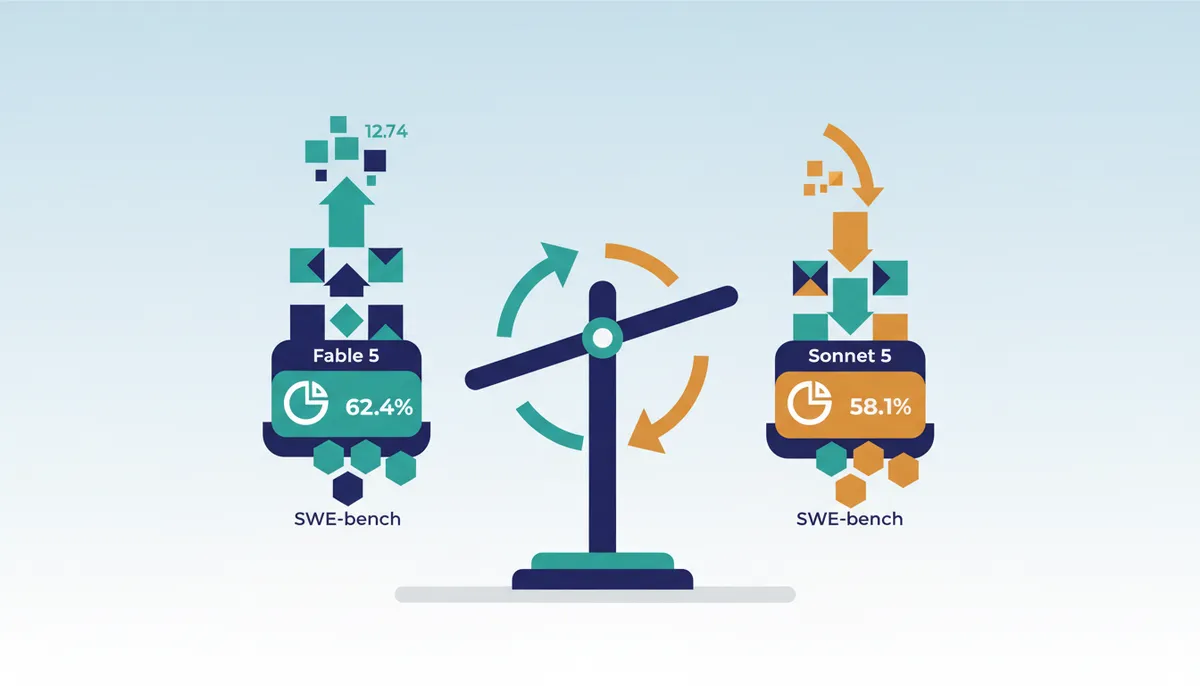
Fable 5 achieves a 95.0% success rate on SWE-bench Verified, surpassing the 88.6% score of Opus 4.8, which establishes a clear performance tier for verified software engineering tasks. This metric quantifies the model's ability to resolve real-world GitHub issues without introducing regressions, a capability necessary for autonomous code generation pipelines. Such dominance in repository-level tasks does not translate uniformly to all interaction modes. On Terminal-Bench v2, the architecture scores 83.1%, trailing the sector leader by a narrow margin. The divergence suggests that context window management strategies optimized for long-horizon file editing may incur latency penalties in rapid-fire command line interactions.
In the open-weight category, GLM-5.2 posts a 55.3% Pass@1 on Integration within the APEX-SWE framework, marking the first instance of an open model leading a specific benchmark category. This figure demonstrates significant capability in code synthesis. It remains substantially lower than the frontier closed models. Integration complexity still favors proprietary orchestration layers. Operators must weigh these specialized strengths against cost structures, as high-performance on SWE-bench often correlates with higher compute expenditure per task. AI Agents News recommends validating these metrics against internal codebases before committing to a primary orchestrator.
Routing Fable 5 for High-Value Planning Tasks
Builders report a substantial improvement in end-to-end PR yield by using Fable 5 only for higher-value reasoning while delegating implementation to cheaper models. This hybrid strategy mitigates the high $/task cost observed when running frontier models on routine verification work. Operators route complex architectural decisions to Fable 5, then switch to Opus 4.8 for standard code generation and computer-use actions. This approach balances the high accuracy on complex reasoning tasks against the economic reality of running multi-million token operations. The constraint is increased orchestration complexity.
| Dimension | Fable 5 Strategy | Opus 4.8 Strategy |
|---|---|---|
| Primary Role | High-level planning | Implementation |
| Cost Profile | Highest per task | Moderate |
| Best Use | Architecture design | Routine coding |
| Latency | Higher (deep reasoning) | Lower (fast completion) |
AI Agents News recommends isolating planning tasks to preserve context window capacity for critical path logic. Delegating execution prevents premature token exhaustion during long-horizon projects.
Fable 5 Cost Per Task vs GLM-5.2 Accessibility
Cursor states Fable 5 leads its evals but remains the most expensive per task, driving strict budget controls for high-volume agents. The morphllm.com leaderboard explicitly tracks $/task metrics alongside accuracy, forcing operators to balance raw capability against economic reality.z.ai launched ZCode featuring a quota boost for coding-plan subscribers optimized for GLM workflows, positioning GLM-5.2 as a viable daily driver. This accessibility gap defines current deployment strategies where cost dictates model selection for non-critical paths.
The Remote Labor Index stands at 16.10% for Fable 5, a figure reflecting its specialized utility rather than general labor substitution. Teams ignoring these cost structures risk runaway token consumption when scaling autonomous agents beyond proof-of-concept phases. AI Agents News recommends reserving frontier models for architectural decisions while delegating verification to accessible alternatives.
Implementing Wiki Memory and SkillComposer for Enterprise Agents
Initialize the memory substrate by executing openwiki --init to generate agent-consumable documentation directly from the codebase. This command creates a persistent wiki-structured memory layer, addressing the critical failure mode where agents lose working context between threads. Without this maintained knowledge layer, autonomous workflows frequently stall or hallucinate file structures during long-running tasks.
Skill selection operates through SkillComposer, which frames tool choice as a joint autoregressive composition problem rather than a naive retrieval task. This structured approach reportedly yields significant accuracy gains on SkillsBench compared to unstructured baselines.
- Execute
openwiki --initto establish the persistent knowledge layer from existing codebase structures. - Configure permission-aware access controls so shared memory respects enterprise governance boundaries rather than exposing raw logs.
- Validate that candidate memories undergo transformation against existing entries before commitment to resolve contradictions early.
| Feature | Naive Retrieval | Reconciliation Model |
|---|---|---|
| Contradiction Handling | Query-time conflict | Pre-commit resolution |
| Governance | File-level access | Permission-aware shared state |
| Context Stability | Volatile per thread | Persistent substrate |
Weaviate's Engram implements exactly this reconciliation model in production. This mechanism ensures that governed memory systems do not propagate conflicting instructions during multi-agent coordination. However, enforcing strict reconciliation introduces latency during the write path, trading immediate ingestion speed for long-term consistency. Builders must balance this overhead against the cost of hallucinated file structures in production environments. AI Agents News recommends testing reconciliation latency under load before deploying permission-aware shared memory to critical workflows.
About
Diego Alvarez, Developer Advocate at AI Agents News, brings direct, hands-on expertise to the complex topic of multi-model orchestration. In his daily work, Diego builds and benchmarks autonomous agents using frameworks like CrewAI, AutoGen, and LangGraph, giving him practical insight into the challenges of coordinating diverse models within a single system. Unlike theoretical overviews, his analysis stems from real-world implementation, where he routinely evaluates tool use, function calling, and failure modes across different architectures. At AI Agents News, an independent hub for engineers building with agentic systems, Diego focuses on concrete details over hype, ensuring readers understand exactly what shipped and how it compares. His experience dissecting coding agents and multi-agent coordination allows him to explain orchestration patterns with the technical precision software engineers require. By grounding every claim in runnable code and cost analysis, Diego helps technical founders and ML engineers make informed decisions about building reliable, production-ready agent systems.
Conclusion
Routing planning only is what this data supports. Fable 5 leads Cursor evals and tops SWE-bench Verified at 95.0%, and it is also the costliest option to run, so it earns the architectural decisions and nothing else. Implementation, routine code generation and verification go to Opus 4.8 or to accessible open models like GLM-5.2, which is what lifts end-to-end PR yield without paying frontier prices for routine work.
That split holds only as long as the memory substrate does. Agents acting on stale premises produce confident, wrong work, so pre-commit reconciliation and permission-aware access are the tax that keeps a routed fleet consistent rather than merely fast. Measure reconciliation latency on your own workload before shared memory reaches production, and treat any routing policy that skips that measurement as untested.
Frequently Asked Questions
Fable 5 leads evaluations but costs the most per task, forcing a shift to orchestration. Builders route high-value reasoning to it while delegating implementation to cheaper models to manage expenses effectively.
GLM-5.2 posts a 55.3% Pass@1 on Integration within the APEX-SWE openweight category. This shows it closes specific gaps as the best open model tested, though it has not surpassed top Western frontier models overall yet.
Fable 5 scores 16.10% on the Remote Labor Index, reflecting its specific efficiency profile. This figure helps operators balance raw performance metrics against the high economic cost of running multi-million token tasks.
An in-house dflash drafter on Qwen3-32B reportedly yields roughly 50% higher throughput on identical hardware. This allows teams to significantly accelerate decode speeds while maintaining model quality during inference workloads.
Orchestration approaches require validation that cheaper models hold output quality on the work they take over. Without this rigor, delegating tasks to cheaper alternatives could compromise the reliability of complex engineering solutions.
References