Model vs Agent: Why TerminalBench 2.1 Scores Vary
Codex CLI with GPT-5.5 leads the Terminal-Bench 2.1 leaderboard at 83.4%, proving that agent architecture dictates performance more than the underlying model. An AI coding agent plans multi-step tasks, executes code, and observes results without hand-holding. Yet benchmark data from tbench.ai shows identical models score differently depending on their orchestration layer. This variance exposes the critical need to evaluate the full agent-model pairing rather than relying on raw model capabilities alone.
We examine how agent frameworks influence real-world task completion rates across 89 curated development challenges. The analysis covers why certain pairings like Claude Code with Opus 4.8 achieve a 78.9% success rate while others lag, and how export controls suspended high-performing variants like Claude Fable 5 in June 2026. Understanding these architectural nuances is necessary for deploying autonomous systems that actually function in production environments.
The Role of Agent Frameworks in Modern Benchmarking
Terminal-Bench 2.1: The Shift to Agent-Plus-Model Scoring
Terminal-Bench 2.1 evaluates 89 curated terminal tasks where agents edit files, run commands, and fix failures autonomously. This benchmark measures the combined performance of the agent harness and the underlying large language model rather than assessing the model in isolation. The framework requires the agent to drive a real terminal environment, testing end-to-end orchestration capabilities that static code completion cannot replicate. Version 2.1 specifically corrected issues in 28 tasks to ensure reliable scoring across different configurations.
The transition to agent-plus-model scoring reveals that orchestration logic notably impacts task completion rates independent of model capability. GPT-5.5 achieves 83.4% when orchestrated by Codex CLI but drops to 76.40% under the Terminus 2 harness on identical tasks. Tool use efficiency and error recovery mechanisms within the agent framework contribute as much to the final score as raw reasoning power. Builders must therefore evaluate the specific agent-model pair against their target workflows rather than relying on standalone model leaderboards.
Dependency creates a fragmentation risk where performance data for a specific model becomes siloed within incompatible agent ecosystems. A model optimized for one framework's function-calling schema may underperform in another without architectural changes. Developers selecting tools for production must validate both the orchestration framework and the model together, as the harmonic mean of their interaction defines actual utility in terminal automation scenarios.
Leaderboard Reality: Claude Opus 4.8 vs Suspended Claude Fable 5
Claude Fable 5 achieved an 83.1% accuracy on the Terminal-Bench 2.1 leaderboard but remains inaccessible due to regulatory suspension. While the model demonstrated peak potential with minimized refusal rates through hybrid fallback strategies, it was suspended on June 12, 2026, under a U.S. Export-control order, rendering the high-performing agent unusable for general deployment. That leaderboard peak is now moot for most users due to the export restrictions.
Meanwhile, Claude Opus 4.8 leads available solutions with strong performance on SWE-bench Pro. Fable 5 scored higher on raw terminal tasks, yet Opus 4.8 provides the necessary stability for production environments where export compliance is mandatory. The distinction between a BYOK agent and a fixed pairing becomes critical here; builders can route Opus 4.8 through various harnesses, whereas the suspended model offers no such flexibility. Maximizing benchmark scores often requires accepting significant operational risk regarding model availability. Relying on a suspended model introduces a single point of failure that no amount of orchestration logic can resolve. Evaluating agents based on the long-term viability of their default models is necessary rather than focusing on transient leaderboard peaks.
Inside the Architecture of Model-Agnostic Orchestration
BYOK Architecture: How Codex CLI and OpenCode Route Requests
Bring Your Own Key (BYOK) patterns separate agent orchestration logic from the underlying inference provider. Tools like opencode, Cline, Aider, Kilo Code, Zed, and Gemini CLI function as model-agnostic interfaces under this design. The agent framework handles tool use, file system access, and multi-step planning while the inference provider determines performance and cost. Proprietary bundles lock the agent and model together, but BYOK agents route requests to any compliant backend. This makes the inference provider a swappable variable rather than a fixed constraint.
Proprietary agents often lead on specific benchmarks due to tight integration. Open-source harnesses like opencode, which has passed 180,000 GitHub stars, have become highly popular options, signaling a shift toward evaluating the agent-plus-model pair rather than the model in isolation. Operational overhead presents a limitation because builders must configure endpoints and select models whereas closed systems abstract these choices. This separation enables precise cost control and the ability to switch models when a specific task requires different reasoning capabilities without changing the development environment.
Morph Router Mechanics: Classifying Requests
Morph executes request classification to route tasks to specialized backends before token generation begins. This model router operates as a distinct infrastructure layer that decouples orchestration logic from the inference engine to optimize for specific workload types. The system dispatches code generation queries to specialized models tuned for speed or reasoning instead of relying on a single generalized model. This approach contrasts with standard BYOK agents like opencode or Cline where the user-managed API key dictates both the routing intelligence and the raw generation speed.
Benchmark variance clarifies the architectural benefit given that the agent framework notably influences final output quality. Morph capitalizes on this by pairing classification with codegen-tuned decoding so the inference kernel matches the task complexity. The router classifies each request in approximately 430ms at a cost of $0.001 per request. Once classified, the system directs traffic to specific kernels; for instance, morph-v3-fast applies edits at approximately 10,500 tokens per second. The distinction lies in whether the framework actively manages model selection or merely passes requests through for engineers evaluating the best agent for terminal tasks. Infrastructure that integrates routing mechanics directly into the inference path offers measurable throughput gains for high-volume development workflows while many CLI coding agent tools remain model-agnostic pass-throughs.
Quantization Trade-offs: Morph's 16-bit Activations vs Serverless fp8
Morph open-source Models maintain 16-bit (bf16) activations to preserve numerical fidelity during code generation. Most serverless providers quantize activations to fp8 to reduce memory footprint, a choice that can impact complex reasoning tasks. Terminal automation often requires strict adherence to syntax that lower-precision formats might corrupt, making this precision difference matter. Builders evaluating open-source vs proprietary agent architectures must weigh this fidelity against infrastructure costs.
Economic constraints drive the trade-off since maintaining higher precision increases compute requirements per token. However, morph-dsv4flash offers competitive pricing at $0.139 per 1M input tokens and $0.278 per 1M output tokens, mitigating the cost of avoiding quantization. Standard serverless models often sacrifice accuracy for memory savings, creating a sharp contrast with this approach. Selecting a backend that avoids aggressive quantization ensures more reliable function calling for model-agnostic agent deployments. Prioritizing activation precision is recommended when benchmarking agents on Terminal-Bench 2.1 because numerical errors compound across multi-step tool use. Not all inference engines support unrestricted bf16 without latency penalties, which remains a limitation. Operators must verify that their chosen orchestration layer does not force down-conversion before inference begins.
Strategic Selection of Agents for Enterprise and Terminal Workflows
Terminal-Native Agents vs IDE-Bundled Architectures
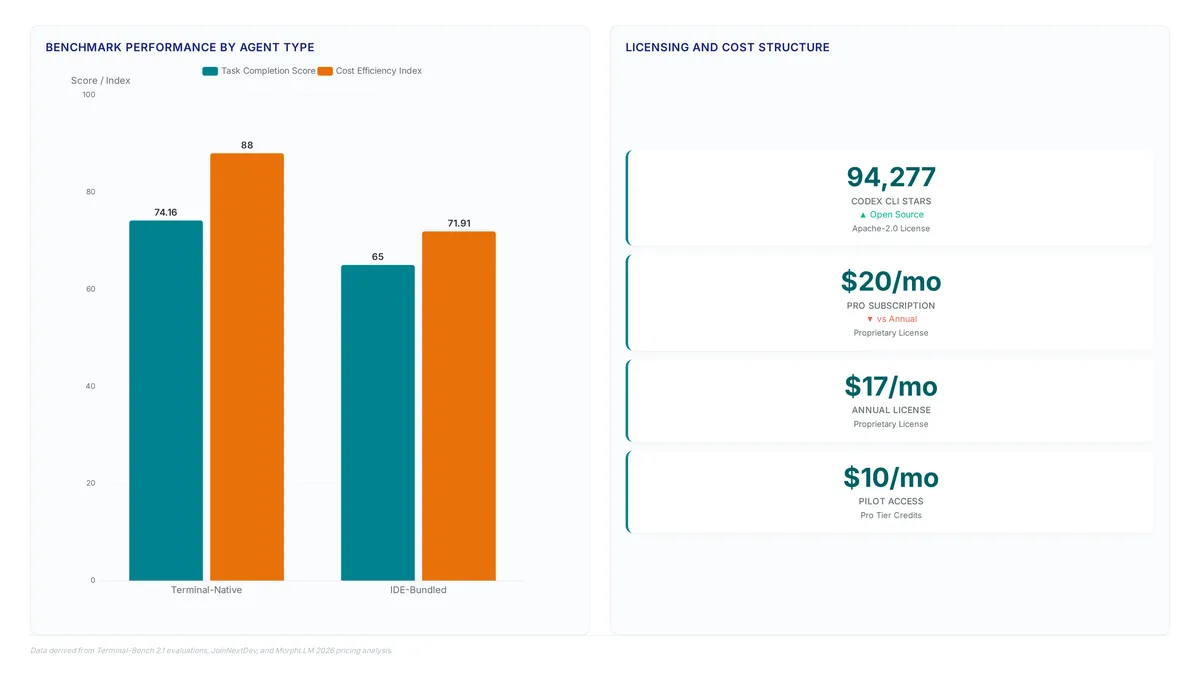
Standalone CLI tools function as fixed agent-plus-model units, whereas IDE-bundled solutions decouple orchestration from the underlying language model. Codex CLI is OpenAI's open-source agent with 94,277 stars under an Apache-2.0 license, operating as a unit that pairs with specific models to execute terminal automation tasks. In contrast, Claude Code serves as Anthropic's terminal-native agent, though it also exists within broader integrated development environments and web interfaces.
| Feature | Terminal-Native (Codex CLI, Claude Code) | IDE-Bundled (Cursor, Copilot) |
|---|---|---|
| Coupling | Fixed agent-model pair | Model-agnostic or BYOK |
| Environment | Shell-centric, direct execution | Editor-centric, sandboxed |
| Primary Metric | End-to-end task completion | Code acceptance rate |
Emerging data indicates a shift toward integrated terminal agents that execute and debug without human intervention, favoring the tight coupling found in CLI tools. This architecture creates a vendor lock-in risk absent in model-agnostic frameworks. Teams requiring open-source agent flexibility often face a maturity gap in out-of-the-box performance compared to proprietary pairs.
Applying Terminal-Bench 2.1 Scores to Enterprise Workflows
Benchmark divergence between harnesses dictates subscription justification more than raw model capability. Case studies involving model switching between different agents reveal significant performance variations, indicating that the agent layer contributes notably more to the final score than the base model alone.
| Metric | Codex CLI Pairing | Claude Code Pairing |
|---|---|---|
| Benchmark Score | 83.4% with GPT-5.5 | 78.9% with Opus 4.8 |
| Reasoning Depth | High terminal automation | High reasoning on SWE-bench |
| License Type | Apache-2.0 | Proprietary |
The economic implication is clear: the distinction between "model" costs and "agent" costs matters, as the same model yields different economic and performance outcomes depending on the harness used to execute the tasks. Experts recommend selecting the harness that matches your primary workflow bottleneck. The benchmark is designed to measure "economically consequential deployments," implying that cost-efficiency per completed task is a primary metric for enterprise adoption alongside raw accuracy. Choose the pairing that aligns with your specific failure modes, not the headline number.
Cost Analysis: Free Apache-2.0 Tools vs $20 Monthly Subscriptions
Direct terminal automation economics hinge on whether a team requires the fixed agent-plus-model pairing of proprietary stacks or the flexibility of BYOK orchestration. The entry prices sit close together:
| Option | Entry cost | What the team manages |
|---|---|---|
| opencode, Gemini CLI, Cline free tiers | Free | API keys, rate limits, MCP servers |
| GitHub Copilot Pro | $10/mo | Bundled credits |
| Claude Code Pro | $20/mo Pro or $17/mo annual | Managed session, enterprise support |
The real variable is engineering time rather than licence fees: a free harness trades the subscription for hours spent configuring MCP servers against the Turnkey reliability of paid tiers. The benchmark applies the same accounting with its "$/task" metrics, and its "resource budgets" were identified as too tight for valid solutions in some v2.0 tasks, necessitating fixes in v2.1 to allow for realistic cost execution.
Deploying Local Agents: Installation Surfaces and Local Inference
Defining Claude Code Installation Surfaces and Agent Types
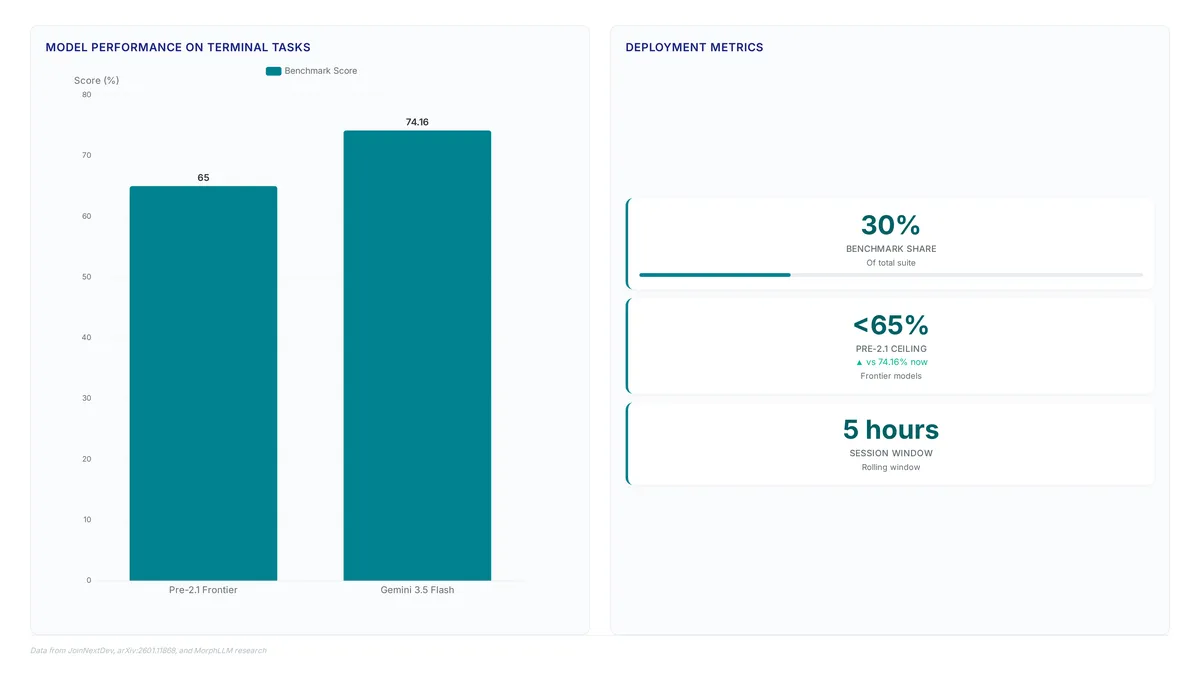
Developers install Claude Code to access a terminal-native agent distinct from IDE-bundled alternatives, and the deployment model further divides into proprietary sessions versus BYOK (Bring Your Own Key) configurations. This distinction dictates cost structures and model flexibility, particularly when comparing against open harnesses that may exhibit maturity gaps in out-of-the-box performance.
- Identify the installation surface: terminal-native CLI versus IDE extension.
- Select the session model: managed proprietary account or BYOK infrastructure.
- Verify the agent's ability to execute commands in real terminal environments.
Operators must recognize that choosing a proprietary session locks the evaluation loop to vendor-specific constraints, whereas BYOK agents allow custom model routing but require manual inference configuration. Evaluating the orchestration layer separately from the underlying model helps ensure terminal task automation meets production requirements.
Executing Local Model Setup with Morph and Ollama
Configuring opencode with Ollama allows operators to run model-agnostic agents using local inference engines. This setup bypasses cloud latency, enabling rapid iteration cycles for code generation tasks.
- Initialize the local runtime by pulling a compatible model variant into Ollama to serve as the inference engine.
- Define the server connection in the agent configuration file, explicitly setting the endpoint to the local host port.
- Enable available decoding parameters within the backend to maximize throughput during complex code generation tasks.
Operators must recognize that shifting to local execution transfers the burden of quantization management from the provider to the deployment environment.
About
Marcus Chen serves as Lead Agent Engineer at AI Agents News, where he specializes in evaluating autonomous coding agents and the orchestration frameworks that power them. His daily work involves rigorously testing agent performance against benchmarks like Terminal-Bench, directly aligning with this article's analysis of current leaderboard standings. Chen's hands-on experience deploying multi-agent systems allows him to dissect why specific model-agent pairings, such as Codex CLI with GPT-5.5, achieve superior task completion rates compared to open-source alternatives like opencode. At AI Agents News, an independent hub for technical leaders, Chen focuses on separating verified capability from marketing hype. By grounding his assessments in concrete metrics and version-specific data, he provides engineers with the factual clarity needed to navigate the rapidly evolving environment of AI coding tools without vendor bias.
Conclusion
Performance variance reveals that orchestration overhead can degrade model accuracy by nearly 7% even when the underlying intelligence remains identical. This discrepancy proves that selecting a high-performing base model is insufficient if the execution framework introduces latency or context loss. The operational cost of poor agent architecture manifests not just in token spend, but in the compounding error rates of autonomous loops that fail to self-correct. Teams must prioritize framework benchmarking alongside model evaluation before committing to production deployments.
Organizations should mandate a comparative validation phase lasting two weeks where candidate agents run identical terminal tasks across both cloud and local environments. Do not assume local inference automatically solves latency issues without verifying hardware throughput against specific quantization strategies. The shift to autonomous coding requires treating the agent runtime as a critical variable rather than a transparent wrapper.
Start this week by benchmarking your current agent's success rate on a standardized set of ten complex, multi-step coding tasks using the TerminalBench methodology. Record the delta between planned steps and executed outcomes to quantify your specific orchestration tax. This data provides the baseline necessary to justify infrastructure upgrades or framework migrations based on actual throughput rather than vendor claims.
Frequently Asked Questions
Orchestration logic dictates performance as much as raw model intelligence. GPT-5.5 scores 83.4% with Codex CLI but drops 7% under Terminus 2, proving framework efficiency impacts task completion rates significantly.
Codex CLI paired with GPT-5.5 leads the leaderboard with an 83.4% success rate. This specific combination outperforms other usable pairings by effectively managing terminal commands and error recovery autonomously.
Claude Fable 5 achieved 83.1% accuracy but faces suspension under U.S. Export controls since June 2026. Consequently, Claude Code with Opus 4.8 at 78.9% remains the top usable option for most teams.
GitHub Copilot Pro offers a low-cost entry at $10 per month for basic access. However, advanced tiers like Claude Code Pro require $20 monthly, while some open-source tools remain free at $0.
Opencode leads community adoption with over 180,000 GitHub stars, surpassing proprietary competitors. While proprietary tools offer integrated support, open-source options provide model-agnostic flexibility without mandatory subscription fees or vendor lock-in risks.
References