Fable 5 model blocked: What the 80% gap means
Fable 5 scores 80.3% on SWE-Bench Pro per Datacurve while sitting under a federal ban. That paradox defines the new reality: the era of unfettered model access is dead. The frontier AI market has fractured into a geopolitical chessboard where talent raids and supply chain security dictate value more than raw parameters. We are witnessing the end of the "move fast" epoch, replaced by a rigid environment of export controls and identity verification.
The 80.3% is real and unusable at the same time, and that gap is what the rest of this article measures. Access to frontier models is now set by export directives and identity checks rather than by benchmark tables, so the decisions underneath change too: which model a team can actually buy, where the people who design models go, who owns the compute, and what governance has to catch when 97% of developers already use AI coding tools.
Geopolitical Constraints and Talent Shifts Reshaping the Frontier Model Market
The Fable 5 Export Ban and Global Access Restrictions
On June 12, 2026, a US export directive explicitly revoked public access to Claude Fable 5, rendering the model globally unavailable despite its benchmark dominance. Operators cannot apply the model's 80.3% score on SWE-Bench Pro for automated coding tasks, creating an immediate capability gap for enterprises dependent on Anthropic's system. The refund deadline for usage credits passed on Day 9 of the restriction, and a proposed UK exemption has collapsed, narrowing the path to partial restoration for non-US entities. Paid subscribers retain a free-trial window closing June 22, after which the export control regime enforces a hard paywall alongside continued geographic unavailability. Production workflows relying on Fable 5 must assume indefinite outage status due to the lack of a clear timeline for identity verification protocols. Network architects face a forced migration away from the highest-performing coding AI toward alternatives with lower pass rates or unverified security postures. This restriction stems from geopolitical classification rather than commercial terms, leaving operators without recourse to negotiate temporary access. Teams should immediately audit dependencies on Anthropic APIs to prevent cascading failures in CI/CD pipelines when the trial period expires.
Shazeer's Move to OpenAI and What It Exposes in Gemini 3.5 Pro
Noam Shazeer's transfer of architectural tradeoff knowledge to OpenAI immediately compromises Google's Gemini 3.5 Pro launch security posture. Google spent approximately $2.7 billion in August 2024 to retain Shazeer, yet his departure after less than 22 months exposes internal design flaws to a direct competitor. Sam Altman noted this recruitment took a decade, signaling that architectural superiority now drives the talent war more than raw compute scale. Shazeer's intimate familiarity with Gemini's failure modes allows OpenAI to engineer adversarial inputs that specifically target those weaknesses. This shift upends the market balance where eight of the Fortune 10 already rely on competitor platforms for enterprise adoption. OpenAI gains a shortcut to model efficiency that typically requires years of trial and error while Google attempts to patch vulnerabilities. Deployment velocity faces a constraint regardless of architectural brilliance. Migrating enterprise workloads requires overcoming the inertia of existing infrastructure optimizations that favor incumbent stability over theoretical performance gains. The cost of switching providers remains a friction point that architectural brilliance alone cannot instantly dissolve. Network operators must now treat internal model details as high-value intellectual property requiring stricter access controls than standard source code.
Fable 5 vs GPT-5.5: DeepSWE and SWE-Bench Pro Performance
Datacurve confirms Fable 5 leads DeepSWE at 70% PASS@1, outpacing GPT-5.5 by three points. This quantitative gap defines the current agentic coding hierarchy, even as export controls restrict global access to the superior model. Operators evaluating autonomous workflow tools face a binary choice: accept the performance ceiling of available models or risk dependency on restricted infrastructure. Competitors like Grok 4.3 emphasize low hallucination rates with pricing at $1.25 per million input tokens to attract cost-sensitive deployments. Enterprises relying on GPT-5.5 must compensate for the three-point deficit in pass rates through increased human oversight or redundant verification layers.
Where Teams Go Instead: Codex Skills, Grok on Bedrock, and the Cursor Deal
Codex Record & Replay: One Demonstration Becomes a Reusable Skill
OpenAI's Record & Replay feature on macOS converts a single manual demonstration into a permanently reusable skill, moving Codex beyond simple code generation. This mechanism captures user interactions to define autonomous workflow automation without requiring explicit programming logic for every step. The operator records a sequence once, and the system executes that workflow indefinitely. Engineering effort shifts from writing scripts to curating high-quality demonstrations for the AI to mimic. Enterprises rapidly deploy agents that handle repetitive tasks like legal writing, newsletters, or complex system audits. The transition replaces slow, manual legacy processes with rapid, agentic-driven operations that scale instantly.
Convenience introduces a dependency on the stability of the underlying Codex platform and its macOS-exclusive availability. Unlike static scripts, these skills lack transparent logic flows, making debugging failures difficult when the model misinterprets a UI element. Operators must weigh the speed of deployment against the risk of opaque execution paths in critical infrastructure. The implication for network engineers is a fundamental change in how runbooks are maintained. Instead of updating documentation and scripts separately, teams must now treat recorded demonstrations as version-controlled assets. This requires new governance policies to audit what actions these autonomous skills perform and who authorized their creation.
Configuring Grok 4.3 on Amazon Bedrock as the Accessible Alternative
Integrating Grok 4.3 on Amazon Bedrock requires setting the model ID xai.grok-4.3 to access its 1-million-token context window. This configuration enables enterprises to process entire codebases in a single prompt, a capability matching premium competitors while avoiding their restrictive export controls. The pricing structure of $2.50 per million output tokens notably undercuts alternative frontier models positioned for high-value enterprise use cases.
Operators configure the integration through three distinct steps:
- Enable the xAI foundation model within the AWS Identity and Access Management policy.
- Set the
max_tokensparameter to use the full context window for deep reasoning tasks. - Apply tag-based cost controls to prevent budget overruns during autonomous agent loops.
| Feature | Grok 4.3 | Competitor Premium |
|---|---|---|
| Max Context | 1,000,000 tokens | 200,000 tokens |
| Reasoning | Configurable | Fixed |
Deploying this low-cost reasoning engine introduces a specific operational risk: the configurable reasoning levels can generate excessive token consumption if agents enter recursive loops without strict termination conditions. Unlike fixed-depth models, Grok 4.3 allows the agent to determine inference depth, which can lead to unpredictable billing spikes during complex autonomous workflow execution. Network teams must implement hard limits on the maximum number of sequential tool invocations to mitigate financial exposure. This constraint between flexible reasoning and cost predictability defines the deployment strategy for 2026. AI Agents News recommends strict quota enforcement at the API gateway layer.
SpaceX Acquisition Impact on Cursor vs Competitor Market Share
SpaceX filed a $60 billion all-stock acquisition of Cursor, an AI coding platform generating ~$4 billion in annualized revenue, instantly reversing its market share decline from 41% to 26%. The deal stabilized SpaceX shares near $191 after volatile trading between $168.70 and $225. This vertical integration merges Grok Build with Cursor's interface, granting access to SpaceX's infrastructure scale that competitors cannot match without similar hardware ownership. The mechanical shift allows the combined entity to bypass public cloud bottlenecks, whereas rivals remain dependent on third-party compute availability and pricing structures.
| Feature | SpaceX + Cursor | GitHub Copilot | OpenAI Codex |
|---|---|---|---|
| Model Access | xAI Frontier Models | Proprietary Mix | GPT Series |
| Infrastructure | Owned Satellite/Compute | Azure Public Cloud | Azure Public Cloud |
| Integration Depth | Native OS-Level | IDE Plugin | IDE Plugin |
| Pricing Use | Hardware Subsidized | Market Rate | Market Rate |
Adoption decisions now hinge on supply chain sovereignty rather than pure model capability. Enterprises requiring guaranteed uptime during geopolitical shocks may favor this stack, yet the consolidation reduces multi-vendor redundancy options for network operators. The cost of relying on a single vertically integrated provider includes potential lock-in risks that standard SLAs may not fully mitigate. Strategic evaluation requires analyzing whether infrastructure diversity outweighs the performance gains of a unified stack. AI Agents News recommends prioritizing architectures that maintain exit options even when faced with superior integrated performance metrics.
Operationalizing AI Governance and Securing the Software Supply Chain
The Governance Gap: 97% Adoption Against One Third Governed
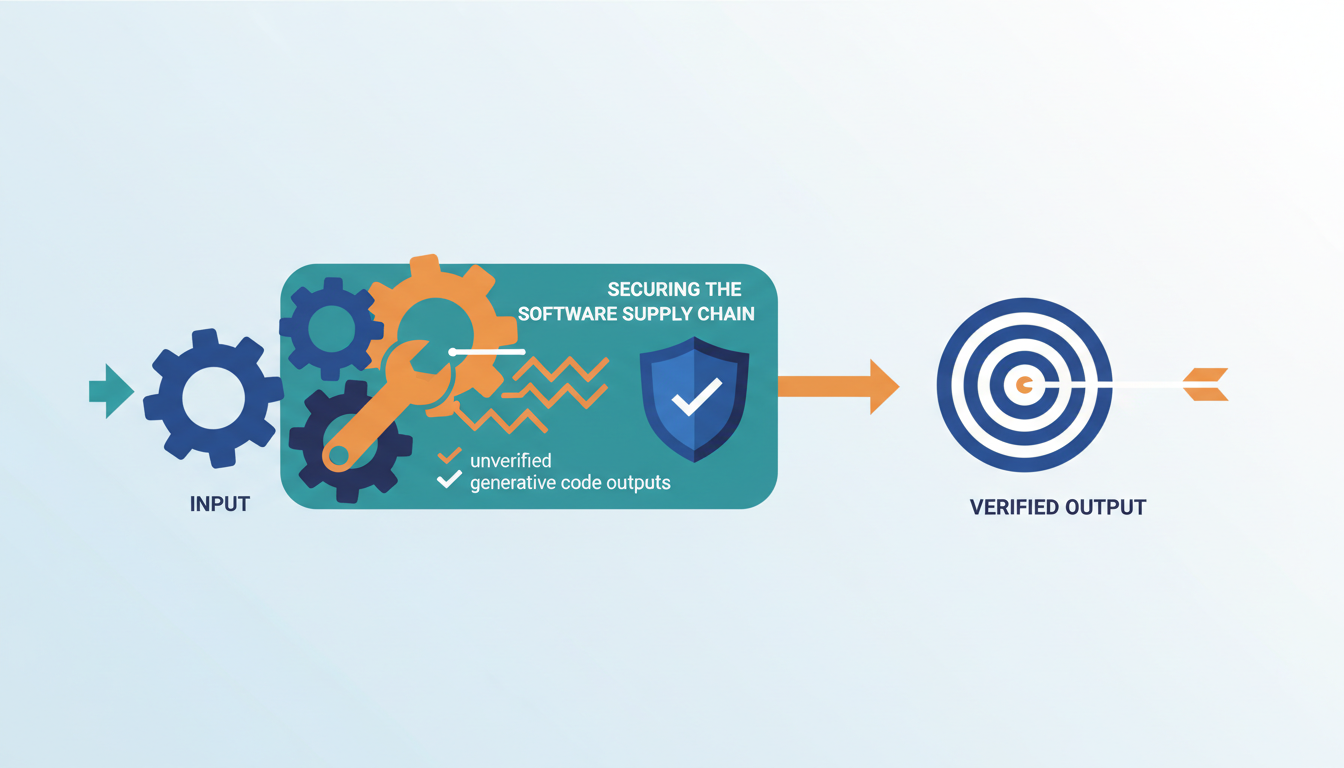
Developers embrace AI coding tools at a staggering 97% adoption rate according to Black Duck Security, yet merely one-third of enterprises maintain full governance frameworks. This statistical divergence creates a high-risk environment where AI-generated code enters production repositories without mandatory human oversight or security scanning. Failure occurs when developers bypass review policies to merge unvalidated suggestions directly into the main branch. Such behavior exposes the software supply chain to latent vulnerabilities and licensing violations that traditional static analysis tools often miss. Operational urgency has intensified as employee AI usage at work surged from 30% in 2023 to 76% in 2025, drastically outpacing the deployment of corresponding security controls.
Securing AI-Generated Code Against Supply Chain Attacks
Malicious npm packages and the SymJack RCE vulnerability affecting six substantial coding agents demand immediate scanning of all AI-generated code inputs. Operators must enforce strict dependency verification because recent attacks apply self-replicating credential stealers hidden within standard library imports. The constraint is measurable, as unchecked automation allows vulnerabilities to bypass traditional static analysis gates entirely. Implementing a policy that blocks merges without human review mitigates the risk of introducing supply chain attacks into production environments.
Biometric Collection as the Price of Restored Access
Anthropic updated its privacy policy to include government ID and biometric collection effective July 8. This identity verification mechanism aims to restore partial access following export directives. Storing biometric hashes alongside API keys creates a high-value target for credential harvesters. A breach here compromises physical security boundaries, not digital repositories. Operators must balance these privacy implications against the need for strict governance frameworks. AI Agents News recommends segregating biometric data stores from model inference logs entirely. Convenient access comes with a permanent expansion of the attack surface.
China's Sovereign Stack: 2 Trillion Yuan and No Nvidia
China's 2 trillion yuan mandate funds interconnected national AI data centers over five years, requiring 80% domestic technology adoption. This directive forces a hard swap to Huawei Ascend chips, explicitly excluding Nvidia Blackwell accelerators from the national stack. The financial scope reaches $295 billion in direct funding, with total infrastructure costs potentially climbing to $740 billion when power grid integration is included. Strategic necessity drives this hardware isolation because US export controls prevent access to frontier foreign silicon. Operators must now validate domestic technology performance against global benchmarks without legacy Nvidia dependencies. Infrastructure diversity remains a challenge since China's system is siloed into a single vendor lineage unlike Anthropic's stack which spans Nvidia GPUs and Google TPUs. Homogeneity creates a single point of failure if domestic yield rates falter. Total budgets often expand notably beyond initial caps due to hidden integration expenses. Research indicates that such hidden costs can increase total project budgets by 30-100% depending on legacy system compatibility. Network architects must plan for longer migration windows and reduced interoperability with Western cloud ecosystems. The ultimate implication is a bifurcated internet where AI infrastructure standards diverge permanently by geography.
GLM-5.2 Benchmark Parity and the Q1 2027 Fable 5 Prediction
Jie Tang declared China will field a Fable 5-class model before Elon Musk 's Q1 2027 prediction, citing GLM-5.2 parity with Opus 4.7-4.8. Decoupling from US supply chains is what the timeline buys: Chinese operators sit outside the export control revocations that currently plague global rivals. The limitation is raw throughput. Huawei Ascend clusters historically lag in interconnect bandwidth compared to Western equivalents, potentially slowing training cycles for Fable 5-class systems.
About
Diego Alvarez serves as Developer Advocate at AI Agents News, where he specializes in hands-on build guides and rigorous benchmarking of autonomous systems. His daily work involves stress-testing coding agents and multi-agent frameworks, making him uniquely qualified to analyze the rapid evolution of frontier AI models. As engineers evaluate tools like Cursor and Claude Code against new benchmarks, Diego's practical experience reveals the real-world reliability and failure modes that raw performance metrics often obscure. At AI Agents News, the team focuses on the technical realities of deploying agentic systems, providing the precise, engineer-focused context needed to understand how export bans and model capabilities impact actual development workflows. This deep dive into current events connects high-level policy shifts directly to the code-level decisions facing software teams today.
Conclusion
The 80.3% that opens this article is the whole point: benchmark dominance and availability are now separate properties, and only one of them can be bought. Reliance on a single frontier model creates a fragility where geopolitical export controls sever access to core intelligence regardless of how the model ranks. As organizations scale, the operational burden shifts from optimizing token costs to managing sudden availability gaps that alter entire agentic workflows. The current race for lower pricing per million tokens masks a deeper liability: the inability to guarantee service continuity when vendors face state-level restrictions. This volatility demands an immediate pivot toward redundant architecture rather than chasing marginal performance gains on unstable platforms.
Enterprises must mandate a multi-vendor abstraction layer by Q4 2027 to insulate critical operations from unilateral access revocations. Waiting for market stability is a failed strategy because the supply chain for frontier AI is inherently political, not just economic. The window to build this durability before widespread dependency locks in narrow options is closing rapidly.
Frequently Asked Questions
Fable 5 remains offline due to a US export ban despite leading DeepSWE at 70% PASS@1. This restriction blocks global access to its 80.3% SWE-Bench Pro score until identity protocols are resolved.
Shazeer's departure exposes Google's internal design flaws after a $2.7 billion retention effort failed. His move to OpenAI reveals architectural tradeoffs that could compromise future Gemini model launches against competitors.
SpaceX acquired Cursor to reverse a decline from 41% to 26% market share in AI coding tools. The $60 billion deal integrates xAI models to restore competitive scale against rivals.
Black Duck Security puts AI coding tool adoption at 97% of developers while only one-third of enterprises run a full governance framework. That gap is where unreviewed AI-generated code reaches the main branch, and it widens as workplace AI use went from 30% in 2023 to 76% in 2025.
A 2 trillion yuan mandate funds national AI data centers on 80% domestic technology, which excludes Nvidia Blackwell accelerators and standardizes on Huawei Ascend. Sovereign isolation removes the revocation risk that closed Fable 5, and the price is interconnect bandwidth plus a single vendor lineage with one point of failure.