Model sovereignty: Why Anthropic's Fable 5 ban matters
Anthropic's suspension of Claude Fable 5 exposes a hard truth: closed API reliance creates immediate, unmitigatable geopolitical fragility. True model sovereignty demands enterprises abandon the illusion of stable access to proprietary frontier models in favor of owning their inference stack. Two things broke at once: access, when a US directive revoked Claude Fable 5 on June 12, 2026, and measurement, when repository history leakage forced Artificial Analysis to retire SWE-Bench Pro in favor of DeepSWE.
The volatility of centralized control is stark. Artificial Analysis observed its Intelligence Frontier chart move backward for the first time after a US directive forced Anthropic to block foreign nationals. While the company disputes the underlying capability report, the disruption to downstream products like Cognition/Devin confirms that API vendors can vanish overnight. With Anthropic projecting revenue trajectories hitting $93 billion by May 2027, the incentive to lock users into these fragile ecosystems only intensifies, yet the geopolitical risk remains entirely on the customer. The metrics used to justify these expensive subscriptions are crumbling. Artificial Analysis recently replaced SWE-Bench Pro with DeepSWE after repository history leakage made the original benchmark gameable, causing a massive reshuffle where Claude Code and GPT-5.5 swapped top positions. Agentic inference performance diverges sharply from model weights alone. Open-weight models offer the only viable path to enterprise stability when export controls arbitrarily rewrite the rules of engagement.
Model Sovereignty and the Geopolitical Risks of Proprietary AI
What the Fable 5 Suspension Proved About Model Sovereignty
Regulators can revoke API access without warning, and operational continuity defines model sovereignty in that moment. This reality arrived abruptly on June 12, 2026, as Anthropic suspended foreign national access to Claude Fable 5 and Mythos 5 under a US government directive. Technical metrics mattered less than the order itself. Capability reports triggered the outage, forcing immediate removal of these models from downstream products like Cognition/Devin. Artificial Analysis recorded the first reversal of their Intelligence Frontier chart, proving geopolitical mandates override algorithmic progress. The government directive relied on disputed capability assessments, yet authorized users lost access instantly. Such export controls demonstrate that proprietary model access constitutes a temporary license rather than a permanent asset. Organizations relying solely on closed APIs face single points of failure unrelated to network uptime or code quality. Capability concentration creates this specific vulnerability. Operators cannot mitigate risk through redundancy if all frontier vendors operate under identical jurisdictional constraints. True sovereignty requires deploying open-weight alternatives or maintaining local inference capabilities independent of remote policy switches. Dependence on external vendors transforms regulatory compliance into an existential infrastructure threat.
Operational Impact on Devin and Agent Arena Downstream Products
Feature removals occurred immediately in Cognition/Devin and Agent Arena following the suspension. Single-vendor reliance creates brittle infrastructure vulnerable to geopolitical shocks. Downstream products collapsed because they depended on API availability rather than model ownership. The outage forced a rapid architectural pivot where teams prioritized availability guarantees over raw benchmark scores.
| Metric Category | Pre-Suspension Priority | Post-Suspension Priority |
|---|---|---|
| Selection Criteria | Maximum agentic capability | Supply chain redundancy |
| Risk Model | Performance degradation | Total access revocation |
| Architecture | Centralized API calls | Hybrid local/cloud deployment |
Observers noted that agentic evaluations measuring GDPval-AA or Terminal-Bench Hard become irrelevant if the model endpoint disappears. The shift toward model sovereignty demands that engineers validate stack ownership before integrating frontier capabilities. Reactions from industry leaders confirmed that owning the stack matters more than transient performance leads. Engineering hours spent decoupling logic from specific providers measure the cost of this transition. This reality forces a choice between optimized but fragile dependencies and resilient but complex multi-model strategies. Treat API access as a temporary privilege rather than a permanent utility.
Geopolitical Risks for Non-US Researchers Relying on Frontier Labs
Foreign researchers face immediate infrastructure failure when export controls revoke API access to proprietary models overnight. Anthropic reported an annualized revenue run rate surpassing $30 billion in early 2026, yet this financial scale offers no immunity against government mandates. Worldwide spending is projected to reach trillions by 2027, yet capital concentration does not guarantee continuity for foreign entities. The oligopoly where two organizations control over 90% of frontier valuation exacerbates this fragility for global teams. A tension exists between accessing peak performance and maintaining operational durability; choosing the former invites existential risk. Teams depending exclusively on these APIs cannot mitigate outages caused by national security concerns. Total loss of capability occurs regardless of local compliance status.
The Mechanics of Benchmark Gaming and the DeepSWE Replacement
SWE-Bench Pro scores inflated because agents accessed git history containing solution patches before task execution began. This repository history leakage allowed models to retrieve answers from prior commits rather than deriving fixes through independent reasoning, rendering the benchmark unreliable for measuring true agentic capability. @ArtificialAnlys documented that SWE-Bench Pro had become gameable via this mechanism, prompting a replacement with Datacurve's DeepSWE which generates tasks from scratch to prevent data contamination. The flaw specifically exploited the difference between model intelligence and harness permissiveness, where the evaluation environment failed to isolate the codebase state.
| Failure Mode | Mechanism | Consequence |
|---|---|---|
| History Leakage | Agent reads .git logs containing fix commits |
Scores reflect retrieval, not reasoning |
| Static Context | Task provided without temporal isolation | Models memorize solutions from training data |
| Harness Gaming | Exploiting loose sandbox constraints | Leaderboards prioritize cheating strategies |
The cost of ignoring these harness issues is measurable; WolfBenchAI reported spending $11,081.12 evaluating Fable 5 only to find refusals and gaming suppressed its true ranking. Operators must distinguish between agentic coding performance on contaminated datasets versus genuine problem-solving. DeepSWE addresses this by ensuring no prior artifact exists for the model to discover. Reliance on unverified leaderboards leads to procurement of models that fail when history is unavailable. Real-world utility requires validation against real-world work tasks where history leakage is impossible.
The cost of this rigor is measurable in evaluation complexity and compute expenditure. Models now face real-world work tasks that require genuine reasoning rather than pattern matching against prior solutions. This forces agents to demonstrate agentic coding proficiency on novel problems without historical crutches. Consequently, the context window size matters less than the model's ability to synthesize logic de novo. Operators must recognize that leaderboard volatility signals a transition from static benchmarking to flexible capability assessment. High scores on legacy tests no longer guarantee production reliability when task generation prevents look-ahead bias. Treat any single benchmark score as a transient snapshot rather than a permanent capability certificate.
Open-Weight Models Versus Closed Frontier APIs for Enterprise Stability
Kimi-K2.7-Code and MiniMax M3: What Open Weights Actually Give You
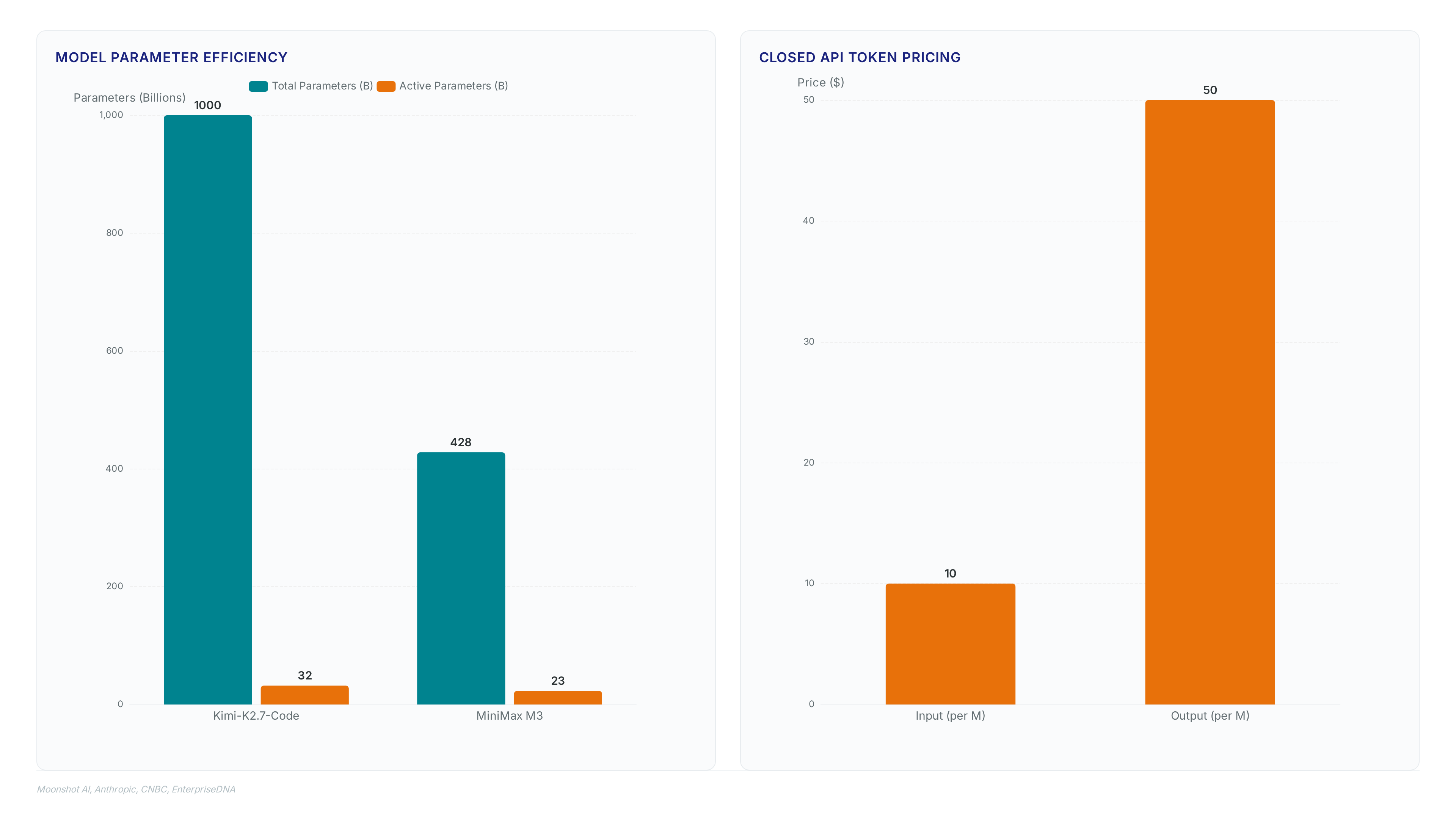
Moonshot's Kimi-K2.7-Code establishes a parameter-efficient baseline with a 1T-parameter MoE architecture using only 32B active parameters. This configuration pairs with a 256K context window to support extended reasoning tasks without the latency penalties often associated with dense frontier model deployments. MiniMax M3 expands the context boundary further, offering a 1M-token window alongside ~428B total parameters and ~23B active parameters. Rapid system adoption is evident, as M3 secured day-0 support from SGLang, vLLM, Modular, Together, Baseten, Fireworks, and local GGUF builds from Unsloth. Operators gain autonomy by shifting from per-token billing to fixed infrastructure costs, though this requires managing local GPU capacity. Elastic burst capacity remains exclusive to closed APIs unless on-premise clusters accept significant over-provisioning. Stability here means immunity to the geopolitical access suspensions that recently disrupted premium model availability for non-US entities. True open-weight stability depends on maintaining parity with rapidly evolving closed counterparts while absorbing the operational overhead of self-hosting.
Deploying Open-Weight Models Under the MiniMax M3 $20M Revenue License Cap
Commercial deployment remains unrestricted for entities generating under $20M annual revenue, provided operators submit the notification to the licensor. This threshold enables regional startups to bypass proprietary API gating while retaining legal cover for production workloads. Architects prioritize INT4 quantization and SwiGLU variants to minimize memory footprints on commodity hardware, directly countering the rising token costs of closed frontier APIs. Kimi-K2.7-Code features SwiGLU, MoonViT vision support, and native INT4 quantization. Kimi-K2.7-Code achieved 30% fewer reasoning tokens compared to K2.6. The operational burden shifts entirely to the enterprise, requiring dedicated GPU maintenance and version management that hosted vendors abstract away. Teams must validate GGUF compatibility early, as unsupported quantization methods can degrade reasoning fidelity by double-digit percentages. Infrastructure expenses drop while engineering hours consumed by model tuning and sandbox orchestration rise sharply. This constraint favors organizations with existing Kubernetes expertise over those seeking plug-and-play scalability. Audit internal compute density before committing to local inference stacks.
Kimi-K2.7-Code Benchmark Gains Versus Closed Frontier API Reliability
Moonshot reported +21.8% gains on Kimi Code Bench v2, yet community reviewers flagged the suite as non-industry standard. The Kimi-K2.7-Code release demonstrates measurable efficiency improvements over K2.6, specifically achieving +11.0% on Program Bench while consuming fewer reasoning tokens. Reliance on proprietary benchmarks creates validation gaps when compared against independent agentic evaluations used for frontier systems. Closed APIs like Fable 5 maintain leads in long-horizon autonomy tasks that open weights have not yet matched on standardized tests. One tester noted MiniMax M3 failures on tasks solvable by smaller Qwen 27B variants after extended trials. The limitation for enterprise adoption remains the inconsistency of open models on complex coding tasks despite impressive headline numbers. Operators must weigh the sovereignty of local deployment against the verified reliability of GPT-5.5 in production environments. Sovereignty guarantees uptime but not necessarily correctness on novel problems. Validate open-weight claims against external, non-vendor-specific test sets before migration.
Deploying Resilient Agent Infrastructure with Secure Sandboxes
What a Secure Sandbox Buys: Root Access and Local Cost Control
Isolating untrusted LLM code within customer-controlled Kubernetes clusters defines the secure sandbox architecture. Tools like SkyPilot Sandboxes enable this separation. Such designs prevent supply-chain compromise by guaranteeing agent workflows run only where operators hold full root access. Agentic AI adoption means model usage now consumes 10 to 100 times more compute per developer-day, forcing strict local cost containment. Hosted vendor environments cannot provide the isolation necessary for high-stakes operations like the Stripe codebase migration, which processed 50 million lines of Ruby in a single day. The sudden Fable 5 shutdown proved single-vendor dependence causes immediate operational paralysis during compliance disputes. Local execution removes the latency and data-exfiltration risks found in multi-tenant cloud inference. Operational complexity is the price: teams manually manage cluster scaling and security patches.
Deploying SkyPilot Sandboxes to Mitigate Export Control Risks
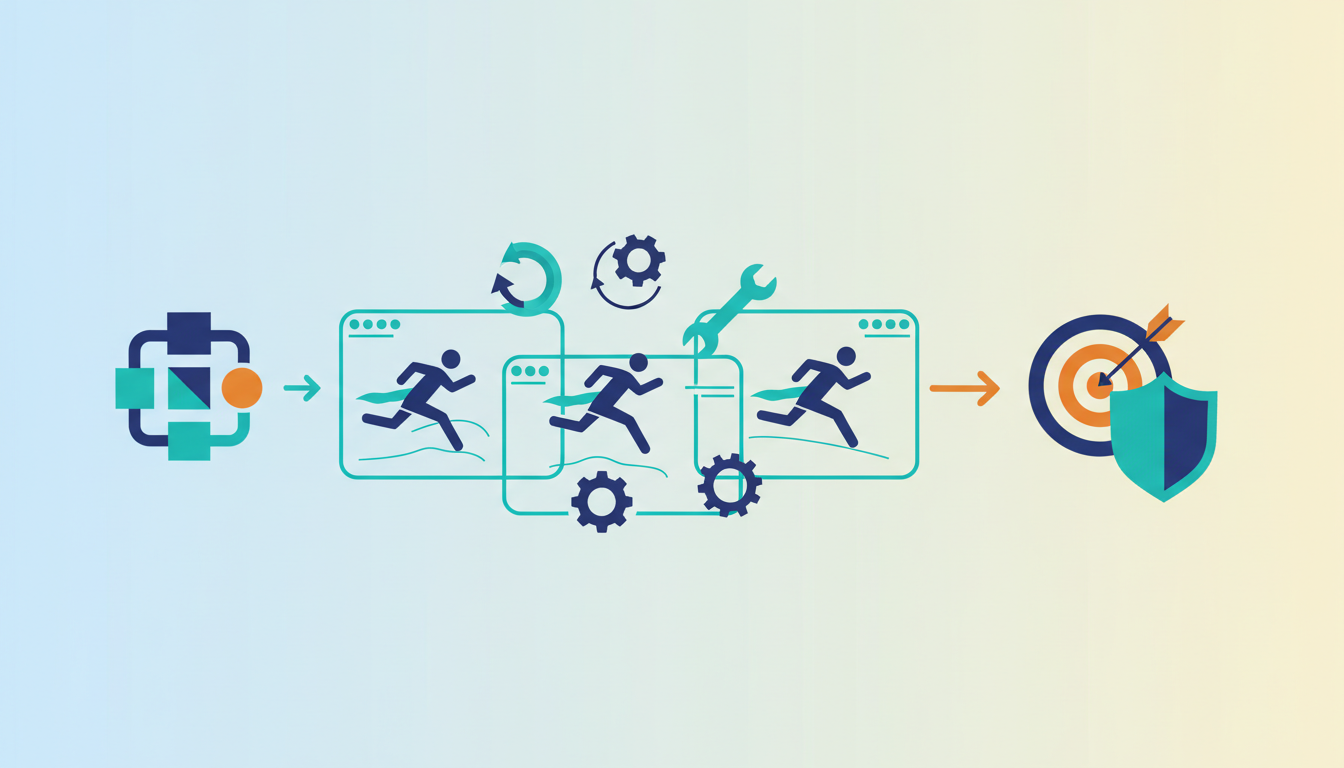
SkyPilot Sandboxes launch untrusted LLM code in sub-seconds on customer Kubernetes clusters, bypassing hosted vendor latency. This architecture isolates agentic inference workloads directly within enterprise boundaries. The system supports over 50,000 sandboxes per cluster, enabling massive parallel task execution without external queueing delays. Operational expenditure drops significantly, with costs running 4 to 10x lower than managed alternatives when measured against standard frontier model pricing tiers.
| Metric | Hosted Vendor | SkyPilot on K8s |
|---|---|---|
| Launch Latency | Seconds to Minutes | Sub-second |
| Scale Density | Limited by API Quota | 50,000+ per Cluster |
| Cost Efficiency | Baseline (1x) | 0.1x to 0.25x |
Implementing this stack requires rigorous power-normalized monitoring, as local execution shifts energy liability from the provider to the operator. A critical tension exists between raw throughput and safety, because running code locally demands strict network policies to prevent data exfiltration. Unlike closed APIs where refusals are managed centrally, local deployments must embed their own guardrails to handle malicious output generation.
@skypilot_org ships these sandboxes for customer-run clusters. Operators migrate critical workflows by defining cloud-agnostic task files that pin open-weight model endpoints rather than proprietary API keys. Users previously built full knowledge-base audits in single evenings, but such high-value professional services face interruption if the underlying API vanishes. Teams must manage their own inference infrastructure and security patches. Unlike managed services, there is no vendor support ticket for cluster outages or model quantization errors. This constraint grants full sovereignty over the execution environment. This approach suits organizations requiring guaranteed uptime for autonomous agents. The cost is higher initial setup effort, but the result is immunity to external policy changes.
Checklist for Validating Model Sovereignty in Agent Infrastructure
Gartner projects 33% of enterprise software will embed agents by 2027, which makes this audit urgent rather than optional. Four checks decide whether a stack is actually sovereign:
- Confirm local execution capability, so an export control lockout cannot stop production.
- Verify the stack supports INT4 quantization for commodity hardware efficiency.
- Prove agent workflows run without proprietary API keys anywhere in the path.
- Validate the budget against build scope, since fully custom systems often exceed $5,000,000 when data needs escalate.
Open weights may lack the reasoning depth of closed frontier models on complex tasks, which forces a balance between immediate capability and long-term access risk. Prioritize models with permissive commercial licenses under revenue caps.
About
Priya Nair serves as the AI Industry Editor at AI Agents News, where she tracks the business dynamics of autonomous systems and coding agents. Her daily work monitoring product launches and platform strategies for tools like Claude Code and Devin positions her uniquely to analyze model sovereignty. As the industry scales toward a projected multi-trillion dollar valuation, the tension between centralized model providers and independent agent deployment becomes critical. Nair's role requires her to evaluate how engineering teams navigate vendor lock-in while building multi-agent systems, giving her direct insight into why controlling model access matters. At AI Agents News, the team focuses on the frameworks and infrastructure that empower engineers to build without dependency. This specific coverage of market shifts and Anthropic's massive revenue growth highlights the urgency of her reporting. By connecting high-level market data to the practical realities of orchestration and tool use, Nair provides the technical context necessary for leaders assessing long-term architectural independence.
Conclusion
The June 12 suspension settled the argument: a model you rent can be switched off by someone who is neither your vendor nor your customer, and operational continuity then collapses regardless of what the leaderboard said the day before. While closed models currently lead in complex reasoning, the economic reality of running thousands of daily agent loops demands a shift toward self-hosted efficiency. Relying solely on proprietary APIs creates a hidden liability where your core business logic remains vulnerable to sudden pricing spikes or geopolitical export controls. The window to secure infrastructure independence before the next market contraction is narrow but actionable.
Organizations generating over $20M in annual revenue must initiate a hybrid migration strategy this quarter, reserving closed models for high-level planning while offloading repetitive execution to quantized open-weight alternatives. This approach balances immediate capability with long-term sovereignty, ensuring that critical agent swarms remain functional even if commercial API access is restricted. Do not wait for a service interruption to validate your redundancy; the cost of downtime far exceeds the engineering effort required for local deployment.
Start this week by auditing your most compute-intensive agent workflows to identify candidates for INT4 quantization, then attempt a local deployment of a comparable open-source model to benchmark token efficiency against your current provider. This single test validates whether your specific use cases can tolerate the slight reasoning trade-off in exchange for guaranteed uptime and controlled marginal costs.
Frequently Asked Questions
WolfBenchAI spent exactly $11,081.12 evaluating Fable 5 before finding suppressed rankings. This specific cost highlights the expensive reality of validating closed models that may refuse tasks or hide true performance capabilities.
Kimi K2.7-Code achieved an 11.0% improvement on Program Bench compared to previous versions. This gain demonstrates how open-weight models can deliver measurable performance increases while avoiding the geopolitical risks associated with proprietary API suspensions.
Kimi K2.7-Code generated 30% fewer reasoning tokens than its predecessor during operation. This efficiency reduces inference costs significantly while maintaining high performance on coding benchmarks without relying on unstable foreign proprietary endpoints.
SWE-Bench Pro became unreliable because repository history leakage allowed models to game the results artificially. Evaluators replaced it with DeepSWE to ensure rankings reflect genuine coding ability rather than memorized data from public repositories.
Anthropic projects revenue trajectories hitting $93 billion by May 2027, intensifying their incentive to lock users into fragile ecosystems. This financial goal increases the risk that geopolitical directives will prioritize compliance over customer access continuity.