Cursor deep integration ends chatbot latency
SpaceX's $60 billion acquisition of Cursor, reported by TechCrunch, instantly validates deep IDE integration as the critical infrastructure for post-IPO AI scaling. Standalone chatbots are obsolete for high-velocity engineering. Code generation and execution must share the same memory space. As SpaceX merges its AI division with xAI following a tumultuous restructuring, the strategic imperative is clear: only tools embedded directly into the developer workflow can sustain the velocity required for orbital manufacturing and autonomous systems.
Cursor's deep integration outperforms generic LLM wrappers by eliminating context-switching latency. This bottleneck plagues 84% of developers relying on external assistants according to recent adoption data. Embedding AI into the IDE creates a defensible moat against the fragmentation seen in xAI's early Grok iterations.
With AI-generated code now representing 41% of global output, the constraint has moved from generation to control. A full IDE fork holds the entire project in context and enforces policy before a request leaves the workstation, which is exactly what a sidebar plugin cannot do. That capability is what SpaceX paid for, and it is why the same acquisition doubles as a governance reset after xAI lost its founding team.
What SpaceX Bought and Why the Timing Was Forced
Defining the $60 Billion SpaceX-Cursor Stock Acquisition
The $60 billion all-stock agreement announced on Tuesday, 16 Jun 2026, formally transfers ownership of Cursor to SpaceX following an April option pact. This transaction specifically targets the AI coding startup formerly known as Anysphere, distinct from the operational restructuring occurring at xAI. Prior terms dictated that SpaceX must either execute this purchase or incur a $10 billion penalty, a clause that locked the valuation before the public IPO surge. Michael Truell, the CEO who guided the company from an MIT project to a $29.3 billion valuation in November 2025, now leads the unit within the aerospace giant. The all-stock structure bypasses the need for fresh capital.
Execution follows a strict three-step sequence to satisfy IPO-era compliance standards:
- Trigger the April call option to initiate the mandatory purchase window.
- File updated S-4 registration statements reflecting the new AI division assets.
- Close the transaction by Q3 2026 to avoid activating the break-up fee clause.
The timeline compresses standard due diligence into a narrow window, requiring Michael Truell to maintain operational continuity while legal teams finalize terms. This pace often sacrifices deep technical integration planning for speed, leaving legacy systems temporarily siloed. The constraint is potential friction when merging IDE forks with existing aerospace software stacks. AI Agents News recommends pre-negotiating API compatibility maps before signing to mitigate this specific integration debt.
Complete departure of all 11 xAI co-founders by March 2026 signals a total governance collapse requiring immediate structural replacement. This exodus left SpaceX without the original architectural oversight needed to prevent the generation of non-consensual deepfakes involving women and children. Musk admitted the previous entity "was not built right," creating a vacuum that demands a fresh operational foundation. Integrating Cursor bypasses these legacy failures by importing a team with a different track record, specifically the four MIT dropouts who founded the company in 2022. The risk profile shifts from reputational liability to manageable compute costs under the new regime. Unlike the uncontrolled chatbot outputs at xAI, Cursor's March 2026 pricing restructuring penalizes unfocused model calls and bills background agents per compute minute. This mechanism enforces discipline on API usage, preventing the runaway costs often seen in generative AI deployments.
| Risk Factor | xAI Legacy Status | Cursor Mitigation Strategy |
|---|---|---|
| Leadership | 100% co-founder turnover | Original founding team intact |
| Content Safety | Deepfake controversies | Enterprise-grade guardrails |
| Cost Control | Unchecked token consumption | Per-minute billing enforcement |
Acquiring an established codebase reduces the surface area for security failures compared to building from scratch. AI Agents News notes that such acquisitions prioritize immediate revenue reliability over speculative model training.
Architectural Advantages of Deep IDE Integration Over Standalone Chatbots
Cursor as a VS Code Fork with Native Agent Architecture
Cursor operates as a full IDE fork of VS Code rather than a standard extension, embedding the agent directly into the editor process. This architectural choice allows the system to manipulate the entire project context locally, bypassing the latency inherent in chat-based interfaces that rely on manual copy-pasting. The native integration supports switching between models like Claude Sonnet and GPT-4o within a single interface, granting operators flexibility absent in locked ecosystems. Monetization follows a strict credit-pool model where base subscriptions include credits equal to the dollar amount paid, contrasting sharply with the flat-rate unlimited completions offered by GitHub Copilot. This structure aligns costs directly with compute intensity, preventing the resource exhaustion common in fixed-fee arrangements during heavy agent usage.
| Feature | Cursor Architecture | Extension-Based Tools |
|---|---|---|
| Integration Depth | Full IDE Fork | Plugin / Sidebar |
| Context Access | Native Project-Wide | Limited File Scope |
| Billing Model | Credit-Pool | Flat-Rate Subscription |
| Model Choice | Editor-Agnostic | Vendor-Locked |
Complexity is the trade-off. Managing credit pools requires more active budget monitoring than simple seat licensing. However, this granularity enables precise cost attribution for specific engineering tasks. Satellite-based AI compute remains constrained by latency, making local IDE execution the only viable path for real-time agent interaction. AI Agents News identifies this local-first approach as the defining mechanic for enterprise adoption in 2026.
Bugbot Deployment and Coinbase Engineering Velocity Gains
Bugbot deployment in July 2025 introduced a dedicated review agent that identifies a notable share more bugs per cycle while reducing run costs by a meaningful margin. This code-review tool integrates directly into GitHub pull requests, shifting analysis from post-merge remediation to pre-commit validation. The mechanism relies on deep IDE context rather than diff-only scanning, allowing the agent to flag logical inconsistencies invisible to standard linters. Security policies clash with agent efficacy in highly segmented environments because this depth requires full repository access. Operators must weigh the benefit of earlier detection against the risk of exposing entire codebases to external processing threads.
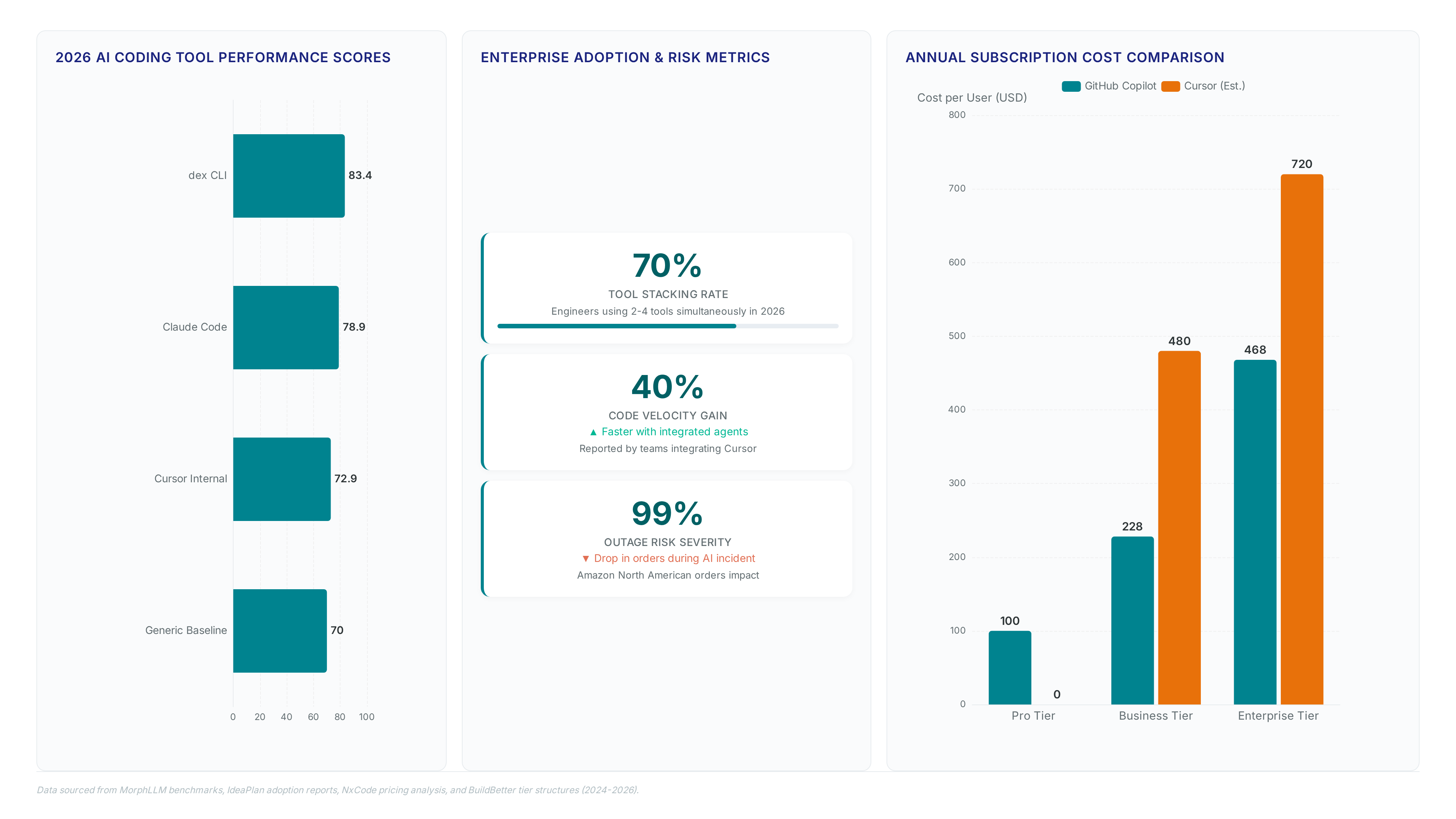
Market behavior reflects a "stacking" trend where 70% of engineers use 2-4 tools simultaneously. Operators often pair the broad compatibility of Copilot with the speed of specialized agents. Benchmarks from 2026 indicate Cursor wins on speed, while GitHub Copilot retains value for money through its flat-rate model. However, the extension model struggles with cross-file refactoring tasks that require global awareness. The cost of this limitation is measurable in delayed detection of logic errors spanning multiple modules. Network engineering teams must balance tool interoperability against depth of insight. Relying solely on extensions risks missing systemic architectural flaws that a native agent would catch. Conversely, migrating entirely to a forked environment introduces friction in standardizing workflows across diverse developer setups. The editor-agnostic approach of Cursor allows switching between Claude Sonnet and GPT-4o, offering flexibility that locked ecosystems cannot match. Yet, this flexibility demands rigorous credit-pool management to prevent budget overruns.
Enterprise ROI from AI Coding Tools in High-Velocity Development Environments
Validating revenue velocity against developer adoption rates defines enterprise readiness for AI coding tools. Rising developer adoption correlates with a dramatic valuation increase between August 2024 and April 2026, signaling that high-velocity environments prioritize integrated agents over chat interfaces. Operators measure readiness not by tool access, but by the shift to credit-pool models where subscription costs directly map to compute consumption. Unlike flat-rate extensions, this structure forces teams to optimize prompt efficiency rather than maximizing token usage. Rapid scaling introduces friction when engineer utilization reaches saturation across disparate toolchains. Context fragmentation is the limitation; without a unified IDE fork, agents struggle to maintain project-wide coherence during complex refactors. Teams relying on extensions face higher latency compared to native implementations that ingest full workspace directories. Organizations must audit their development workflows for architectural mismatches before committing to enterprise licenses. True readiness demands an environment where the agent understands the entire codebase, not the active file. AI Agents News recommends focusing on integration depth rather than raw completion speed to sustain long-term productivity gains.
Deploying Composer and Bugbot to Match Coinbase Velocity
Replicating Coinbase velocity requires deploying the Composer feature to iterate over long time horizons until outputs are verified. This mechanism captures environment snapshots in a reusable .cursor/environment.json file, enabling quicker startup for future cloud agents. Teams achieve similar 2 to 5x gains only by shifting from chat-based queries to persistent agent loops that handle multi-step refactoring tasks autonomously. Unrestricted agent access introduces severe security risks, as unverified AI code contributed to significant outages at Amazon in early 2026. Operators must restructure AI teams to prioritize verification workflows over raw generation speed to prevent similar production failures. Integration strategies must address the specific threat environment where 2026 saw OWASP publish a "Top 10" for MCP risks, focusing on token exposure and command injection vulnerabilities. Enterprises ignoring these vectors face compounded liability when automated agents execute privileged commands without human oversight.
| Deployment Phase | Required Action | Risk Mitigation |
|---|---|---|
| Initialization | Configure .cursor/environment.json |
Limit scope to read-only paths |
| Execution | Enable Composer iteration | Enforce manual approval for writes |
| Validation | Run Bugbot pre-commit checks | Block merges on low-confidence diffs |
Successful adoption demands restructuring engineering squads to treat AI agents as untrusted interns rather than authoritative sources. AI Agents News reports that teams achieving maximum utilization embed strict guardrails before scaling agent permissions. The cost of skipping this governance layer exceeds the efficiency gains of rapid prototyping.
Governing Hundreds of Millions of Daily Completions
Handling hundreds of millions of daily completions across 500,000 developers demands strict governance to prevent the governance failures that caused all 11 xAI co-founders to depart by March 2026. The mechanism relies on embedding security policies directly into the IDE fork rather than relying on post-hoc scanning. Evidence from early 2026 shows unverified AI code caused an Amazon outage with a 99% drop in North American orders, proving that volume without validation creates catastrophic operational risk. Security-focused instructions often conflict with developer velocity, creating a tension where strict controls may slow the very speed enterprises seek. This fragmentation means a single unguarded agent can bypass enterprise safeguards entirely.
Rebuilding AI Divisions: Applying Musk's 'Foundations Up' Strategy to xAI Turmoil
Musk's admission that xAI failed structurally demands replacing chaotic chat interfaces with the deterministic IDE fork architecture Cursor proved viable. Operators must execute a four-step reconstruction to arrest leadership exodus and governance collapse.
- Discard standalone chatbots in favor of integrated development environments that enforce policy at the editor level, preventing the generation of non-consensual deepfakes that plagued earlier iterations.
- Migrate unstable distributed SQL dependencies to strong relational backends immediately, replicating the rapid database migration executed during critical indexing outages to guarantee data integrity.
- Deploy persistent agent loops for refactoring tasks rather than transient queries, a shift that enabled Mixin Agency to change their entire brand strategy with a fraction of the usual personnel.
- Institute strict credit-pool accounting to align compute consumption with engineering output, forcing optimization before scaling volume.
Unlike the failed xAI model, this approach embeds security policies directly into the workflow. Rebuilding foundations requires abandoning the "chat-first" mentality entirely. Most operators overlook this necessity. The drawback of retaining legacy chat architectures is measurable in legal liability and talent churn. AI Agents News recommends anchoring all post-restructuring metrics to defect rates rather than code volume. Success depends on treating the IDE as the boundary of trust, not the model itself, with safety rules executing locally before any request leaves the workstation.
About
Marcus Chen serves as Lead Agent Engineer at AI Agents News, where he daily evaluates the orchestration mechanics and tool-use capabilities of emerging coding agents. As an engineer who rigorously tests frameworks like LangGraph and AutoGen in production, Marcus understands the technical leap Cursor represents in autonomous software development. His work involves dissecting how these agents coordinate complex tasks, directly connecting to the strategic value SpaceX sees in integrating advanced AI coding directly into their aerospace engineering workflows. At AI Agents News, a hub dedicated to technical founders and engineers building with agentic systems, Marcus provides the precise, non-hyped context necessary to understand this industry-shifting deal. He bridges the gap between high-level corporate strategy and the on-the-ground reality of shipping code with AI assistance, offering readers a clear view of how this acquisition impacts the broader environment of autonomous development tools.
Conclusion
Scaling AI coding tools reveals that governance latency becomes the primary bottleneck, not compute power. When policy checks occur remotely after code generation, the window for liability exposure widens unacceptable for enterprise contracts. The operational burden shifts from managing developer productivity to auditing legal exposure across every generated line. This structural flaw demands a fundamental re-architecture where safety enforcement happens locally within the IDE before any token leaves the workstation.
Organizations must mandate local-first policy execution for all AI development tools by Q3 2026. Do not adopt cloud-native coding assistants that lack offline verification capabilities, regardless of their speed advantages. The risk of unverified output creating immediate legal liabilities outweighs the convenience of rapid, unguarded generation. Teams should prioritize tools that embed safety rules directly into the editor environment rather than relying on post-hoc cloud filtering.
Start this week by auditing your current CI/CD pipeline to identify exactly where AI-generated code bypasses local security checks. Map every instance where a model request leaves the developer's machine without prior policy validation. This inventory provides the baseline required to enforce the necessary boundary of trust at the source code level. Only by securing the IDE as the definitive control point can teams sustain long-term viability without incurring the catastrophic turnover seen in less disciplined implementations.
Frequently Asked Questions
SpaceX paid $60 billion to avoid a $10 billion penalty and to inherit a working codebase instead of building one. Acquiring an established codebase reduces the surface area for security failures compared to starting from scratch, which matters more than time saved.
Deep IDE integration eliminates context-switching latency that plagues 84% of developers using external assistants. By sharing the same memory space, the tool allows code generation and execution to occur seamlessly, significantly improving velocity in high-stakes engineering environments compared to chatbots.
SpaceX faced a mandatory $10 billion break-up fee if the deal fell through after the April option pact. This clause locked the valuation before the public IPO surge, ensuring the company secured the asset rather than losing capital to penalties.
Cursor arrives with its original founding team intact, after all 11 xAI co-founders had departed by March 2026. Its March 2026 pricing restructuring penalizes unfocused model calls and bills background agents per compute minute, replacing unchecked token consumption with enforced cost discipline.
Cursor grew from an MIT project to a $29.3 billion valuation by November 2025 before the deal. This rapid ascent attracted SpaceX, which needed a stable AI asset after its own division suffered from a total co-founder exodus earlier this year.