Coding agent shifts as SpaceX buys Anysphere
SpaceX's $60 billion acquisition of Anysphere proves the coding agent is no longer optional. This deal validates the thesis that autonomous development tools have evolved from simple IDE plugins into the central nervous system of modern software engineering. By securing Anysphere, SpaceX is not merely buying an editor; it is capturing the entire developer workflow to bypass third-party model dependencies.
Owning the underlying models and compute distribution now matters more than building the slickest chat interface. The stakes have shifted dramatically since Anysphere's founding in 2022. Gartner predicts that by 2027, 40% of enterprise applications will embed task-specific AI agents, a massive leap from less than 5% in 2025. With Cursor reaching $2 billion in ARR before this purchase, the race is no longer about feature parity but total infrastructure ownership. Companies ignoring this shift risk losing control over their most valuable asset: proprietary code.
The Mechanics of Vertical Integration in AI Development
What SpaceX Bought: Editor, Agent, Model, Compute
Vertical integration in AI coding stacks requires owning the editor, agent, model, compute, and developer relationship rather than just the chat interface. This structural shift moves the industry from an era of raw growth toward a focus on infrastructure, control, and long-term economics. Consequently, competition now targets the entire development lifecycle instead of isolated autocomplete features.
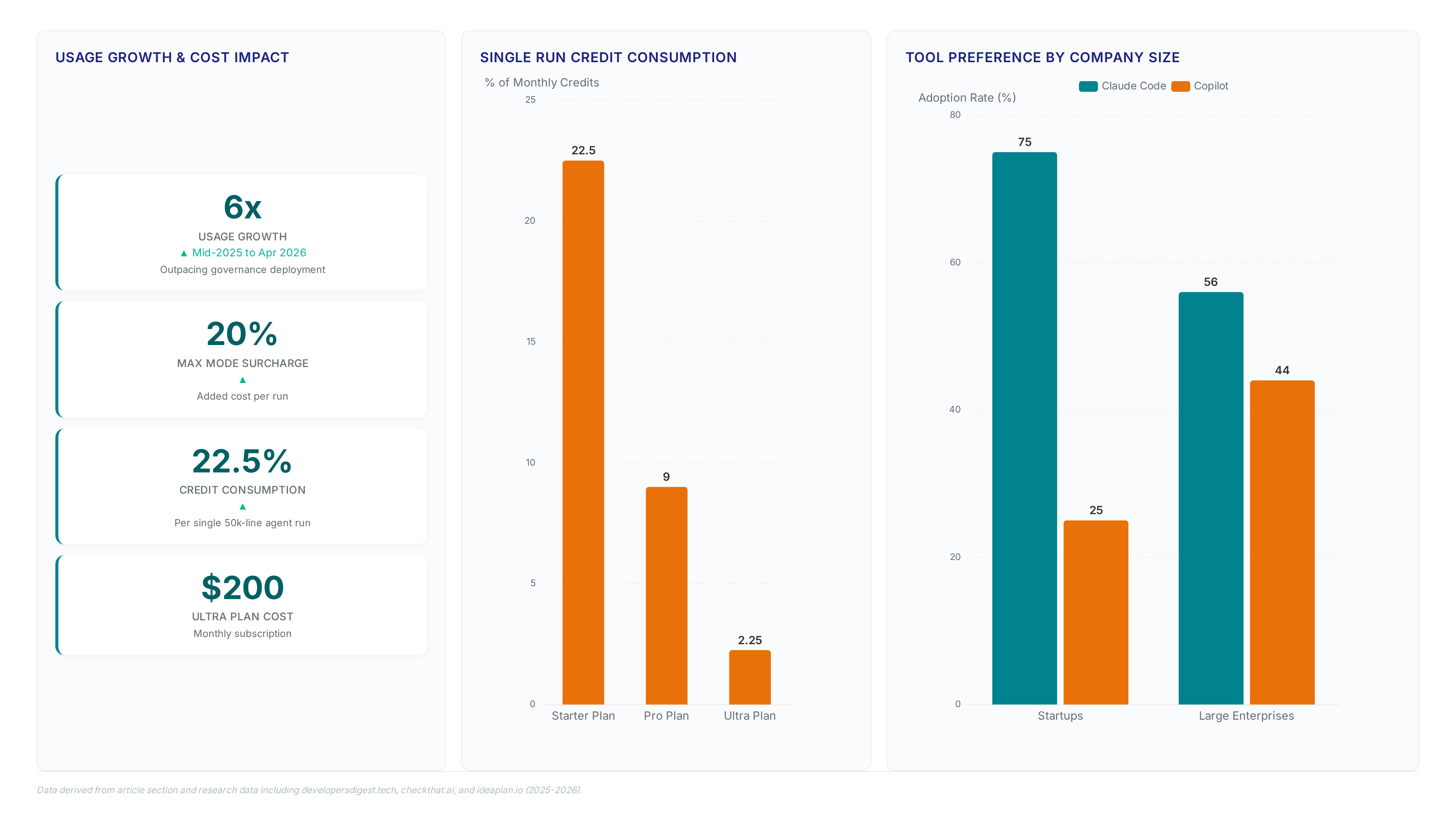
Economic structures reflect this depth, with tiers like the Ultra plan priced at $200/month to support heavy agent usage (usage limits). Deep integration offers superior workflow automation but creates significant vendor lock-in risks for enterprises. Unlike fragmented toolchains, a vertically integrated system allows a single provider to govern permissions, logging, and secrets across the build process. This consolidation means that owning the model becomes more strategically valuable than merely accessing it. The ultimate implication for network architects is that AI coding platforms will soon demand the same rigorous governance controls as production database access. Cloud Agents require MAX mode, which applies a 20% surcharge on every autonomous execution cycle.
GitHub Copilot serves 4.7 million paid users as the general-purpose default, contrasting sharply with Cursor's specialization for complex architectural refactoring. This divergence forces a strategic choice between low-cost ubiquity and deep, agent-native workflow integration. General adoption relies on the familiar extension model, whereas advanced architectural manipulation demands the standalone capabilities found in an AI-native IDE. Developers frequently maintain both tools, reserving the extension for daily tasks while switching to the forked editor for multi-file operations. This complementary pattern emerges because the extension-based workflow lacks the file-system permissions required for autonomous structural changes. Demand for multi-file refactoring validates the need for specialized tools capable of managing entire codebases rather than single functions. The operational tension lies in governance; teams must balance the speed of autonomous agents against the risk of unverified bulk modifications. Adoption strategies should prioritize the standalone IDE for backend modernization projects while retaining the general-purpose plugin for routine frontend updates.
Implementing Governance and Security for Autonomous Agents
Defining AI Agent Governance as Critical Infrastructure
A fast agent without governance isn't a helpful teammate, it is just a quicker way to introduce risk. This reality forces operators to treat agents like critical infrastructure now rather than optional productivity aids. The defining shift in 2026 moves development from simple autocomplete to engineered workflows capable of autonomous planning and execution. At-work usage of these advanced tools grew 6x in under a year, rising from 3% in mid-2025 to 18% in April 2026. Such rapid adoption outpaces security maturity, creating a dangerous gap between capability and control.
Isolating routine coding from destructive actions prevents accidental production outages caused by over-privileged autonomous execution.
- Define scoped access policies that restrict file system writes to non-production directories during initial development phases.
- Configure workflow engines to separate standard refactoring tasks from database migrations or infrastructure changes.
- Mandate human approval gates for any agent action attempting to modify production configuration or deploy code.
- Audit all agent logs continuously to verify adherence to permission boundaries and detect drift.
- Isolate secrets in environment variables the agent cannot read or log.
Over-privileged access means the agent holds write permissions far beyond what the task requires, so a routine refactor can traverse the file system and alter production the moment it runs. Keeping secrets out of its context prevents accidental credential leakage during autonomous planning cycles, and broad permissions cost the audit trail that incident response depends on: an agent with unrestricted read-write access cannot be reconstructed after a failure event. By 2027, AI coding agents routinely complete development tasks lasting 30+ minutes, moving beyond simple autocomplete to complex workflow execution. This extended autonomy window increases the blast radius of any single permission error exponentially. The cost of ignoring these boundaries is measurable system instability. Separating routine coding from destructive actions ensures that even if an agent hallucinates a command, the production environment remains immutable without explicit human intervention.
Strategic Risks and Economic Realities of Agent Adoption
The Economics of MAX Mode and Usage Credits
The MAX mode surcharge on Cloud Agents, layered on a $200/month Ultra subscription, turns variable compute usage into a predictable budget drain for large-scale refactoring projects. The economic reality shifts when teams enable Cloud Agents for complex tasks, as the base subscription no longer covers meaningful workloads. Critics argue that monthly usage credits obscure the true cost of autonomous editing compared to flat-rate alternatives. The alternative involves sacrificing the deep IDE integration that defines the platform's value proposition. Organizations must calculate the break-even point where agent speed offsets the premium paid for MAX mode surcharges. Ignoring this math results in sticker shock when the billing cycle resets. Teams should model their specific workflow patterns before committing to Ultra tiers or equivalent high-volume plans. Strategic adoption requires treating these tools as capital infrastructure rather than disposable utilities. AI Agents News recommends auditing current credit burn rates before enabling autonomous features across engineering groups.
Enterprise Demands for Logging and Permission Controls
Enterprise buyers now mandate strict controls over permissions and logging as the primary purchase criterion for coding agents. This shift reflects a move from experimental tooling to governed infrastructure where auditability outweighs raw speed. In early 2025, Anysphere assembled an enterprise sales team to address inbound interest from thousands of companies seeking these exact governance features. The demographic split is sharp, with large enterprises showing different adoption patterns compared to startups that prioritize rapid iteration over strict oversight.
Hidden costs emerge when governance frameworks lag behind agent capabilities.
- Unaudited autonomous actions introduce undetected vulnerabilities in production codebases.
- Credential leakage occurs when secrets enter the agent context without rotation protocols.
- Compliance failures result from incomplete audit logs of agent-driven code modifications.
- Standard package manager security checks get bypassed by untraceable dependency injections.
AI Agents News recommends treating agent output as untrusted input until verified by established CI/CD pipelines. The economic model of agents changes when security teams demand full visibility into every token generated and every file touched.
About
Sofia Berg serves as Research Editor at AI Agents News, where she specializes in translating complex agentic research into actionable insights for engineering teams. Her daily work involves rigorously evaluating coding agents against benchmarks like SWE-bench and dissecting the underlying architectures of tools such as Cursor and Devin. This specific expertise makes her uniquely qualified to analyze the monumental acquisition of Anysphere by SpaceX, a deal that fundamentally reshapes the AI coding agent environment. Berg's routine assessment of multi-agent coordination and function calling capabilities allows her to separate genuine technical breakthroughs from market hype. At AI Agents News, an independent hub dedicated to autonomous systems, she ensures that coverage of industry-shifting events remains grounded in technical reality.
Conclusion
SpaceX's $60 billion purchase of Anysphere settles where the value sits: in owning the editor, the models and the compute, not in the chat interface layered on top. That ownership arrives with a bill. The operational expense of "MAX mode" surcharges combined with mandatory human-in-the-loop verification will render blanket usage policies financially unsustainable. Organizations relying on unrestricted agent access will face exponential cloud bills and unmanageable security debt, forcing a pivot from broad adoption to highly constrained, role-specific deployment strategies.
The logic that made the deal rational makes blanket agent access irrational. Owning the stack concentrates permissions, logging and secrets in one provider, which is exactly why whoever buys that stack has to segment what the agent may touch: scaffolding on the autonomous tier, database migrations and infrastructure changes behind human verification. Enterprise buyers had already made granular permissioning their primary purchase criterion. The acquisition moves that requirement one layer down, into the vendor that now owns the editor, the models and the compute.
Frequently Asked Questions
SpaceX paid $60 billion to secure direct control over the entire coding agent stack. This vertical integration eliminates dependency on third-party model providers for core intelligence. Owning the workflow prevents commoditization of the product layer.
Owning the editor, models and compute lets one provider govern permissions, logging and secrets across the entire build process, which a fragmented toolchain cannot do. That depth is also the lock-in: the same integration that removes handoffs hands a single vendor the whole development workflow.
Gartner forecasts that 40% of enterprise applications will embed task-specific AI agents by 2027, up from less than 5% in 2025. That surge drives enterprise spending on environments that manage multi-step autonomous workflows. Traditional IDEs cannot match this level of deep integration capability.
The extension model runs inside the editor and lacks the file-system permissions needed for autonomous structural changes, which is why teams keep the general-purpose plugin for routine edits and switch to the standalone IDE for multi-file refactoring. Anything that can rewrite across files is closer to a service account with production reach than to a plugin, and it needs the same boundaries.
Agents modifying code create a single point of failure across the entire software supply chain. Teams must audit agent actions rather than just human commits to manage concentrated internal operational risk effectively. Scoped access is now mandatory for safety.