SpaceX acquisition of Cursor shifts AI coding
SpaceX's $60 billion all-stock acquisition of Anysphere confirms that agentic workflow dominance is the new economic reality for software development. The practical consequence is narrower than the headline: which coding models a team may call is now set by ownership and export policy rather than by benchmark results. Fable 5 stays offline under US Commerce Department directives, and the G7 governance agreements signed in Evian-les-Bains fix the safety terms the surviving vendors work under.
With SpaceX controlling Cursor's $4 billion ARR, the question moves from raw capability to how AI agents sit inside sovereign-controlled infrastructure. Operational mechanics already shifted: 95% of Cursor users now function as agent users, relying on complex task execution rather than simple snippets.
The Cursor Acquisition and the G7 Safety Accord
SpaceX $60 Billion All-Stock Acquisition of Anysphere
The SEC Form 8-K filing on June 16 formalized an all-stock acquisition of Anysphere at an implied equity value of $60 billion. This transaction executes a call option secured in April 2026, where SpaceX elected full ownership over a $10 billion partnership alternative. Each Cursor share converts to SpaceX Class A common stock, with closing expected in Q3 2026.
Resolution of a key dependency drove the deal structure. Cursor previously relied on external models from Anthropic and OpenAI, creating strategic vulnerability as those vendors launched competing coding tools. Integration with xAI's Grok models on the Colossus supercomputer eliminates this third-party risk. Stakeholders now face volatility in the nascent SPCX ticker, which surged 17% following the IPO. Network architects observe the consolidation of AI coding supply chains. Reliance on a single vendor for both infrastructure and development tools increases systemic coupling. Operators must evaluate whether deep integration with SpaceX's proprietary system outweighs the flexibility of multi-vendor AI agent strategies.
Sam Altman and Dario Amodei joined other CEOs at the G7 AI working lunch to finalize voluntary safety commitments. This closed-door session prioritized shielding minors from harmful AI-generated content through multilateral alignment rather than binding treaty law. Altman attended at the personal invitation of French President Macron, placing youth safety above frontier cyber risks on the agenda. The resulting voluntary commitments package mirrors the 2023 White House framework but extends governance to a G7 context. Attendees included Dario Amodei, Demis Hassabis, Arthur Mensch, and Aidan Gomez alongside world leaders.
These leaders face immediate pressure to align AI coding tools with new safety norms as market dynamics shift. Cursor previously shifted to usage-based billing on June 1, 2026, creating variable cost structures that complicate enterprise compliance budgeting. Enforcement relies on market access rather than legal penalty because the accords remain voluntary. Companies failing to self-police risk exclusion from G7 data centers or procurement lists. Rapid model iteration conflicts with the static safety baselines required for minor protection. Operators must choose between unrestricted agentic capabilities and maintained access to Western infrastructure. Reduced experimentation velocity measures the cost of compliance for affected teams.
Post-IPO valuation pressure forces SpaceX to justify its status as the 4th most valuable US company. The recent substantial capital raise created immediate expectations for sustained growth, yet market volatility remains a primary risk factor. Reliance on external model providers previously exposed the platform to supply chain interruptions. Future plans involve training proprietary models on xAI datasets to mitigate this dependency. Executives must now navigate the tension between rapid feature deployment and the stability required of a public entity. Failure to deliver immediate cooperation could trigger a correction disproportionate to operational setbacks. The sheer scale of the IPO means even minor deviations from growth targets will invite intense scrutiny from institutional holders. Stability now outweighs raw innovation speed.
Operational Mechanics of Modern AI Models and Export Control Constraints
GLM-5.2 Long-Context Architecture and Reasoning Modes
Zhipu AI's GLM-5.2 delivers a 1 million token context window alongside dual reasoning effort levels for precise computational control. The architecture processes massive input streams by maintaining state across the full sequence, enabling analysis of entire codebases or legal corpora without truncation. This capacity supports complex agentic workflows where token consumption increases exponentially, with tasks consuming 5x to 20x more tokens than standard completions. Operators configure the model via two distinct modes: "max" for deep logical derivation and "high" for quicker, heuristic-based responses. Benchmark testing records a 46.2% score on DeepSWE, establishing current state-of-the-art performance among open-weight alternatives.
| Feature | Max Mode | High Mode |
|---|---|---|
| Latency | High | Low |
| Compute Cost | Significant | Moderate |
| Use Case | Complex reasoning | Rapid iteration |
Deep reasoning modes drastically increase inference costs, forcing a reevaluation of pricing models from flat-rate to usage-based structures pricing models. Local deployment of such large models demands substantial GPU memory, often exceeding single-node capabilities. Teams balancing cost against capability frequently opt for the "high" setting during development, reserving "max" for final validation steps. Infrastructure limits dictate model utility more than raw parameter counts. AI Agents News recommends validating hardware readiness before enabling full context windows in production.
Restoring Enterprise Access During Fable 5 Export Restrictions
Claude Fable 5 and Mythos 5 remain globally offline on Day 6 of the US Commerce Department's export control directive. Anthropic advises enterprise teams to treat Fable 5 restoration as an open-ended timeline event rather than a temporary outage. Network operators must activate contingency protocols immediately instead of waiting for diplomatic resolution between US and Canadian officials. The immediate operational gap requires shifting development workflows to models with verified compliance status or open-weight alternatives available on public repositories. Teams relying on centralized billing and admin controls within Cursor Enterprise must reconfigure access policies to route requests through compliant endpoints. Security teams should enforce data isolation measures to prevent accidental leakage of proprietary code to restricted model interfaces during the transition. Disruption costs extend beyond lost productivity; they expose the fragility of supply chains dependent on single-jurisdiction AI providers. Export controls create binary access states where no partial fallback exists without architectural changes. Operators must now classify AI model access as a geopolitical risk factor alongside traditional network reliability metrics. Rapid agent deployment conflicts with regulatory compliance, defining the new operational baseline for enterprise AI. Waiting for policy clarity guarantees extended downtime while competitors adapt.
Open-Weight MIT Licensing vs Proprietary API Lock-In
Zhipu AI released GLM-5.2 on Hugging Face under the MIT license, bypassing the API outages currently crippling proprietary competitors. This deployment model grants operators full local control, eliminating the single point of failure seen when enterprise governance policies collide with sudden government export directives. Teams avoiding model dependency on closed ecosystems gain durability against black-box shutdowns affecting global coding workflows.
| Feature | Open-Weight MIT | Proprietary API |
|---|---|---|
| Access Control | Local deployment | Vendor-gated |
| Continuity Risk | Low | High |
| Licensing | Permissive | Restrictive |
Autonomy carries the operational burden of self-hosting infrastructure and managing GPU memory for million-token contexts. The open approach demands internal expertise to maintain uptime during geopolitical friction. Reliance on external APIs creates a fragile supply chain where political decisions instantly sever development capabilities. Convenience trades directly for sovereignty. Operators must weigh the immediate ease of vertical integration against the strategic risk of vendor lock-in. Entire development pipelines halt when a provider faces regulatory pressure. Open weights ensure that code generation continues regardless of diplomatic status. This architectural choice defines whether an organization owns its intelligence layer or merely rents.
Evaluating AI Agent Pricing Models and Enterprise Data Pipeline Solutions
Microsoft's Per-Use AI Agent Billing Mechanics
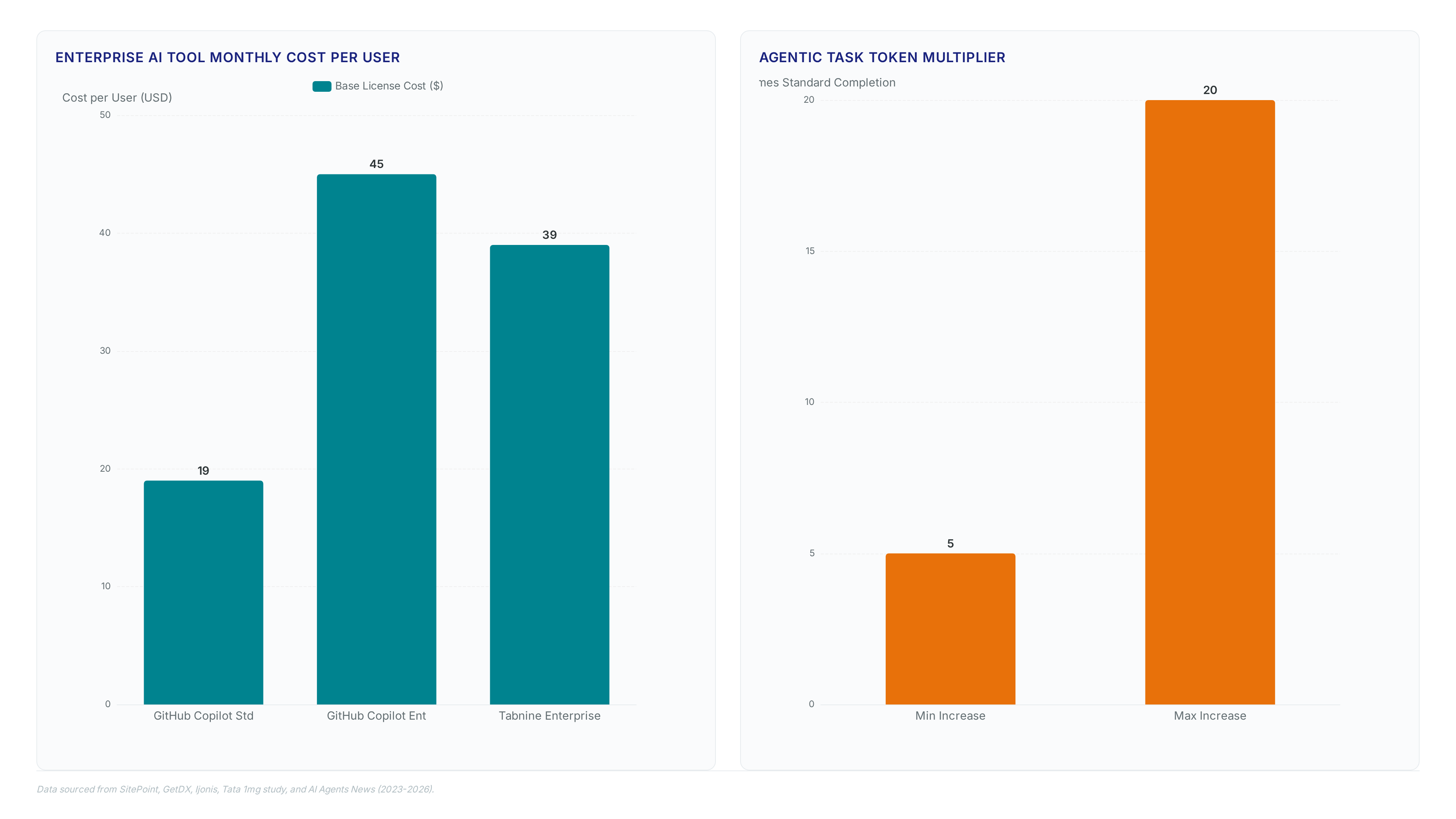
Microsoft alters its software charging methodology for the first time in two decades by shifting customers to per-use billing for new AI agent capabilities. This structural change replaces fixed per-seat licensing with variable consumption models where token multipliers drive final expenses. Teams using heavy API usage for agentic workflows may see costs double due to token limits, credit multipliers, and add-on fees beyond the base list price costs double. Unlike traditional SaaS where GitHub Copilot Enterprise remains static at a fixed monthly rate per user, agentic tasks consume 5x to 20x more tokens than standard completions. Predictability suffers as monthly budgets fluctuate wildly when autonomous loops execute without human throttling. Operators must implement strict rate limiting policies or risk exponential billing surprises during automated debugging sessions. This pricing evolution forces a reevaluation of AI tool pricing models from flat-rate to usage-based structures. Enterprise architects now face tension between maximizing agent autonomy and controlling operational expenditure. Financial governance becomes impossible without granular telemetry on token burn rates. Procurement teams must demand real-time cost visibility tools before deploying agents at scale. AI Agents News identifies this billing opacity as the primary barrier to widespread enterprise adoption in 2026.
Resolving Data Pipeline Bottlenecks in Agentic Workflows
Databricks solves the decades-old split between operational and analytical databases that now cripples high-volume agent deployments. This unified architecture allows engineering teams to ingest raw telemetry from agentic loops without the latency penalties of traditional ETL processes. Constraints appear when code generation spikes. A yearlong study by Tata 1mg documented a 60% increase in total code volume among 300 engineers using custom AI tools. Such surge capacity demands upgraded review pipelines because legacy human-in-the-loop gates cannot process the influx of machine-generated artifacts.
Economic friction compounds this technical bottleneck. Usage-based agent costs scale non-linearly with autonomy instead of following static per-seat licensing. Operators must deploy automated linting and semantic diffing before human review to prevent pipeline paralysis. Failure to upgrade results in either rejected valid code or accepted vulnerabilities. The limitation is clear: without unified data management, the velocity of AI agents creates a backlog that stalls deployment cycles. AI Agents News identifies this infrastructure gap as the primary blocker for production adoption. Enterprises must prioritize pipeline throughput over raw model speed to realize value.
Strategic Risks of Vendor Lock-In and Consumer Resistance to AI Branding
Consumer Resistance to AI-Written Brand Messaging

Enterprise adoption of generative AI faces immediate rejection when consumer sentiment turns against synthetic brand voices. While drafting correspondence accelerates by 20%, the resulting messaging fatigue creates a measurable churn risk that efficiency gains cannot offset. The strategic pivot toward proprietary ecosystems aims to secure data isolation and governance controls, yet this consolidation ignores the primary failure mode: customer aversion to non-human tone. Hidden operational costs emerge when brands prioritize speed over authenticity:
- Eroded trust metrics across digital channels.
- Increased manual intervention to correct tone-deaf outputs.
- Loss of competitive differentiation as all vendors sound identical.
Operators must now weigh the efficiency of deep integration against the risk of platform dependence. AI Agents News recommends auditing current code generation pipelines for exposure to single-vendor outages before Q3 closing.
Legal Exposure from Forecasted Death by AI Claims
Gartner forecasts over 2,000 "death by AI" claims by year-end 2026, creating immediate liability for autonomous system failures. This surge targets safety failures in deployed agents rather than simple output errors. The legal definition of negligence expands as regulatory bodies demand proof of guardian agent efficacy before deployment. Organizations face hidden litigation costs when failing to document compliance steps:
- Absence of pre-deployment safety audits for agentic loops.
- Lack of real-time monitoring for unauthorized external calls.
- Failure to isolate training data from production inference paths.
The enterprise AI coding market enters a high-scrutiny phase where volume of code matters less than verification rigor. A defensive posture requires shifting from output speed to auditability. AI Agents News recommends maintaining immutable logs of every agent decision cycle. The cost of retroactive compliance exceeds the expense of initial governance architecture. Operators must treat autonomous actions as regulated financial transactions. Legal exposure scales with agent autonomy, not deployment count.
About
Marcus Chen serves as Lead Agent Engineer at AI Agents News, where he daily architects and evaluates production multi-agent systems. Unlike general tech reporters, Chen's work involves rigorously testing frameworks like LangGraph and AutoGen, giving him direct insight into why SpaceX would prioritize owning the underlying coding agent infrastructure rather than merely licensing it. His daily experience dissecting how agents like Cursor interact with codebases allows him to explain the strategic shift from simple autocomplete to autonomous development loops. At AI Agents News, Chen connects these high-level corporate moves to their practical impact on software engineers, ensuring the analysis remains grounded in technical reality rather than market hype.
Conclusion
Consolidation decided the shape of this market before most teams finished their pilots: the coding surface and the compute beneath it now belong to one owner, and access travels with export policy rather than with capability. GLM-5.2 under an MIT license is the counterweight, because weights already downloaded cannot be switched off at a gateway. The second exposure is economic: per-use billing ties spend to agent autonomy instead of headcount, so deep integration erodes projected ROI whenever loops run unthrottled. Organizations relying solely on vendor-provided safety guards will find themselves legally exposed when regulatory definitions of negligence shift toward strict liability for undocumented agent behaviors.
Answer consolidation with portability and evidence: keep one open-weight path validated in CI, and mandate immutable audit trails for every autonomous action by Q4 2026. Do not wait for a compliance incident to architect your defense; the window for retroactive governance is closing. Treat code generation volume as a liability metric rather than an asset until verification rigor matches output speed. The market will soon penalize speed without provable safety controls, making current lax standards a future financial burden.
Start by auditing your current CI/CD pipeline this week to identify where agent decisions lack persistent, tamper-proof logging. Implement a mandatory guardian agent layer that validates external API calls before execution to establish an immediate baseline for accountability.
Frequently Asked Questions
SpaceX executed an all-stock deal converting Cursor shares to SpaceX stock. This follows a massive capital raise that positioned the company as the fourth most valuable US entity by market cap recently.
95% of Cursor users now function as agent users, relying on complex task execution rather than simple snippets. Integration with xAI's Grok models on the Colossus supercomputer removes the platform's earlier dependence on external model vendors.
Fable 5 remains offline due to US Commerce Department export control directives. Although G7 leaders discussed voluntary safety commitments, these geopolitical constraints currently prevent access to specific frontier models for many global enterprise teams.
Cursor shifted to usage-based billing on June 1, making costs variable. While specific dollar amounts vary, this change complicates enterprise compliance budgeting compared to previous flat-rate subscription models used by coding tool providers.
Zhipu AI released GLM-5.2 with a 1 million token context window. It achieves a 46.2% score on DeepSWE, providing a cost-effective, MIT-licensed option for teams needing long-context reasoning without commercial API lock-in.