Coding agents: Simon Willison's new llm-coding-agent
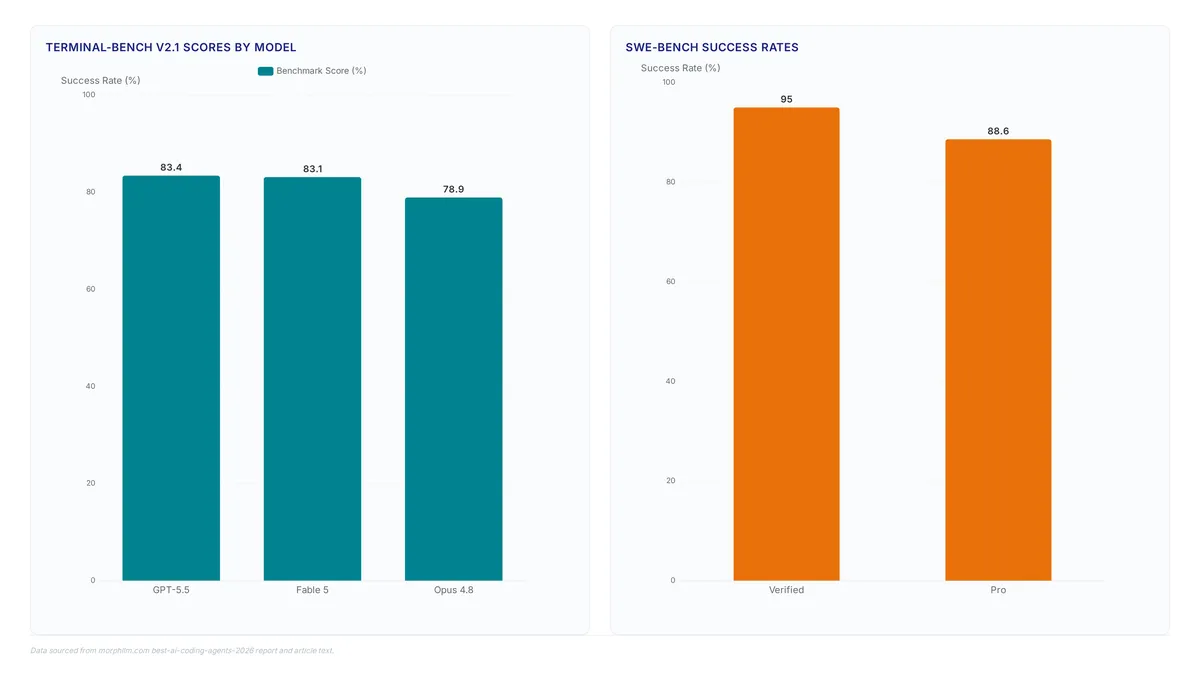
Simon Willison dropped llm-coding-agent 0.1a0 on 2 July 2026. It's an experiment in Fable 5 driven automation that skips the hand-holding. This release proves coding agents can now autonomously execute file edits and command-line operations using red/green TDD workflows. While broader market benchmarks show Codex + GPT-5.5 leading with an 83.4% score, this tool ignores abstract problem-solving. It focuses entirely on local repository manipulation.
The core of this release is tool execution. The agent doesn't guess; it uses specific functions like CodingTools_edit_file to modify source code safely. The system handles file system operations through glob patterns that respect .gitignore rules while blocking access to hidden directories. You can install the package via uvx and run initial coding tasks immediately.
The Claude Code style prompts used during development reveal how simple instructions generate a functional agent framework capable of running shell commands with set timeouts. The Python API lets developers instantiate a CodingAgent with specific model parameters like gpt-5.5, and that is where the gap between high-level benchmark performance and the gritty reality of local software automation shows up.
The Role of LLM Coding Agents in Modern Software Automation
Defining the LLM Coding Agent and Claude Code Style Architecture
Stop thinking of an LLM coding agent as a chatbot that writes code. It is an autonomous component executing file edits and shell commands through structured tool calls. Simon Willison released version 0.1a0 of llm-coding-agent on 2nd July 2026, labeling it "A coding agent built on LLM." This implementation adopts a Claude Code style architecture depending on explicit tool use instead of implicit code generation. Models must interact with the filesystem via set functions like edit_file and execute_command. The framework exposes a CodingAgent class so developers instantiate agents with specific models and approval flags for test-driven development workflows.
Proprietary variants hit high benchmark scores. Open implementations prioritize transparency in how the LLM selects actions. Human review remains necessary because the mean acceptance rate for solutions generated by top agents on complex projects remains 27.38%. Builders gain a reference implementation for function calling patterns without opaque backend logic. The low acceptance rate on complex projects indicates "augmented coding" rather than full autonomy represents the current state of the art.
Real-World Performance of Fable 5 and GPT-5.5 on SWE-bench and Terminal-Bench
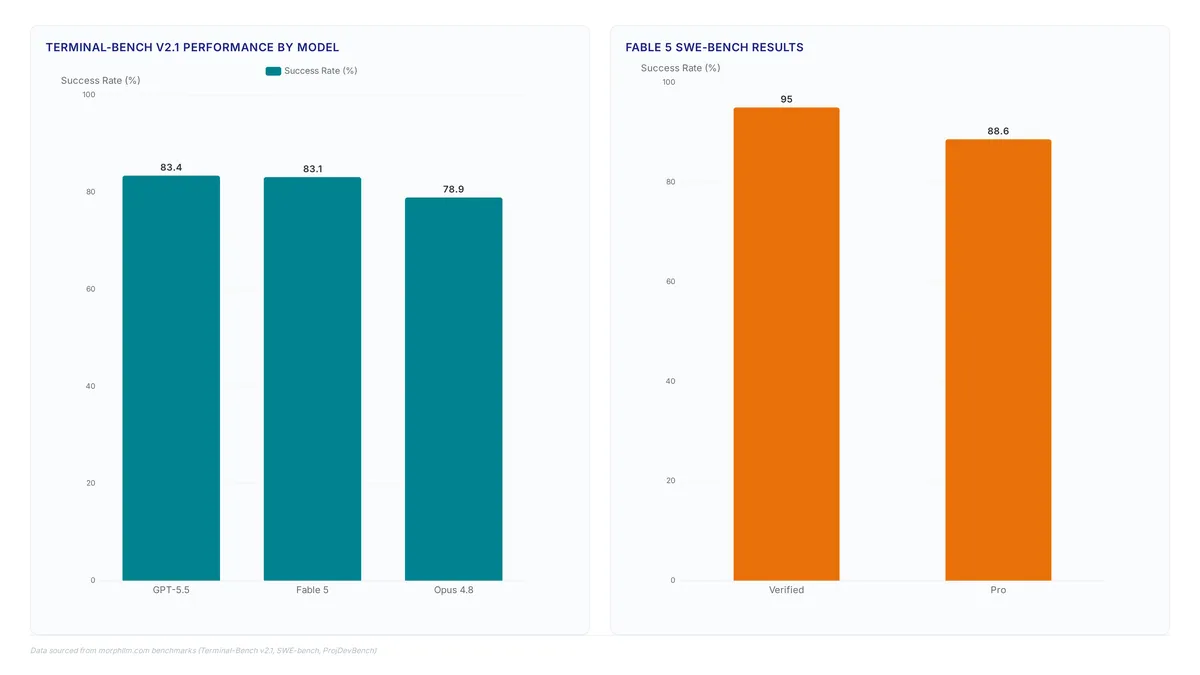
Fable 5 leads the SWE-bench Verified dataset with a 95.0% success rate, establishing a new baseline for repository-level issue resolution. Such performance metrics indicate autonomous agents now reliably navigate complex codebases to implement fixes. Terminal-heavy workflows present a different challenge entirely. Codex combined with GPT-5.5 edges ahead with an 83.4% score on TerminalBench v2.1. This distinction matters for operators deciding between local repository fixes and command-line orchestration tasks. Some scenarios demand file manipulation while others require reliable shell interaction.
Fable 5 Versus Opus 4.8: Benchmark Disparities in Terminal-Bench Scores
Model selection dictates terminal proficiency because newer architectures outperform legacy variants on command-line tasks. Claude Code running on Fable 5 achieves a close second on TerminalBench v2.1 with a score of 83.1%, trailing only the GPT-5.5 leader. The same agent framework running on Opus 4.8 scores 78.9% on TerminalBench, notably trailing the GPT-5.5 and Fable 5 variants. A 4.2-point delta illustrates that model architecture matters more than the orchestration layer for shell-heavy workflows.
Operators asking whether to use AI for coding tasks must distinguish between file editing and terminal execution capabilities. Data suggests Fable 5 handles complex command sequences better than Opus 4.8, though both remain viable for standard file modifications. Agents on the ProjDevBench dataset average 138 turns per problem to reach a solution. Even top-tier models require significant interaction to solve complex problems. Builders should evaluate models against their specific workload profiles rather than relying on aggregate scores.
Internal Mechanics of Tool Execution and File System Operations
How CodingTools_edit_file Enforces Exact String Matching
CodingTools_edit_file rejects any edit request where the old_string parameter fails to match file contents exactly, down to every whitespace character. This strict comparison stops the agent from hallucinating context or applying partial matches that could corrupt code structure. The tool demands the target substring identify a unique location within the file; if the string appears multiple times, the operation fails unless the replace_all flag is explicitly set to true. Ambiguous context often leads LLM agents to unintended modifications across similar functions, a failure mode this mechanism directly addresses. Returning a diff of the change rather than the full file allows immediate verification of applied logic without re-reading the entire artifact. Documentation specifies that old_string must match exactly so autonomous agents cannot silently overwrite critical logic when file state drifts from the model's internal representation.
Executing Shell Commands and Handling Timeout Limits
The CodingTools_execute_command utility runs shell instructions within the session root and returns combined stdout and stderr followed by an exit code line. This mechanism enables the agent to validate code changes by running test suites or build scripts directly during autonomous workflows. Operators configure the timeout parameter in seconds, respecting a hard ceiling of 600 seconds for any single operation. When a process exceeds this duration threshold, the framework terminates the entire process tree rather than just the parent PID. Aggressive cleanup prevents orphaned child processes from consuming resources after the LLM context has moved on. Such behavior proves necessary when fixing failing tests where a compilation error might cause a test runner to hang indefinitely waiting for input. The tool definition strictly enforces this limit, killing the process tree upon timeout. Resource predictability comes at the cost of reduced autonomy, yet builders gain transparency into exactly what the agent executes. Closed alternatives often hide command execution behind a black box, whereas this approach avoids such opacity.
Practical Implementation Steps for Installing and Running the Agent
Executing the Agent via uvx and PyPI
The installation process relies on a "slop-alpha" release currently hosted on PyPI, requiring explicit flags to handle pre-release stability. Operators must use the uvx runner with the --prerelease=allow directive to bypass default version constraints and access the experimental build. This configuration enables the llm code entry point, which orchestrates file system tools and command execution within a local sandbox.
- Ensure the
uvpackage manager is installed on the host system. - Execute the agent using the specific command structure:
uvx --prerelease=allow --with llm-coding-agent llm code
- Verify tool availability by checking the loaded
CodingToolsset in the runtime output.
Operate the agent immediately via the --yolo flag for unrestricted execution or constrain scope with --allow patterns. Recipes from Fable demonstrate this duality, permitting pytest* while blocking broader system access. This configuration balances automation speed against safety requirements in production environments. Builders requiring tighter integration can embed the CodingAgent class directly into Python scripts for programmatic control. Initialize the runner with a specific model like gpt-5.5 and a target root directory to start execution.
- Import the
CodingAgentclass from the library. - Instantiate with
approve=Trueto enable auto-approval for trusted tasks. - Call the
runmethod with a natural language instruction.
This API approach enables embedding agent logic within larger CI/CD pipelines or test harnesses. While the CLI offers immediate interactivity, the Python interface supports complex orchestration workflows. However, relying on autonomous execution requires careful scoping of tool permissions. Operators must weigh the convenience of auto-approval against the potential for unintended file modifications during early adoption phases.
Validating Prerelease Flags and Model Configuration
Verify the --prerelease=allow flag in uvx commands to access the alpha-stage llm-coding-agent package on PyPI. Without this explicit directive, the runner rejects the unstable build, preventing execution of the llm code entry point entirely.
- Confirm the host environment permits pre-release package resolution.
- Validate the active model configuration matches the intended benchmark profile before running tasks.
- Inspect the loaded toolset to ensure file system permissions align with the
approveparameter.
Selecting a model requires matching specific benchmark strengths rather than assuming universal capability. Model selection is therefore an economic constraint as much as a performance one. The author implemented this Python API unexpectedly, noting delight at the addition. However, the --yolo flag explicitly bypasses approval steps, which removes human verification gates.
Red/Green TDD and the SwiftUI CLI Test Case
TDD Methodology in AI Coding Agents
Test-Driven Development in llm-coding-agent 0.1a0 executes a strict red/green/refactor loop where the agent generates failing tests before writing implementation code. This workflow relies on tool use for file editing and command execution to validate each commit incrementally. The development process for the agent itself utilized prompts to "build it using red/green TDD in a series of sensible commits," ensuring passing tests and updated docs at each step.
| Dimension | AI Agent TDD | Human-Assisted TDD |
|---|---|---|
| Test Generation | Automated via LLM prompt | Human or LLM-assisted |
| Verification Speed | Seconds per iteration | Variable |
| Error Handling | Immediate retry on failure | Manual debugging required |
| Context Scope | Full project file system | Local IDE focus |
Benchmarks indicate that agents using full project contexts achieve higher success rates on project-level tasks compared to those limited to single-file completion. However, this automated approach relies heavily on the initial specification; the agent implements tools like edit_file which require exact string matches, meaning precise test boundaries and file content definitions are critical before execution begins. Without precise initial constraints, the agent may optimize for passing tests rather than solving the underlying business problem. Validating agent-generated tests against known edge cases remains a recommended practice before trusting subsequent code synthesis.
Generating SwiftUI CLI Apps and ASCII Art via llm code --yolo
Executing llm code --yolo with a prompt to build a SwiftUI command-line interface reveals immediate framework constraints. In the test transcript, reasoning explicitly notes that "SwiftUI isn't suitable for a true CLI," yet the agent proceeds to generate a functional ASCII time-telling application. This behavior demonstrates how the system navigates conflicting requirements by prioritizing executable output, resulting in an app that outputs ASCII art via standard output rather than a native GUI.
| Metric | Agent Behavior | Manual Development |
|---|---|---|
| Framework Selection | Detects mismatch, adapts output | Usually rejects early |
| Output Format | ASCII art via standard output | Native GUI or error |
| Iteration Speed | Single command execution | Multi-step setup |
| Error Handling | Self-corrects logic flow | Requires debugging |
The distinction here is that while a human developer might halt to resolve the GUI-versus-CLI conflict, the agent attempts a workaround to satisfy the prompt's core intent. Observations suggest that such adaptive reasoning helps achieve high success rates in terminal-heavy tasks. However, this flexibility introduces risk; the resulting binary may lack the robustness of a manually curated project structure. Builders must verify that function calling for file creation does not obscure deeper compatibility issues when targeting specific platforms like macOS. The limitation is clear: rapid prototyping capability comes at the cost of strict architectural enforcement, which is why autonomous development workflows require strict separation between reasoning validation and tool invocation permissions.
About
Priya Nair serves as AI Industry Editor at AI Agents News, where she tracks product launches and platform shifts across the autonomous agent environment. Her daily work involves rigorously evaluating new tools like llm-coding-agent against established players such as Claude Code and Devin to provide engineers with trustworthy market analysis. This specific release by Simon Willison falls directly within her beat, as it represents a significant experiment in evolving the llm library into a full agent framework. Nair's expertise in verifying technical claims ensures that the coverage of this 0.1a0 alpha release focuses on concrete capabilities rather than hype. By connecting Willison's development process to broader industry trends, she helps technical founders and engineering leaders understand how lightweight, spec-driven agents fit into the current system. Her reporting grounds the project's "Fable 5" experimental status in practical reality, offering readers a clear perspective on its potential utility for coding automation.
Conclusion
High benchmark scores often mask critical fragility in long-horizon tasks. While models like GPT-5.5 dominate terminal benchmarks, the persistent gap between automated success and human-ready reliability means operational costs shift from writing code to auditing architectural drift. The real bottleneck is no longer token generation speed but the enforcement of structural constraints during autonomous execution. Teams must stop treating these tools as universal solvers and start deploying them as specialized components with strict guardrails.
Adopt a hybrid workflow immediately where agents handle isolated terminal operations while humans retain ownership of project-level structure. This approach mitigates the risk of agents creating functional but logically incoherent file systems. Do not wait for project-level benchmarks like ProjDevBench to mature before adjusting your strategy; the current data already proves that single-file proficiency does not guarantee system stability.
Start by auditing your existing agent configurations this week to enforce the 600-second operation ceiling on all non-critical paths. This specific timeout prevents indefinite loops during complex reasoning tasks without stifling legitimate execution. You can review the latest performance metrics for coding agents to baseline your expectations against current market leaders. By anchoring your deployment strategy in these hard limits, you ensure that automation accelerates delivery rather than compounding technical debt.
Frequently Asked Questions
Human review remains necessary because top agents on complex projects have only a 27.38% acceptance rate. This low success rate means developers must verify every output to prevent errors in production systems.
Fable 5 leads the SWE-bench Verified dataset with a 95.0% success rate. This high performance indicates it is the most reliable choice for resolving repository-level issues autonomously.
The agent framework running on Opus 4.8 scores 78.9% on TerminalBench, trailing GPT-5.5. Users needing strong command-line orchestration should prefer GPT-5.5 for improved terminal proficiency.
The system enforces a hard ceiling of 600 seconds for any single operation to prevent hangs. Processes exceeding this limit are killed automatically to maintain system stability and responsiveness.
Open implementations prioritize transparency in how the LLM selects actions, giving builders a reference implementation for function calling patterns without opaque backend logic. Closed alternatives often hide command execution behind a black box.
References