Code agents need verified facts, not just context
At $15 per million tokens, Claude Sonnet 4.6 makes global code guessing an expensive liability rather than a feature. True token efficiency demands replacing probabilistic guesses with verified graph facts. While Forrester and Gartner identify 2026 as the breakthrough year for multi-agent systems, these collaborative workflows will fail without rigorous dataflow mechanics to underpin their decisions.
Stop feeding models massive repository dumps. Engineers must distill codebases into dependency graphs that explicitly define reachability and dominance. By shifting focus from raw context volume to the signal quality of handed-over facts, teams prevent agents from confidently asserting incorrect assumptions about tenant checks or destructive writes.
Context-only approaches cannot answer global questions like cycle detection or topological ordering, however large the window gets. The working split is between Tree-sitter, fast but estimated, and the Language Server Protocol, slower but type-resolved; only facts carrying that provenance label are safe for an agent to act on.
The Limitations of Context-Only AI Agents in Global Code Analysis
Why Token-Limited Context Windows Fail Global Code Questions
Sequence-limited context windows stumble on global code questions because they force AI coding agents to guess structural dependencies rather than retrieve verified code facts. A coding agent can edit a single function beautifully. Ask what breaks if a specific component changes and the model starts guessing. This failure mode persists even as models like Claude Sonnet 4.6 offer massive 1M token contexts in beta. Window size is not the core issue. The absence of graph-based representations encoding call graphs and data flows creates the gap. Without these structures, the agent lacks the verified code facts required to answer impact analysis questions accurately.
Solving Dependency Cycles with Graph Theory Reachability
Reachability analysis over call graphs resolves the specific failure where agents miss tenant checks or propose invalid migration orders. Context-only models frequently suggest code that bypasses security guards because they lack a structural map of execution paths. A coding agent might confidently delete a function, unaware that a critical downstream service depends on it, because it cannot traverse the call graph to verify impact. This limitation persists even as tools like Cursor dominate the IDE environment with superior local autocomplete. Replacing heuristic guessing with topological sort algorithms detects cycles in dependency DAGs.
The Fallacy of Buying More Context Over Verified Facts
Expanding context windows to 1M tokens fails because token efficiency demands verified graph relations, not raw text volume. Operators paying $15 per million tokens for Claude Sonnet 4.6 access still face global analysis failures when agents guess dependencies instead of traversing structured data. The core fallacy assumes that providing more source code allows an agent to infer depends-on or flows-to relationships accurately. Facts an agent struggles to derive from text often emerge cleanly once encoded as explicit graph edges. Verified code facts require structural transformation, not larger input buffers.
Graph Algorithms and Dataflow Mechanics Powering Code Verification
Defining Dominance and Dataflow Graphs for Code Verification
A dominator node forces a safety guard to run before any critical operation starts within the control flow. This structural rule swaps heuristic guessing for mathematical certainty about execution order. Standard text retrieval misses these non-linear dependencies unless engineers encode them as explicit graphs. Organizations now integrate GraphRAG. A dataflow graph traces how untrusted input moves through variables to reach a sink function. Reachability analysis across this directed structure confirms if sanitization logic actually intercepts malicious payloads. Constructing these graphs demands precise type resolution that early build stages often lack. Inference costs for running such complex analysis in production have become a significant long-term factor for AI applications. Teams must balance the computational expense of real-time graph generation against the risk of undetected vulnerabilities. Static analysis tools offer base theory, yet domain-specific rules define the actual security perimeter.
| Concept | Graph Type | Verification Goal |
|---|---|---|
| Dominance | Control Flow | Guard precedes sink |
| Reachability | Dataflow | Input reaches sanitizer |
| Ordering | DAG | Migration sequence valid |
Accepting higher initial processing latency eliminates costly runtime failures later. Agents cannot validate migration sequences or detect circular dependencies without topological sort capabilities. This mathematical foundation shifts engineering focus from prompt tweaking to structural verification. AI Agents News notes that domain optimization now outweighs generic algorithm performance in practical deployments.
Implementing Dominator Analysis to Detect Unguarded Database Operations
Building a code dependency graph requires mapping explicit calls and flows-to relations to detect when assert_tenant fails to dominate a database sink.
- Generate a control flow graph using an incremental parser like tree-sitter for error-tolerant structure extraction.
- Compute the dominator tree to identify which nodes must execute before reaching any sensitive operation.
- Mark security checks as required dominators for all sensitive write operations within the DAG.
- Flag any path where the guard node does not appear as an ancestor of the sink.
This structural verification replaces the costly compute required for inference with a single traversal pass. Static analysis cannot resolve flexible imports without runtime data, which leads to potential false negatives in highly reflective codebases. Operators must combine this method with lightweight runtime instrumentation to cover flexible dispatch paths. Token spend only becomes an asset when verification logic replaces blind context expansion. Agents will continue to hallucinate safe migration paths that bypass critical guards without dominator analysis. Operators deploying these checks gain a verified fact base rather than probabilistic guesses about code safety. AI Agents News recommends reviewing the latest guides on graph-based verification workflows for more implementation details on domain-specific detectors.
The Risk of Unsound Dominator Computations in AI-Assisted Verification
AI-generated dominator logic often appears plausible but remains subtly unsound, creating false confidence in safety guards. An agent misidentifying that assert_tenant dominates a dangerous sink causes the resulting code to bypass critical security checks entirely. Paid models currently lead verified coding benchmarks, yet they still hallucinate graph relations without explicit structural constraints. A high-probability guess replaces a verified fact, passing initial review but failing in production.
| Failure Mode | Graph Requirement | Consequence |
|---|---|---|
| Missed Guard | Dominance Tree | Unauthorized Data Access |
| Cycle Blindness | Topological Sort | Infinite Recursion |
| Wrong Precedence | Path Reachability | Data Corruption |
Operators must distinguish between text completion and actual graph traversal to avoid these traps. Emerging guardian agents aim to monitor such systems, yet they too rely on accurate underlying graph data. No amount of context window expansion fixes a broken algorithmic foundation. True verification requires computing the dominator tree explicitly rather than inferring order from linear code history. Every deployed guard remains a probabilistic hope rather than an engineering fact without this mathematical guarantee. AI Agents News warns that unsound computations will define the next wave of security incidents.
Strategic Tool Selection Between Tree-sitter and Language Server Protocol
Tree-sitter as an Incremental Error-Tolerant Parser
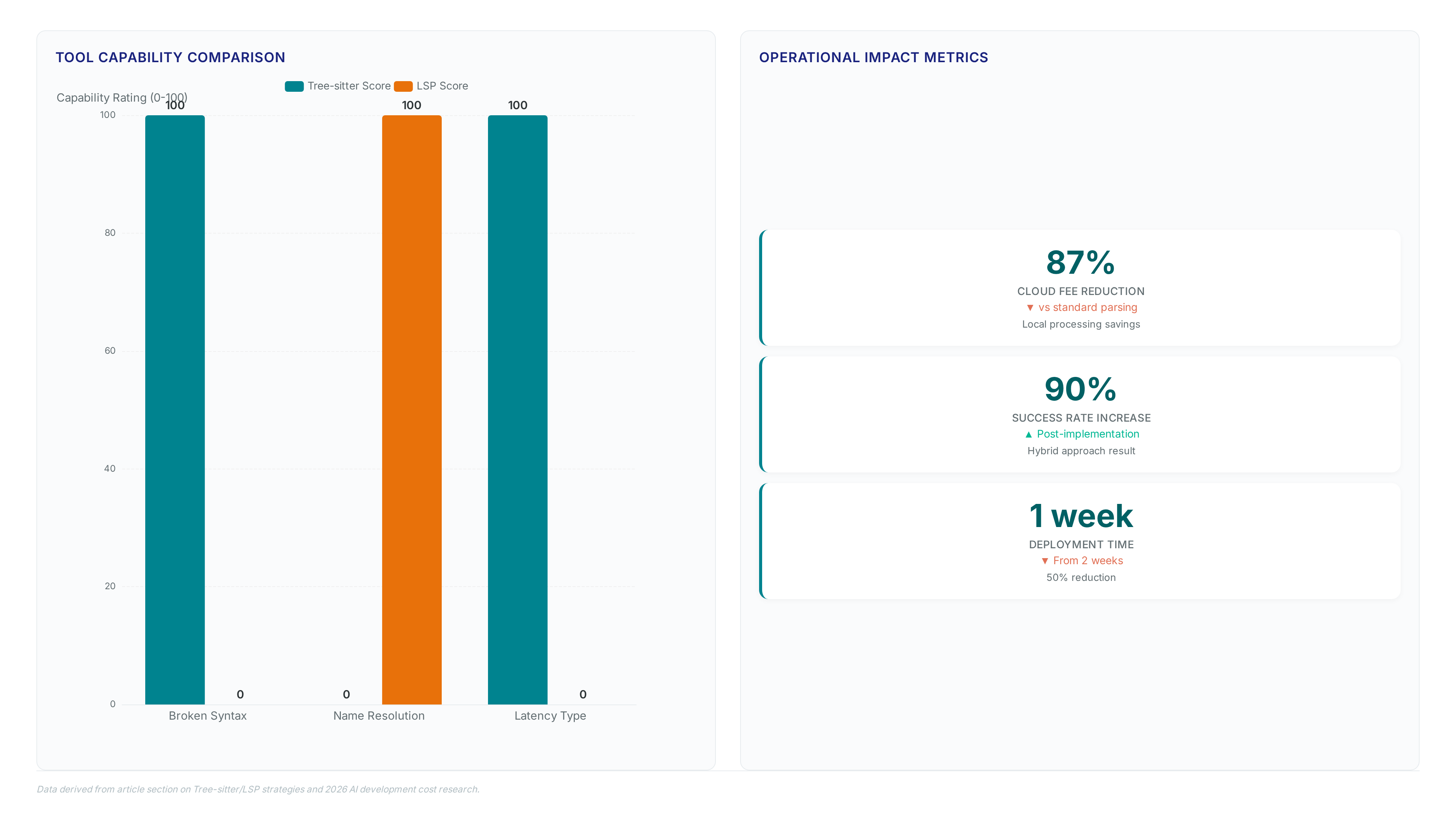
Tree-sitter functions as an incremental, error-tolerant parser that extracts syntax structure from half-written or broken buffers without resolving names. Facts derived from this local, synchronous layer carry an estimated label because the tool lacks type resolution capabilities. The trade-off is immediate availability versus semantic precision; operators gain fresh buffer state but lose cross-file reference accuracy.
Generic detectors miss domain-specific invariants that homegrown tools catch by design. Domain logic requires custom rules that generic open-source models cannot infer from text alone. Teams investing in data infrastructure upgrades find that building these specific parsers yields higher returns than buying larger context windows. The limitation remains that estimated facts cannot validate security guards like assert_tenant dominance without subsequent LSP verification. AI Agents News recommends treating this parser as a first-pass filter rather than a final authority. Operators must chain this fast extraction with slower, verified lookups to prevent unsafe code generation. This hybrid approach balances the cost of computation against the risk of deploying unsound dominator logic.
Combining Tree-sitter and LSP for Strong Detectors
The hybrid strategy deploys an 'until LSP catches up, fall back to tree-sitter and label it estimated' switch to balance freshness against semantic accuracy. This approach treats tree-sitter as the primary source for dirty buffers while deferring to the language server for anything that depends on resolved types. Operators synchronize the buffer state via didChange notifications, ensuring the parser sees the latest edits before the language server index updates. The mechanism requires juggling multiple servers across languages.
However, the cost of this dual-layer architecture is increased memory footprint and the operational overhead of maintaining parallel parse trees. A tension exists between immediate feedback and correctness; relying solely on the fast path risks propagating estimated facts that lack cross-file context. The implication for detector builders is clear: custom tools must explicitly tag facts with their provenance source to prevent agents from treating structural guesses as resolved truths. AI Agents News recommends implementing strict provenance checks before any fact enters the agent context window.
LSP Statefulness Versus Tree-sitter Synchronous Speed
LSP statefulness introduces cold starts and lag that frequently cause analysis to bail on half-written buffers. Tree-sitter operates synchronously on local structures, parsing broken code instantly without waiting for server indexing. This performance gap matters because Cursor has established a baseline for superior flow that developers now expect from their toolchains. The mechanism relies on didChange notifications to keep parsers aligned with the editor buffer state. The implication is a mandatory hybrid strategy where immediate but approximate local data bridges the gap until verified LSP results arrive.
| Feature | LSP | Tree-sitter |
|---|---|---|
| Buffer State | Fails on half-written code | Parses broken buffers |
| Execution | Stateful with lag | Synchronous and local |
| Fact Quality | Verified types | Estimated structure |
| Resource Cost | High server overhead | Minimal CPU usage |
Operators must accept that verified facts arrive slower than estimated ones during active editing sessions. Relying solely on synchronous parsing risks propagating errors from unresolved symbols into the dependency graph. Conversely, waiting for LSP convergence breaks the interactive loop required for rapid iteration. AI Agents News highlights that flow disruption remains a primary friction point in agent adoption. The optimal path forward involves labeling tree-sitter outputs clearly while asynchronously validating them against the language server.
Implementing Verified Facts to Secure Database Dependencies and Migrations
Defining the Trust Boundary for AI-Generated Dominator Computations
The trust boundary sits exactly where human oversight must intervene: before any database migration logic executes. Unlike local pattern matching, verifying that a safety guard dominates a dangerous sink requires constructing a global control-flow graph to prove reachability properties definitively.
Even architectures linking a control plane like PostgreSQL to a data plane comprising object storage and columnar formats function as a single dependency graph when modeled correctly. Physical separation of transactions and analytics often misleads operators into treating OLTP and OLAP layers as distinct silos, yet event logs bind writes to aggregations into one connected topology. This unified view transforms static documents into living, enforceable schemas that remain accurate as business definitions change, effectively creating an Enterprise Knowledge Graph for the entire stack. Without this graph, missing tenant checks on data flowing from Postgres to columnar stores become invisible until runtime failure.
| Component | Traditional View | Graph-Based View |
|---|---|---|
| Scope | Isolated database instances | Unified node network |
| Relations | Implicit foreign keys | Explicit flows-to edges |
| Safety | Manual audit required | Automated dominance check |
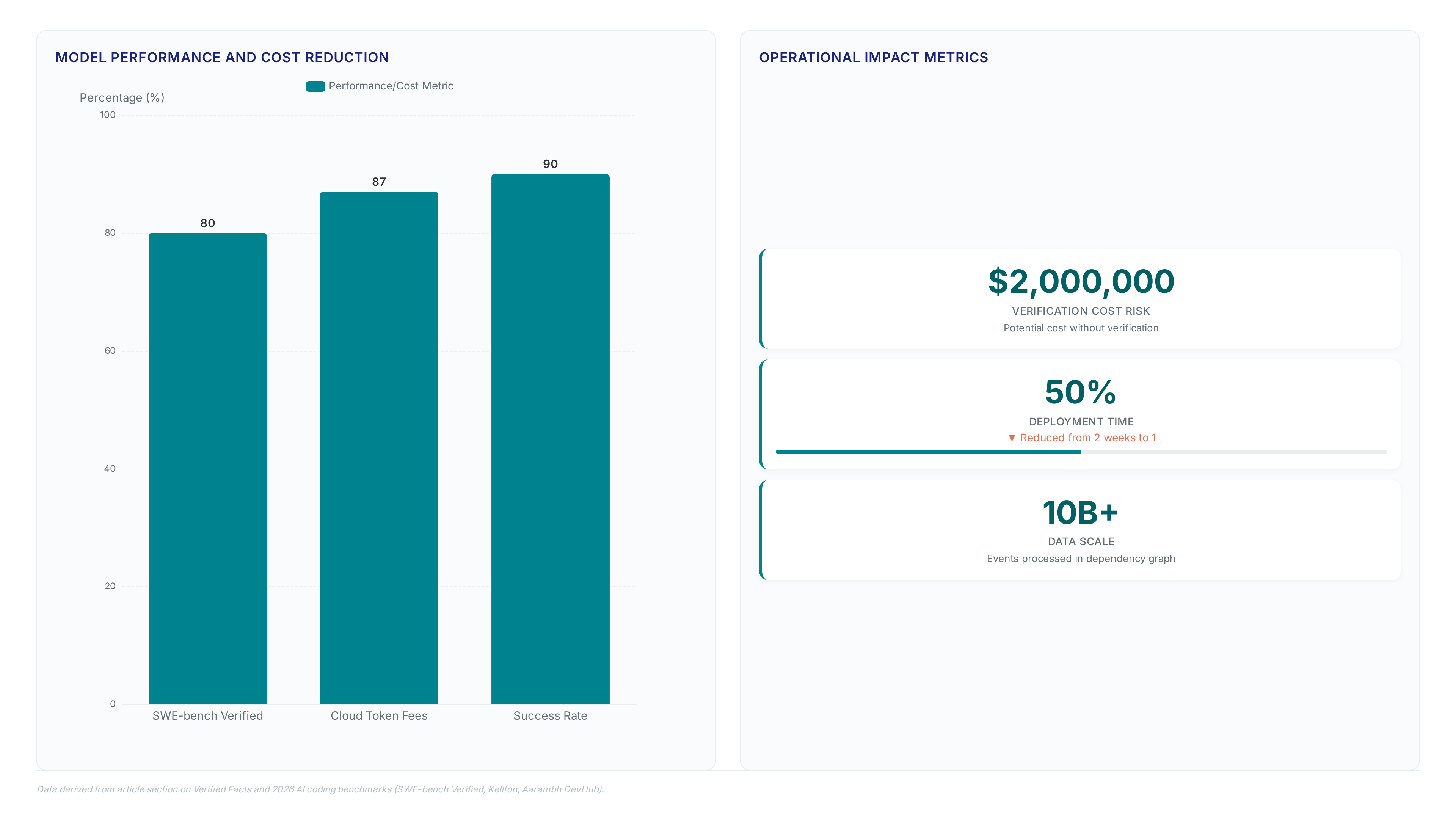
Modelling a stack this way is not free: custom cross-system verification reaches $2,000,000 or more, because every disparate system has to be mapped by hand first. The limitation of this approach lies in the initial ontology definition; relations such as depends-on and must-precede must be explicitly codified before the graph yields value. Operators gain the ability to prove that a tenant guard dominates a dangerous sink across storage boundaries, eliminating an entire class of multi-system data leaks. This structural rigor replaces guessing with verified facts about global reachability.
Validation Checklist for Borrowing Battle-Tested Algorithm Cores in Migration Strategies
Operators must restrict custom logic to domain rules while reusing proven algorithm cores to prevent subtle soundness errors.
- Import standard dominator libraries rather than hand-rolling path traversal code.
- Label every fact as verified via graph database architecture or estimated via pattern matching.
- Isolate DB. GUARD_BYPASS checks to explicit reviewable predicates instead of implicit agent reasoning.
- Validate that multi-agent systems cannot override dominance results without human approval.
Borrowing battle-tested cores removes the risk of AI generating plausible but broken control-flow logic. The cost is rigid interface contracts that demand precise mapping between application symbols and graph nodes. Limiting bespoke code to reviewable domain constraints ensures that safety-critical guards remain visible during audit. This discipline forces the migration strategy to expose dependency cycles before execution begins. Operators who skip this verification step often face destructive data loss when agents misinterpret global state. The resulting workflow transforms migration from a guessing game into a deterministic graph traversal problem.
About
Sofia Berg serves as Research Editor at AI Agents News, where she specializes in translating complex agentic research into actionable insights for builders. Her daily work involves rigorously evaluating benchmarks like SWE-bench and dissecting papers on multi-agent coordination, giving her a unique vantage point on why coding agents struggle with global reasoning. Unlike surface-level observers, Sofia's deep dive into orchestration failures reveals that simply increasing context windows fails to solve structural ignorance. At AI Agents News, she constantly analyzes how frameworks handle state, leading to her thesis that agents require structured knowledge graphs rather than raw token volume. This article stems directly from her observation that current models guess at system-wide impacts because they lack verified factual grounding. By connecting academic findings on context limitations to practical engineering hurdles, Sofia provides the technical clarity engineers need to build more reliable, graph-augmented coding agents.
Conclusion
Scaling coding agents beyond pilot projects exposes a harsh reality: unstructured context windows collapse under complex dependency chains, turning runtime errors into expensive feedback loops. While early adoption focuses on speed, the operational bottleneck shifts to verification latency as agent-generated code interacts with legacy boundaries. Organizations ignoring this structural friction will see their initial efficiency gains evaporate into continuous remediation cycles. You must transition from ad-hoc prompting to deterministic graph-based orchestration by Q4 2027 to maintain viability. This requires treating agent outputs as probabilistic suggestions that must pass through rigid, pre-validated algorithmic cores before touching production systems. Do not attempt to scale agent fleets without first establishing these hard guardrails, or your technical debt will compound quicker than your throughput. Start this week by auditing your current agent workflows to identify any implicit logic handling critical path dependencies, then immediately refactor those specific nodes to use explicit, library-based dominator checks. This single step isolates failure modes and creates the necessary visibility for safe expansion.
Frequently Asked Questions
They guess structural dependencies instead of retrieving verified facts. This happens even with large windows costing $15 per million tokens, as sequence limits prevent true graph-based understanding of code relationships.
Topological sort algorithms detect cycles in dependency DAGs to ensure valid sequences. This structural rigor lets developers orchestrate agents confidently without risking destructive writes or broken dependencies.
It maps execution paths to verify tenant checks dominate dangerous operations. Without this graph traversal, agents confidently suggest code that bypasses security guards because they lack a structural map.
Tree-sitter offers fast parsing but cannot resolve types needed for verified facts. Operators must choose between its speed and the precision required to prevent agents from making confident global assertions.
It demands maximum signal per token by handing over verified graph facts. Buying more context tokens fails to solve the structural blindness inherent in sequence-only models used for global analysis.