BTL-3 agentic coding: 27B params, low overhead
BTL-3 retains 92.2% of full-model behaviors despite its compact 8.39 GB footprint, according to Bad Theory Labs data. This 27 billion parameter system, derived from the Qwen3.6 architecture, delivers high-fidelity tool use without the overhead of larger counterparts.
The model manages structured tool use across parallel calls while maintaining a low irrelevance score. Its internal mechanics rely on a frozen RL-0013 adapter to enable reliable failure recovery during long multi-turn tasks. These architectural choices allow the Compact edition to outperform expectations on the BFCL benchmark.
Implementation for agentic coding focuses on the model's ability to inspect tool results and halt actions when no further steps are required. Unlike generic text generators limited by rigid function-calling schemas, this model demonstrates autonomous decision-making within an Apache-2.0 framework. The following analysis relies on verified performance metrics from the official release to illustrate why this specialized agent demands attention in the current environment of autonomous software development.
Defining BTL-3 as a Specialized Agentic Text Generation Model
BTL-3 Reasoning Block and PEFT Adapter Architecture
BTL-3 is a 27 billion parameter open-weight model built on the Qwen3.6 dense architecture, optimized specifically for agentic coding workflows. It diverges from standard base models that rely on general instruction tuning by integrating a specialized reasoning block to manage complex tool orchestration. The architecture separates the planning phase from execution, forcing the model to validate function signatures before generating calls. This structural distinction reduces invalid tool invocations, a common failure mode in multi-agent coordination. To inject domain-specific knowledge without altering base weights, the model employs PEFT LoRA adapters with a rank of 32 and alpha of 64.
Execution relies on structured tool use, achieving a 91.2% BFCL irrelevance score to prevent unnecessary API calls. Agentic systems often waste tokens on redundant function invocations during complex problem-solving loops. BTL-3 distinguishes itself from general chatbots by focusing specifically on repository work rather than generic instruction following. Builders should deploy this architecture for test-driven repair tasks where the system achieves a 95.12% HumanEval pass@1 score in thinking mode. The chat template enforces strict XML delimiters around tool arguments, ensuring parsers correctly identify function boundaries without hallucination.
However, the RL-0013 reasoning policy can become repetitive or fail to terminate on specific prompts during extended thinking sequences. Builders deploying this architecture for agentic coding must recognize that enabling the model's native reasoning block introduces a non-deterministic termination risk absent in standard completion modes. Operational safety requires explicit confirmation gates before executing any destructive actions or privileged financial transactions. Unlike simple function calling, complex tool use chains in production environments demand strict sandboxing to prevent unintended system modifications.
| Risk Factor | Mitigation Strategy |
|---|---|
| Non-terminating thought loops | Disable thinking mode for repetitive tasks |
| Privileged command execution | Require human-in-the-loop confirmation |
| Unbounded token generation | Implement hard stop limits at 32k tokens |
While the 8.39 GB Compact version enables local deployment, it does not inherently restrict the scope of executed shell commands or API calls. Operators must engineer external guardrails rather than relying solely on the model's internal alignment.
Internal Mechanics of Structured Tool Use and Reasoning Flows
Structured tool use here is a template-level contract rather than a convention: the reasoning block plans the step, and the XML tags carry the call. The workflow demands a rigid sequence:
- The model uses a
thinkingblock to articulate the next logical step before selecting a tool. - Valid function calls must appear inside the template's XML tool-call tags immediately after the thinking phase concludes.
- Parameter values are enclosed in their own XML tags with explicit newline delimiters to prevent parsing errors.
The cost of this strict formatting is the inability to recover from malformed XML without restarting the conversation turn. Developers must validate that upstream systems never inject raw tool-call tag strings into the user history, as the parser treats these as definitive execution commands rather than conversational text. The compact edition allows local verification of these templates before deploying to production clusters where context window limits become the primary constraint.
Executing Parallel and Multiple Tool Calls with BFCL v4
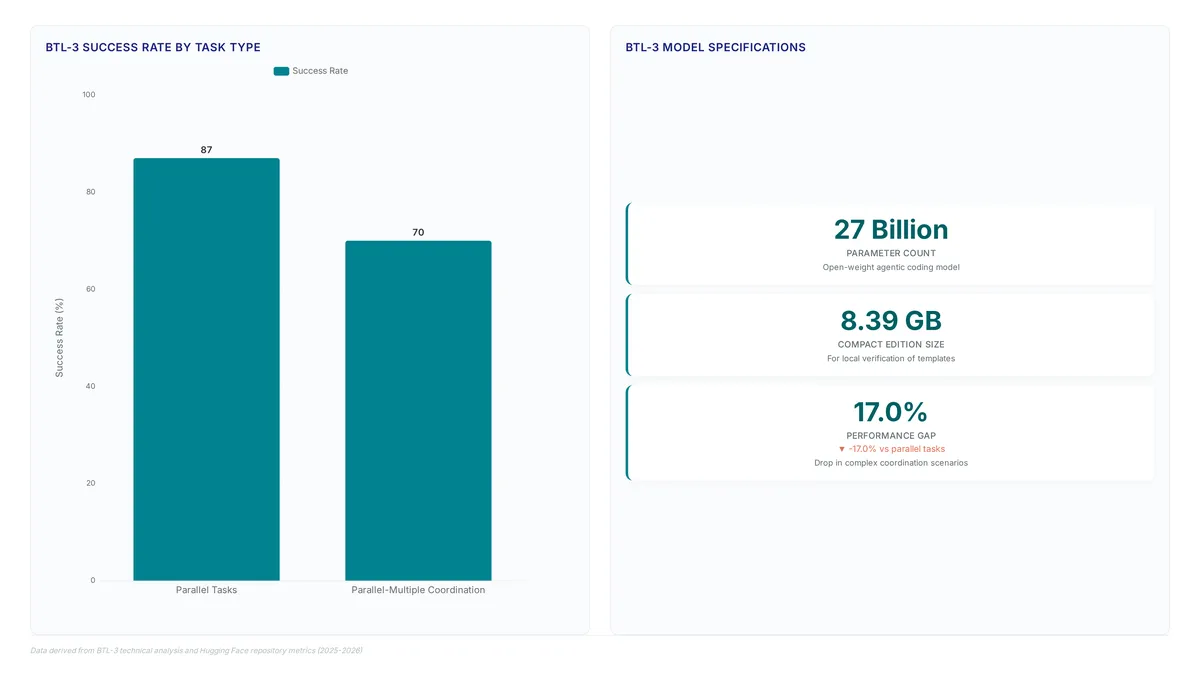
Parallel execution relies on strict XML delimiters to separate simultaneous function definitions within a single response turn. The model distinguishes between independent parallel requests and sequential multiple calls through specific tag nesting structures set in the chat template. BTL-3 achieves an 87.0% success rate on parallel tasks, yet this metric drops to 70.0% when the workload requires parallel-multiple coordination. This performance gap indicates that managing state across concurrent tool executions introduces significant formatting complexity for the reasoning block. Unlike simple sequential logic, parallel-multiple scenarios demand that the PEFT adapter maintain distinct argument namespaces to prevent cross-contamination of variable values.
BTL-3 Base Model and PEFT Adapter Configuration
Deploying the model requires binding the Qwen/Qwen3.6-27B base to the badtheorylabs/BTL-3 adapter within Transformers. Operators must explicitly define LoRA target modules to preserve structural tool use capabilities during fine-tuning. The necessary projection layers include q_proj, k_proj, v_proj, o_proj, in_proj_qkv, in_proj_z, in_proj_b, in_proj_a, out_proj, gate_proj, up_proj, and down_proj. Omitting specific projections like in_proj_a degrades the model's ability to parse complex repository states.
Stable execution demands torch.bfloat16 precision to prevent numerical instability during long-horizon reasoning tasks. While self-hosting incurs infrastructure overhead, comparable dense models are billed by the hour on H100 hardware, which gives a baseline for capacity planning against commercial API rates charged per million tokens. The dense, fully active parameter approach consumes higher VRAM per instance compared to sparse mixture-of-experts designs, necessitating careful GPU memory allocation for multi-agent coordination.
Enabling vLLM Serving Flags and XML Tool Parsers
VLLM version 0.23.0 requires the --reasoning-parser qwen3 flag to activate the specialized XML tool parser for structured function calling. Without this specific argument, the server cannot interpret the model's output tags, causing agentic workflows to fail during repository tasks. Operators must also include --enable-lora and set --max-lora-rank 32 to support the Parameter-Efficient Fine-Tuning adapters necessary for BTL-3 performance.
This reliance on exact command-line flags introduces a fragile dependency where minor version drift breaks the parsing logic entirely. While the Qwen XML tool parser enables strong function calling, it demands strict adherence to the supported vLLM release cycle. This constraint means upgrades require simultaneous validation of the reasoning policy to prevent termination failures in long multi-turn contexts. The cost of this rigidity is reduced flexibility in choosing inference backends, as alternative servers may lack the specific tag handling logic. For builders, this necessitates a pinned deployment strategy rather than flexible updates to maintain operational stability in production environments.
| Configuration Parameter | Required Value | Failure Consequence |
|---|---|---|
| vLLM Version | 0.23.0 | Incompatible LoRA handling |
| Max LoRA Rank | 32 | Adapter weight mismatch |
| Reasoning Parser | qwen3 | Malformed XML tool output |
| Target Modules | q_proj, k_proj | Missing function signatures |
Sandboxing Code Execution and Thinking Mode Limitations
Operational guidance explicitly advises running generated code in a sandbox to contain potential execution errors. Users must require explicit confirmation before allowing destructive, privileged, financial, or otherwise high-impact actions within any environment. This isolation prevents the agentic coding loop from corrupting local repositories or accessing sensitive network resources during structural tool use. While thinking mode remains available for controlled evaluation, it is currently discouraged because the RL-0013 reasoning policy can become repetitive or fail to terminate on some prompts.
The primary risk involves infinite reasoning loops where the model reiterates logic without invoking tools or producing output. Operators should disable this feature by default in production manifests to guarantee task completion. Enabling vision input support requires careful handling of the chat template to avoid system message errors regarding image tokens.
- Set
enable_thinking=Falsein the model configuration to bypass the unstable reasoning block. - Deploy a dedicated execution container with no network egress for all tool responses.
- Implement a middleware check to validate image tags appear only in user messages, not system prompts.
Deep reasoning capabilities conflict with system reliability; choosing the former introduces non-termination hazards that most production SLAs cannot tolerate.
Defining System Message Image Errors and Content Type Mismatches
System message image errors occur when the Qwen3.6 chat template hits a raise_exception block in its Jinja2 logic upon detecting media tokens within the system role block. The chat template logic enforces a strict separation where system instructions must remain text-only to maintain context window integrity. Operators attempting to embed base64 image strings in system prompts trigger immediate parsing failures before inference begins.
Content type mismatches frequently arise when HTTP headers declare image/jpeg while the payload contains PNG binary data or corrupted streams. This discrepancy causes the multimodal parser to reject the input during the initial tokenization phase. Sanitizing input upstream, so that visual data never reaches the instruction block, is the only reliable guard against both failure modes.
About
Marcus Chen, Lead Agent Engineer at AI Agents News, brings deep practical expertise to this analysis of the BTL-3 text generation model. His daily work involves rigorously testing agent orchestration, tool-use mechanics, and failure recovery loops across frameworks like CrewAI and LangGraph. This hands-on experience allows him to critically evaluate BTL-3's specific claims regarding 27B parameter efficiency and its ability to handle 100-turn tool contracts without drifting. Unlike generalist observers, Chen routinely builds evaluation harnesses to verify if models truly stop when actions are complete, making him uniquely qualified to assess BTL-3's reported 83/90 behavior retention in its Compact edition. At AI Agents News, our team focuses exclusively on autonomous agent systems and the underlying models that power them. We dissect technical specifications to help engineers distinguish between marketing hype and genuine architectural improvements. This report reflects our commitment to providing fact-based insights for builders navigating the rapidly evolving environment of open-weight agent models.
Conclusion
Scaling agentic workflows exposes a critical fragility where logical consistency degrades under parallel workloads, dropping success rates from 87.0% to 70.0% when concurrency increases. This volatility means that without strict isolation, the operational cost per task can spike while delivering unreliable code. The shift toward agentic coding demands that organizations treat model reasoning as a volatile resource requiring containment rather than just optimization. You must prioritize architectural safeguards over raw performance metrics to ensure stability in production environments.
Deploy hard termination limits and sandbox all model interactions within ephemeral containers before attempting any complex multi-turn orchestration. This approach prevents infinite reasoning loops from exhausting your compute budget and protects host systems from accidental file system modifications. Do not rely on inherent model constraints to manage resource usage or prevent recursive tool invocation failures. Start this week by auditing your current deployment pipeline to identify where state persists between agent interactions and implement immediate reset mechanisms for those checkpoints. Securing the execution boundary is the only way to safely use advanced reasoning capabilities without inviting systemic failure.
Frequently Asked Questions
Costs for similar agentic tasks range from a few cents to a few dollars per task depending on efficiency. Deploying locally with BTL-3 avoids these variable cloud expenses and provides predictable operational budgeting for development teams.
The Compact edition requires only 8.39 GB of storage for native local inference. This small footprint allows developers to run the model on standard hardware without needing expensive cloud infrastructure or large GPU clusters.
The system achieves a 91.2% BFCL irrelevance score to effectively prevent unnecessary API calls. This high precision reduces token waste and ensures your agentic workflows remain cost-effective during complex problem-solving loops.
It achieves a 95.12% HumanEval pass@1 score in thinking mode for repair tasks. This high accuracy rate makes it a reliable choice for automated debugging and maintaining code quality in production environments.
The adapters utilize a rank of 32 and alpha of 64, resulting in a minimal footprint compared to the base model. These lightweight updates allow efficient domain adaptation without altering the base weights of the underlying foundation model.
References