Agent quality: Split reasoning from action layers
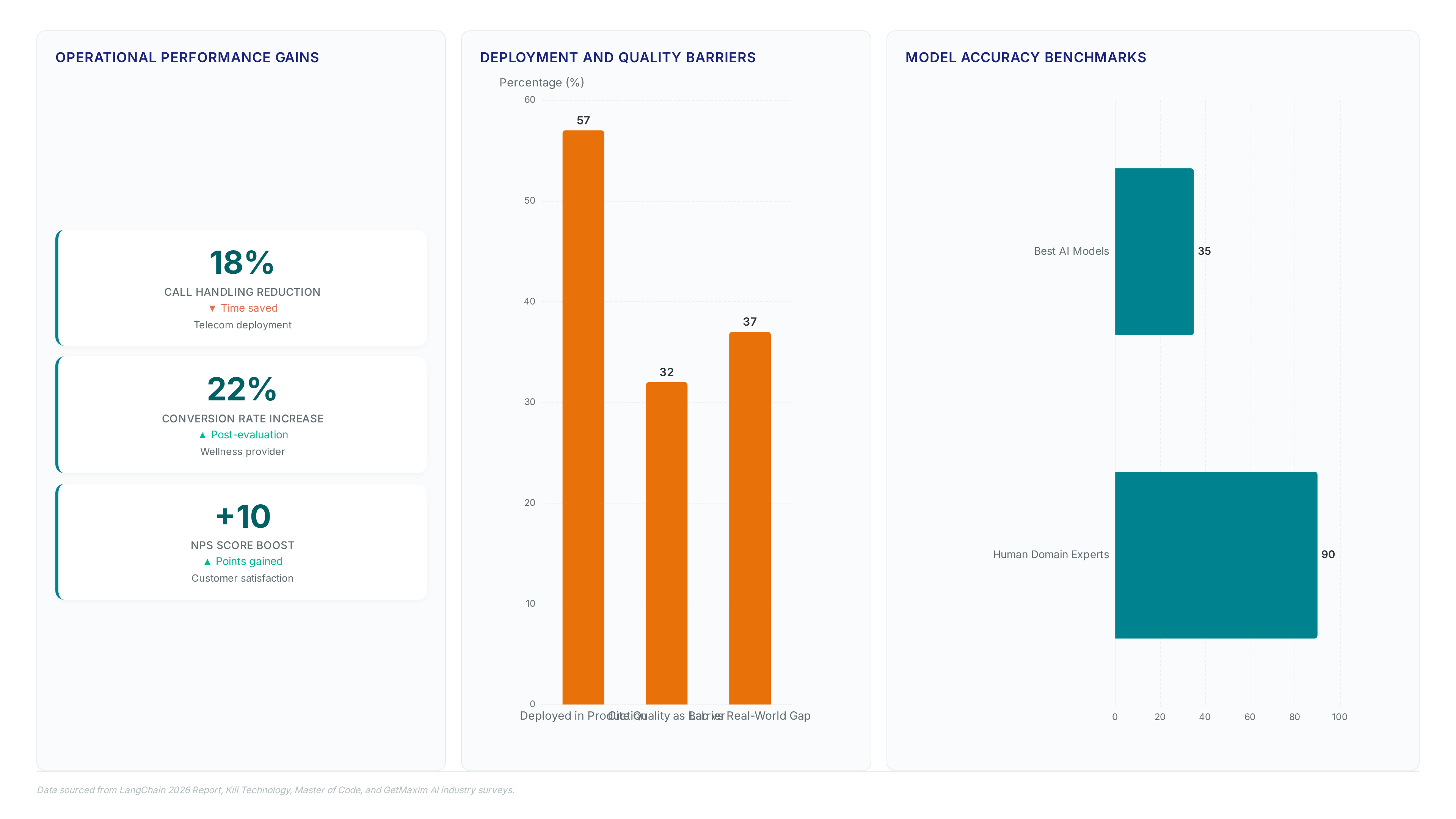
With 57% of organizations deploying agents in production, the primary bottleneck has shifted from feasibility to verifiable quality. LangChain's 2026 report identifies that a significant share of respondents cite quality concerns as the top barrier to further deployment, proving that blind trust in autonomous loops is no longer a viable strategy. We must stop treating agents as monolithic black boxes. The dual-layer architecture of modern systems demands distinct testing protocols for reasoning versus action. This discussion cuts through the noise surrounding LangChain, LangGraph, and OpenAI Agents to address specific pipeline pitfalls.
The path forward requires operationalizing agent evaluation directly within CI/CD pipelines. By separating reasoning layer decisions from action layer outputs, engineering teams can pinpoint whether a failure stems from poor strategy or faulty tool implementation. This structured approach replaces vague confidence scores with actionable data. It ensures that frameworks like LangChain, LangGraph, and OpenAI Agents support reliable, debuggable autonomy rather than opaque black boxes.
The Dual-Layer Architecture of AI Agent Systems
Defining the Dual-Layer AI Agent Architecture
An AI agent functions as an LLM-driven system designed to reason autonomously, formulate plans, and execute actions through external tools. This dual-layer architecture distinctly separates the reasoning layer, where the LLM understands tasks and devises strategies, from the action layer, which handles tool selection and argument generation. Measuring these layers independently allows teams to isolate logic failures from execution errors. Effective assessment frameworks tackle scaling issues by analyzing task completion, logic paths, and trajectory efficiency separately instead of relying on single-turn accuracy metrics. The reasoning layer leans heavily on LLM choice and prompt templates to break down tasks, while the action layer needs precise tool schemas to produce valid arguments.
Plan granularity often clashes with execution reliability. Highly detailed plans inflate token costs and latency, while high-level strategies frequently miss dependency constraints needed for complex workflows. An agent might generate a logically sound plan yet fail during execution because of ambiguous tool descriptions or incorrect argument formatting. Builders must instrument span logging to visualize specific component failures within the agent architecture. This separation enables teams to pinpoint exactly what is broken when an agent fails to book a flight, determining if the error stemmed from poor date selection logic or a malformed API call. Distinguishing these failure modes enables more targeted improvements to automation reliability.
Operationalizing Reasoning and Action Layer Loops
The reasoning layer breaks user intent into plans before the action layer executes specific tool calls. This iterative loop continues until the system satisfies the goal or hits a failure threshold. Operators must evaluate these components separately because enterprise systems show a performance gap between controlled lab benchmarks and real-world operational results. The reasoning component relies on the LLM to understand context, while the action component manages API schemas and argument generation.
On complex benchmarks like "Humanity's Last Exam," top models achieve only 35% accuracy, whereas human experts average 90%. This disparity highlights that strong planning does not guarantee successful tool execution in production environments. Debugging requires isolating whether a failure originated from a flawed plan or an incorrect function signature.
Increasing model size to improve reasoning often introduces latency that violates real-time service level agreements. Smaller models may execute tools quicker but generate incoherent strategies for multi-step tasks. Builders must balance LLM choice against latency budgets rather than assuming larger parameters always yield improved task completion. The implication for pipeline design is clear: evaluation harnesses must trace intermediate reasoning steps, not final outputs, to identify where the loop breaks.
Verifying State Changes Instead of Final Text
Coupled evaluation obscures whether failure stems from flawed logic or incorrect tool arguments. As of 2026, 57% of organizations have deployed AI agents in production environments, and treating those systems as monolithic blocks collapses a planning error and an execution error into one pass or fail verdict.
Technical assessment must verify state changes in external systems rather than just textual responses. State-based verification confirms that actions were actually executed against databases or APIs, ensuring the agent did not hallucinate a result. Without this granular separation, identifying the specific signal for improvement becomes difficult because the data remains hidden within the combined trace. Builders must isolate these variables to determine if a model upgrade or a schema correction is the necessary fix.
Mechanics of Component-Level Reasoning and Action Metrics
Defining PlanQualityMetric and PlanAdherenceMetric for Reasoning
PlanQualityMetric determines if a generated strategy holds logical weight, covers necessary ground, and avoids waste before any code runs. This static check confirms the agent breaks complex intents into valid sub-tasks without skipping required dependencies. Solid planning stops the system from burning compute cycles on goals it cannot reach, a frequent failure mode in autonomous loops. PlanAdherenceMetric takes a different angle by measuring whether the agent sticks to its own blueprint or drifts during the action phase. A flawless plan yields zero value if the system ignores its stated steps while invoking tools. Deviation during execution undermines the initial reasoning entirely.
| Metric | Focus Area | Evaluation Scope |
|---|---|---|
| PlanQualityMetric | Logical completeness | Pre-execution trace |
| PlanAdherenceMetric | Execution fidelity | Runtime trajectory |
Teams must separate these measurements because a model can generate sound logic yet fail to follow it under load. Mixing the two metrics masks whether the root cause is a reasoning defect or an adherence lapse. If adherence drops while quality stays high, the issue lies in execution fidelity rather than reasoning capability. Operators should implement End-to-end evals to capture full traces where these metrics diverge.
Implementing ToolCorrectnessMetric with @observe Decorators
Attaching ToolCorrectnessMetric directly to the LLM component via the @observe decorator isolates tool selection errors from broader planning failures. This configuration requires decorating the specific function executing the model, such as call_openai, with metrics=tool_correctness, argument_correctness. ToolCorrectnessMetric evaluates if the agent selects the right tools and calls them in the expected manner. The ArgumentCorrectnessMetric then validates that generated parameters match the required schema for each invoked tool, ensuring the agent generates correct arguments for each tool call. Unlike end-to-end evaluations that analyze full traces, this component-level approach targets the precise moment an agent decides how to interact with external systems.
Teams distinguish between selecting the wrong API and providing malformed inputs by inspecting these granular scores. The evaluation framework logs spans for each component, allowing the platform to visualize architecture and attribute failures accurately. Well-set input/output schemas with proper types and examples help generate correct arguments, whereas vague descriptions lead to incorrect selection. For instance, calling a WeatherAPI with {"city": "San Francisco"} when the tool expects {"location": "San Francisco, CA, USA"} may cause errors. While argument validation ensures data integrity, the constraint is clear: backend actions fail silently if inputs do not match expectations despite the agent claiming completion.
| Metric | Target Component | Validation Focus |
|---|---|---|
| ToolCorrectnessMetric | LLM Function | Selection logic and sequence |
| ArgumentCorrectnessMetric | LLM Function | Parameter schema and types |
Operationalizing these metrics turns abstract quality concerns into actionable engineering data. Evaluation frameworks must include cost and efficiency measurements as primary dimensions to prevent the development of highly capable but resource-intensive agents that are impractical to deploy at scale.
End-to-End vs Component-Level Evaluation Scopes
End-to-end evals analyze the full agent trace to score reasoning metrics like PlanQualityMetric, whereas component-level evals attach strictly to the LLM node to isolate tool calling failures. This architectural separation matters because reasoning errors propagate differently than schema violations during execution.
| Feature | End-to-End Scope | Component-Level Scope |
|---|---|---|
| Primary Target | Reasoning Layer | Action Layer |
| Key Metrics | PlanAdherenceMetric | ToolCorrectnessMetric |
| Placement | evals_iterator loop |
@observe decorator |
| Data Source | Full execution trace | Local LLM invocation |
Operators must route PlanAdherenceMetric through the main evaluation loop to verify if the agent deviates from its initial strategy over multiple turns. Action metrics require embedding validators directly within the span logging mechanism of frameworks like DeepEval to capture immediate context. This distinction prevents false negatives where a correct plan fails solely due to malformed arguments passed to an external API. The industry shift toward flexible workflow evaluations demands this granularity, as static benchmarks cannot detect specific breakdown points in complex loops. Component checks offer precise debugging data but increase instrumentation overhead on the critical path. This hybrid approach balances observability depth with runtime latency constraints.
Operationalizing Agent Evaluation in CI/CD Pipelines
TaskCompletionMetric and StepEfficiencyMetric Definitions
Operators define success by verifying goal achievement against the full execution trace using TaskCompletionMetric. This metric assesses whether the agent accomplishes the intended task, such as confirming a flight booking rather than merely searching for options. Separately, StepEfficiencyMetric evaluates path directness to ensure the agent avoids unnecessary loops or redundant tool calls. Distinguishing outcome validity from operational efficiency allows teams to isolate whether a failure stems from poor planning or execution drift. Integrating these definitions into a CI gate prevents regression by blocking updates that drop scores below set thresholds. Builders implement this validation through a structured checklist:
- Define goldens containing expected inputs and successful outcomes.
- Instrument the agent stack using Manual Instrumentation or framework-specific handlers.
- Execute tests via
deepeval test runto generate pass/fail signals. - Reject builds where TaskCompletionMetric indicates goal failure.
- Flag cases where StepEfficiencyMetric detects excessive step counts.
Strict completion criteria often clash with flexible reasoning paths. Enforcing rigid step counts may penalize valid exploratory behavior required for complex, multi-hop queries. Conversely, ignoring step efficiency allows agents to consume disproportionate resources on trivial tasks. Teams must calibrate thresholds based on task complexity rather than applying uniform limits across all agent functions.
Integrating deepeval with pytest for CI/CD Regression Checks
Builders establish a regression guardrail by wrapping agent entry points with @observe decorators and executing deepeval test run within the pipeline. This configuration transforms standard pytest suites into automated quality gates that block deployments when evaluation scores drop below set thresholds. Manual instrumentation requires importing update_current_trace to capture the full execution context necessary for end-to-end analysis. Framework-specific handlers simplify this process; for OpenAI environments, replacing the standard import with from deepeval.openai import OpenAI automatically converts every completion call into a traced LLM span.
Define components within the agent via LLM tracing using the @observe decorator to enable granular metrics. This configuration maps the execution trace without adding latency, allowing operators to isolate tool call sequence errors from reasoning flaws. Without this separation, debugging the agent loop becomes speculative when tool arguments deviate from schemas.
- Wrap top-level functions with
@observeand explicitly settype="tool"for action functions likesearch_flights. - Verify that spans capture argument correctness to detect schema violations before they propagate downstream.
- Deploy live evaluation endpoints to validate database states rather than relying on text outputs that may hallucinate success.
| Configuration | Purpose | Risk if Omitted |
|---|---|---|
@observe(type="tool") |
Marks action layer spans | Traces merge with reasoning logic |
update_current_trace |
Captures full context | Metrics lack execution history |
| State verification | Confirms backend changes | False positive task completion |
The Action Layer often fails due to incorrect tool sequencing, where an agent attempts to book a flight before searching for availability. Instrumentation reveals these ordering defects by timestamping each span within the agent loop. Developers must distinguish between a model selecting the wrong API and one providing malformed inputs, as the remediation strategies differ fundamentally. Proper tracing ensures that ToolCorrectnessMetric evaluates only the specific function invocation, preventing global plan failures from obscuring local execution errors. This targeted approach allows teams to optimize tool definitions independently of prompt engineering efforts.
Strategic Impact of Evaluation on Real-World Agent Performance
The Significant Benchmark-to-Reality Performance Gap in Enterprise Agents
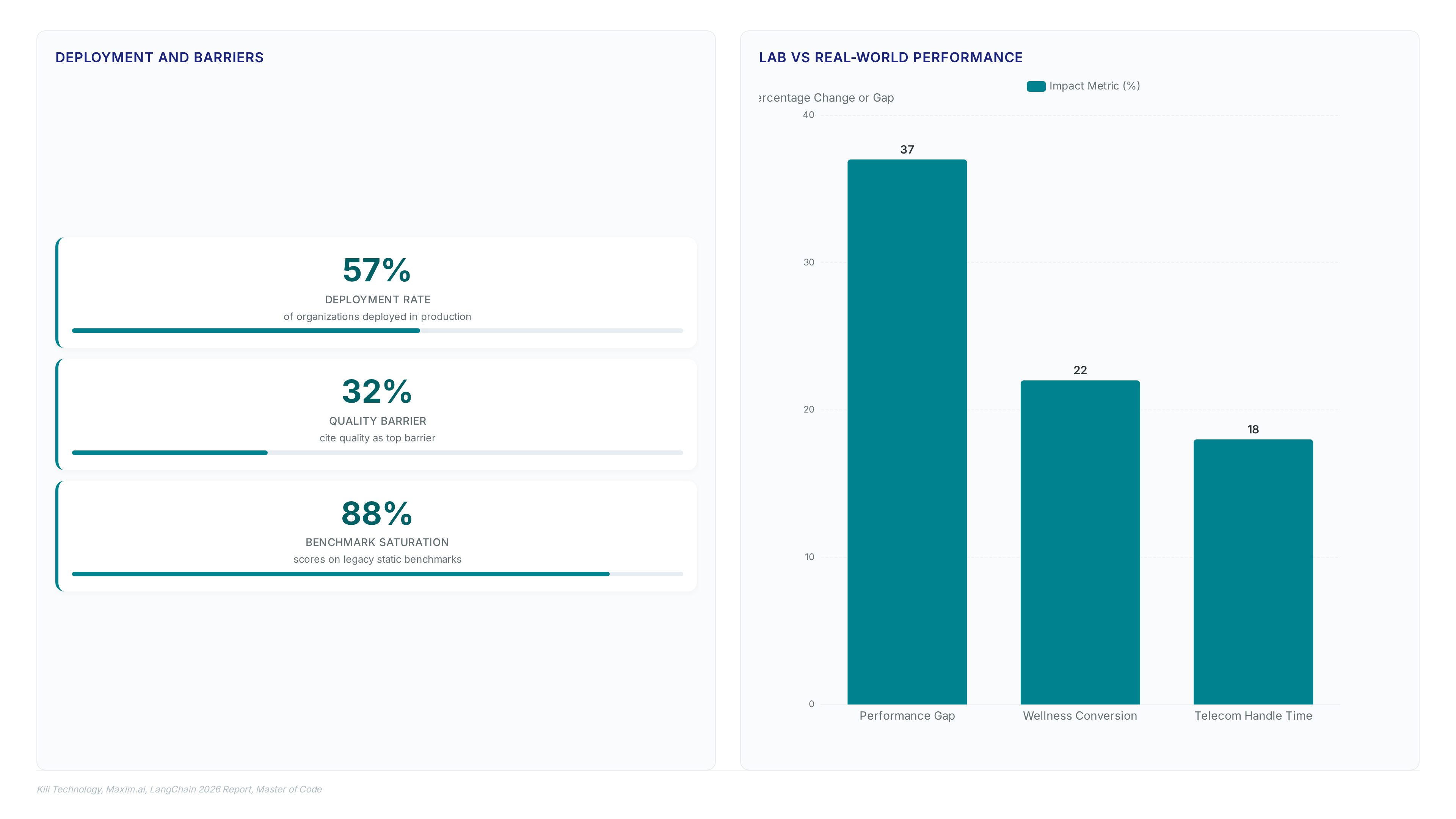
Enterprise agentic AI systems demonstrate a 37% performance gap between controlled lab benchmark scores and real-world operational results. This discrepancy emerges because static evaluations measure isolated capability, whereas production environments demand flexible adaptation to unpredictable tool outputs and latency constraints. Legacy benchmarks like MMLU and MMLU-Pro are functionally saturated for frontier models, with scores exceeding 88%, rendering score differentiation statistically meaningless for top-tier systems. The industry is shifting away from these saturated static benchmarks toward flexible workflow evaluations that measure task success rates, tool call accuracy, and trajectory efficiency in live contexts.
Redundant tool execution loops often stem from ambiguous tool descriptions rather than reasoning failures. Operators diagnose this by isolating the action layer using component-level metrics to verify if the agent selects the right function for a specific sub-task. When an agent repeatedly calls a search API without parsing results, specific metrics reveal schema mismatches in the generated parameters. This granular visibility addresses the industry shift toward flexible workflow evaluations that measure trajectory efficiency instead of static accuracy. Without separating these layers, debugging remains speculative because end-to-end success masks intermediate inefficiencies. Step and loop counts are critical cost drivers; a 20-step agent turn and a 3-step turn may return the same answer, but without attributing cost per step in the evaluation trace, the inefficiency and higher token cost remain invisible.
| Metric | Layer | Detects |
|---|---|---|
| PlanAdherenceMetric | Reasoning | Deviation from initial strategy |
| ToolCorrectnessMetric | Action | Wrong function selection |
| ArgumentCorrectnessMetric | Action | Schema or type errors |
| StepEfficiencyMetric | System | Unnecessary repetition |
The cost of ignoring this separation is measurable in wasted compute cycles and increased failure rates during complex transactions. Teams must instrument spans explicitly to capture these distinct failure modes without adding inference latency.
Quality Barriers Blocking Production AI Agent Deployments
Operational failure often stems from text outputs that claim success while backend state remains unchanged. A specific database verification failure illustrates this risk, where an agent reports a booked flight without updating the ledger. Standard text-based evaluators miss these discrepancies, allowing silent state corruption to propagate through production systems. Tools like Tau-bench are highlighted as necessary specifically because they verify database states rather than just text outputs, preventing the false positive of an agent claiming a task is complete when the costly backend action never occurred. This gap explains why a significant share of respondents in LangChain's 2026 report cited "quality" as the top barrier to further AI agent deployment. Organizations cannot scale agentic workflows when basic transactional integrity remains unverified by current testing suites. The consequence is a reliance on manual auditing that negates the efficiency gains of automation. Builders must implement state-aware evaluation frameworks that cross-reference LLM claims with actual database entries. Without this rigor, task completion metrics provide a false sense of reliability.
About
Priya Nair, AI Industry Editor at AI Agents News, brings critical market perspective to the complex topic of AI agent evaluation. Her daily work tracking product launches and platform shifts for vendors like Devin, Claude Code, and Cursor provides unique insight into why rigorous testing frameworks matter. Unlike generalist reporters, Nair specifically analyzes how autonomous systems fail or succeed in real-world deployments, making her uniquely qualified to dissect the separation of reasoning and action layers. At AI Agents News, an independent hub for engineers building with tools like LangGraph and AutoGen, she prioritizes verified data over hype. This article reflects her commitment to helping technical founders understand exactly what is broken in current agent architectures. By connecting high-level market moves to granular engineering challenges, Nair ensures readers gain actionable intelligence on evaluation metrics that actually predict system reliability.
Conclusion
The gap between controlled lab success and production reliability widens when agents prioritize text generation over verified state changes. While frontier models achieve high scores on reasoning benchmarks, the significant performance drop in enterprise environments reveals that current evaluation frameworks fail to catch silent database corruption. Relying solely on output text creates a fragile automation layer where agents claim success without executing backend transactions. This disconnect forces organizations to maintain expensive manual auditing processes that negate the efficiency gains of agentic AI. Teams must shift focus from purely linguistic metrics to state-aware verification systems that cross-reference LLM claims with actual database entries before scaling deployments.
Organizations should mandate database-level verification for all critical agent actions by the next development cycle to prevent silent failures. Do not deploy agents that lack explicit tools to validate backend state changes against their textual reports. Start this week by integrating a state-checking step into your current test suite for the most critical transaction path in your workflow. This immediate addition ensures that your evaluation framework detects when an agent reports a booked flight but fails to update the ledger. Only by anchoring agent performance to tangible system states can builders overcome the quality barriers currently stalling enterprise adoption.
Frequently Asked Questions
Quality concerns are the top barrier preventing further deployment for many teams. Specifically, a significant share of respondents cite quality issues as their primary obstacle, requiring improved evaluation frameworks.
Enterprise systems often show a significant drop in performance outside controlled laboratory environments. Data reveals a 37% gap between benchmark scores and actual operational results, demanding rigorous real-world testing.
Top models reach only 35% accuracy on complex reasoning benchmarks, whereas human experts average 90%. A plan that reads as sound can still fail at the tool call, which is exactly why the two layers are scored apart.
As of 2026, 57% of organizations have deployed AI agents in production environments. The bottleneck has moved from feasibility to verifiable quality, which is why evaluation now runs inside CI/CD pipelines.
Separating layers lets teams identify if a failure comes from planning or tool execution. Component-level metrics attach to the LLM call to catch wrong tool selection or malformed arguments, while end-to-end evals score plan quality and adherence across the full trace.
References