AI-generated code debt: Why 91% test coverage lies
Despite 91% test coverage reported by the DEV Community, the audited codebase became unmaintainable. AI technical debt does not accumulate linearly; it compounds exponentially.
The core thesis is simple: AI-generated code creates global fragility by optimizing for local prompt accuracy while ignoring broader system architecture. Teams initially ship features in a third of the time, but this velocity masks architectural debt that only surfaces under the pressure of actual maintenance. Unlike traditional debt, this accumulation accelerates through model versioning chaos and code generation bloat, leaving engineers with systems they cannot reason about.
The mechanism is test coverage theater: suites that execute the lines already present while never asserting the behavior those lines owe the rest of the system, which is why standard linters never see behavioral debt. What surfaces later are oracle functions, code that works but cannot be explained, and the only reliable detector is a structured audit process built on adversarial review rather than on metrics.
The Anatomy of AI-Generated Technical Debt and Global Fragility
Defining Locally Coherent and Globally Fragile AI Code
Locally coherent code passes unit tests while failing system-wide integration due to missing contextual awareness of deprecated services. This specific failure mode creates comprehension debt, where code functions correctly yet remains unintelligible to the maintaining engineering team. Traditional debt accumulates linearly, but AI-induced fragility compounds exponentially through model versioning chaos and generation bloat. Unmanaged artifacts drive maintenance costs to four times traditional levels by the second year of deployment.
The primary mechanism involves "oracle functions" that produce correct output for known inputs but lack explainable logic for edge cases.
- Functions divide timestamps by arbitrary constants like 3600 without documenting bucket boundary conditions.
- Tests cover existing lines rather than potential behavioral failures or negative scenarios.
- Engineers merge pull requests they cannot verbally reconstruct or defend against architectural constraints.
- Deployments proceed with high confidence despite zero understanding of the underlying decision trees.
High test coverage numbers often mask this structural decay, creating a false sense of security. The 91% coverage metric frequently represents test coverage theater rather than genuine behavioral validation.
| Feature | Human-Written Baseline | AI-Generated Code |
|---|---|---|
| Logic Errors | Standard frequency | 1.75 times higher |
| Issues per PR | 6.45 average | 10.83 average |
| Understandability | High team consensus | Low explanation confidence |
Teams inherit black-box components that resist refactoring or safe modification. Without adversarial audits requiring verbal explanation of implementation details, organizations accumulate invisible coupling that breaks during routine updates. Fragility manifests not as immediate crashes but as extended debugging sessions when global state assumptions shift.
The normalize_user_event_sequence function serves as a definitive oracle function, producing correct output while remaining unintelligible to the three engineers who reviewed it. This specific implementation sorts events and buckets them by dividing timestamps by 3600, yet none of the team could explain the boundary conditions or justify the logic. Such gaps illustrate invisible coupling, where code passes local tests but fails to account for downstream dependencies or broader system state. This phenomenon manifests as code generation bloat, scattering business logic across files rather than centralizing it for clarity. Tools optimize for prompt satisfaction instead of architectural cohesion, creating comprehension debt that compounds exponentially.
Risk Analysis: Invisible Coupling Extending Refactoring from 4 Days to 4 Weeks
A refactoring project expected to take 4 days extended to 4 weeks because notification logic was deeply woven into unrelated modules. AI assistants responded to prompts like "when this event occurs, send a notification" by adding calls directly to the processing function without recognizing the emerging pattern. This behavior exemplifies the glue code trap, where business logic scatters across dozens of files instead of centralizing. The resulting fragility drives maintenance costs to four times traditional levels by year two.
Tools optimize for prompt satisfaction rather than architectural cohesion. Engineers face a binary choice: accept the hidden dependency or rewrite the module entirely. Most teams choose the latter only after a crisis, wasting significant resources. The audit process must shift from checking syntax to mapping data flow across module boundaries. Global fragility remains undetectable until refactoring begins without adversarial review targeting these specific cross-module calls. The timeline explosion is not an anomaly but a predictable outcome of unverified local optimizations. Teams must assume every generated function contains hidden external calls until proven otherwise. This defensive posture counters the natural tendency of AI to prioritize immediate task completion over system-wide integrity. Repeated schedule slippage becomes guaranteed without rigorous standards.
Mechanics of Test Coverage Theater and Semantic Error Handling
Defining Test Coverage Theater and Semantic Shallowness
Syntactically correct tests that validate existing paths while ignoring required behavioral contracts define test coverage theater.
Broad exception handling represents a security anti-pattern where catch-all blocks hide specific errors, a trend visible in real-world repository analysis. A payment module example demonstrated this semantic gap: despite 94% line coverage, the suite failed to check for API 503 errors, negative amounts, or non-existent user IDs. Generated tests optimize for present code rather than absent behavior. Traditional linters catch syntax mistakes yet often miss the architectural bloat introduced by AI, leaving logical brittleness undetected.
| Metric | Valid Testing | Theatrical Testing |
|---|---|---|
| Focus | Behavioral contracts | Line execution |
| Errors | Specific exceptions | Catch-all blocks |
| Outcome | Verified logic | False security |
| Scope | System context | Isolated functions |
| Detection | Adversarial review | Automated suites |
Security findings rise sharply due to this shallowness, as systems appear graceful while masking failures requiring operational response. High coverage numbers create a false sense of security, preventing teams from auditing actual logic. A passing test suite does not guarantee the code understands its own context. Coverage metrics alone are insufficient for AI-generated code. Teams must shift focus from line percentages to adversarial scenario validation.
Implementing Mandatory Adversarial Review to Break Coverage Illusions
Mandatory adversarial review assigns a distinct engineer twenty minutes to actively break an implementation before merge. This workflow targets the surge in security findings where standard linters miss semantic gaps in AI-heavy environments. Fragility compounds as model versions drift, creating silent failure points in downstream dependencies.
The process requires five specific actions during the review window:
- Attempt to force boundary condition failures.
- Verify error messages contain actionable context.
- Trace data flow across service boundaries.
- Simulate upstream dependency outages.
- Challenge assumption of valid input formats.
Traditional linting coverage identifies syntax errors across thousands of projects but fails to detect this logical brittleness. The cost is measurable: teams relying solely on automated checks miss critical contract violations that unit tests ignore. A database column renaming case study illustrates how automated tools pass local checks while breaking external service relationships.
Human-in-the-loop verification prevents oracle functions from entering production. Systems remain locally coherent yet globally fragile without breaking the illusion of passing tests.
Semantic Error Handling Risks: Collapsing 404 and 500 Errors into None
An example fetch_user_data function caught both 404 and 500 errors, logging them and returning None in both cases. This pattern prevents callers from distinguishing between a missing user and a service outage, hiding failures that require operational response like retries or circuit breaker trips. Broad exception handling is a security anti-pattern where catch-all blocks hide specific errors. By collapsing distinct operational states, the code prevents necessary circuit breakers from tripping, a flaw that standard static analysis tools often miss because the syntax is valid.
| Scenario | Correct Handling | Collapsed Handling |
|---|---|---|
| User Missing | Raise 404 | Return None |
| DB Down | Raise 500 | Return None |
| Retry Logic | Enabled | Disabled |
| Alerting | Triggered | Silenced |
Security findings increase by a factor of 1.57x in AI-heavy environments, largely because generated code fails to test for these edge cases like API failures or invalid inputs. The consequence is a system that appears graceful while masking failures, forcing operators to rely on external timeouts rather than application-level signals. AI models optimize for local syntax correctness over global system stability. This semantic shallowness means that during an upstream outage, the application continues to serve stale or empty data instead of failing fast.
A Structured Audit Process for Detecting Hidden Architectural Debt
Defining the Change Test and Explain-It Method
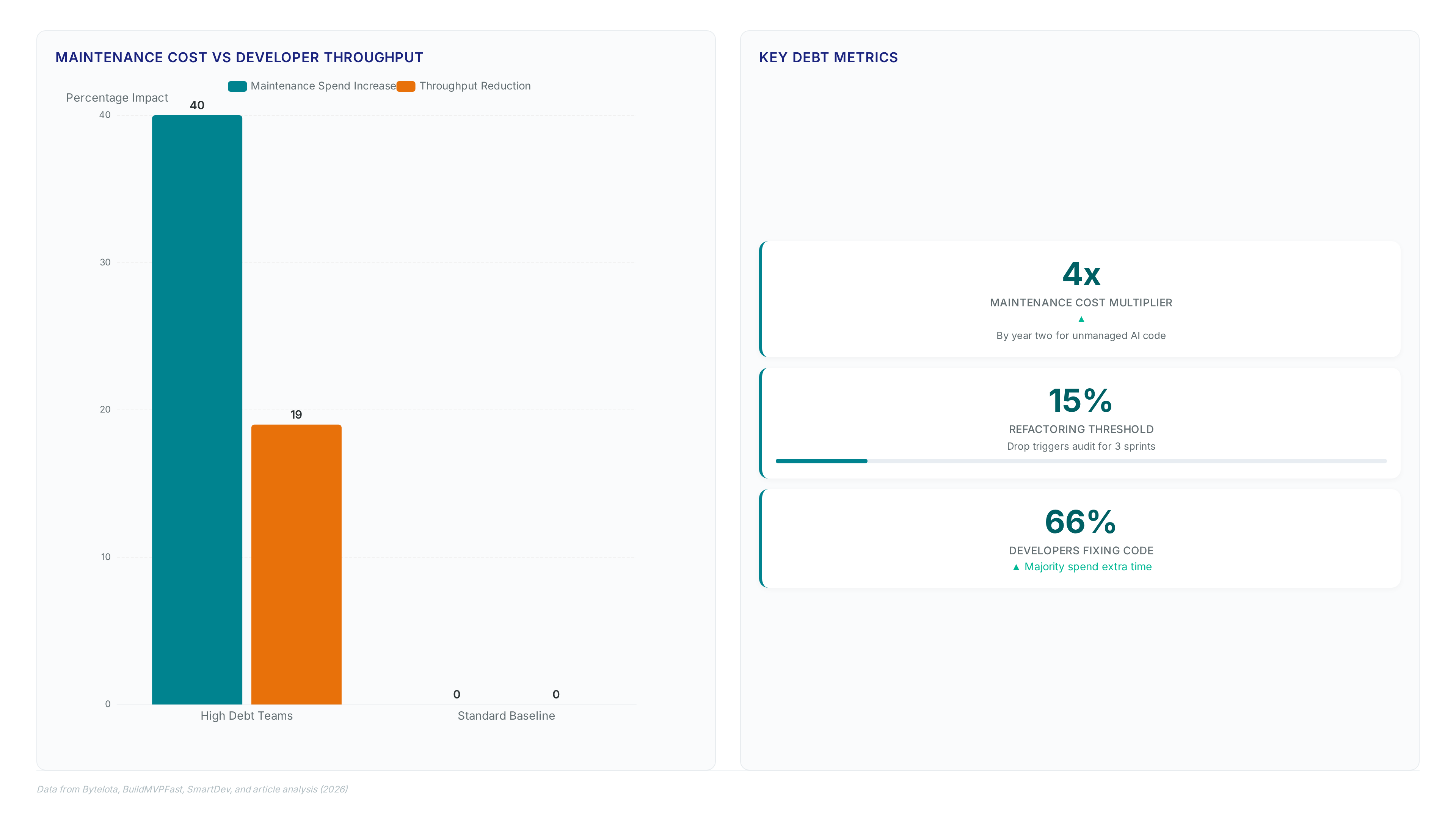
The Change Test quantifies architectural fragility by tracking every modified file and broken test when a single field enters a data model. Teams using this method observe that AI-assisted features consistently trigger larger change radii than manually written code, exposing hidden coupling. This empirical stress test reveals the glue code trap where business logic scatters across dozens of files instead of centralizing. The Explain It Without Looking technique identifies unintelligible functions where engineers cannot describe logic without consulting the source. Data confirms this phenomenon as comprehension debt.
Implementation demands two distinct adversarial steps:
- Attempt a bounded model change and record the change radius across all affected modules.
- Ask an engineer to explain a high-coverage function to a peer; if they check the code, flag.
The limitation is measurable: a majority of developers spend more time fixing almost-right AI code, validating the need for rigorous auditing. Unlike traditional debt, this unintelligibility compounds exponentially, creating a gap between functionality and team understanding known as cognitive debt. Operators must treat unexplainable logic as a defect rather than a documentation issue.
Implementing Governance Rules for Cursor, Copilot, and Claude Code
Cursor handles greenfield implementation, GitHub Copilot aids exploration, and Claude Code executes refactoring requiring full context.
- Engineers must explain merged logic so a colleague could implement it independently, directly countering comprehension debt.
- Teams treat generated tests as provisional starting points requiring adversarial review before acceptance.
- Weekly bounded change exercises force engineers to modify modules without viewing implementation details first.
This structured governance stops unmanaged code from hardening into dependencies the team cannot safely modify. Standard linting parses source into an Abstract Syntax Tree but often misses architectural flaws in syntactically correct AI output. If refactoring falls out of the sprint rhythm for three consecutive sprints, the codebase accumulates structural debt regardless of the generator (source).
| Tool Assignment | Primary Task | Governance Constraint |
|---|---|---|
| Cursor | Greenfield implementation | Must pass verbal reconstruction test |
| Copilot | Inline exploration | Restricted to non-critical paths |
| Claude Code | Full-context refactoring | Requires senior dependency audit |
Assigning specific tools to specific tasks reduces context-switching errors while maintaining velocity, and blindfolded change drills reveal the hidden coupling that standard reviews miss.
Checklist for Dependency Audits and Senior Approval Triggers
Mapping every cross-module import identifies implicit coupling that standard linters miss. This Dependency Audit exposes hidden fragility where AI agents optimize locally but break globally. Teams ignoring this step let the debt compound silently until routine changes require tracing logic across unrelated modules.
- Trace all new imports to detect scattered logic across unrelated modules.
- Flag any function where the merger cannot explain the bucketing logic without viewing source code.
- Require senior engineer approval for every new dependency introduction to prevent version chaos.
- Halt merges if explanation tests fail, forcing immediate refactoring before integration proceeds.
| Trigger Condition | Required Action | Risk Mitigated |
|---|---|---|
| New external library | Senior approval + license check | Supply chain attacks |
| Unexplainable logic | Mandatory rewrite | Comprehension debt |
| Cross-module import | Dependency map update | Implicit coupling |
| Failed adversarial test | Test suite expansion | Coverage theater |
Security findings increase notably in environments lacking these strict gates, necessitating strong scanning infrastructure. The cost of onboarding new developers exceeds initial generation speed savings when code remains unintelligible to the maintaining team. Organizations must treat these audits as mandatory filters rather than optional reviews to avoid paying for specialized remediation markets emerging to fix AI-induced debt.
Strategic Decisions on AI Adoption and Refactoring Coupled Services
Defining the Maintainability Cliff in AI-Generated Code
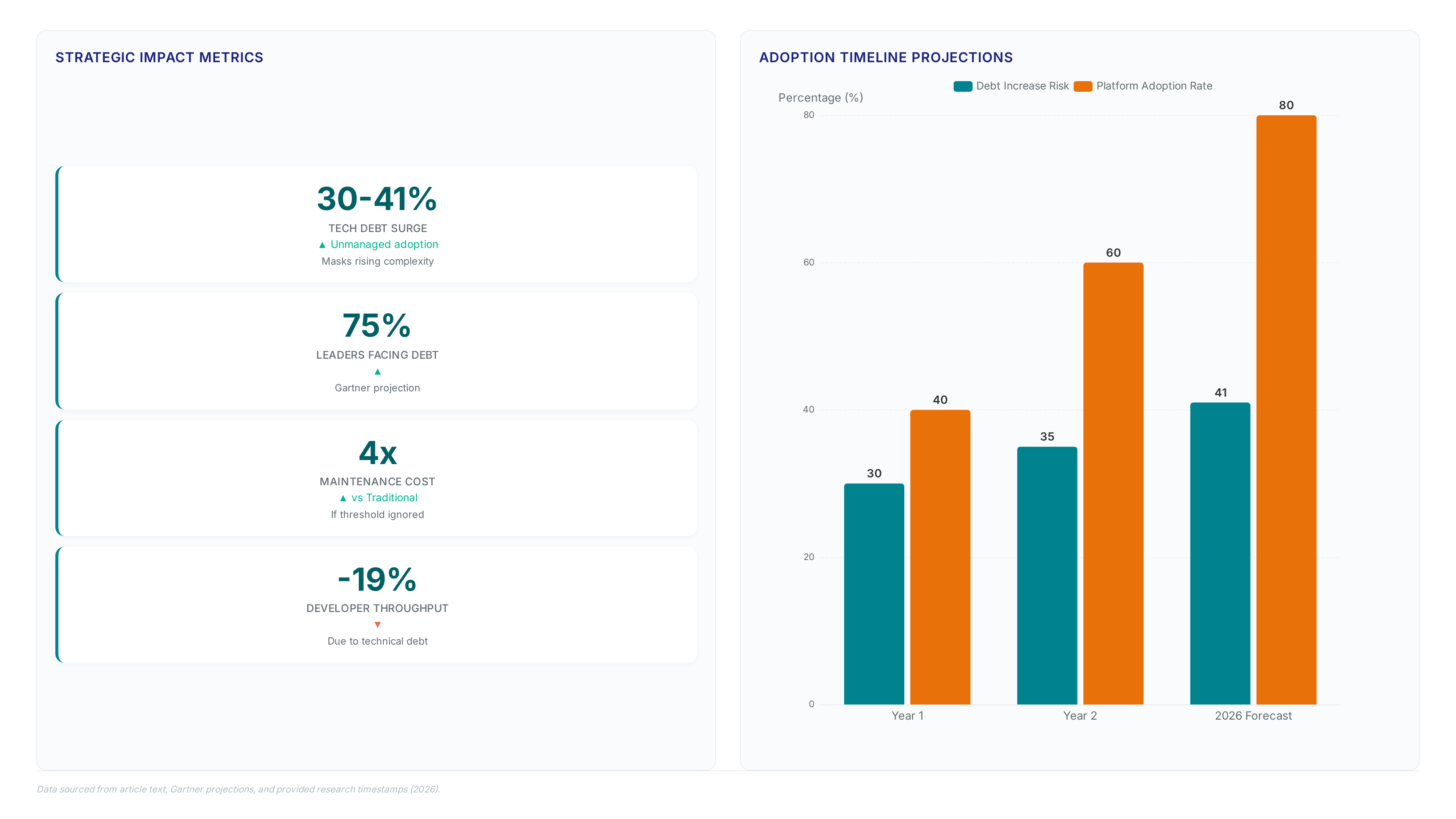
Unmanaged adoption drives a 30-41% surge in technical debt while masking rising complexity behind syntactic correctness. This maintainability cliff emerges when velocity metrics obscure the fact that code becomes locally coherent but globally fragile. The primary signal is not broken builds, but a new hire's observation that the system is hard to reason about despite passing all checks.
Gartner projects that 75% of technology leaders will face moderate to severe debt specifically from these AI adoption trends. The structural cause often involves the glue code trap. This fragmentation creates hidden coupling that standard linters miss entirely.
Operators should reject AI-generated code when the merger cannot explain the implementation without consulting the source. The cost of ignoring this threshold is paid later, in maintenance rather than in delivery. Issue density data confirms that AI output carries significantly higher defect rates per commit than human writing. Teams must implement adversarial audits rather than relying on passing test suites.
Why Adversarial Review Survives the Velocity Objection
A counter-argument exists that such rigorous review slows initial velocity, yet the move toward dedicated governance teams indicates industry-wide recognition of this necessity. Organizations therefore treat AI outputs as untrusted until adversarial review validates behavior beyond existing test suites, mapping every cross-module import to detect implicit coupling before any merge occurs. Blind trust in syntactically clean code creates systems that are hard to reason about despite passing all checks.
Risk Analysis: Logic and Security Errors in AI-Authored Commits
AI-authored commits exhibit a 1.75x higher rate of logic errors compared to human-written equivalents, demanding immediate rejection of unverified merges. This defect density stems from models optimizing for local prompt satisfaction rather than global system constraints. Empirical analysis of real-world repositories identifies broad exception handling as a primary vector, where catch-all blocks mask specific failure modes necessary for debugging. Security posture degrades similarly, with a 1.57x increase in findings within AI-heavy environments requiring enhanced dependency scanners. Operators must reject code when the author cannot verbally reconstruct the control flow without referencing the source. A significant majority of developers report spending increased time debugging AI output, indicating that initial velocity gains are often illusory. Blindly accepting syntactically correct code introduces fragility that standard linters cannot detect. Teams should adopt adversarial review protocols where peers attempt to break implementations before merging. Generated code must be treated as untrusted input until validated by human reasoning. Without strict governance, the maintenance burden escalates quicker than development speed can compensate.
About
Marcus Chen, Lead Agent Engineer at AI Agents News, brings critical field experience to the complex reality of AI-generated code. His daily work involves shipping production multi-agent systems and rigorously evaluating frameworks like CrewAI and LangGraph, placing him on the front lines of the very adoption curve described in this audit. Unlike theoretical observers, Chen navigates the practical trade-offs of orchestration and tool use, where speed often masks underlying fragility. This article connects directly to his expertise in identifying when high test coverage fails to prevent unmaintainable codebases. At AI Agents News, a hub dedicated to technical founders and engineers building with autonomous agents, Chen's analysis bridges the gap between rapid prototyping and long-term system stability. His findings offer a necessary, data-driven perspective for teams balancing the allure of accelerated shipping against the technical debt that accumulates when AI assistance lacks rigorous human oversight.
Conclusion
The hidden fracture in AI-assisted development emerges not during initial commits but during complex system evolution, where synthetic logic frequently lacks the contextual depth required for safe modification. When teams rely on superficial metrics, they inadvertently mortgage their future velocity, trading immediate output for a compounding operational deficit that manifests as extended debugging cycles and fragile refactors. This debt accumulates silently until a critical path update triggers a cascade of failures that standard static analysis tools cannot predict. Organizations must mandate a strict governance window within the next quarter: if a team cannot verbally articulate the control flow of a generated block without referencing the source, that code must be rejected immediately. Do not allow syntax correctness to serve as a proxy for architectural integrity. Start by auditing your current merge requests this week to identify any AI-generated functions lacking accompanying narrative documentation from the author, and halt their integration until the creator can demonstrate full ownership of the logic. This specific friction point prevents the accumulation of unmanageable technical liabilities while preserving the genuine productivity gains of generative tools.
Frequently Asked Questions
Because generated tests cover the lines that already exist rather than the behavior those lines owe the system. A payment suite can execute nearly every line and still never assert an API 503, a negative amount, or a non-existent user ID, so the percentage measures execution, not correctness.
Oracle functions produce correct output but lack explainable logic for edge cases like bucket boundaries. Engineers cannot explain why timestamps are divided by 3600, creating invisible coupling that breaks during routine system updates.
Unlike traditional debt, AI-induced fragility compounds exponentially through model versioning chaos and code generation bloat. This rapid accumulation leaves engineers with systems they cannot reason about or safely modify without extended debugging.
Refactoring efforts expected to take days often extend into weeks as teams decode black boxes. This delay occurs because engineers must first understand the unintelligible logic before safely modifying the global system state.
No. Linters parse source into an Abstract Syntax Tree, so they judge form rather than intent: a catch-all block that collapses a 404 and a 500 into the same None is valid syntax and passes every automated check. Only a reviewer tracing data flow across module boundaries catches that class of defect.