AI coding agents: 2026 workflow fit beats raw power
A June 2026 sweep of the AI coding agent market reveals a hard truth: raw model power matters less than workflow fit. Simple autocomplete is dead. We now operate in an era of supervised agency, where tools like Cursor and Claude Code plan changes, run commands, and draft pull requests for human review. This isn't an upgrade; it's a paradigm shift demanding strategic selection based on terminal autonomy and cloud sandboxing capabilities.
You need to understand how terminal autonomy and cloud sandboxes actually drive performance in isolated environments. While GitHub Copilot remains the default for Microsoft-entrenched teams, Claude Code dominates terminal-first supervised engineering. The distinction between asynchronous task drafting and real-time IDE integration is critical; using a browser-based prototype tool for complex backend refactoring is a recipe for disaster.
One rule survives every tool choice: all generated code must pass developer supervision, automated tests, and security review before reaching production. What actually separates these agents is narrower than the marketing suggests. It comes down to how much terminal autonomy the scaffolding grants, whether execution happens on the local filesystem or inside a cloud sandbox, and how the vendor bills the tokens an autonomous loop consumes.
The Role of Supervised Agency in Modern AI Coding Agents
Defining the Observe-Plan-Act-Evaluate Loop in AI Agents
Forget single-line predictions. Modern AI coding agents manage reasoning across entire repositories through a supervised observe-plan-act-evaluate loop. This agentic workflow inspects repository context, generates a structural plan, invokes tools like terminal commands or file writers, and evaluates test outputs before iterating. Systems from the 2022 era offered reactive autocomplete, yet modern tools such as Codex CLI achieve an 83.4% score on TerminalBench 2.1 by autonomously navigating complex dependency graphs. Large context windows allow these models to maintain coherence across hundreds of files simultaneously.
Expanded context retention increases token costs and latency, forcing teams to balance depth against responsiveness. GitHub Copilot serves approximately 15 million developers, though its transition to full agency requires explicit permission grants for every tool call to prevent unintended repository mutations. Engineers must define strict guardrails for the evaluation phase so the agent halts on ambiguity rather than guessing. Agents optimizing for local test passes without human supervision during the planning stage may introduce architectural drift.
Executing Multi-File Reasoning and CI/CD Integration Workflows
Current agentic workflows initiate pull requests, execute linters, and retry failing tests without step-by-step prompting. These systems parse voice specifications or natural language inputs to trigger a chain of tool invocations across the repository boundary. An agent maintains coherence while modifying multiple files simultaneously to resolve complex dependencies by using large context windows. The Fable 5 model leads the industry with a 95.0% success rate in resolving real-world GitHub issues autonomously on the SWE-bench Verified benchmark.
Models can now reliably navigate complex codebases to implement functional fixes. However, fully autonomous execution introduces risk when agents misinterpret subtle requirement constraints or introduce regressions during rapid iteration. Developer review, testing, and security scanning remain mandatory gates before any merge occurs. Teams must configure CI/CD integration points where agents submit draft changes for human validation rather than direct deployment. This separation ensures that while the agent handles the heavy lifting of file manipulation and command execution, final accountability rests with the engineering team. The operational result is a shift from writing code to supervising the verification of generated solutions.
Reactive Autocomplete vs Supervised Agentic Workflows in 2026
Reactive autocomplete suggests single lines, whereas supervised agency executes multi-step goals with user-granted permissions. Traditional tools from the 2022 era operated reactively within a single file scope, stopping after generating text. Modern agentic assistants differ by taking a high-level objective and running an observe-plan-act-evaluate loop to modify codebases autonomously. This shift transforms the developer role from writer to reviewer, as agents now invoke terminal commands and manage pull requests.
This autonomy introduces new risks requiring strict security review before any merge occurs. Unlike early plugins, current systems are scored on distinct memory and security modules to ensure enterprise readiness. Pricing models have consequently shifted from flat seats to usage-based billing to reflect this increased computational load. Speed and safety create tension; while agents accelerate drafting, they necessitate rigorous human oversight to validate logic. Teams cannot simply adopt tools but must engineer specific review checklists into their pipelines.
Terminal Autonomy and Cloud Sandboxes Drive Agent Performance
Terminal Autonomy Mechanics in Codex CLI and Claude Code
Shell commands execute without step-by-step prompting when terminal autonomy functions correctly. This metric captures how well an agent chains file reads, script executions, and output parsing on its own. Codex CLI leads that measure with 83.4% on TerminalBench 2.1, and Claude Code follows closely at 83.1% using the Fable 5 model. Both systems rely on an observe-plan-act-evaluate loop managed by a scaffolding layer that grants explicit tool permissions.
The terminal interface serves as the primary execution environment where the agent writes scripts and interprets stdout directly. Developers choosing between cloud or local agents must weigh this divergence: terminal-heavy DevOps tasks favor Codex CLI, whereas complex issue resolution may require the reasoning depth found in other benchmarks. Unrestricted shell access introduces significant security risks if the scaffolding layer fails to validate command intent before execution. Strict permission boundaries become mandatory under these conditions.
Cloud Sandboxes, Local Agents, and the Bill for Autonomy
Isolated, full-stack environments solve the multi-file context problem better than local shells. Unlike local IDE-attached tools that struggle with large repository graphs, cloud-hosted sandbox architectures provide the compute isolation necessary for safe, autonomous command execution. This deployment model allows agents to perform multi-file reasoning across entire codebases without risking host system stability or leaking sensitive local credentials. By offloading execution to the cloud, these systems integrate directly with CI/CD pipelines, enabling agents to run linters, execute test suites, and draft pull requests within a controlled perimeter.
Private networks host local IDE-attached agents that execute entirely without third-party servers for teams avoiding them. This configuration eliminates external data transmission but shifts the operational burden to managing local compute resources for model inference. Market categorization distinguishes these private deployments from cloud-hosted sandboxes based on specific security and latency requirements. Local execution guarantees data sovereignty yet often lacks the massive context windows available in cloud environments.
Public cloud agents increasingly abandon flat subscriptions for consumption metrics tied to actual usage. Pricing structures are shifting towards $task or token-based billing to accommodate autonomous loops that consume significant resources. This model aligns costs with value but introduces financial uncertainty for complex, multi-step refactors. Developers must weigh the privacy guarantee of local execution against the scalable context utilization offered by premium cloud tiers. Selecting the wrong architecture creates friction; high-security teams cannot tolerate cloud logging, while rapid prototyping suffers under local hardware bottlenecks. AI Agents News recommends evaluating repository sensitivity before locking into a billing structure.
Strategic Selection of AI Agents for Specific Development Workflows
Cursor Composer Mode Versus GitHub Copilot Autocomplete Scope
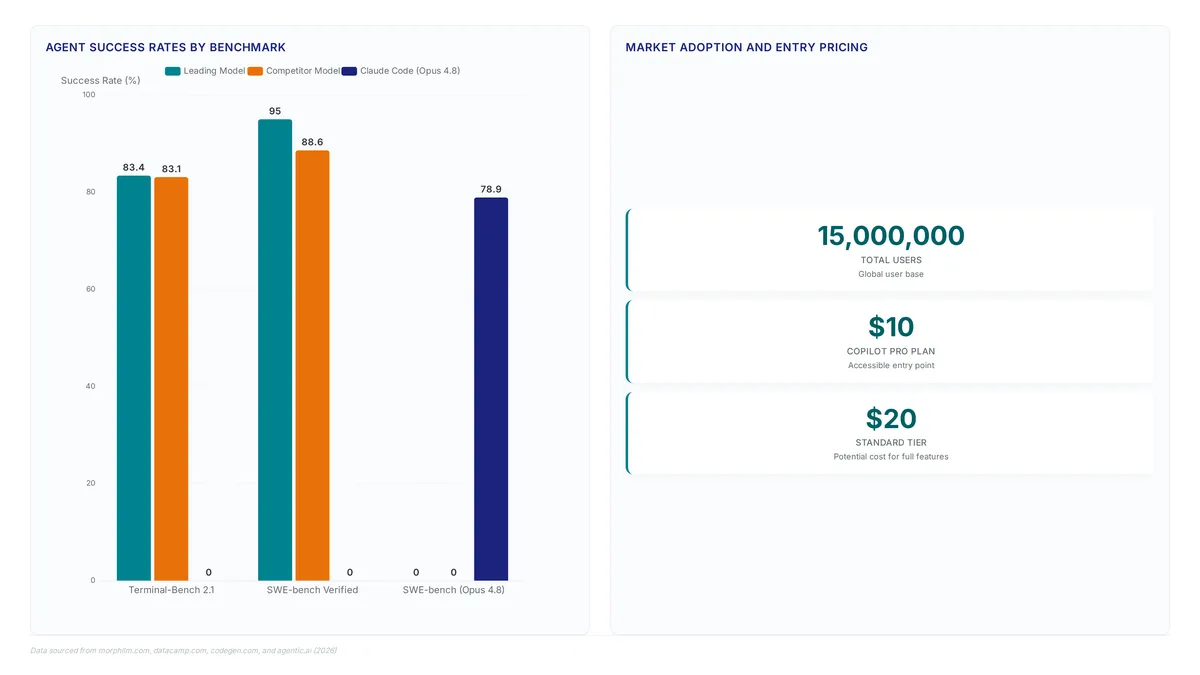
Cursor functions as a dedicated IDE forked from VS Code, distinguishing its Composer mode for logical block tab completion across multiple files from GitHub Copilot's line-level scope. This architectural divergence defines the selection boundary for developers choosing between an AI-native environment and an accessible entry point integrated into existing editors. Cursor embeds agency directly into the editor shell, allowing the observe-plan-act-evaluate loop to execute within the local file system without requiring terminal switching.
The limitation is environmental isolation; adopting Cursor requires migrating away from standard VS Code configurations, whereas Copilot users retain their exact plugin system. For open-source workflows demanding transparency and local control, the IDE-fork model offers deeper context awareness but introduces a steeper onboarding curve compared to the ubiquitous Pro plan priced at $10 per month. Operators must weigh the cost of context switching against the need for multi-file reasoning. If a project requires modifying ten files to implement a feature, the IDE-native approach reduces friction by maintaining state. However, teams prioritizing minimal workflow disruption for simple tasks will find the accessible entry point of Copilot sufficient for daily throughput. AI Agents News recommends reserving the heavier IDE fork for complex refactoring sessions while retaining lightweight autocomplete for routine logic.
Mapping Terminal-Native Claude Code to Legacy Monorepo Refactors
Legacy monorepos demand agents with expansive context windows to process interdependent modules without losing structural coherence. Claude Code operates as a terminal-native CLI tool, granting it direct filesystem access that IDE-attached agents often abstract away. This architecture enables the agent to execute complex, multi-step refactors by reading thousands of files simultaneously and running build commands locally. Token consumption scales linearly with repository size, making blind execution on massive codebases financially risky without scoped constraints. Developers should select terminal-native agents when the refactor requires running local build tools or accessing environment-specific secrets that cannot be safely replicated in a cloud sandbox. This distinction ensures that the agent's autonomy aligns with the project's security boundaries and operational constraints.
Hidden Costs in Usage-Based Billing for Individual Pro Tiers
An Individual Pro tier at $20 per month can become expensive with premium requests or token spend. Costs are now a mix of seats, tokens, credits, premium requests, quota windows, and overage rules. However, agent usage is governed by GitHub's premium request and AI credit rules, meaning high-frequency autonomous tasks trigger additional charges beyond the base fee. Similarly, while Cursor's Individual Pro tier provides a fixed monthly rate, usage-based billing applies after included usage limits are exceeded. This structure contrasts with solutions like Augment Code, which justify their premium positioning through specialized features like the 200K-token Context Engine, suggesting a pricing model based on context window utilization rather than per-seat licensing alone. The financial risk for individual developers lies in assuming the seat price covers unlimited agency; in reality, complex multi-file reasoning consumes quota rapidly. Builders must calculate the cost per completed task rather than relying solely on the headline monthly rate.
Operationalizing AI Agents Through Secure CI/CD Integration
Setting Permission Boundaries for Autonomous Shell Runs
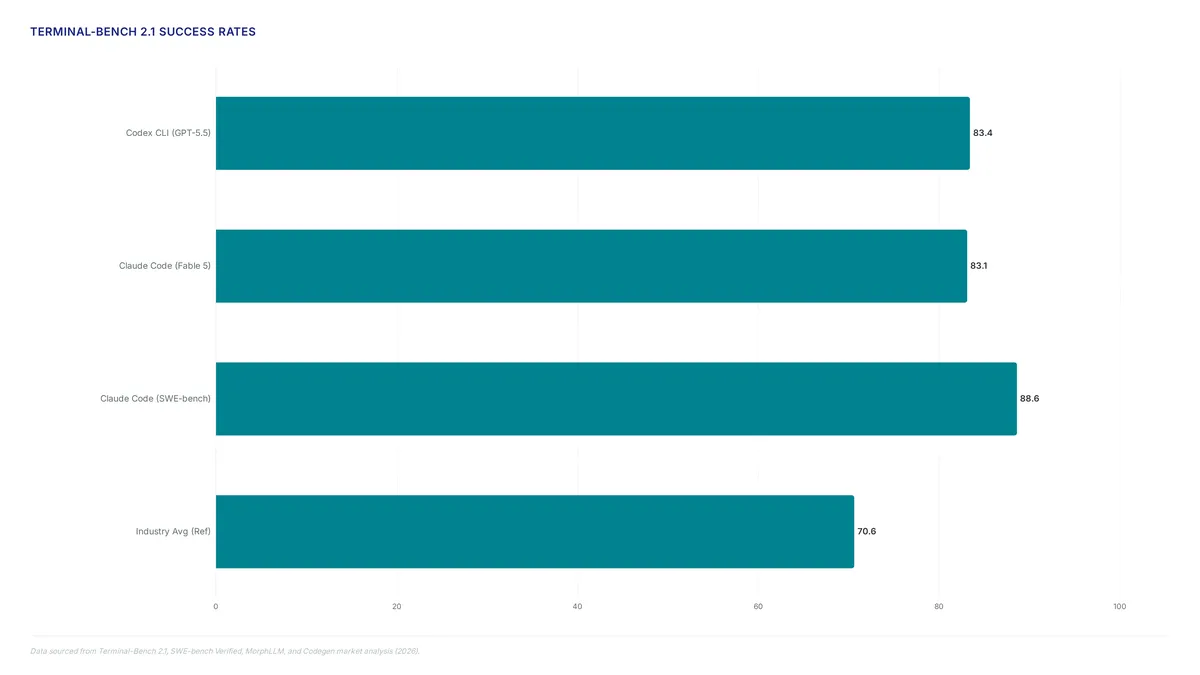
Terminal autonomy shifts execution from line completion to goal-oriented task planning within the shell. This metric validates the agent's capacity to chain file edits and command invocations without constant human intervention. Increased scrutiny becomes the necessary cost for this autonomy; agents executing shell commands require strict permission boundaries to prevent unintended system changes. IDE-attached tools operate within a visual context, whereas CLI natives demand precise prompt engineering to define scope. AI Agents News recommends configuring explicit allow-lists for destructive commands before enabling full autonomous loops. Developers should start by delegating low-risk refactors before trusting agents with database migrations or production deployments.
Gating Agent Pull Requests Inside CI/CD Pipelines
Integrating AI agents into CI/CD pipelines requires shifting from interactive prompting to defining strict supervised agency boundaries for automated runs. Engineering teams now stack specialized tools, combining IDE-attached agents for local development with terminal-native variants for isolated workflow integration. This hybrid approach allows developers to delegate complex issue resolution while maintaining oversight on the final merge. Transitioning a prototype to production hardening demands rigorous human review, as debugging generated code requires auditing for subtle logic errors that appear correct at a glance. The mental model for operators must evolve from writing code to verifying agent planning and execution paths. A working full-stack prototype might emerge quickly. Production readiness depends on validating every automated change against security and dependency policies.
A critical tension exists between speed and safety; fully autonomous merges risk introducing hard-to-detect logical flaws that pass unit tests but fail in production scenarios. Builders should treat agent output as a high-quality draft requiring explicit approval before it enters the main branch.
Auditing Subtle Logic Errors in AI-Generated Code
Generated code often compiles successfully while containing flawed business logic that passes initial unit tests but fails under edge conditions. Senior developers tend to get more use from these tools than juniors because seniors are better at evaluating output, catching bad patterns, and giving precise instructions. The mental model shifts from writing syntax to auditing reasoning chains where an agent might misinterpret a variable's scope across files. Tasks like boilerplate, unit tests, documentation, and refactoring may take minutes instead of hours when well-scoped. The risk of subtle errors increases with task complexity. Verification must run against the actual specification rather than assumed intent.
The cost of skipping this review is measurable in production incidents where logic gaps cause data corruption silently. Teams should integrate automated security checks to flag known vulnerability patterns before human review begins. Ultimately, the technology accelerates velocity only when paired with rigorous human oversight to validate the underlying assumptions of the generated solution.
About
Marcus Chen serves as Lead Agent Engineer at AI Agents News, where he daily architects and evaluates production multi-agent systems. This specific role positions him to rigorously assess AI coding agents based on actual orchestration mechanics rather than marketing claims. Having shipped systems using CrewAI, AutoGen, and LangGraph, Chen understands the critical nuances of tool use, function calling, and agent memory that differentiate a true autonomous worker from simple autocomplete. His work at AI Agents News involves tracking framework releases and benchmarking real-world capabilities, directly informing this 2026 comparison of tools like Cursor, Claude Code, and Devin. By grounding his analysis in hands-on engineering experience, Chen connects the theoretical potential of agentic workflows to the practical needs of software engineers building today. This ensures the article's recommendations reflect verified performance in asynchronous task drafting and supervised engineering rather than hype.
Conclusion
Scaling AI coding agents reveals that velocity creates a new bottleneck: the sheer volume of plausible but flawed logic requiring human verification. As models like Fable 5 approach near-perfect resolution rates on standard benchmarks, the operational cost shifts from writing syntax to auditing complex reasoning chains across entire repositories. Teams relying solely on speed without enhancing their validation protocols will find their incident response times increasing, not decreasing, because logical gaps often bypass unit tests entirely. Production readiness now demands a strict separation between agent execution and merge approval.
Organizations should mandate a hybrid workflow where agents handle boilerplate and refactoring while senior engineers focus exclusively on verifying architectural alignment and edge cases. This transition requires treating every automated contribution as a high-risk draft until explicitly signed off. Do not wait for a substantial outage to recalibrate your review process. Start by implementing a mandatory human-in-the-loop gate for all agent-generated pull requests this week, ensuring that no code merges without explicit validation of its underlying business logic against the original specification.
Frequently Asked Questions
Approximately 15 million developers use GitHub Copilot, making it the most widely adopted tool globally. This massive user base indicates strong system integration, suggesting teams already using Microsoft tools will face the least friction during adoption.
The Fable 5 model leads with a 95.0% success rate on the SWE-bench Verified benchmark. This high reliability means engineers can delegate complex bug fixes to agents using this model, though human review remains mandatory before merging code.
Codex CLI achieves an 83.4% score on TerminalBench 2.1, setting the standard for terminal-based tasks. This metric helps practitioners identify agents capable of navigating complex dependency graphs without constant human intervention during command execution sequences.
A $20 monthly subscription can become expensive when scaling across large engineering groups. Teams must calculate total seat costs against productivity gains, as unrestricted access for every developer may strain budgets compared to targeted agent deployment strategies.
Modern agents execute multi-step goals like running tests and drafting pull requests autonomously. Unlike reactive autocomplete, this requires developers to establish strict guardrails and review gates to prevent unintended repository mutations during automated planning phases.
References