AI agents kill the open source knowledge tax
Some 5.6 million open-source AI projects sit on GitHub, ready to use. Code availability isn't the bottleneck anymore. Execution is. AI agents are tearing down the historical exclusivity of open-source by translating raw user intent directly into deployed infrastructure. This shift exposes the paradox of free software: zero licensing fees mean nothing when installation friction locks out the average person. We are moving past simple package managers toward autonomous runtimes that handle dependency resolution and environment configuration without human hands on the keyboard. The endgame is practical deployment, where persistent, self-improving agents bridge the gap between a user's request and a running service.
The industry is pivoting hard from prompt-response chatbots to agentic workflows where AI orchestrates complex tasks semi-autonomously. Gartner predicts that 40% of enterprise applications will embed these task-specific agents by late 2026. As Jeff Boudier from Hugging Face noted, open models create ecosystems, and now, agents are finally making those ecosystems accessible to everyone, not just those who can read a README file.
The Paradox of Free in Modern open-source
Defining the Knowledge Tax in open-source Access
Non-developers hit a wall called the knowledge tax. It's the prohibitive cost incurred when documentation assumes terminal proficiency. Open-source communities optimize for contributors, not users. The result? Free code that requires expensive expertise to deploy. Users try to install self-hosted services but close installation tabs within fifteen minutes because the learning curve is too steep. README files presume you know package managers, environment variables, and dependency resolution. If you don't, you pay. Organizations trying to build in-house capabilities to bypass this face a three-year Total Cost of Ownership ranging from $2,035,000 to $6,132,500, with personnel accounting for the majority of expenses. The "free" label is a mirage without accessible execution paths.
Rising AI agents act as a general-purpose runtime, collapsing the distance between intent and execution. Unlike coding agents stuck in IDEs, these tools parse documentation, resolve version conflicts, and configure reverse proxies autonomously. Commercial models are already reacting; security tools like Semgrep offer a Team plan at $35/contributor per month to bridge the gap between basic free scanners and complex enterprise suites. But adoption requires trust. You must hand automated systems full environment control. For network operators, the knowledge tax is no longer just a time sink. It's a calculated risk assessment between manual configuration errors and autonomous agent reliability.
A general-purpose agent runtime executes user intent by automating complex setup tasks without requiring code knowledge. This architecture handles the full lifecycle of self-hosted applications, from dependency resolution to SSL certificate generation. The Nous Research agent, developed by builders including Teknium, operates as a persistent, self-improving entity that retains context across sessions to refine future executions. This persistence allows the system to manage long-running services like private wikis or photo backups without constant user intervention.
Target audiences differ sharply. Tools like Supermaven focus on sub-50ms latency for active developers writing code. General-purpose runtimes target non-developers who lack terminal access entirely. These agents absorb that friction by silently resolving version conflicts that typically cause users to abandon installation within minutes. Commercial alternatives often restrict automation features; competitors may limit task volumes unless users self-host in a Docker container.
Autonomous agents introduce a trust boundary where the system modifies production configurations without direct oversight. Errors in a self-healing loop could cascade quicker than human intervention allows. Open-source models create ecosystems, yet the operational burden shifts from learning syntax to verifying agent behavior. Organizations must define strict guardrails for what an agent can modify on a live server. The shift represents a move from manual configuration to intent-based delegation, fundamentally altering how non-developers access software capabilities.
| Barrier Type | Assumed Knowledge | User Outcome |
|---|---|---|
| Documentation | Terminals, package managers, environment variables | Abandonment within fifteen minutes |
| Dependency | Git, building from source, conflict resolution | Failed installation attempts |
| Configuration | Reverse proxies, SSL certificates, DNS records | Inability to self-host services |
Projects prioritize contributor onboarding over usability, leaving general users stranded. Core technology remains free, yet operational complexity forces reliance on paid tiers or complete abandonment of the tool. The cost of this exclusion is measurable; personnel account for the majority of total ownership expenses when internal teams must bridge these gaps manually. Without automated runtimes to absorb this complexity, the paradox of free ensures that access remains restricted to those who can afford the hidden learning curve. The software exists, yet the majority cannot use it.
Evolution from Package Managers to Autonomous Runtimes
The AI Agent as Natural Language Package Manager
The AI agent functions as the natural language package manager, executing intent where legacy tools like apt or npm require syntax. Unlike commercial app stores limiting access to curated binaries, this runtime unlocks the entire open-source corpus for non-developers. This shift relies on interoperability standards like the Agent2Agent protocol to coordinate tasks across disparate frameworks without manual glue code. Traditional package managers resolve dependency trees; AI agents resolve knowledge gaps by translating vague requests into precise system calls. An Observability Platform Company demonstrated this by mapping natural language directly to custom query syntax, bypassing the need for users to learn complex grammar. Trust remains the primary hurdle; agents must validate actions against governance policies before execution. Syntes addresses this by translating requests into Cypher queries only after validating results against a live graph. The implication for operators is a transition from configuring tools to auditing agent behavior. Legacy managers fail without explicit instructions, yet agents infer context while introducing unpredictability in method selection.
Coding Agents Versus General-Purpose Agent Runtimes
Coding agents fail non-developers because they demand an IDE, terminal access, and repository literacy that the majority population lacks. This specialization traps 62% of adopters within development environments, leaving infrastructure tasks unaddressed by design. General-purpose runtimes bypass these barriers by executing commands directly through messaging interfaces like Telegram or WhatsApp. The industry shift toward agentic workflows enables systems to orchestrate end-to-end tasks semi-autonomously without human code intervention. Unlike tools bound to editor windows, these runtimes absorb the knowledge tax of dependency resolution and configuration management silently. Accessibility creates a security tension: granting agents full system control via chat interfaces expands the attack surface beyond traditional perimeter defenses. Operators must weigh the convenience of natural language execution against the risk of unrestricted command injection. Coding agents accelerate creation for experts, yet general-purpose runtimes democratize access for everyone else by collapsing the gap between intent and execution. AI Agents News identifies this divergence as the critical inflection point for enterprise adoption strategies.
Practical Deployment of Self-Hosted Infrastructure via AI
Defining the Human-AI Division of Labor in Server Setup
Machines install nginx packages quickly yet lack the context to judge if a specific security posture matches a threat model. This separation defines a new architectural pattern where the agent executes the "how" while humans retain judgment on the "what" and "why." Such a division is becoming standard because algorithms cannot assess privacy tradeoffs or decide between self-hosting and commercial alternatives. Governance remains critical. Organizations ignoring human review face significant compliance risks despite high operational efficiency. The limitation of this model is clear: agents expand access but do not replace strategic decision-making. AI Agents News analysts note that while execution speed increases, the responsibility for defining acceptable risk shifts entirely to the operator. Humans must define the boundaries within which the agent operates so mechanical efficiency does not override security necessities.
Executing Nextcloud Deployments Through Natural Language Commands
Nextcloud setup now executes via natural language prompts where agents silently resolve dependencies, configure databases, and generate SSL certificates without user intervention. The mechanism relies on the agent reading documentation to install software, set up reverse proxies, and fix breakages by parsing logs autonomously, coordinating with external system tools through open standards like the Model Context Protocol. Similar automation patterns cut the volume of routine support cases teams resolve by hand, mirroring the 54% deflection rate seen in enterprise IT issue resolution. The price of that convenience is permission scope: agents need broad system access, and granting root-level control to an autonomous runtime concentrates the attack surface on one compromised model.
Specialized coding agents fail home server maintenance because they demand an IDE and terminal access that 74% of users lack compared to chat interfaces. The split runs along four axes:
| Dimension | Coding Agents | General-Purpose Runtimes |
|---|---|---|
| Interface | Integrated Development Environment | Messaging Applications |
| Prerequisite | Git, Terminal, Build Tools | Natural Language Request |
| Target | Software Creation | Software Deployment |
| Adoption | Developer-centric | Population-wide |
The limitation of specialized tools is their inability to function outside a development context.
Subculture Grief When the Barriers Drop
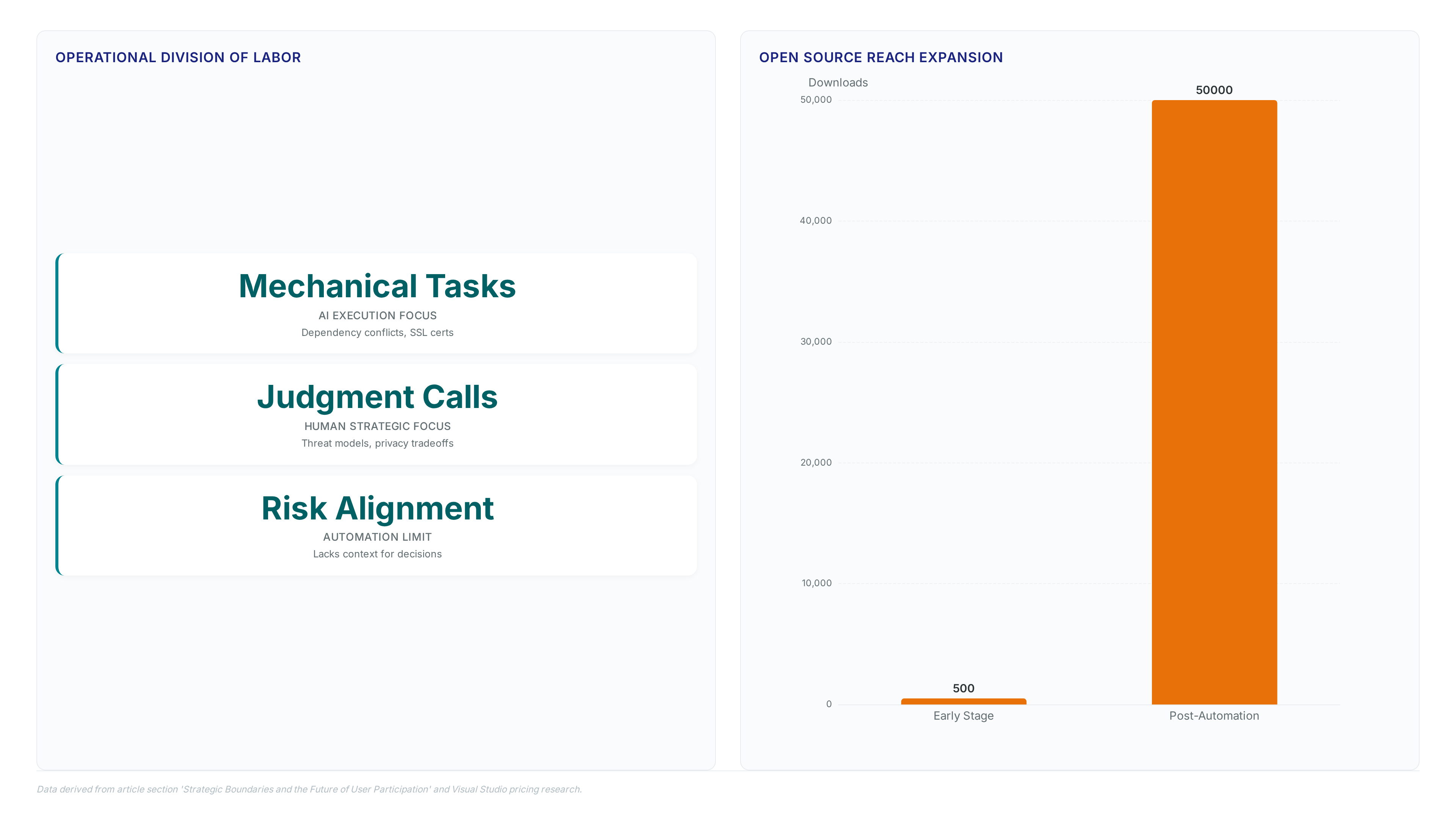
Historical precedents in Linux and crypto communities reveal identity loss when exclusivity vanishes for general users. Early adopters often resist accessibility tools that dilute technical gatekeeping, viewing widespread adoption as a threat to community status. This grief mirrors the tension observed when Ubuntu simplified desktop usage, alienating purists who valued complexity as a filter. Restricting access limits the potential audience for open-source projects. A maintainer witnessing download counts surge from 500 to 50,000 experiences a tangible dopamine of impact that outweighs lost elitism. This shift transforms obscure utilities into viable infrastructure through automated deployment.
About
Diego Alvarez, Developer Advocate at AI Agents News, bridges the gap between complex agentic frameworks and practical application. As someone who daily builds and benchmarks systems using CrewAI, AutoGen, and LangGraph, Diego possesses the technical depth to dissect how persistent, self-improving agents function under the hood. His role involves rigorous testing of coding agents and multi-agent coordination, giving him unique insight into how tools originally designed for developers can be abstracted for broader use. At AI Agents News, where the focus remains on technical credibility and actionable engineering guides, Diego identifies the key shift where open-source agents move beyond code generation to become accessible utilities for non-technical users. By analyzing real-world failure modes and reliability metrics, he explains why this democratization matters, grounding the hype of "self-improving" AI in the tangible reality of current orchestration capabilities and tool-use limitations.
Conclusion
Free code stopped being the bottleneck the moment an agent could read the README for you. What the knowledge tax leaves behind is not a licensing bill but a verification bill: someone still has to judge whether the agent that installed nginx picked a security posture worth keeping. The gate moved from typing the commands to checking the result.
Adopt a hybrid governance model by Q3 2026 that strictly separates mechanical tasks from strategic decision-making. Reserve human expertise for defining threat models and architectural tradeoffs, while delegating repetitive configuration and SSL generation to agents. This approach prevents the erosion of technical standards while maximizing the dopamine of impact that comes from scaling utility to thousands of users. Do not attempt to automate complex judgment calls until your organization has established clear boundaries for agent authority.
Start this week by auditing your current automation patterns to identify which processes lack explicit failure states. Map every automated workflow to a specific human owner responsible for defining its limits before deploying additional agent capacity. This immediate inventory prevents the accumulation of unchecked technical debt as your agent fleet expands.
Frequently Asked Questions
Building in-house capabilities to avoid installation friction costs organizations millions over three years. Specific Total Cost of Ownership estimates range from $2,035,000 to $6,132,500, with personnel expenses accounting for the vast majority of these significant infrastructure deployment costs.
Teams bridging the gap between basic scanners and enterprise suites pay a specific monthly fee per contributor. The Semgrep Team plan is priced at $35 per contributor each month to enable more advanced automated security scanning features.
Users often abandon installation attempts quickly because documentation assumes deep terminal proficiency and package manager knowledge. This structural barrier causes many people to close installation tabs within fifteen minutes due to the steep, prohibitive learning curve involved.
General-purpose runtimes target non-developers lacking terminal access, unlike tools focusing on sub-50ms latency for active coders. These agents silently resolve version conflicts and manage full application lifecycles without requiring any code knowledge from the end user.
Despite there being 5.6 million open-source AI projects on GitHub, execution complexity remains the primary barrier. The sheer volume of available code is irrelevant if users cannot overcome the knowledge tax required to deploy these solutions effectively.