AI agents beat chatbots for complex frontend tasks
Frontend developers adopting AI agents now are projected to ship features five times quicker than their peers by 2027. This isn't just an efficiency tweak; it is the Agent Leap. Intelligence is moving from simple text generation to orchestrating complex, semi-autonomous workflows inside production systems. Basic prompting is the foundation, but the architectural value sits in building systems that execute multi-step plans rather than parroting text.
The difference that matters is between the static nature of chatbots and the flexible, tool-using capabilities of true AI agents that manage memory and adapt to context. Inside React applications that difference shows up as secure integration patterns: the runner stays server-side and the interface handles an event stream instead of a single reply. Data from Talent500 confirms AI agents have graduated from experimental curiosities to central actors in enterprise software. By understanding the hierarchy from instruction to orchestration, you can build interfaces that dynamically configure dashboards and route issues. Frontend development is currently the software function most impacted by these coding agents.
Defining the AI Agent Distinction from Prompts and Chatbots
Defining the AI Agent as an Autonomous System Beyond Chatbots
An AI agent is an autonomous system executing multi-step plans, not a tool merely responding to single-turn text instructions. This distinction separates the agent workflow from the conversational memory found in standard chatbots. Agents orchestrate tools and make decisions to reach specific goals. The industry shift toward this model, the Agent Leap, marks the end of simple prompts in favor of semi-autonomous task completion.
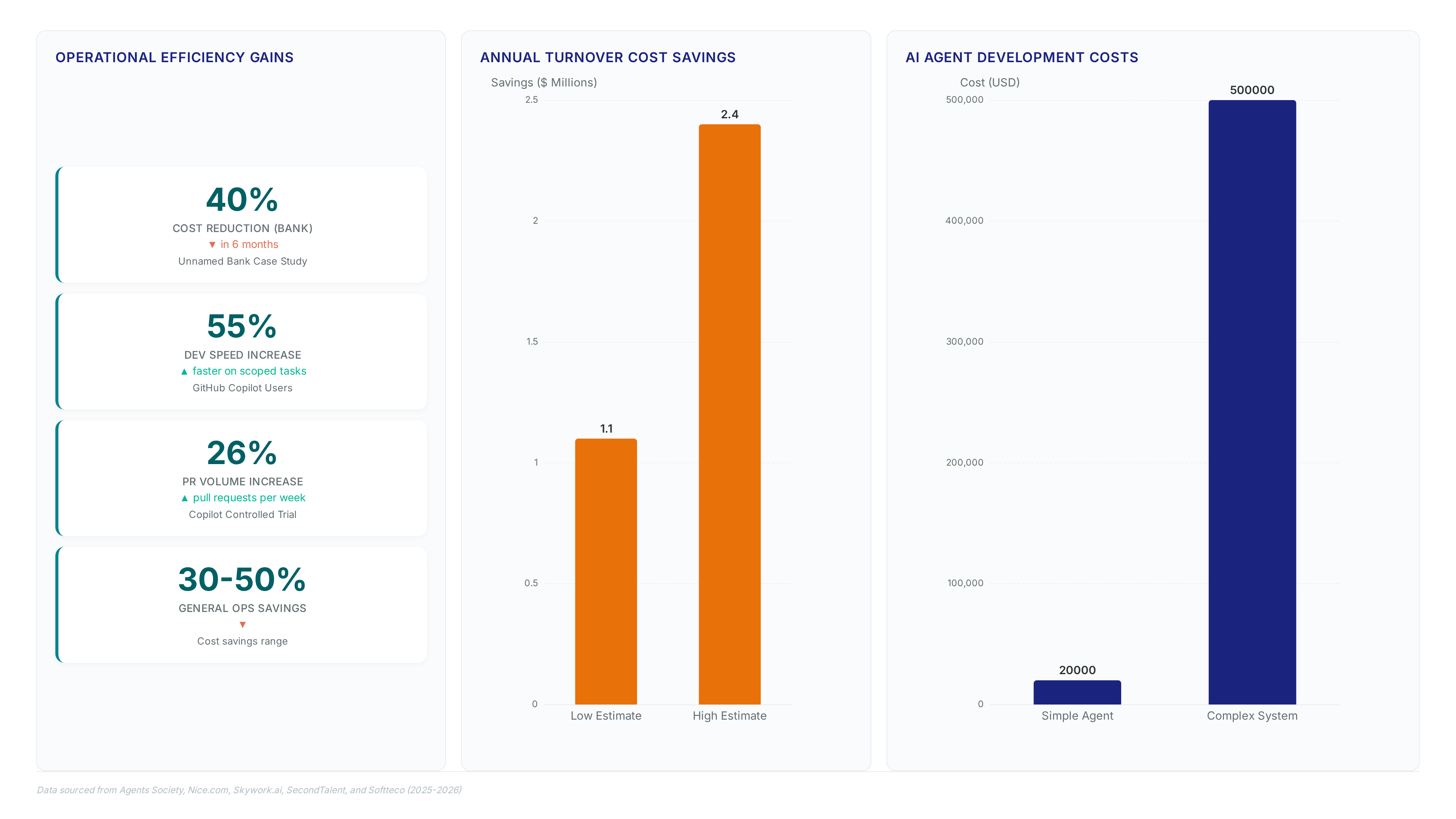
Development costs reflect this complexity. Implementations range from $20,000 for basic setups to over $500,000 for production-grade systems requiring strong state management. Unlike chatbots relying on linear history, agents loop through reasoning and action phases to adapt as context changes. Smaller teams face a high barrier to entry due to these infrastructure costs. Consequently, frontend architects must treat agent integration as a distinct architectural layer requiring explicit tool definitions. Without rigorous input specifications, the agent's ability to orchestrate tools degrades into unpredictable behavior. You are no longer just writing components; you are designing entire decision loops. Failure to account for this autonomy gap results in UIs that cannot reliably handle complex user intents.
The Agent Leap: Enterprise Adoption Projections for 2026
Enterprise integration of autonomous systems jumps from 5% in 2024 to a projected 40% of applications by 2026. This surge defines the Agent Leap, shifting logic from static text generation to flexible workflow orchestration. Developers adopting these patterns are projected to ship features five times quicker while building cleaner system architectures.
Speed requires rigorous spec-first engineering rather than loose prompting. Ignoring this shift risks obsolescence, as simple prompt-response models fail to meet complex enterprise needs. Organizations must prioritize learning agentic workflows to remain competitive. Without proper guards, an agent's ability to call APIs introduces new failure modes not present in read-only chatbots. Mastery of this architecture separates modern frontend engineers from those restricted to basic component assembly.
Comparing the Three Levels and Their Cost of Entry
Four axes separate the levels in practice: what context they hold, whether they can act, how much autonomy they carry, and what counts as a finished job. The table below is the short version; the cost of entry is the part teams underestimate.
Developers must choose frameworks based on specific needs: LangGraph suits production durability, while other tools favor role modeling.
| Feature | Prompt | Chatbot | AI Agent |
|---|---|---|---|
| Context | None | Conversation History | Long-term Memory |
| Action | None | Text Response | Tool Execution |
| Autonomy | Zero | Low | High |
| Goal | Immediate Output | Clarification | Task Completion |
The cost of entry varies notably across this spectrum. Basic prompting is free. Commercial multi-agent systems like CrewAI start at $25 per month for limited workflows. Conversely, some orchestration platforms remain completely free during preview phases. Complexity is the limiter; higher autonomy introduces unpredictable failure modes that static interfaces do not face. Frontend teams must implement deterministic UI patterns to manage these risks. Ignoring this distinction leads to brittle applications that fail when context shifts. Mastery requires treating prompts as specifications rather than casual requests.
Architecting Agentic Workflows with Spec-First Prompt Engineering
Treating Prompts as Code Specifications for Deterministic Output
Vague instructions act as a lottery ticket for model hallucination, forcing developers to accept inconsistent logic rather than deterministic code. Transforming prompts into code specifications eliminates ambiguity by defining strict roles, output formats, and stack constraints before generation begins. Models function as copycats. A single concrete sample outweighs paragraphs of descriptive prose when anchoring behavior. Teams implementing Tailwind-based systems explicitly forbid CSS-in-JS within the prompt to prevent style drift. This approach aligns with TypeScript-first frameworks like Mastra, which demand rigorous type definitions to integrate agents into React workflows successfully.
Operational costs for tailored automation vary widely across published agent pricing tiers, a spread driven largely by the labor required to engineer these precise specifications. Writing specs demands more upfront cognitive load than issuing simple commands. Developers must list edge cases like large numbers or null values explicitly to guarantee stability. Without these constraints, the agent workflow fails to produce production-ready artifacts. Consistency requires treating every prompt as the contract rather than a casual request.
Managing Context Windows and Preventing Agent Amnesia
Context loss in long-running applications triggers inconsistent outputs when the token limit forces the model to discard early constraints. The context window operates as a fixed-size buffer, dropping initial instructions as conversation history grows. Developers must pin critical constraints at the start of every turn while pruning or summarizing old messages to maintain state. Relying solely on compaction fails during extended sessions, necessitating context resets combined with structured handoffs to clear the memory safely.
| Strategy | Mechanism | Risk Profile |
|---|---|---|
| Pinning | Re-injects rules each turn | Increases token usage |
| Pruning | Deletes oldest messages | Loses historical nuance |
| Reset | Clears window entirely | Requires state handoff |
Aggressive pruning removes the very examples needed for few-shot consistency, creating a tension between memory depth and instruction fidelity. Teams integrating these patterns into TypeScript frameworks observe that without explicit handoff logic, agents hallucinate previous decisions after a reset event. Stateless components cannot sustain complex workflows without externalizing memory to a persistent store. Treat the context window as volatile cache rather than permanent storage. Failure to implement structured handoffs results in agents that appear to suffer amnesia, repeating errors or ignoring established guardrails. Consistent behavior demands that the application layer, not the model, owns the source of truth for long-term state.
Frontend Prompt Engineering Checklist: Roles, Formats, and Edge Cases
Proven prompt engineering demands explicit role definitions like "Reply with only the code" to eliminate conversational noise before execution. Developers must specify stack constraints such as "React with Tailwind" to prevent the model from inventing incompatible styles like CSS-in-JS. Listing edge cases including empty arrays and null values ensures the generated logic handles production data without crashing.
| Constraint Type | Vague Instruction | Spec-First Instruction |
|---|---|---|
| Output Format | "Show me the code" | "Reply with only the code" |
| Styling | "Make it look good" | "Use Tailwind classes only" |
| Data Handling | "Handle errors" | "Return null for empty arrays" |
Pin critical constraints at the start of every turn to combat context loss during long sessions. Cursor excels at deep codebase understanding while Copilot suits repetitive generation tasks. Strict prompting reduces creativity; models may fail to suggest novel architectural patterns outside the provided examples. This rigidity forces frontend engineers to act as architects rather than coders, shifting the bottleneck from typing to specification design. Deterministic output requests like "No randomness" are necessary for maintaining consistency across repeated component generations. Failure to define these boundaries results in UI fragmentation where generated components violate the existing Design System Sync.
Implementing Secure and Responsive AI Agents in React Applications
Architecting Secure Agent Runners with OpenAI and Edge Functions
OpenAI's APIs serve as the default runner for prototypes, yet browser-side execution exposes API keys to extraction via developer tools. Moving logic to secure edge functions isolates credentials from the client while reducing latency for global users. This architectural shift prevents direct credential leakage but introduces cold-start delays that demand careful timeout configuration.
- Define the agent role to execute only server-side, rejecting any frontend-initiated tool calls.
- Route requests through a backend API that validates tokens before invoking the OpenAI model.
- Implement strict CORS policies to limit which domains can trigger the agent workflow.
Securing the runner is only half of the React work. Teams cannot simply swap a chatbot backend for an agent; the frontend must handle bidirectional event streams like RUN_STARTED to manage state effectively. Failure to implement deterministic UI patterns leads to erratic user experiences when the agent loops or retries. TypeScript-first frameworks like Mastra reduce that risk, since agents defined with rigorous type definitions integrate natively with React workflows.
Evaluating the Strategic ROI and Risk Profile of Frontend AI Agents
Quantifying Frontend AI Agent ROI: From $60M Savings to 55% Faster Tasks
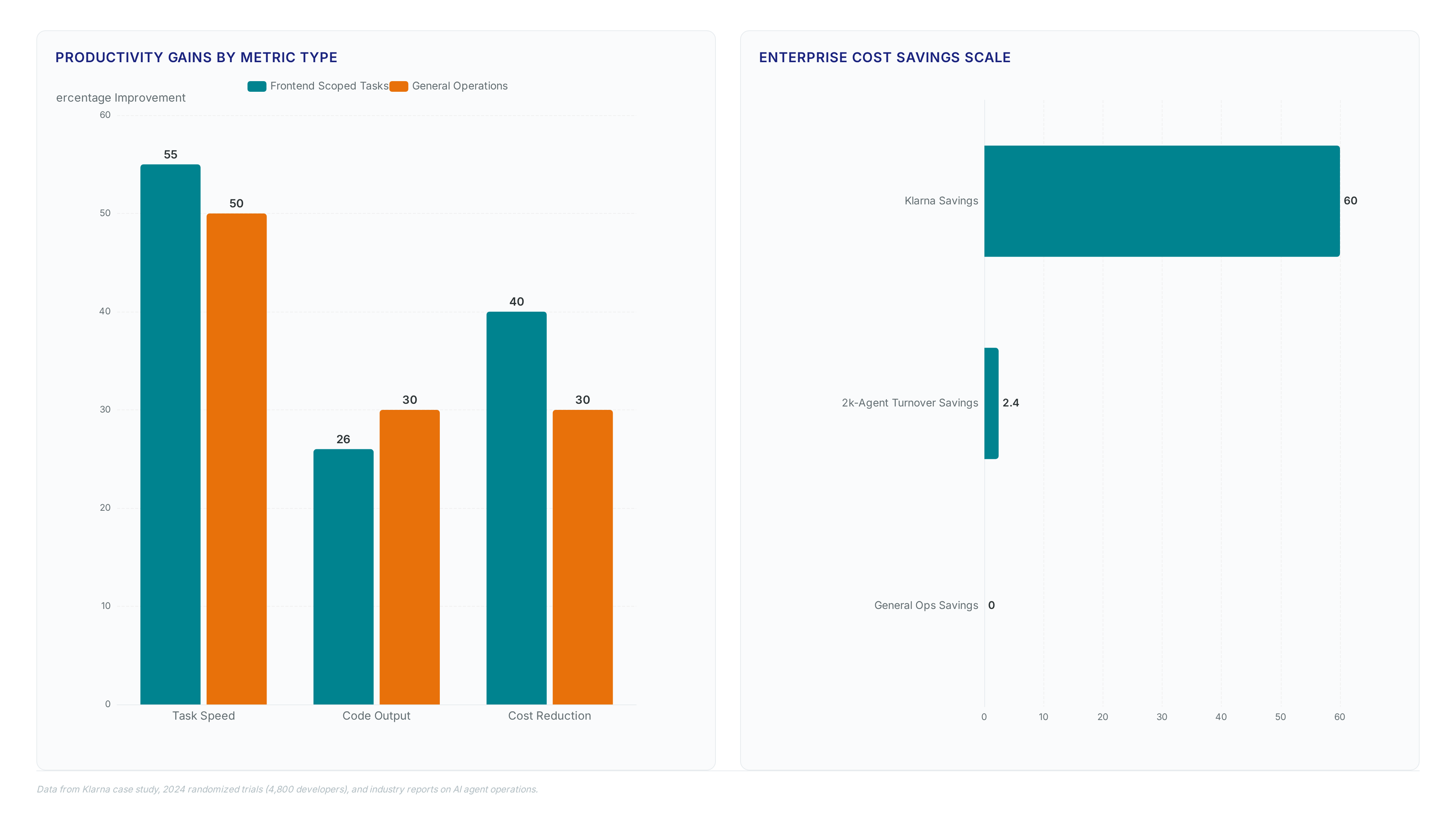
Klarna secured $60 million in savings from its agent deployment, yet frontend teams see value through 55% faster task completion on scoped work. Capital reduction appears on enterprise ledgers while developer velocity metrics reveal the immediate tactical advantage of autonomous systems. Randomized trials across 4,800 developers in 2024 found a 26% increase in pull requests weekly, signaling sustained throughput gains. Visual iteration loops benefit most from immediate code generation and layout adjustments according to recent industry analysis. Frontend functions experience higher acceleration from coding agents compared to backend or infrastructure layers. Raw speed often masks the complexity of maintaining deterministic user interfaces.
Real-World Use Cases: Flexible UIs, Figma-to-Code, and Autonomous Support Flows
Kombai outperforms general models on frontend tasks by generating reliable code from design specs. Developers moving from a Figma comment to a working UI stub avoid manual glue code when using domain-specific agents like Kombai. These systems parse visual data to produce components that adhere to brand tokens via Design System Sync. Flexible interfaces now adapt layouts in real-time, personalizing content without human intervention. Background agents such as Builder read repositories directly to validate visual previews, a capability missing in general code editors. Autonomous support flows route customer issues and auto-configure dashboards based on user behavior patterns.
This shift reduces friction but introduces a tension between speed and maintainability. Rapid generation often yields complex, hard-to-debug component trees if guardrails lapse. Teams must balance the velocity of autonomous routing with the stability required for production environments. Over-reliance on generation can obscure the underlying logic, making future iterations costly for human maintainers. Agents excel at scaffolding but require strict deterministic UI patterns to prevent chaos. Frontend architects should deploy these tools for initial stubs while enforcing rigorous review policies on generated logic.
The Cost of Failure: Analyzing Wasted Spend and Complex Integration Risks
Organizations report up to 70% wasted spend reduction when optimizing agent deployments through disciplined discovery phases. Future capabilities where agents self-test and integrate pull requests increase the stakes of initial configuration errors. A single misconfigured policy in a high-autonomy system can cascade into expensive operational downtime. Engineering hours required to retrofit safety into a deployed system represent the hidden cost rather than model usage. Teams skipping the proof-of-concept phase face higher failure rates during production scaling. Developers must implement strict context resets and structured handoffs to prevent state corruption. Relying on default configurations without custom validation logic invites catastrophic failure modes. Financial exposure grows linearly with agent autonomy if oversight mechanisms remain static.
About
Priya Nair, AI Industry Editor at AI Agents News, tracks the rapid evolution of autonomous systems daily. Her role requires deep immersion in the "Agent Leap," analyzing how tools like Devin and Claude Code shift from simple prompt responses to orchestrating complex workflows. This constant evaluation of emerging frameworks and coding agents uniquely positions her to guide frontend developers through this transition. While many focus solely on prompt engineering, Priya's coverage of multi-agent coordination and tool use reveals why understanding agent architecture is now a critical skill for 2026. At AI Agents News, she dissects the practical realities of building interfaces that "do genuinely smarter things," moving beyond parroted text to true autonomy. Her insights bridge the gap between high-level industry moves and the daily work of frontend engineers, offering a factual roadmap for integrating semi-autonomous agents into modern user experiences without the hype.
Conclusion
The frontend case for agents is not faster text generation but execution: prompts stay stateless, chatbots keep history, agents orchestrate tools and finish multi-step tasks. That gap is what separates a $20,000 prototype from the $500,000 systems built around real state management, and it is why the work moves from writing components to designing decision loops.
The order of work is fixed. Write prompts as specifications with explicit roles, stack constraints, and edge cases. Keep the runner server-side behind a backend that validates tokens, and treat the context window as volatile cache the application layer owns. Only with those guards in place do the reported gains, 55% faster task completion on scoped work and 26% more pull requests weekly, survive contact with production, because the same autonomy that produces them is what makes an unguarded agent expensive.
Frequently Asked Questions
Basic AI agent implementations start around $20,000 while production systems exceed $500,000. This wide range reflects the complexity required for robust state management in autonomous workflows.
Enterprise integration of autonomous systems jumps from 5% in 2024 to a projected 40% of applications by 2026. This surge defines the Agent Leap toward dynamic workflow orchestration.
Agents execute multi-step plans and orchestrate tools rather than just storing conversational memory. This autonomy demands spec-first engineering to prevent unpredictable behavior during complex decision loops.
Failure to implement deterministic UI patterns leads to erratic user experiences when the agent loops or retries. Proper guards are essential since agents call APIs unlike read-only chatbots.
Prompts evolve from simple text generation into specifications for semi-autonomous task completion. Developers must design entire decision loops instead of writing components that merely parrot text back.