Agent-native systems need ephemeral auth, not OAuth
Hugging Face logged 48.6 million requests from Claude Code and 36.4 million from Codex in two months, and none of that traffic can stop to click through a browser login. That is the working case for agent-native infrastructure: dashboards built for human eyes give way to architectures where an AI coding agent is the primary user, which means ephemeral deployments and dual-mode CLIs instead of authentication walls.
Legacy tooling was designed for an interactive human at the other end. As Claude Code hits a $2.5 billion run-rate, the friction of a browser-based login stops being cosmetic and becomes a failure point for background operations.
Machine-readable authentication via auth.md standards replaces OAuth pop-ups with claim tokens, and OpenEnv RL training benchmarks agents on real tool usage rather than static code completion. Both point the same way: the interface an agent meets decides whether it finishes the job or stalls.
The Definition of Agent-Native Infrastructure in Modern Development
Temporary accounts valid for exactly 60 minutes remove authentication barriers by generating disposable credentials on demand. Agent-native infrastructure defines systems where AI agents operate without human intervention during the build loop. When an unauthenticated agent invokes the Wrangler CLI, the platform issues a proof-of-work challenge to prevent spam before creating the disposable environment. Output includes a claim URL so humans intervene only when necessary. This design eliminates the friction of interactive OAuth flows that stall autonomous workflows.
Legacy platforms face severe economic consequences under this new model. Scaling infrastructure expenses for cloud resources can run 2-5x above initial projections as software transitions from development to production, a risk compounded by idle-time billing models. Agent-native designs mitigate this by charging only for compute time rather than wall time, ensuring costs align strictly with active iteration. Rapid feedback loops required for autonomous coding become prohibitively expensive without such efficiency.
Executing the Write-Deploy-Verify Loop with Wrangler CLI
The --temporary flag in Wrangler CLI v4.103.0+ enables unauthenticated agents to bypass OAuth walls and execute immediate code deployments. This mechanism creates ephemeral environments where AI coding agents write logic, deploy via a proof-of-work challenge, and verify outputs via curl within a strict 60 minute window. Unlike legacy platforms charging for idle time during long agent workflows, this model charges only for active compute time, dramatically reducing the cost of failed iterations. The design assumes agents require cheap, throwaway contexts to close their feedback loops without human credential management.
Security tension arises between rapid iteration and persistent state protection due to this velocity. Temporary accounts vanish after the window expires, meaning any data not claimed or migrated to persistent storage like R2 object storage is lost forever. This constraint forces agents to treat state as external and transient, a shift that breaks traditional application patterns relying on local disk persistence. The limitation is clear: while the loop accelerates development, it cannot sustain long-running services without human intervention to claim the deployment.
Checklist for Dual-Mode CLIs and Machine-Readable JSON Status
Redesigning infrastructure for agents requires publishing auth.md specifications and enforcing non-interactive CLI flags to eliminate human dependency. This shift addresses the reality where backend data infrastructure costs often exceed user-facing application expenses, demanding higher automation efficiency.
- Add
--no-inputflags to prevent CLI hangs during credential prompts. - Output full, untruncated JSON status objects for machine parsing.
- Detect
$AI_AGENTenvironment variables to switch output modes automatically. - Provide structured error codes instead of human-readable advice text.
Traditional interfaces fail because they truncate logs, breaking the parse-deploy-verify loop necessary for machine learning models in production. Dual-mode design increases binary size and adds complexity when maintaining parallel output schemas.
Mechanics of Dual-Mode CLI and Machine-Readable Authentication
Dual-Mode CLI Output Mechanics via Environment Variables
Detection of the $CLAUDECODE environment variable triggers the hf CLI to swap human-readable tables for machine-parsable streams. ANSI colors and truncated dates confuse autonomous agents, often forcing costly inference loops to parse output. Human Mode displays aligned tables with short dates like 2025-04-27 alongside prose hints for visual scanning. Agent Mode strips all styling to emit plain TSV streams containing full tag arrays and ISO 8601 timestamps like 2025-04-27T03:40:08+00:00. This structural shift allows agents to process resumable Codemode execution without discarding non-compliant characters.
Strict schema enforcement creates a hard constraint; any deviation in the TSV structure causes immediate agent failure rather than graceful degradation. Operators must prioritize practical value in their CLI design by eliminating all decorative elements that do not serve the write-deploy-verify loop. AI Agents News identifies this binary output capability as the baseline requirement for any tool claiming autonomous readiness.
Implementing auth.md for Agent-Verified OAuth Flows
Publication of an auth.md file at the standard path enables agents to bypass interactive browser redirects by advertising supported flows like agent-verified authentication. This open protocol, hosted at yourapp.com/auth.md, explicitly defines token lifetimes so autonomous systems know access tokens expire after 3600 seconds without requiring human intervention. Developers implementing this standard reduce inferential load, allowing agents to select the correct grant type immediately rather than guessing from HTML error pages. The mechanism shifts the burden from runtime discovery to static specification, a requirement as AI moves from experimental projects to the backbone of enterprise architecture. Static files introduce versioning risks if the specification drifts from the actual server implementation. Teams must treat auth.md as a vital dependency, validating it against live endpoints during CI pipelines to prevent agent lockout.
Credential isolation from the agent context mirrors how resumable Codemode execution maintains state across interruptions. Without this machine-readable contract, agents stall at OAuth walls, forcing expensive human fallback. Platforms without a published auth.md will see autonomous adoption stall as agents route to compliant alternatives.
Token Efficiency: Redesigned CLI versus Curl and Python SDK
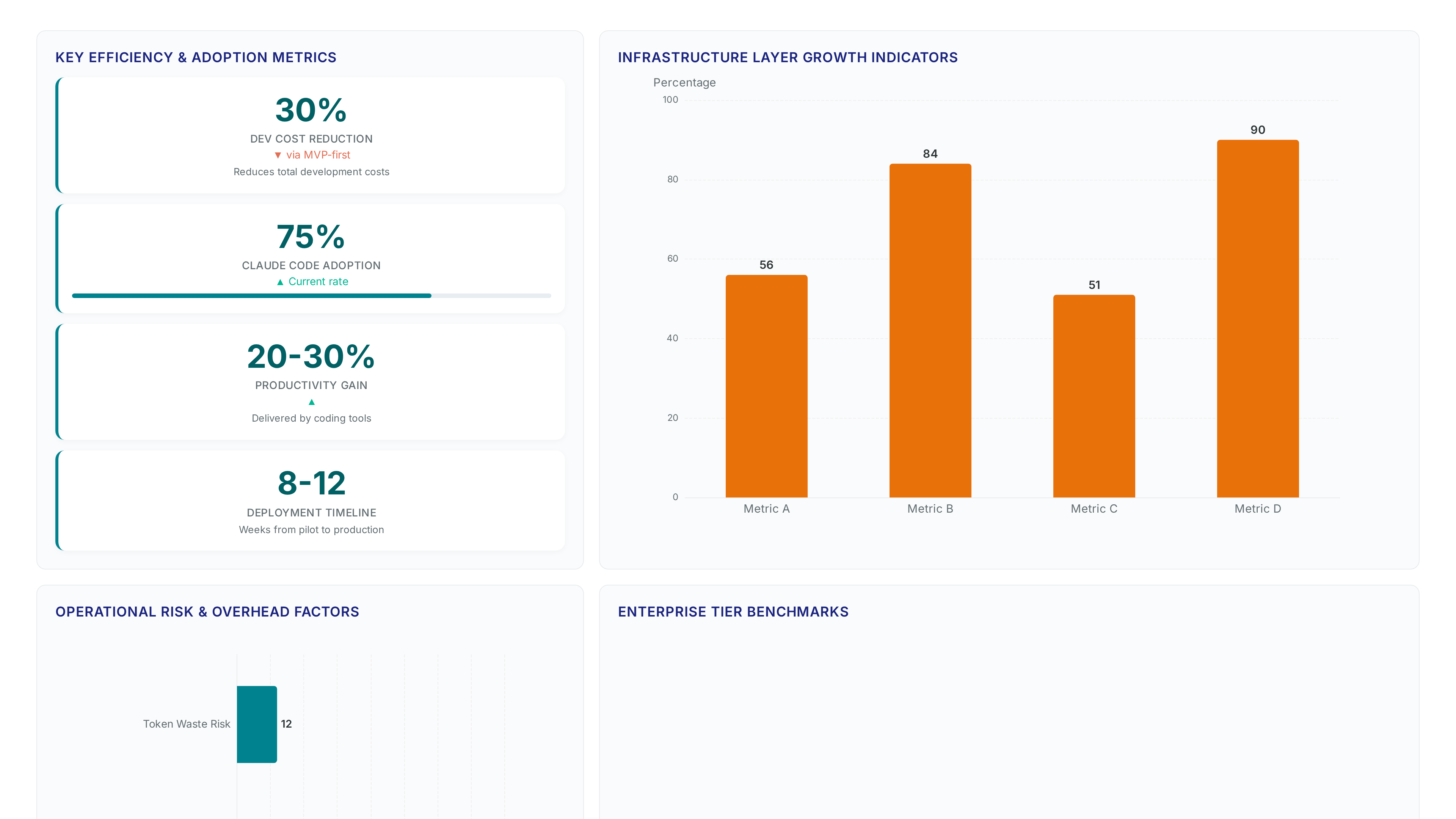
Elimination of parsing overhead allows the redesigned dual-mode CLI to consume 1.3 to 6 times fewer tokens than raw curl or Python SDK calls. Pre-parameterized hints embedded in the CLI output reduce inferential load, allowing agents to skip trial-and-error loops when constructing API requests. This efficiency gap widens as task complexity increases, turning minor latency savings into substantial cost reductions across thousands of daily deployments. Small companies dominate this shift, with Claude Code holding a 75% adoption rate where rapid iteration outweighs legacy compliance needs. These environments benefit most from agent-native designs that prioritize machine readability over human aesthetics. Conversely, large enterprises show 56% adoption of GitHub Copilot, often constrained by existing contracts that slow the transition to ephemeral, token-efficient workflows. The cost remains clear: without standardized dual-mode output, agents waste capacity interpreting human-formatted errors instead of executing logic. Organizations ignoring this friction risk inflating their operational costs as agent traffic scales. AI Agents News identifies token efficiency as the primary lever for sustaining autonomous development cycles in 2026.
Implementing Ephemeral Deployments and Dual-Mode Support
Where the Two Output Modes Differ
Human mode and agent mode part ways on date format, color codes and truncation. The price of the rigid one is a loss of visual hinting for humans, requiring separate documentation for manual troubleshooting.
| Output Mode | Date Format | Color Codes | Truncation |
|---|---|---|---|
| Human | Short (YYYY-MM-DD) | Enabled | Yes |
| Agent | ISO 8601 Full | Disabled | No |
AI Agents News recommends validating these switches against production logs before wide rollout.
When a CLI hides full error codes, an autonomous system cannot distinguish a transient network glitch from a permanent configuration fault, and blind retries consume budget without advancing the state machine. Enterprise architectures relying on Model Context Protocol servers require deterministic failure signals to maintain operational stability.
What Agent-Ready Interfaces Buy: Benchmarks, Training Loops, Field Data
Defining Agentic Benchmarking Tiers: Bare, Clone, and Skill
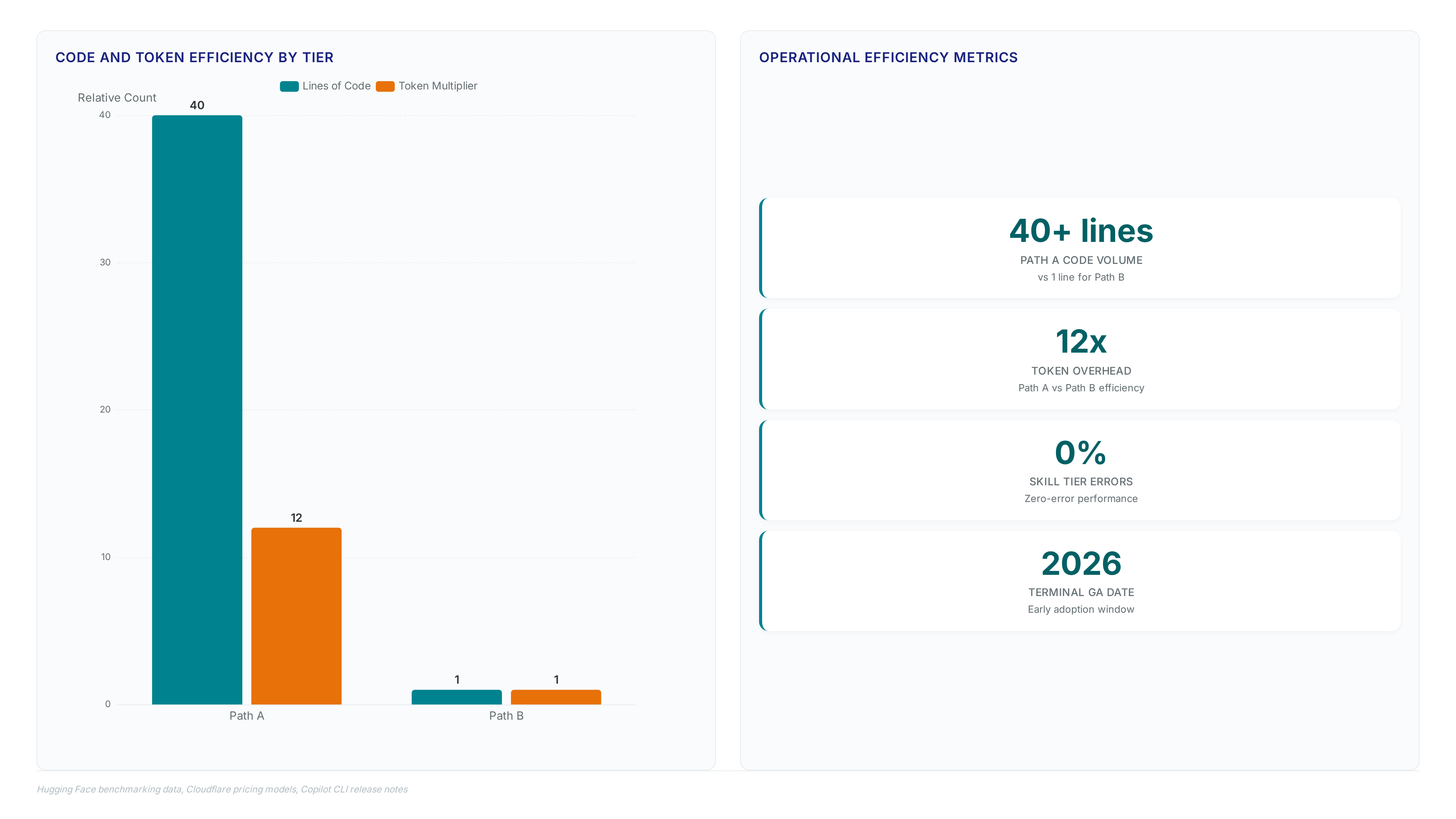
Hugging Face benchmarking data reveals Path A required 40+ lines and ~12x tokens compared to the single-call efficiency of Path B. This three-tier framework evaluates agent path efficiency rather than simple task correctness across distinct environmental constraints. The bare tier restricts agents to basic package installation, forcing costly trial-and-error discovery without context. Clone environments provide the full source tree, reducing inferential load but still requiring significant navigation logic. Skill tiers load curated CLI documentation and examples, enabling the zero-error performance seen in optimized workflows.
| Tier | Context Provided | Token Efficiency | Error Rate |
|---|---|---|---|
| Bare | None | Low | High |
| Clone | Full Source | Medium | Medium |
| Skill | Curated Docs | High | Zero |
Infrastructure pricing models often penalize wall time, making the token savings from Skill environments financially material for high-volume operations. The shift toward agent-optimized interfaces aligns with broader industry moves where Copilot CLI terminal integration reached general availability in early 2026. Adopting Skill tiers requires maintaining parallel documentation sets specifically for machine consumption. Neglecting this creates a hidden tax where agents consume excessive tokens parsing unstructured text. Operators must treat agent documentation as a first-class engineering deliverable to avoid compounding latency costs.
Applying OpenEnv Protocols for Real-World Agent Training
OpenEnv uses reset, step, and state calls over HTTP to train agents on real terminal interfaces without manual intervention. This universal interface, backed by Microsoft, replaces brittle, human-centric CLIs with a consistent protocol layer that leaves reward definition to libraries like TRL. Operators must expose internal tools via strict schemas, limiting legacy system integration without wrappers.
Operators ignoring this hierarchy face inflated inference bills as agent traffic scales. The emergence of Microsoft Agent Framework signals that enterprise readiness now depends on these standardized training grounds. Without them, agents remain trapped in local simulation loops rather than mastering production tooling. Universal training requires universal exposure of tool interfaces, a security posture many organizations hesitate to adopt. AI Agents News identifies this exposure gap as the primary bottleneck for autonomous adoption in regulated industries.
Project Fetch Phase Two: Speed That Depends on the Interface
Anthropic's Project Fetch Phase Two data shows Claude Opus 4.7 completing shared robotics tasks in 9 minutes 35 seconds, a 37.7× speedup over non-assisted human teams. This performance gap highlights how autonomous execution eliminates the coordination latency inherent in human collaboration. The agent wrote 10× fewer lines of code than the human-assisted group, suggesting that direct tool access reduces unnecessary abstraction layers. Efficiency assumes the agent operates within a pre-validated environment; agents in novel contexts may still require human intervention for complex debugging. For network operators, investing in agent-ready interfaces yields higher returns than optimizing for human CLI ergonomics alone.
| Metric | Claude Opus 4.7 | Team Claude | Team Claude-less |
|---|---|---|---|
| Completion Time | 9m 35s | ~3 hours | ~6 hours |
| Code Volume | Minimal | Moderate | High |
| Error Rate | Low | Medium | High |
The underlying mechanism relies on the agent's ability to execute tight feedback loops without waiting for human approval at each step.
About
Marcus Chen serves as Lead Agent Engineer at AI Agents News, where he daily architects and evaluates production multi-agent systems. This hands-on experience directly informs his analysis of agent-native infrastructure, as he constantly navigates the limitations of legacy stacks when deploying autonomous tools like Claude Code and Codex. Unlike observers, Chen's work requires implementing the very ephemeral deployments and auth.md protocols discussed, giving him practical insight into why traditional servers fail under agentic load. At AI Agents News, a hub dedicated to technical founders and engineers building with frameworks like LangGraph and AutoGen, Chen tracks how explosive API growth demands a fundamental redesign of underlying infrastructure. His daily struggle to optimize orchestration and tool-use mechanics ensures this article moves beyond theory, offering actionable guidance for engineers facing the reality of millions of automated requests.
Conclusion
Scaling agent-native infrastructure reveals a critical breaking point: deterministic state signaling. While speed gains are immediate in controlled tests, operational costs skyrocket when agents encounter ambiguous legacy error codes that force expensive retry loops. The real bottleneck shifts from computation to the latency of resolving undefined system states. Organizations must transition from human-centric CLI ergonomics to machine-readable interfaces that explicitly define success and failure boundaries for autonomous execution.
Do not layer agent orchestration on top of systems that cannot self-report token expiration or hold a strict output verification window. An agent that cannot read the state it just changed retries blindly, and a blind retry is a bill rather than an error message.
Frequently Asked Questions
Hugging Face recorded 48.6 million requests from Claude Code and 36.4 million from Codex in two months. Volume by itself is not the problem: none of those calls can pause for a browser redirect, so an interactive login wall turns into a stalled job instead of a prompt somebody answers.
Temporary deployments bypass OAuth entirely by issuing claim tokens. This allows agents to iterate freely within a strict time window, avoiding the friction that stops autonomous workflows dead in their tracks today.
Legacy tools risk losing autonomous agent adoption to friction-free alternatives. With Claude Code generating $2.5 billion in run-rate, platforms blocking background operations will be bypassed entirely by high-volume coding agents.
Dual-mode CLIs detect agent variables to output machine-readable errors. With Claude Code at a 75% adoption rate among small companies, tools requiring interactive human logins will fail to support autonomous development loops effectively.
Bare gives an agent package installation and nothing else, clone adds the full source tree, and skill loads curated CLI documentation and examples. Context is what moves the error rate down to zero in the skill tier, and the cost of getting there is maintaining a documentation set written for machine consumption.