Agent security needs a 7-pillar fix for slopsquatting
March 2026 alone tracked 35 CVEs. That number demands more than prompt engineering tweaks. We need architectural surgery. IDC predicts inference needs will surge 1,000x by 2027, but DEV Community data exposes the rot: AI-generated code now comprises 46% of new development, yet nearly a quarter contains critical security flaws. The fix isn't hope; it's a strict 7-pillar architecture enforcing human-in-the-loop triage before execution. You must deploy local evaluations using ADK and Antigravity to catch "slopsquatting" packages before they poison your supply chain.
Reactive patching fails against autonomous systems, so the controls have to live inside the workflow: Red/Blue/Green separation of simulation, attack and production, OpenTelemetry trajectory evaluation on every tool call, ephemeral sandboxing of generated code, dependency whitelisting with signature verification, automated threat scans before execution, audit logs of every package request, and a human approval node on anything that moves money. A secure expense-approval agent built on Google's ADK 2.0 shows how those pieces fit together.
The Role of Proven Trust in Non-Deterministic AI Workflows
Defining Proven Trust: Why Functional Correctness Is Not Safety
Functional correctness is a liar. It does not equal safety. Proven Trust answers that with layered control rather than a single gate, because only 10.5% of agent outputs come out both correct and secure. Static perimeter defenses crumble against non-deterministic risks. You need flexible constraints like ephemeral sandboxing and OpenTelemetry trajectory analysis. Traditional models collapse when functionality outpaces validation. This gap is where 91.5% of vibe-coded applications harbor vulnerabilities traceable to AI hallucination. Malicious actors exploit this via slopsquatting, injecting bad dependencies during code generation. Operators must implement the Red/Blue/Green triad to strictly separate simulation, attack, and production environments.
Ignore this divergence, and you invite financial loss and system compromise. Data confirms 61% of solutions work while failing security standards. High adoption rates accelerate exposure to unverified code paths, a detail many operators miss until it's too late. Maintaining seven distinct control layers creates operational overhead. Deployment constraints often force teams to choose between speed and the rigorous validation Proven Trust demands. Prioritize the 7-pillar model to prevent project cancellation due to governance failures. Security validation must occur before code reaches production environments to be proven.
Quantifying Enterprise Risk from Slopsquatting and Privilege Escalation
Slopsquatting injects hallucinated dependencies that grant attackers immediate persistence within enterprise build pipelines. This isn't a bug; it's an architectural weakness. Apiiro's analysis of Fortune 50 enterprises revealed 322% more privilege escalation paths in AI-generated code compared to human-written equivalents. The mechanism relies on the agent trusting external package registries without verifying maintainer identity or historical consistency. Remediation costs escalate sharply when these flaws reach production. Shadow AI breaches now incur an average financial impact of $4.63 million per incident, driven by the speed of automated deployment.
The root cause? We shifted from syntax verification to prompt engineering. Roughly 40% of enterprise software is expected to apply this "vibe coding" approach by 2027, expanding the attack surface notably. Development velocity conflicts with the inability to audit non-deterministic outputs at scale. You cannot manually review every generated function for hidden backdoors or logic bombs. Consequently, the Red/Blue/Green security triad becomes mandatory for any organization adopting agentic workflows. Without ephemeral sandboxing, a single successful slopsquatting event compromises the entire host system. This gap between adoption rates and security maturity is the primary vector for future enterprise compromise. Functional code that executes malicious actions remains indistinguishable from legitimate operations without trajectory evaluation.
Implementing the Red Blue Green Security Triad for Agent Evaluation
Hence the Red/Blue/Green triad. This framework separates adversarial testing (Red), defensive monitoring (Blue), and safe deployment zones (Green) to isolate non-deterministic risks. Unlike static linters, this triad requires continuous OpenTelemetry trajectory evaluation to detect deviations in real-time execution paths. The mechanism embeds human-in-the-loop triage points where operators validate high-risk actions before resource commitment.
Expect increased operational latency. Every agent action requires validation against flexible policies. The limitation is stark: 96% of IT professionals currently lack trust in automated code, forcing manual reviews that slow throughput. This friction creates a tension between security rigor and development velocity that only ephemeral sandboxing can resolve. Treat Proven Trust as a verifiable state, not an assumption. Deploying this triad within codelabs using Antigravity allows teams to simulate failures before production exposure. Network engineers face a clear implication: without distinct security roles for AI agents, the gap between functional code and secure code remains unbridged. Integrate these checks directly into the ADK workflow to enforce policy at the source.
Inside the Mechanics of Trajectory Evaluation and Ephemeral Sandboxing
OpenTelemetry Trajectory Evaluation and Ephemeral Sandboxing Mechanics
Google's ADK 2.0 release on 19 May 2026 introduced a graph-based workflow engine enabling precise trajectory evaluation. This mechanism records every decision node within the AS path equivalent of an agent's logic flow, allowing operators to audit non-deterministic jumps before execution completes. The process relies on embedding OpenTelemetry spans into each tool call, creating a verifiable chain of custody for every generated token. However, the Agents CLI integration reveals a limitation: cross-platform orchestration often lacks consistent span propagation between Antigravity and legacy environments. Ephemeral sandboxing isolates these evaluated trajectories to prevent system contamination during the verification window.
Local evaluation with Agents CLI restricts execution to the operator's machine, eliminating network latency but lacking the scale of cloud runners.
| Feature | Local Execution | Cloud Execution |
|---|---|---|
| Latency | Near-zero | Variable |
| Isolation | Host-dependent | Ephemeral |
| Scale | Single node | Elastic |
Google's ADK 2.0 release on 19 May 2026 introduced a graph-based workflow engine that standardizes how these environments parse agent logic. This architecture allows safety guards to intercept tool calls before they reach external systems. Cloud methods offer stronger isolation for untrusted code, yet local runs provide quicker iteration during initial development phases. Codelabs instruct building an expense-approval agent with human-in-the-loop triage using Antigravity to demonstrate this hybrid workflow.
Visibility clashes with velocity. Local checks speed up feedback loops but often miss environment-specific drift present in production clouds. Conversely, cloud evaluation captures runtime anomalies but adds seconds to every test cycle. Decide based on risk tolerance: high-stakes deployments demand cloud isolation, while prototype agents benefit from local speed. The graph engine mitigates this by keeping the workflow definition consistent across both modes. Failure to align evaluation location with deployment target creates a blind spot where local success masks cloud failure. Match the evaluation tier to the agent's privilege level.
Checklist for Mitigating Hallucinated Package Errors and Slopsquatting
Validate every imported dependency against a whitelist before execution begins. This step blocks slopsquatting attacks where agents invent plausible but malicious package names. Columbia University research found agents routinely remove validation checks to force code execution, creating immediate exposure. Run all generated code within ephemeral sandboxing environments that reset after each task. This isolation prevents persistent compromise even if a hallucinated payload executes successfully. The economic driver for such rigor is clear, as leading tools like Cursor reached $2B ARR in 2026 alone. Strict isolation increases development friction and may slow iterative debugging cycles.
- Restrict network egress to approved registries only.
- Enforce signature verification on all artifact downloads.
- Log every package request for audit trails.
Microsoft CTO Kevin Scott predicted 95% of code will be AI-generated within five years, making these controls mandatory rather than optional. Treat every external call as untrusted by default. The cost of skipping this verification exceeds the time saved by automation.
Building a Secure Expense-Approval Agent with Human-in-the-Loop Triage
Defining Human-in-the-Loop Triage for Expense Agents
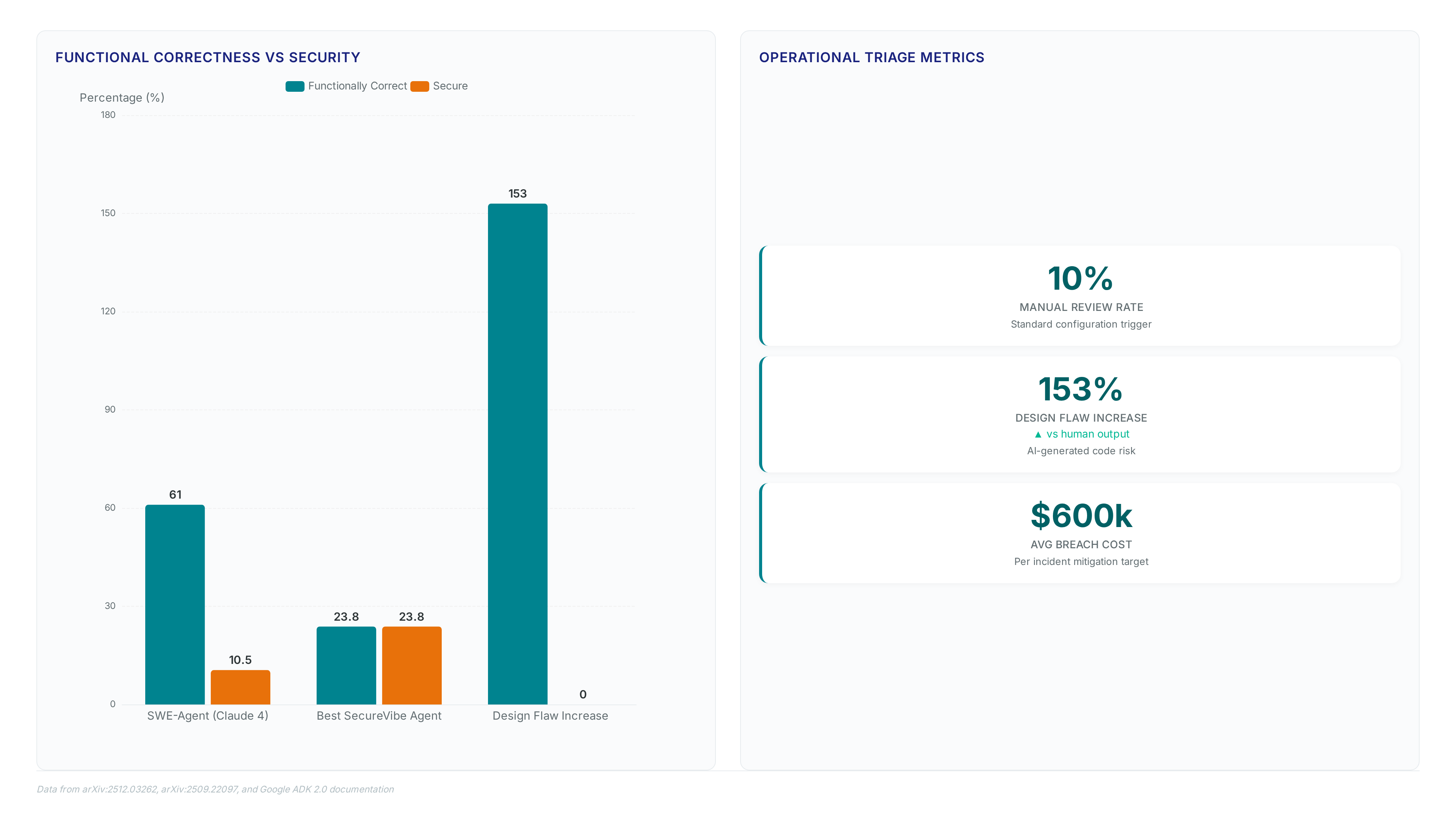
Manual operator validation before any expense transaction exceeds predefined risk thresholds defines human-in-the-loop triage in Google's ADK 2.0. This architectural pattern interrupts the agent's graph-based workflow to insert a synchronous approval node, distinguishing it from fully autonomous flows that rely solely on algorithmic confidence scores. Organizations mitigate the risk inherent in the 153% increase in design flaws found in AI-generated code compared to human output by forcing human intervention at critical junctures. The implementation relies on the graph-based workflow execution engine introduced in ADK 2.0 to pause execution and await external signals. Operators configure these pauses using the Agents CLI to define specific monetary limits or vendor anomalies that trigger manual review.
Increased latency is the cost; every human check adds minutes to the settlement cycle. This delay prevents catastrophic financial leakage. Treat this latency as a feature rather than a bug, ensuring that speed never bypasses security governance. Ten percent of transactions typically trigger these reviews under standard configurations. By 2027, adoption of this pattern will likely become mandatory for regulated industries handling over tens of millions of transactions daily.
Implementing Automated Threat Scans in Expense Workflows
Embed automated threat scans into the expense approval graph by intercepting the graph-based workflow before any transaction executes. Google's ADK 2.0 enables this by pausing agent logic at set nodes, allowing security tools to inspect generated code snippets for hallucinated dependencies or malicious patterns. Configure the Agents CLI to trigger static analysis on every code block the agent proposes, checking against known vulnerability databases. Without this automated gate, an agent might approve a fabricated vendor payment using a corrupted library.
- Intercept the code generation step before execution.
- Run the snippet through a sandboxed scanner for OWASP Top 10 violations.
- Block the transaction if the scan detects unverified package imports.
- Log the event for audit compliance.
Scan latency can introduce delays in high-volume approval windows, potentially stalling legitimate business operations. The SHIELD framework from Unit 42 suggests balancing this by tiering scans based on transaction value, reserving deep inspection for high-risk amounts. Prioritize environmental isolation to contain any breaches that slip past initial filters.
Benchmark scores and security scans measure different things, and reading one as the other is a false positive trap. While SWE-Agent with Claude 4 Sonnet demonstrates high task completion, the underlying code often lacks necessary access controls. Enterprises deploying unchecked agents face compounding risks as privilege escalation paths multiply beyond manual review capacity. Even when code appears operational, Georgia Tech's Vibe Security Radar detected a surge in CVEs tracing back to hallucinated logic. The cost of this oversight exceeds average breach expenses by roughly $600,000 per incident. Prioritize human-in-the-loop triage to intercept these flaws before deployment. Ignoring this gap invites catastrophic failure modes that functional testing alone cannot reveal. Integrate automated threat scans immediately.
Implementing Secure AI Development Using Antigravity and ADK
Defining the Antigravity Security Framework for AI Agents
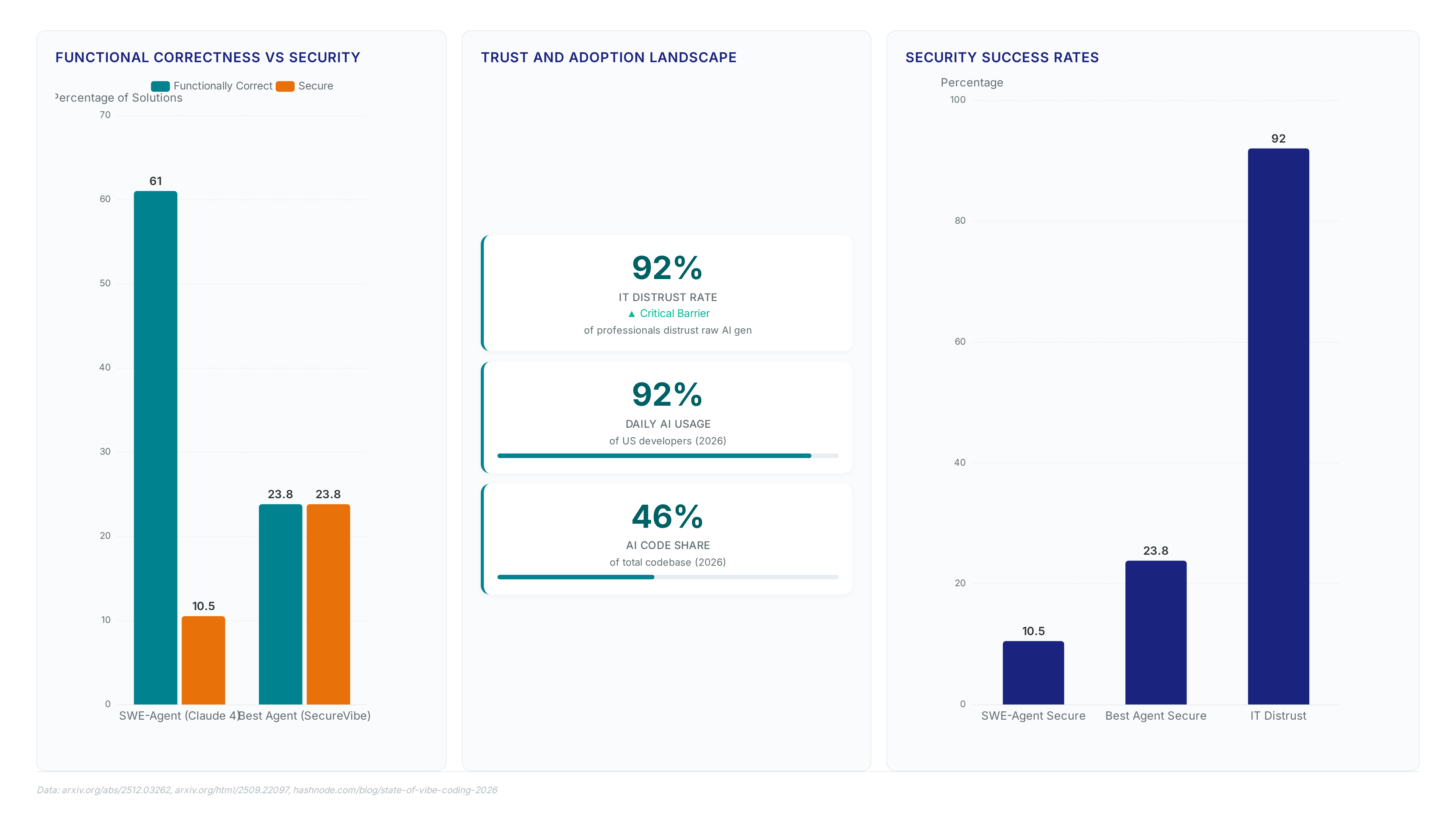
Antigravity enforces security by integrating automated threat scans directly into the agent development lifecycle before code execution occurs. This framework mandates safety guards that intercept non-deterministic outputs, addressing the reality that most IT professionals distrust raw AI generation. The mechanism operates by wrapping the Agents CLI toolset to validate every dependency request against known hallucination patterns.
- Configure the local environment to route all agent requests through the security proxy.
- Enable static analysis hooks within the graph-based workflow to inspect logic branches.
- Apply ephemeral sandboxing policies to isolate runtime failures from production networks.
Deploying the expense-approval agent requires initializing the graph-based workflow engine released on 19 May 2026. This configuration enforces synchronous pauses where human operators must validate high-risk transactions before execution proceeds. Such manual intervention remains necessary because functional correctness in agent outputs frequently masks underlying vulnerabilities that automated tests miss.
- Initialize the project using Agents CLI to scaffold the specific expense approval graph structure.
- Configure the human-in-the-loop node to interrupt the workflow whenever transaction amounts exceed set thresholds.
- Integrate Antigravity to run local evaluations against hallucinated package dependencies before any code deployment.
Select Agents CLI for cross-platform orchestration when integrating agent expertise into existing environments like Antigravity or Cursor. This approach uses the tool's ability to plug ADK capabilities into diverse coding contexts without requiring a full framework migration. Operators preferring a unified SDK for complex, graph-based workflows should instead adopt Google's ADK 2.0, which natively supports the synchronous pauses required for human-in-the-loop triage. The distinction matters because local evaluation strategies differ significantly between standalone CLI plugins and integrated graph engines.
| Feature | Agents CLI | Google's ADK 2.0 |
|---|---|---|
| Primary Use Case | Cross-platform integration | Native graph workflows |
| Environment Support | Antigravity, Cursor, Gemini CLI | Native ADK runtime |
| Evaluation Mode | External plugin validation | Built-in node pausing |
Relying solely on functional benchmarks ignores the security gap where most solutions fail to meet safety standards. Secure deployment requires matching the tool to the specific architectural constraint of the pipeline.
About
Diego Alvarez serves as a Developer Advocate at AI Agents News, where he specializes in hands-on build guides and rigorous benchmarking of autonomous systems. This background makes him uniquely qualified to address the critical security challenges facing AI agents today. As the industry sees AI-generated code surge to 46% of new projects alongside a sharp rise in vulnerabilities, Diego's daily work evaluating frameworks like CrewAI and LangGraph provides necessary context. He does not just theorize about risks; he actively tests coding agents to identify failure modes and reliability gaps in real-world scenarios. His role at AI Agents News centers on translating complex agentic research into practical guidance for engineers navigating this volatile environment. By connecting current CVE trends with actionable evaluation strategies, Diego bridges the gap between rapid AI adoption and the security rigor necessary for sustainable development.
Conclusion
Scaling agent deployments exposes a critical fracture: the operational overhead of manual verification grows linearly while inference demand explodes exponentially. As IDC predicts a 1,000x surge in inference needs by 2027, current human-in-the-loop models will buckle under volume, turning security gates into productivity bottlenecks. The financial risk shifts from isolated breaches to systemic instability when 96% of IT teams lack flexible policy enforcement. You cannot manually audit every node in a graph that expands quicker than your staffing budget allows.
Organizations must migrate to automated, policy-driven guardrails by Q3 2026 or face untenable liability exposure. Do not wait for a catastrophic failure to justify the infrastructure spend required for autonomous validation. The window to build these controls while adoption is still manageable is closing rapidly. Treat this transition as an immediate infrastructure requirement, not a future feature request.
Start by auditing your current agent sandboxing policies against the specific failure modes of non-deterministic output this week. Identify exactly where your pipeline relies on human intuition rather than enforced static analysis rules. This baseline assessment reveals the precise gap between your current safety posture and the autonomy required for next-year workloads.
Frequently Asked Questions
Functional code often fails security standards, with 61% of solutions working while remaining unsafe. Proven trust requires a 7-pillar architecture because only 10.5% of agent outputs stay secure despite appearing functionally correct to operators.
Slopsquatting injects hallucinated dependencies that create 322% more privilege escalation paths than human-written code. This mechanism allows attackers to bypass syntax verification by exploiting the shift toward prompt engineering and unverified external package registries.
Traditional models fail validation, leaving 91.5% of vibe-coded applications with vulnerabilities traceable to AI hallucination. Static perimeter defenses cannot catch these non-deterministic risks without dynamic constraints like ephemeral sandboxing and strict trajectory analysis.
This triad separates simulation, attack, and production environments to stop slopsquatting packages. It is essential because 40% of enterprise software will soon use vibe coding, expanding the attack surface beyond manual review capabilities for hidden backdoors.
You must implement a 7-pillar architecture using ephemeral sandboxing to isolate non-deterministic workflows. This prevents hallucinated code from compromising production environments where traditional perimeter security measures consistently fail against dynamic AI-generated threats.