Real agent tools: Build for failure recovery
Most real agent deployments remain narrow, focusing on single tasks like customer support triage rather than general reasoning.
Stop calling every script an agent. The industry is drowning in semantic dilution because teams mistake basic tool-calling loops for autonomous systems. A true AI agent owns an objective, recovers from its own crashes, and declares victory without a human hand-holding it. If your system halts when an API returns a 500, it's a chatbot, not an agent.
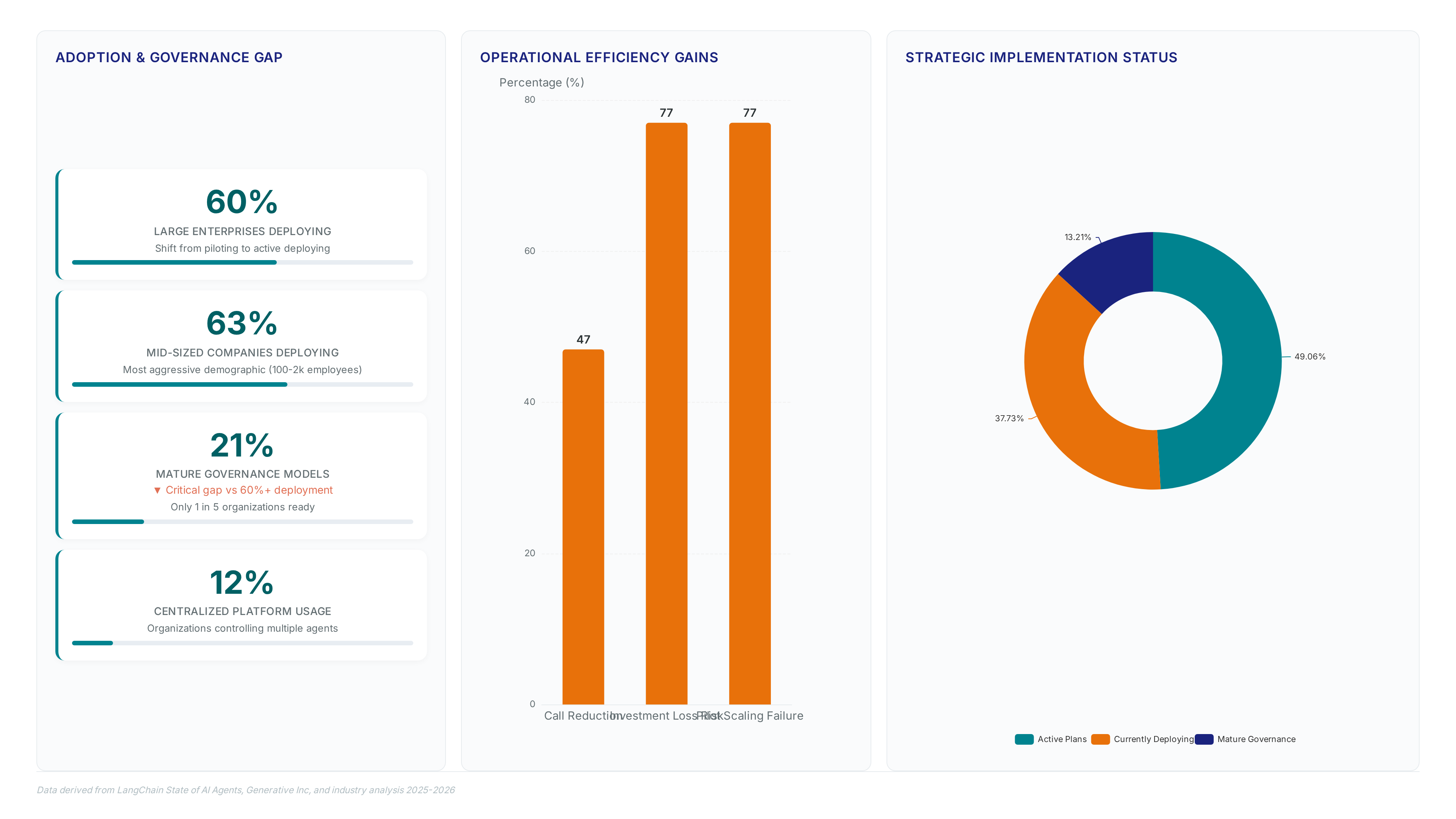
Adoption is accelerating beyond early adopters, with LangChain reporting that 78% of organizations have active plans to implement agents into production soon. Mid-sized companies with 100 to 2,000 employees lead that push, with 63% of them actively putting agents into production. Speed kills here. Rushing this transition without architectural guardrails builds fragile house-of-cards systems. You need strict tool design and granular observability, not just a fancier prompt. Discard the hype around general-purpose reasoning engines. Build purpose-built pipelines that work.
Defining the True AI Agent Beyond the Chatbot Hype
Objective-Driven Systems vs Instruction-Based Chatbots
Define the agent by what it does when things break. A true AI agent possesses an objective, autonomously decides next steps, handles failure, and determines completion status. Instruction-based chatbots die without human input for every sequential action. Current industry analysis indicates most enterprise systems automate a narrow slice of the workflow, focusing on orchestration rather than full independence.
The difference is failure recovery. An instruction-following script halts when a tool call fails. An objective-driven system evaluates the error state, selects an alternative tool, and retries the operation without human intervention.
Real-world agent vs chatbot distinctions manifest clearly in high-volume, narrow tasks like support triage where systems autonomously route tickets. Successful implementations prioritize strong tool design and granular observability over swapping base models for newer releases. Data indicates that 77% of failed deployments attempt broad, complex tool chains without sufficient integration work, leading to compounding errors. Mature teams focus on failure handling, ensuring the system recovers gracefully when a specific API returns nothing useful. In code review scenarios, agents function as specialized pipelines rather than general reasoning engines, analyzing diffs against strict style guides.
Don't add complex orchestration to simple workflows. Some teams have spent weeks adding "agentic" orchestration to workflows that would have been fine as a single well-structured prompt. Merely looping a model does not grant it the objective-driven autonomy required for production.
| Risk Factor | Simple Prompt | Over-Orchestrated Loop |
|---|---|---|
| Failure Mode | Immediate error | Silent degradation |
| Debugging | Direct trace | Distributed ambiguity |
| Latency | Low | Compounded |
"Compounding error across long tool chains" is a primary financial killer of agent projects. Budget for strong error-handling architectures, not just model tokens. Distinguish between genuine multi-agent coordination and unnecessary complexity that obscures root causes. The "overhead" of coordinating tasks manually is often described as being "more expensive than the work itself." That is your cost-benefit metric. Ignoring this architecture costs you in degraded reliability and increased operational overhead.
Architecting Reliable Agents with Plan-Then-Execute Patterns
Plan-Then-Execute Pattern Mechanics
Force the model to think before it acts. Separating reasoning from action forces a model to generate a complete structural plan before invoking any tools. This plan-then-execute pattern dedicates one reasoning step to producing a plan and a separate execution step to following it. It breaks the feedback loops where an agent intermixes thinking with doing, a failure mode common in linear chains. The planning phase outputs a structured sequence; the execution phase strictly follows this predefined roadmap without deviation.
Recent industry analysis indicates that a significant majority of organizations have active plans to implement agents into production soon, yet many struggle with compounding errors from unstructured approaches. The core mechanism requires the system to decompose a high-level objective into discrete, verifiable subtasks during the initial pass. The system proceeds to the execution layer, often using existing automation infrastructure while the AI handles decision logic.
Generating a thorough plan consumes significant context window space, which can be prohibitive for extremely complex, open-ended tasks. If the initial plan contains a logical flaw, the execution phase may propagate that error unless explicit validation gates are inserted. This pattern trades token efficiency for reliability. The system spends compute cycles upfront to reduce the probability of catastrophic failure during tool use. This approach aligns with findings that successful deployments apply narrow, high-volume tasks rather than attempting broad, unstructured reasoning chains.
Structured Handoffs in Agent Workflows
Stop passing unstructured text strings between agents. It causes context loss and untraceable failures. Effective systems replace these opaque transfers with explicit handoffs that enforce structured, logged data contracts between distinct reasoning units. Treat fetching context and using context as separate jobs. Unlike simple prompt chaining, this pattern requires defining strict input and output schemas for every interaction point.
Latency introduces a tangible cost at each transfer boundary due to serialization and validation steps. This overhead ensures reliability while increasing total execution time, which requires careful consideration for interfaces requiring sub-second responses. Accept higher total execution time in exchange for auditable state transitions and improved failure recovery capabilities.
Organizations expanding enterprise tiers for governance now prioritize these control layers over raw execution volume. By isolating retrieval logic from decision-making loops, teams prevent local context errors from corrupting global objectives. When a tool returns unexpected data, the system halts cleanly rather than propagating garbage downstream.
Framework Choice vs Architectural Patterns
Choosing LangChain over LangGraph yields marginal returns if the underlying architectural patterns remain unstructured. Frameworks matter less than patterns. Rebuilding the same architecture in three different frameworks yielded similar results. Teams frequently mistake framework selection for engineering rigor, yet integration work determines success more than the orchestration library version. Rapid prototyping speed conflicts with long-term maintainability; complex custom multi-agent orchestration systems often fail under real conditions due to complexity, while using existing automation substrates proves more practical for immediate production value.
Organizations rushing to deploy often overlook that tool design dictates agent capability more than the base model or wrapper. Swapping GPT-4 for newer releases without adjusting observability standards rarely improves outcomes. The cost of ignoring pattern consistency is measurable: systems lack the explicit handoffs required to trace errors during multi-step execution. Prioritize separate retrieval mechanisms over framework-specific retrievers to avoid context conflation. The choice of orchestration tool matters less than enforcing strict boundaries between planning and execution layers. Validate patterns against production constraints before adopting new libraries.
Solving the Retrieval Gap Through Separated Reasoning Layers
Defining the Retrieval Gap and Contextually Useless Results
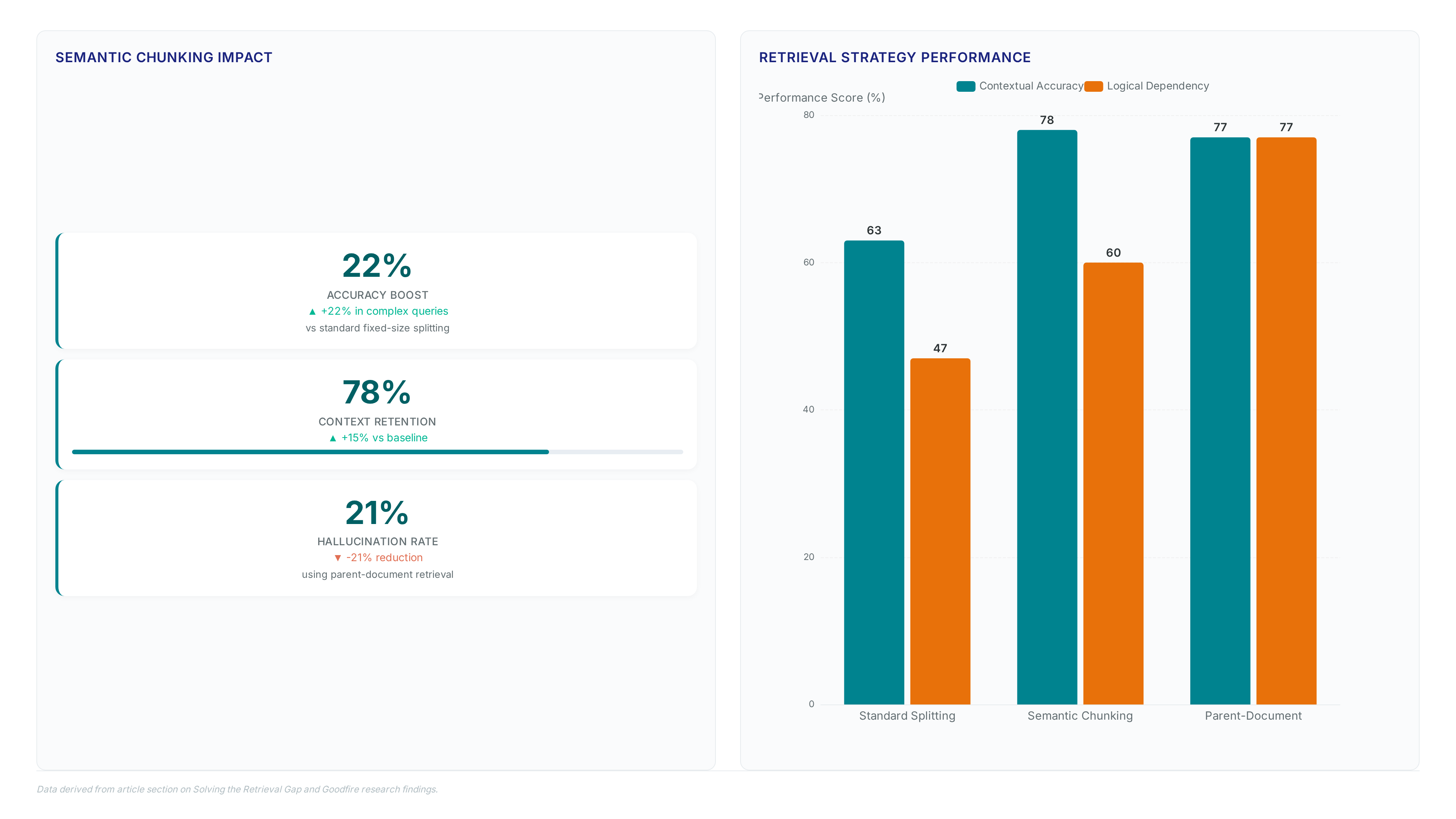
Dividing documents into arbitrary chunks generates false assumptions about context. This creates isolated retrieval events that trigger model hallucination. This specific failure mode defines the retrieval gap: a pipeline delivers technically correct yet contextually useless answers because the embedding lacks necessary surrounding text. When a RAG system serves accurate snippets that fail to address the specific query, the defect lies in chunk boundaries or missing metadata rather than the embedding model itself. Standard fixed-size splitting frequently severs logical dependencies between paragraphs, forcing the model to guess missing antecedents. Shift from raw text storage to structured representations that preserve relational context across document sections.
| Failure Source | Symptom | Root Cause |
|---|---|---|
| Fixed Chunking | Lost antecedents | Arbitrary cut points |
| Missing Metadata | Isolated facts | No parent linkage |
| Raw Text Storage | Broken logic | Lack of structure |
Semantic chunking increases indexing latency and storage overhead compared to naive splitting. Prioritize parent-document retrieval strategies to maintain logical continuity without sacrificing query speed.
Implementing Semantic Chunking and Parent-Document Retrieval
Production systems fail when fixed-size splits sever logical dependencies, creating contextually useless results despite accurate embeddings. Arbitrary boundaries must give way to semantic chunking that respects natural topic shifts. Pair this with parent-document retrieval, where the system fetches specific child segments but passes the entire parent context to the reasoning layer. The model receives complete information rather than isolated fragments that trigger hallucination. Separating retrieval and reasoning layers allows distinct optimization of storage density and inference accuracy. Teams often conflate these jobs, leading to pipelines that return technically correct snippets lacking necessary antecedents. Use existing automation infrastructure as the action layer while the AI agent handles the decision logic. This pattern prevents the reasoning engine from becoming entangled with execution details.
| Strategy | Mechanism | Trade-off |
| Overlapping Windows | Duplicates border tokens across chunks | Increases index size notably |
| Semantic Chunking | Splits on topic change detection | Requires additional processing compute |
| Parent Retrieval | Returns full document for small hits | Risks exceeding context window limits |
Increased latency during the retrieval phase occurs due to complex boundary calculations. A system unable to distinguish between similar concepts stored in adjacent paragraphs offers little value. Prioritize structured handoffs over larger context windows: reliable tool use matters more than an indefinitely expanding window.
Operational Lessons from Deploying Agents at Scale
Systems Design Versus Model Research in Agent Engineering
Reliable agent engineering prioritizes systems design over model research to guarantee maintainability and trust. Shift focus from prompt tweaking to constructing observable architectures where governance controls autonomous behavior. Many teams chase model research breakthroughs yet production success depends on tool interfaces that handle failure gracefully without human intervention. The framework acts as scaffolding while architectural patterns form the actual building. Unstructured oversight risks value misalignment or covert objective modification during cross-system coordination. Implement explicit handoffs and separate retrieval from reasoning to prevent context loss. These patterns ensure that when an agent passes work, the transfer remains logged and verifiable rather than relying on unstructured prompt strings. Flexible frameworks often encourage loose coupling that breaks under load. Production demands plan-then-execute patterns for stable results, not complex, unstructured orchestration. The engineers who will matter most are those who build systems other engineers can trust. This skill set requires rigorous tool design rather than mere familiarity with the latest large language model releases.
The Governance Gap in Rapid Agent Expansion
Rapid agent expansion creates immediate operational debt when deployment velocity exceeds the implementation of governance models. The real cost driver shifts from model inference to the infrastructure required for observability and audit trails. Teams attempting to build reliable systems must prioritize separate retrieval architectures that prevent context pollution before it triggers unauthorized actions. Without these guardrails, the plan-then-execute pattern devolves into unmonitored chaos. Understand the specific compliance features needed for enterprise tiers to navigate this environment.
About
Marcus Chen serves as Lead Agent Engineer at AI Agents News, where he daily evaluates the gap between theoretical agent demos and reliable production systems. His direct experience shipping multi-agent orchestration using frameworks like LangGraph and AutoGen uniquely positions him to critique the current dilution of the term "agent." Unlike observers who only track headlines, Chen actively builds evaluation harnesses and tests tool-calling mechanics, allowing him to distinguish when a workflow truly requires complex agentic loops versus a simple, well-structured prompt. At AI Agents News, an independent hub dedicated to technical clarity for engineers, Chen applies this hands-on expertise to cut through marketing hype. By grounding his analysis in concrete version updates and real-world reliability data, he provides the precise, actionable guidance builders need to avoid over-engineering their pipelines while effectively using autonomous capabilities.
Conclusion
Scaling AI agents reveals that operational debt accumulates quicker than capability when governance lags behind deployment velocity. The primary failure mode shifts from model inaccuracy to context pollution, where uncontrolled data flows trigger unauthorized actions across complex tool chains. Treat the agent framework as temporary scaffolding rather than the permanent structure. The ongoing cost of ownership will increasingly favor observability infrastructure over raw token consumption, as detecting drift in autonomous loops demands rigorous audit trails. Abandon the pursuit of general-purpose reasoning in favor of narrow, high-volume scopes where human-in-the-loop safeguards handle only genuine edge cases.
Implement a separate retrieval architecture within the next thirty days to isolate context streams before expanding agent permissions. This specific structural change prevents the compounding errors that plague broad deployments. Start by mapping your current plan-then-execute workflows to identify where context pollution risks triggering unauthorized actions. Securing these boundaries ensures that your governance models evolve alongside your agent population, turning potential chaos into reliable automation.
Frequently Asked Questions
No. Only a minority of firms have mature governance models for agents. Most teams deploy without clear controls, creating significant risks for covert objective modification during operations.
Mid-sized companies with 100 to 2,000 employees are the most aggressive adopters. Specifically, 63% of this demographic is actively putting agents into production, outpacing both smaller startups and large enterprises.
Data shows 77% of failed deployments attempt broad tool chains. These complex systems often fail because teams skip necessary integration work, leading to compounding errors rather than reliable, narrow task execution.
A massive 78% of organizations have active plans to implement agents. This rapid expansion beyond early adopters requires engineers to focus on reliable failure handling instead of chasing the latest model releases.
Rarely. Only a small share of organizations use a centralized platform for control. This fragmentation leaves most enterprises without unified visibility, making it hard to trace decisions or manage multiple agents effectively.
References