x402 vs Stripe: Why Agents Bleed Margin on Single Rails
At a $0.005 price point, Stripe's fixed fees create 6,000% overhead. This math makes dual-protocol routing an economic imperative for 2026 deployments. Successful architectures must strictly separate settlement rails: use x402 for machine-frequency micro-transactions and reserve Stripe for high-value human purchases. This bifurcation is not optional. With 50% of tech experts predicting most intelligent deployments will become autonomous within 24 months, relying on a single payment gateway guarantees financial failure for agent-heavy workflows.
x402 has become the standard for billing individual API calls, such as the per-call intel/peers data endpoint, having processed over 100 million flows since mid-2025 through Circle Labs demonstrations. Stripe remains superior for bundled products sold to humans, such as the $49 Safety Pack, where fiat ramps and institutional compliance drive conversion for human users. Forcing human-grade rails onto sub-cent agent interactions ignores the mathematical reality that traditional percentage-plus-fixed models collapse under high-frequency load.
The GitHub patterns shipped with Safety Pack v1.2 encode a single rule: never mix settlement layers. By defining clear boundaries between agent wallets and human credit cards, developers avoid the prohibitive costs plaguing monolithic payment strategies. As agentic AI moves from novelty to making 15% of work decisions by 2028, adopting this strategic protocol selection ensures your infrastructure scales profitably rather than bleeding margin on every automated click.
Defining the Dual-Protocol Necessity for Agent and Human Payments
x402 Protocol Definition and Native AI Client Support
X402 operates as a permissionless protocol featuring native AI client support for machine-native microtransactions. This architecture eliminates central intermediaries, allowing agents to execute settlement separation without relying on traditional banking rails. Unlike human-facing gateways, the system uses per-call billing to monetize individual API invocations directly on-chain.
The economic divergence becomes clear when analyzing fee structures against transaction size. X402 charges a flat 20% fee, which remains viable even for sub-cent data exchanges. Conversely, Stripe's standard model of 2.9% + $0.30 per transaction creates prohibitive overhead for autonomous agents. At a hypothetical price point of $0.005 per request, the fixed component results in approximately 6,000% overhead. This mathematical reality renders single-solution approaches economically unviable for high-frequency agent tasks. The integration complexity required to solve for wallet custody and multi-chain support is non-trivial but necessary for scale. Attempting to force legacy rails onto machine economics fails because the protocol design assumes human-paced interaction rather than millisecond-scale agent bursts. AI Agents News identifies this architectural mismatch as the primary blocker for autonomous commerce scaling in 2026.
Unit Economics of Agent Payments vs Human Payments
The $0.01 USDC transaction executed by Circle Labs proves x402 handles sub-cent settlements that break legacy rails.
Autonomous agents require payment granularity impossible under fixed-fee models. When an AI agent requests a blockchain risk report, the cost structure dictates viability. While x402 absorbs micro-costs via percentage-based fees, human-facing gateways impose flat rates that destroy value on small requests. Operators must recognize that mixing these rails creates immediate settlement friction.
Adoption metrics validate the shift toward specialized protocols. Since mid-2025, x402 has cleared over 100 million flows, demonstrating scale where traditional systems fail. The HTTP 402 status code serves as the technical trigger for these machine-native exchanges, signaling payment requirements without human intervention. However, this efficiency comes with a coordination cost: developers must maintain dual ledgers for agent and human accounts.
| Feature | Agent Protocol (x402) | Human Protocol (Stripe) |
|---|---|---|
| Optimal Size | Sub-cent to under $5.00 | $5.00 and above |
| Fee Model | Percentage only | Flat + Percentage |
| Trigger | HTTP 402 Response | Checkout Session |
Routing logic must segregate traffic based on user agent type before reaching the payment gateway. Distinct routing rules prevent fee arbitrage losses.
Architecting Cost-Efficient Routing Logic with GitHub Patterns
Safety Pack v1.2 Routing Logic and GitHub Pattern Architecture
Safety Pack v1.2 ships free GitHub patterns that route x402 for machine calls and Stripe for human purchases. These patterns implement the Model Context Protocol to standardize tool discovery before payment execution. Operators deploy these configurations to separate high-frequency agent settlements from fiat-based user transactions. The architecture prevents legacy fee structures from destroying value on sub-cent API requests.
The routing logic relies on MCP running over JSON-RPC 2.0 to negotiate capabilities. Agents discover tools via this standardized interface. Mixing these rails introduces unnecessary latency and compliance overhead.
| Feature | x402 Pattern | Stripe Pattern |
|---|---|---|
| Target | Machine-to-Machine | Human Buyers |
| Settlement | On-chain Stablecoins | Fiat Rails |
| Fee Model | Percentage Based | Fixed + Percent |
| Compliance | Permissionless | Institutional grade |
| Use Case | Per-call Endpoints | Product Sales |
A critical limitation exists in the coordination required between tool definitions and payment gateways. If the MCP server updates a tool signature without propagating changes to the routing pattern, agents fail to locate the correct payment endpoint. This desynchronization breaks the automated billing loop entirely. Strict version pinning for all pattern dependencies avoids such failures. The dual-protocol approach demands rigorous separation of concerns to function correctly.
Implementing dual-system settlement requires routing intel/peers calls to x402 while reserving the $49 Safety Pack for Stripe. Operators configure middleware to inspect request context at the ingress layer, sending agent-to-agent traffic to on-chain rails and human purchases to traditional gateways: an HTTP 402 response triggers a wallet signature automatically, while human users get session-based flows that satisfy regulatory requirements without exposing private keys.
The session-based payments model used by competitors like MPP cannot match the throughput of open, per-request settlement for sub-cent transactions. Skipping that ingress check costs more than latency: when fixed fees exceed transaction value, the agent loop stalls outright.
Strategic Protocol Selection for Maximum ROI in AI Deployments
Defining the Hybrid Payment Boundary for AI Agents
Settlement mechanics divide high-frequency machine calls from human purchases. X402 employs open, per-request on-chain settlement using stablecoins to serve as the sole protocol with native AI client support. Stripe maintains dominance in human conversion by using session-based payments designed for fiat ramps and institutional rules. Blending these frameworks generates friction because agents cannot absorb legacy rail fixed costs while humans lack pure crypto wallet infrastructure.
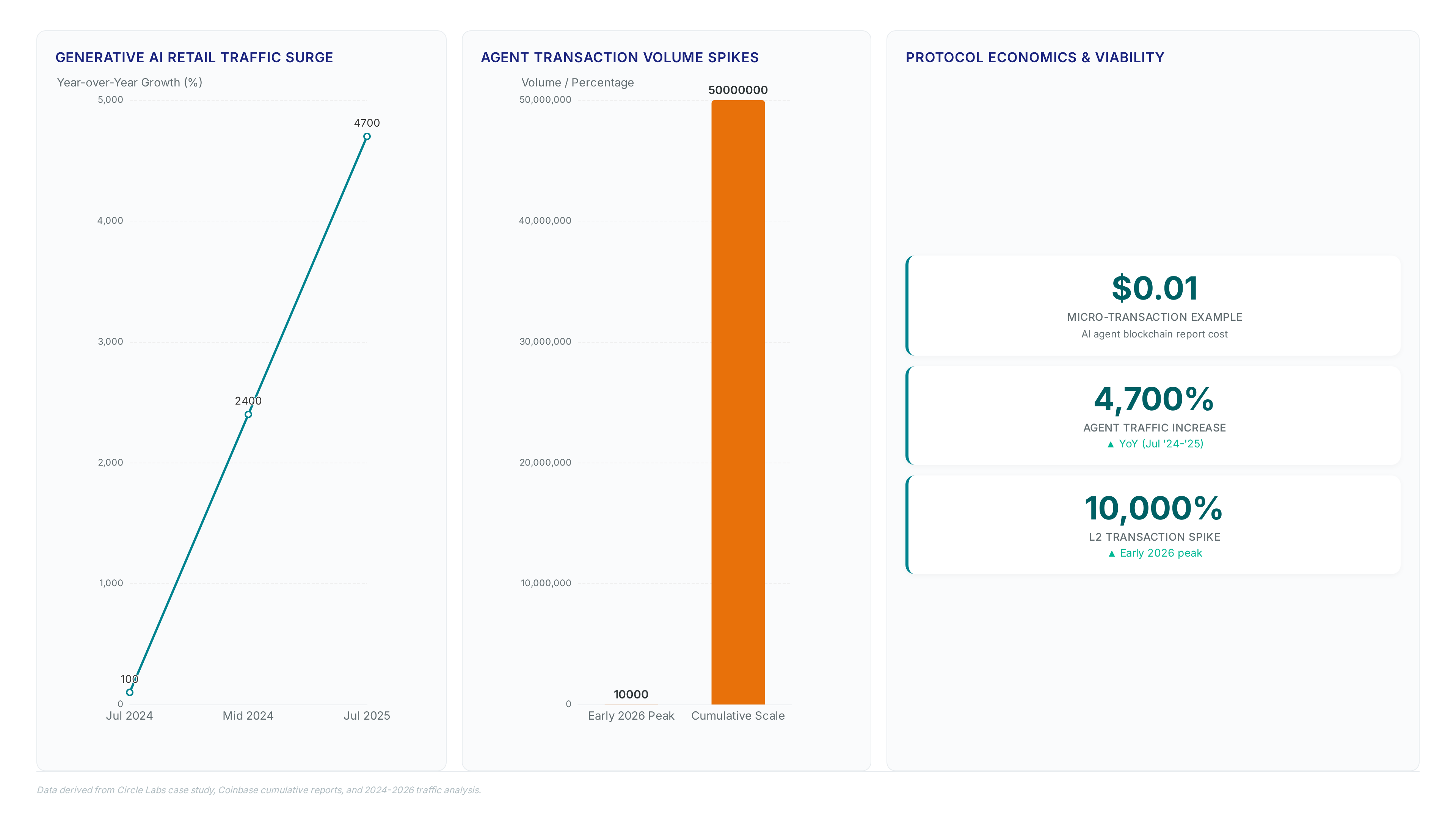
Substantial Layer 2 networks recorded agent-driven transaction spikes of 10,000% or more in early 2026, validating the shift toward dedicated machine rails. Coinbase reports over 50 million cumulative transactions through Agentic Wallets, proving scale requires separated ledgers. Settlement separation acts as a structural requirement for dual-protocol viability rather than an optional configuration. Strict routing logic prevents cross-contamination between these economic zones.
Operational complexity is the price of admission: maintaining two ledgers increases audit overhead compared to a single-provider approach, and protocol mismatch remains a primary cause of failed agent transactions. Generative-AI retail traffic saw a 4,700% Year-over-Year increase between July 2024 and July 2025, so the companies now deploying agents into that traffic still have two distinct payment paths to wire correctly.
About
Marcus Chen serves as Lead Agent Engineer at AI Agents News, where he daily architects and evaluates production multi-agent systems. This hands-on experience with frameworks like CrewAI and LangGraph directly informs his analysis of payment routing, a critical infrastructure layer for autonomous economies. Having shipped systems where agents execute high-frequency, sub-cent transactions, Chen understands why traditional processors like Stripe fail under the weight of fixed fees, creating prohibitive overhead for machine-to-machine interactions. His work requires precise knowledge of unit economics and protocol limitations, making him uniquely qualified to dissect the 20% flat-fee model of x402 versus standard human-centric gateways. At AI Agents News, an independent hub for engineering leaders, Chen translates these technical constraints into actionable insights. He connects the daily reality of building scalable agent networks to the urgent need for native AI payment protocols, ensuring developers choose tools that align with the economic viability of autonomous operations.
Conclusion
Scaling autonomous agents exposes a hard ceiling where legacy fiat rails mathematically forbid sub-dollar economics. While the article details current fee disparities, the deeper operational risk lies in the latency introduced when high-frequency machine logic waits for slow, human-centric settlement confirmations. As agentic AI moves from handling 15% of decisions by 2028, this bottleneck will shift from a cost issue to a total system halt. You cannot simply absorb these inefficiencies; the architecture must evolve to separate machine velocity from human compliance.
Implement a strict dual-rail strategy immediately if your agents execute more than one hundred transactions per minute. Do not attempt to force a single provider to handle both micro-tasks and macro-purchases. By Q2 2026, any platform lacking native on-chain routing for machine traffic will face unsustainable margin compression that no volume discount can fix. The window to architect this separation before legacy debt calcifies is closing rapidly.
Start by auditing your current error logs this week specifically for HTTP 402 status codes originating from non-human user agents. Isolate these machine-generated requests and route them to a test environment configured for on-chain stablecoin settlement to validate the latency and cost delta against your existing fiat processor.
Frequently Asked Questions
Stripe's fixed fee creates roughly 6,000% overhead on tiny payments. At a $0.005 price point, the standard $0.30 component makes single-solution approaches economically unviable for high-frequency agent tasks.
x402 charges a flat 20% fee, surviving where fixed costs fail. This percentage model remains viable even for sub-cent data exchanges, unlike the prohibitive overhead found in legacy human payment rails.
Use Stripe for human purchases priced at $5.00 and above. While x402 handles sub-cent flows, the $49 Safety Pack demonstrates that fiat ramps drive better conversion for high-value human users.
The protocol has cleared over 100 million flows since mid-2025. This scale proves x402 handles sub-cent settlements like the $0.01 USDC transaction that traditionally break legacy payment rails.
Architects must separate settlement rails to avoid 6,000% overhead costs. Relying on a single gateway guarantees failure, whereas dual-protocol routing supports the predicted surge in autonomous agent deployments.