Ask a Human where agents hit production walls
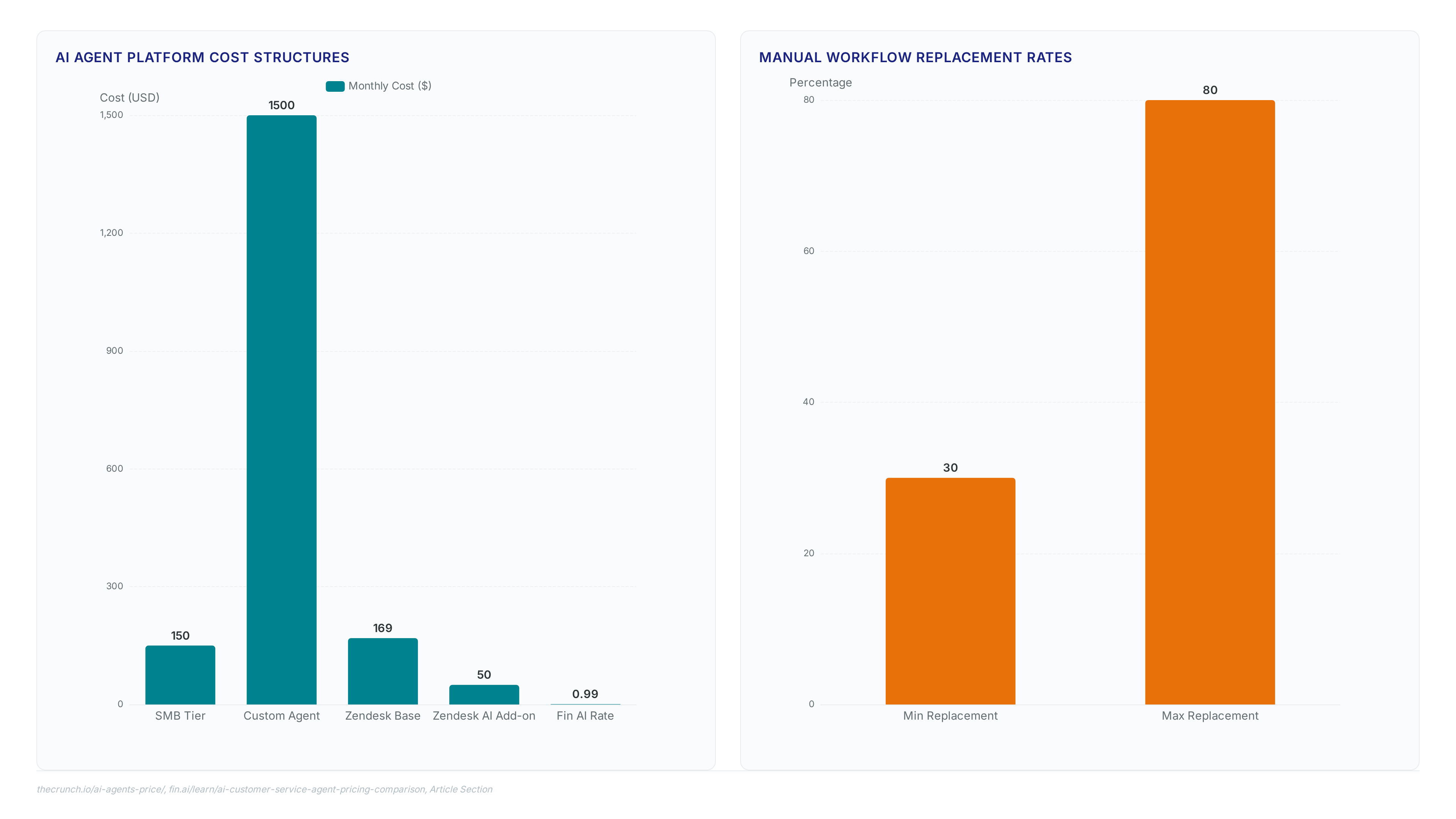
With 74% of organizations deploying AI agents requiring human checkpoints, ask-a-human.ai solves the autonomy bottleneck by acting as a private pager for stuck loops. This system provides the critical infrastructure needed to manage the 26% of edge cases where fully autonomous agents hit a wall, preventing the need to babysit every step or risk unchecked production changes.
This MCP-compatible tool integrates with clients like Claude Code and Codex to interrupt agents only when necessary. In the pairing workflow, a 10-character code establishes a secure session, allowing agents to ring your phone for immediate approval on risky deployments or blocked workflows. This approach bridges the gap between full automation and the 81% resolution rate achievable only with targeted human intervention.
Security remains paramount through a Magic Wormhole architecture that uses a SPAKE2 handshake for pairing. The deployment relies on end-to-end encrypted alerts via NaCl secretbox, guaranteeing that the relay infrastructure remains blind to the content of your critical decisions.
The Role of Private Pagers in Autonomous Agent Loops
Ask-a-human.ai acts as a private pager connecting autonomous agent loops to human operators through mobile notifications. Any client speaking MCP (Model Context Protocol) integrates with a single line of configuration, enabling real-time interrupts without complex setup. This design tackles a specific bottleneck where 74% of organizations mandate human-in-the-loop checkpoints when first deploying AI agents. Frameworks like LangChain or AutoGen often need complex breakpoint definitions, whereas this tool uses a magic wormhole encryption model to push end-to-end encrypted alerts straight to a phone. Pairing relies on SPAKE2 handshakes, keeping the relay server blind to message contents while linking agents such as Claude Code or Codex securely.
Real-World Scenarios for Agent Human Approval Requests
Deadlocks happen when an agent stuck on deploy faces a database migration dropping a production column. The system triggers a mobile interrupt for immediate resolution instead of halting the whole loop. This mechanism solves the choice between babysitting every step or letting agents run hoping nothing touches production. Real-world implementations validate this two-tier approach where routine inquiries stay autonomous while complex needs route to humans. IBM deployed such a model for over 270,000 employees, proving that autonomous resolution scales only when edge cases offload cleanly. The ask-a-human architecture replicates this pattern for infrastructure, allowing a hundred agents to run wide open until one requires a specific yes or no. Ignoring these interrupts carries a measurable cost; operators often disable full-auto modes entirely without a dedicated channel. By 2027, AI agents will be capable of working for 8 hours without interruption, making the tap on the shoulder capability necessary for maintaining velocity. This design ensures that the rare agent needing help does not force a rollback of the entire automation strategy.
One-Line MCP Configuration for Self-Hosted Deployment
Self-hosted deployment needs only a single MCP server line pasted into the agent config alongside the pinned site URL. This architecture enables Claude Code, Cursor, Copilot, or Gemini to reach humans instantly when logic stalls. Operators choose self-hosting to maintain a content-blind relay where the server sees only encrypted blobs, never plaintext decisions. The agent reaches the human by converting a short 10-character code into a strong shared key via SPAKE2 handshake. Moving agents from pilot to production in 2026 demands this isolation for regulated workflows. Complex stateful tasks benefit most from local key control. Operational overhead presents a constraint: restarting the RAM-only relay forces re-pairing all active agents. High-risk systems facing compliance deadlines in August 2026 must verify their chosen framework supports external MCP clients. Token costs for reasoning loops increase with complexity, making local approval gates financially necessary.
Inside the Magic Wormhole Encryption Architecture
SPAKE2 Handshake Mechanics via RFC 9382 and Ristretto255
The SPAKE2 handshake set in RFC 9382 converts a weak 10-character pairing code into a strong cryptographic key without transmitting the secret. This mechanism relies on the ristretto255 curve from RFC 9496 to map the shared password into a uniform group element, preventing leakage even if an attacker observes the exchange.
The system avoids complex memory limits found in other interpreter containers by keeping the handshake stateless and ephemeral. Unlike architectures where routine inquiries might bypass security layers, this protocol forces cryptographic proof of possession before any API integration occurs.
| Component | Function | Standard |
|---|---|---|
| SPAKE2 | Password-authenticated key exchange | RFC 9382 |
| ristretto255 | Prime-order group for scalars | RFC 9496 |
| NaCl secretbox | Message sealing post-handshake | XSalsa20-Poly1305 |
Meanwhile, the trade-off is strict synchronization; if the relay restarts, the RAM-only state vanishes and re-pairing is mandatory. Operators gain a zero-trust boundary where the server acts as a dumb pipe, seeing only opaque ciphertext blobs. This approach mitigates risks associated with configurable memory constraints in agent runtimes by offloading state to the endpoints. No persistent database stores the keys, meaning a compromised server reveals nothing about the task complexity of the agents it transports. The result is a human-in-the-loop channel that remains secure despite total infrastructure compromise.
NaCl Secretbox Encryption Workflow for Content-Blind Relaying
The agent seals every interrupt payload using NaCl secretbox with XSalsa20-Poly1305 before transmission to the relay.
- The client generates a random 24-byte nonce locally.
- The message concatenates with the nonce and undergoes symmetric encryption.
- The output becomes a single base64(nonce‖ciphertext) blob.
This workflow ensures the intermediate server acts strictly as a dumb pipe that routes traffic without inspecting payloads. Operators questioning trust models must recognize that the relay mathematically cannot access plaintext decisions or operational processes because it lacks the session key. The limitation of this blind architecture is that message metadata, specifically room connections, remains visible for routing purposes. Custom-built agents ranging from $300 to $1,500 per month rely on this strict separation to prevent data leakage during production deploys. The consequence for network architects is a hard trade-off: gaining unconditional privacy requires accepting that the relay cannot perform content-based filtering or logging. Any attempt by the server to parse the ciphertext results in garbage data, forcing all logic to the edge devices holding the ristretto255 derived keys. This design choice eliminates the attack surface of centralized databases but pushes the burden of key management entirely to the pairing endpoints.
Shoulder-Surfing Vulnerabilities and Single-Guess Attack Limits
Shoulder-surfing the 10-character pairing code yields exactly one online guess before the SPAKE2 mechanism invalidates the attempt. This hard limit transforms a visual eavesdropping risk into a non-scalable attack vector, as the protocol consumes the single opportunity upon the first failed authentication trial. Operators managing high-value loops must recognize that regulatory pressures from the EU AI Act demand such strict single-attempt boundaries for high-risk systems. The architecture ensures that even if an adversary observes the initial exchange, they cannot iterate guesses offline or retry without triggering a new session setup.
The cost of this security boundary is immediate session termination if the legitimate user mistypes the code during the initial Pairing phase. A fat-fingered entry burns the single allowed attempt, forcing a full restart of the handshake sequence on both the agent and mobile client. This trade-off prioritizes attack surface reduction over user convenience during the critical bootstrap moment. Organizations deploying custom single-purpose agents must train operators to expect this strict failure mode rather than assuming incremental correction is possible. The system design explicitly rejects password-recovery flows to maintain its zero-trust posture.
Deploying End-to-End Encrypted Agent Alerts via MCP
Defining the Magic-Wormhole SPAKE2 Pairing Workflow
Pairing initiates when an operator types a 10-character code like ABCDE-23456 into ask-a-human.ai/app to trigger the handshake. This process converts the weak shared secret into a strong cryptographic key using SPAKE2 mechanics set in RFC 9382. The protocol maps the input string through the ristretto255 curve, so the shared secret itself never travels over the relay.
- The agent and mobile client derive a generator point from the short code.
- Both parties exchange masked public keys over the untrusted relay.
- Each side combines the peer's mask with their private scalar to compute the session.
This design prevents offline dictionary attacks while avoiding complex key distribution. The cost is strict synchronization; operators must input the code before the agent's session timeout expires. For organizations deploying specialized tools like LangGraph for stateful workflows, this manual step remains a necessary friction point to guarantee human presence.
Market data indicates that granular AI credit billing models often accompany such strict human-in-the-loop validation layers. The limitation here is operational latency; the handshake requires active human intervention, unlike fully autonomous agents that might run for hours without interruption. AI Agents News recommends this trade-off for high-risk actions where safety outweighs speed.
What Happens When an Agent Hits a Wall
The workflow initiates when an agent like Claude Code hits a wall it cannot pass alone, such as a risky database migration. This specific failure mode triggers a five-step sequence where the situation is sealed in a wormhole and the system buzzes the operator's phone. The user then taps to approve, decline, or reply, allowing the agent to unblock and roll on immediately.
- The agent encounters a logic boundary requiring human judgment.
- Context is encrypted and transmitted via the MCP server.
- A mobile notification demands a binary choice or text input.
- The operator submits a decision through the secure interface.
- The agent resumes autonomous execution with new parameters.
Deploying this securely comes down to three settings on the relay you control:
- Configure the MCP server to terminate connections instantly upon any authentication mismatch.
- Host your own relay using the
--relayflag to eliminate third-party trust assumptions. - Verify that the mobile client discards the local secret immediately after the first failed attempt.
Re-pairing is manual when the initial exchange fails, so bootstrap depends on someone being available at both ends. AI Agents News recommends validating that your deployment enforces the one-guess limit at the network edge.
Strategic Advantages of Self-Hosted Relays Over Public Protocols
Self-Hosted Relay Against a Public Broker
Self-hosted relays function as private pagers that interrupt agent stalls without exposing internal state to public protocol observers. Unlike standard public protocols where agents might poll indefinitely or leak context, this architecture forces a hard stop until human input arrives via a secure mobile channel. This approach contrasts sharply with traditional live answering services costing between $200 and $7,000 monthly, offering a scalable alternative for high-frequency agent loops.
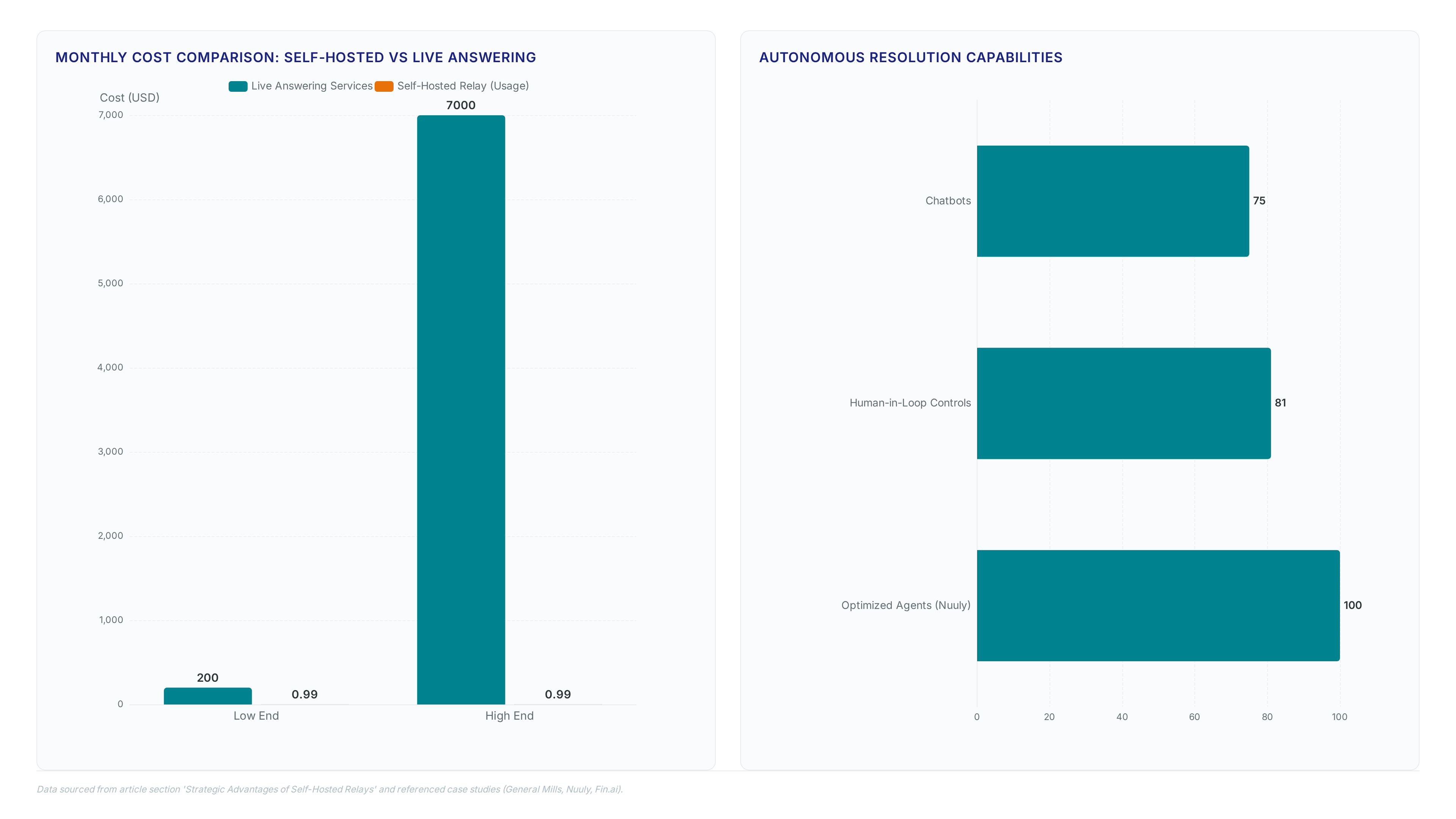
Market momentum favors usage-based models charging roughly $0.99 per resolved outcome over rigid seat licenses. Public brokers enable broad connectivity yet lack the zero-trust enforcement required for high-risk decisions. Operators gain Efficiency Gains by preventing agents from looping endlessly on ambiguous tasks. Operational constraints emerge when the human operator becomes the single point of availability, creating a bottleneck if the pager network congests. This dynamic mirrors the difference between asynchronous email and synchronous voice calls. The MCP interoperability ensures compatibility across diverse agents like Claude Code or Gemini without custom integrations.
Optimized agents at Nuuly resolved 20,000 additional conversations monthly, proving self-hosted relays handle volume public protocols cannot touch. This scale shift relies on the Model Context Protocol to route complex queries only when necessary, avoiding the latency of continuous polling. By deploying specific procedural AI for subscription management, the retailer achieved a 10% increase in resolution rates. The architecture allows the relay to remain blind to content while managing high-frequency handoffs that would overwhelm standard chatbots.
These figures illustrate that self-hosted relays convert agent bottlenecks into direct cost reductions rather than mere efficiency gains. Public protocols often lack the encryption standards required for such high-value data exposure, forcing a choice between security and scalability. Public options offer ease but fail the zero-trust requirement for enterprise financial data. Operators must weigh the convenience of managed services against the risk of unencrypted context leakage. Self-hosting demands internal expertise to maintain the MCP server infrastructure. Without this control, organizations cannot replicate the specific security postures that enabled these documented savings. AI Agents News identifies this gap as the primary barrier to wider adoption.
About
Diego Alvarez serves as a Developer Advocate at AI Agents News, where he specializes in hands-on build guides and rigorous benchmarking of autonomous systems. This background makes him uniquely qualified to analyze ask-a-human.ai, a tool designed to resolve critical decision deadlocks in agent loops. In his daily work evaluating frameworks like CrewAI and coding agents such as Claude Code, Diego frequently encounters the exact friction point this tool addresses: when an agent lacks sufficient context to proceed autonomously.
His practical experience debugging multi-agent orchestration allows him to assess how ask-a-human integrates via the Model Context Protocol (MCP) to provide a smooth "private pager" for developers. At AI Agents News, the team focuses on the technical realities of deploying reliable agents, making this analysis vital for engineers seeking to bridge the gap between full autonomy and necessary human oversight. Diego's evaluation connects real-world failure modes with actionable solutions for reliable agent deployment.
Conclusion
The tool is smaller than the problem it addresses. 74% of organizations put a human checkpoint in front of their agents, so the practical question is not whether to keep the human but how rarely one has to be bothered. A private pager answers exactly that: a hundred agents run wide open, and the one that hits a wall rings a phone instead of stalling until morning.
What you pay for it is bootstrap discipline. The pairing code survives exactly one wrong guess, a relay restart wipes the RAM-only state and forces every agent to pair again, and the content-blind design means no decision can be reconstructed from server logs afterwards. Before wiring this into a production loop, decide which stalls actually deserve a notification: a pager that buzzes for routine work gets muted, and a muted pager returns you to the full-auto mode this tool exists to replace.
Frequently Asked Questions
Seventy-four percent of organizations mandate human-in-the-loop checkpoints when deploying AI agents. This high adoption rate highlights the critical need for tools like ask-a-human.ai to manage autonomy bottlenecks effectively.
Only twenty-six percent of edge cases require human intervention when fully autonomous agents hit a wall. This small fraction represents the critical moments where immediate human approval prevents production errors or stalled workflows.
Mature setups using human-in-the-loop controls report up to an eighty-one percent autonomous resolution rate. This high success metric demonstrates that targeted human input significantly boosts overall system reliability and completion rates.
The SPAKE2 handshake ensures attackers get only one useless online guess before the connection invalidates. This security measure protects the pairing process even if someone shoulder-surfs the initial ten-character code.
The relay server remains completely blind to message contents, seeing only encrypted blobs and room identifiers. It acts as a dumb pipe that never accesses plaintext decisions or sensitive approval data.